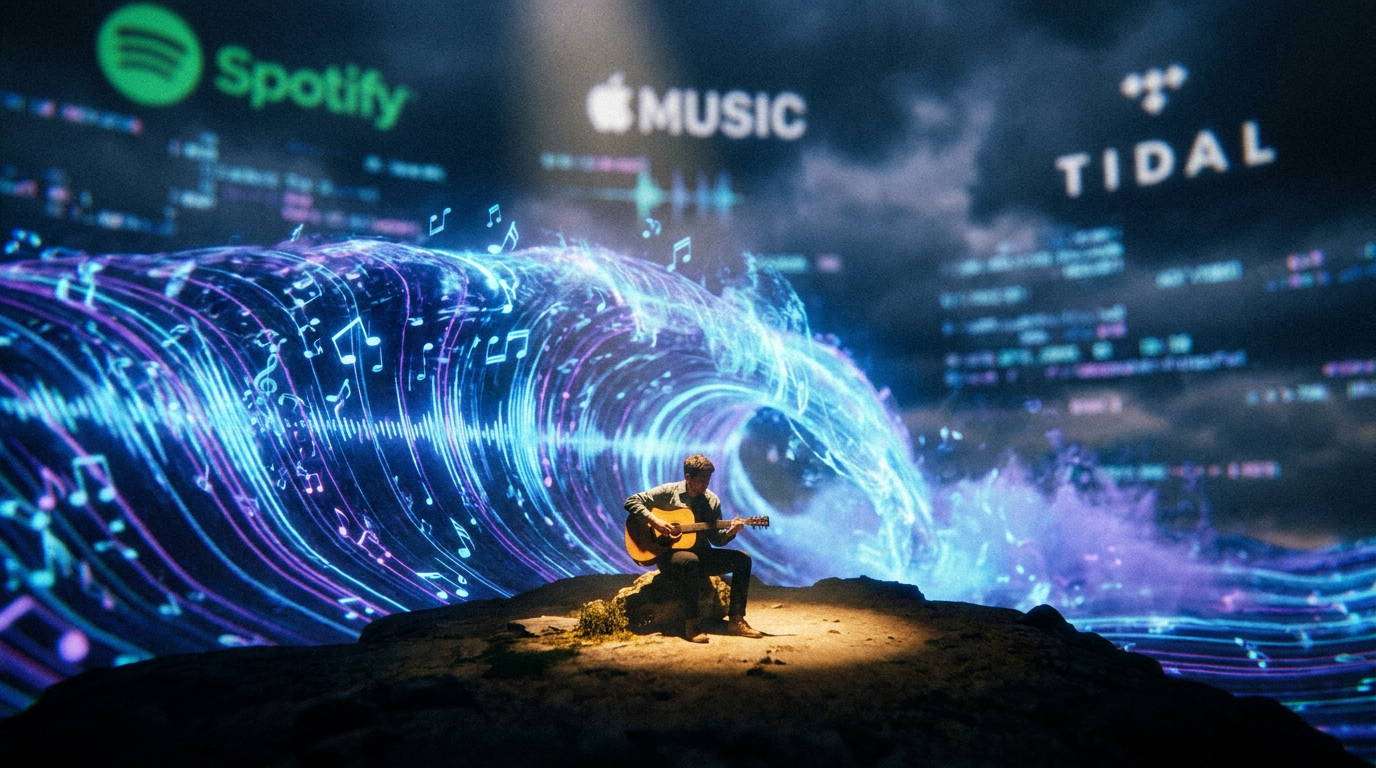
AI Music's Big Lie: 50% of Uploads, 0.5% of Plays
Here’s a number that should stop every musician in their tracks: more than a third of what Apple Music receives today is “100% AI.” And here’s the number that should make you breathe again: “The reality is, the usage of the AI music on Apple Music is really tiny. I’m rounding, but it’s below 0.5% of usage.”
That’s Apple Music VP Oliver Schusser, dropping the most revealing data point the music industry has seen in years. One-third of supply. Half a percent of demand. If you’re a human musician panicking about AI replacing you, the data just handed you the most powerful counterargument in music industry history.
But if you’re smart, you’re also asking the right follow-up question: if AI-generated music can’t capture attention, how do real musicians use AI-powered tools — especially for visuals — to actually stand out?
Let’s unpack the flood, the paradox, and the opportunity.
The Numbers Are Staggering (and Surreal)
The spring of 2026 has produced a torrent of disclosures from streaming platforms, and the picture they paint is almost absurd in its lopsidedness.
Deezer is now receiving “almost 75,000 AI-generated tracks per day, representing roughly 44% of daily uploads,” amounting to more than 2 million AI-generated tracks per month. That number has been climbing — it was around 39% in January 2026.
Spotify has removed 25 million AI-generated tracks over the past year , indicating a broader industry reckoning with the sheer volume of synthetic content flooding the pipes.
And then there’s the China story, which makes the Western numbers look quaint. Tencent Music Entertainment’s leadership warned during the company’s Q1 2026 earnings call on May 12 that the Chinese music streaming market is facing “industry chaos” due to platforms allowing masses of copyright-infringing, AI-made tracks to fill their catalogs.
TME’s CEO Ross Liang accused competitors of using infringing AI content “to quickly fill their music libraries” in a bid to attract users — a practice TME has started calling “song-washing.”
Nobody Is Listening
Here’s where the story gets genuinely fascinating. Despite the deluge, listeners aren’t biting.
Fully AI-generated music still accounts for only 1–3% of streams on Deezer, and 85% of these are labelled as fraudulent. Read that again: the vast majority of what little streaming AI music does get is from bots, not people.
The 66x gap between supply and demand (33% of uploads versus 0.5% of listening) is the largest publicly disclosed supply-demand mismatch in the history of recorded music distribution.
The Luminate “Generative AI in Entertainment 2026” report confirms the listener-side picture. Audrey Schomer, the study’s author, put it bluntly: “Across the board, what we found is that consumers are net negative… people are more likely to feel uncomfortable than to feel comfortable with AI use.”
The decline in interest is marked by people who changed their outlook from positive to negative between May and November 2025.
A separate academic study from the University of Hamburg found something even more pointed: consumers enjoy and even prefer AI-generated music — until they learn it was AI-generated, at which point preferences shift dramatically. The quality isn’t the problem. The story is.
What China Tells Us About Where This Is Heading
China is essentially running the experiment at 10x speed. TME’s 2025 ESG report revealed the company removed over 250,000 policy-violating songs and reviewed more than 600,000 cases involving “high-risk copyright content” across its platforms.
They took down over 27,000 songs specifically involved in “song theft,” “song laundering,” and “trend hijacking.”
The phrase “song laundering” deserves its own paragraph. It means taking an existing human composition and running it through AI to create a slightly altered version — the musical equivalent of money laundering. Strip enough serial numbers off a hit song and you’ve got a new “original” that can siphon royalties. This is the sharp edge of the AI music flood, and it’s why platforms are investing heavily in detection.
The Platforms Are Fighting Back
To their credit, the major streaming services aren’t just watching this happen.
Apple has developed in-house technology to identify the AI models used in music submissions and is introducing “Transparency Tags,” a metadata system allowing labels to disclose whether AI was used in a song’s production.
The company recently doubled its fraud penalty, resulting in a reported 60% reduction in fraudulent uploads.
Meanwhile, Believe, the global distribution company, is simultaneously blocking the distribution of AI-generated tracks produced on unlicensed “pirate studios” while investing in licensed AI tools for its artists. This two-pronged approach — block the slop, embrace the tools — is emerging as the industry’s consensus strategy.
Believe has partnered with Google to offer Flow Music, the Google Labs AI music tool powered by Lyria 3 Pro, to artists across Believe and TuneCore as a “creative collaborator.”
Lyria 3 Pro, developed by Google DeepMind, can generate tracks up to 3 minutes long and follow prompts for specific structural elements like intros, verses, choruses and bridges.
The distinction matters enormously: there’s a world of difference between AI tools that help musicians create and AI bots that replace musicians entirely. The platforms are betting that the former has a future. The data says the latter doesn’t.
Why This Is Actually Great News for Musicians
Let’s flip the narrative, because the doom-and-gloom framing misses the most important insight buried in these numbers.
If AI tracks are 33% of the catalog but generate 0.5% of streams, then 99.5% of the royalty pool still flows to the 67% of uploads that are human-made. Per-stream payouts to human artists do not get diluted by AI flooding the catalog — at least not at current consumption levels.
Human-made original music is not losing the listener-attention war to AI uploads. The economics are on the side of artists who keep investing in craft.
What listeners want hasn’t changed: personality, cultural relevance, an artist they connect with, a story they believe in. Music still depends on cultural relevance, artist identity, and editorial support — something that anonymous generative systems can’t fully replicate.
This is where the smart play becomes obvious. If your music needs to be authentically human to win attention, but your visuals can be supercharged by AI without losing that human authenticity — you’ve found the sweet spot of 2026.
The Visual Opportunity Is Wide Open
Here’s the thing nobody in the “AI music is killing everything” conversation seems to notice: AI music videos face none of the backlash that AI music does.
When a listener discovers a song was made by AI, they feel cheated. But when a listener watches a visually stunning AI-generated music video set to a song that was clearly written, performed, and felt by a human? That’s just… cool. The AI is serving the human artist’s vision, not replacing it.
This distinction is why AI music video creation has emerged as the single most productive use of generative AI for working musicians. You get the cost savings, the speed, and the creative experimentation of AI — without any of the authenticity concerns.
Think about the math: a traditional music video costs anywhere from $5,000 to $500,000. For independent artists already competing against a flood of 75,000 new AI tracks per day on Deezer alone, that kind of budget is impossible. But a compelling AI-generated music video? That’s accessible right now.
Whether you’re making hip-hop visuals, lo-fi aesthetic videos, or cinematic pop releases, the visual layer is where AI adds to human authenticity rather than diluting it.
What Smart Musicians Are Doing Right Now
The data is telling a clear story: the artists who will thrive in the AI flood era are those who double down on what AI can’t do (authentic human connection, live performance, genuine artistic identity) while aggressively adopting AI for what it can do (visual content, rapid iteration, creative experimentation).
Here’s a practical playbook:
1. Make Human Music, Make AI Visuals
Your songs should be unmistakably you. Your music videos should be stunningly visual. AI handles the second part brilliantly. Check out our complete guide to making AI music videos to get started with the workflow.
2. Volume Matters (But Only If Quality Follows)
The streaming algorithms reward consistent releases with visual content. An AI-generated music video for every single or EP track used to be a luxury. Now it’s table stakes. Our complete guide to AI music videos in 2026 breaks down the full strategy.
3. Genre-Specific Visual Identity Wins
AI music videos work best when they’re tailored to your genre’s visual language. The aesthetic expectations for a country music video are wildly different from a K-pop visual or an indie release. Lean into your genre’s conventions, then push them somewhere unexpected.
4. Transparency Is Your Friend
Consumers prefer AI content until they learn it’s AI — but this applies to music, not visuals. Be open about using AI for your video production. Audiences respect the hustle of an indie artist making professional-looking content on a limited budget. What they won’t forgive is passing off bot-generated songs as human artistry.
The Bottom Line
The AI music flood of 2026 is real. AI upload volume on Apple and Deezer is now between 33 and 50 percent of all new tracks. It’s only going to grow. But the data couldn’t be clearer: the cost of AI track generation has collapsed, but listener attention has not redistributed toward AI output. Listeners still want human-made music. The economics of flooding the catalog with AI to capture royalties has gotten harder, not easier.
The flood is a supply-side problem. It’s not a demand-side problem. People still want to hear your music — they just need to find it. And in a world where 75,000 AI tracks hit Deezer every single day, the artists who break through will be the ones with the most compelling visual presence, the most consistent release strategy, and the most authentic creative identity.
AI won’t write your next hit. But it can absolutely make the music video that gets it noticed.
Ready to turn your human-made music into stunning AI-powered visuals? OneMoreShot.ai lets you create professional music videos in minutes — no crew, no budget crisis, just your music brought to life. Because in 2026, the best use of AI in music isn’t replacing the artist. It’s amplifying them.