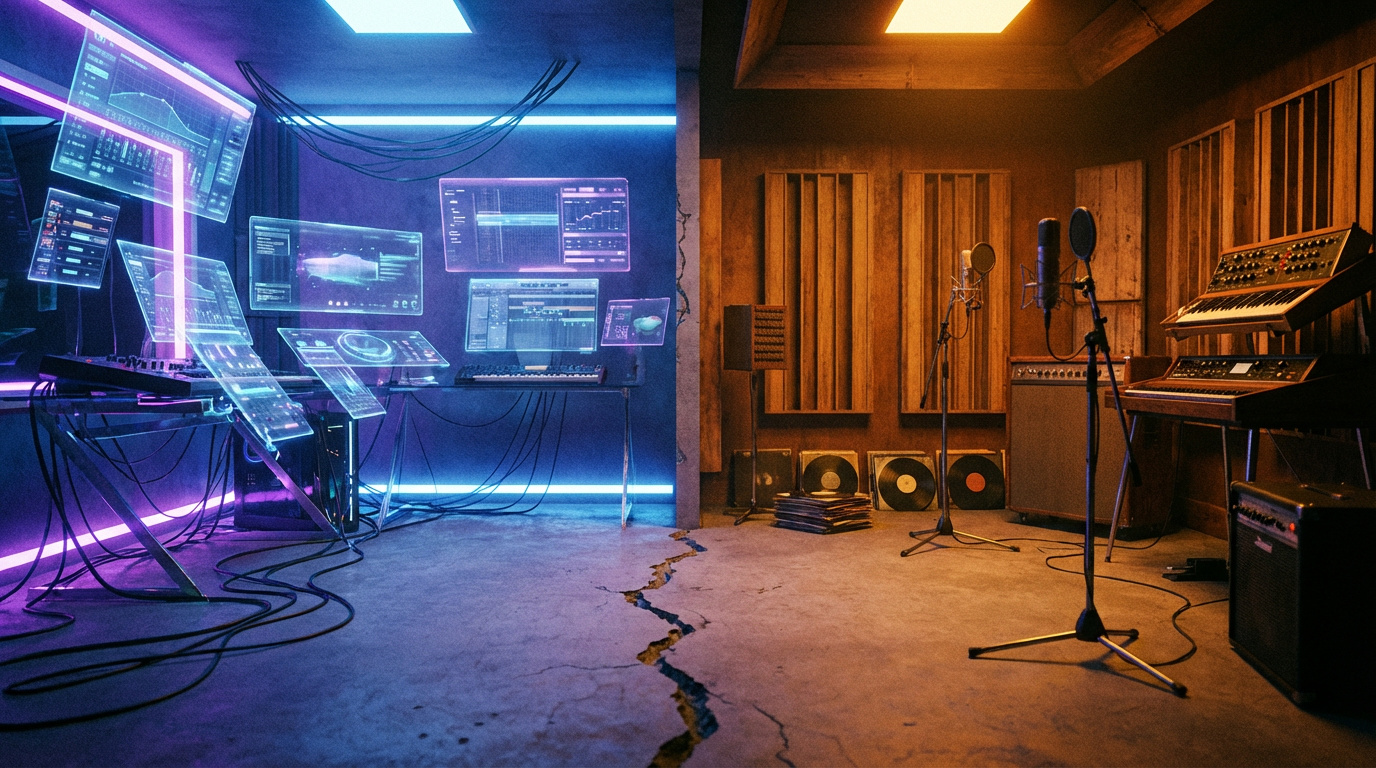
AI Music's Civil War Just Exploded in 2026
There are weeks where nothing happens. And then there are weeks where everything happens at once.
The last seven days in AI music have been so chaotic, so contradictory, and so consequential that if you blinked, you might have missed what could be the defining moment in how AI reshapes the entire music industry.
Let me catch you up.
The Numbers That Broke the Internet
On February 25, Suno CEO Mikey Shulman announced that the AI music generation platform had hit 2 million paid subscribers and $300 million in annual recurring revenue.
Let that sink in. At the time of Suno’s $250 million Series C in November 2025, the company reported $200 million in annual revenue. Growing from $200 million to $300 million ARR in roughly 90 days is an unusually fast monetization trajectory for a consumer AI product.
Shulman also noted that over 100 million people have now used Suno.
The platform now produces approximately 7 million songs per day.
Seven. Million. Songs. Per day.
With 2 million people actively paying for the service, Suno has crossed into genuine consumer adoption territory. For context, that’s more paid subscribers than many established SaaS companies achieve, and it’s happened in a fraction of the time traditional software takes to scale.
To put this in perspective: the $300 million ARR figure positions Suno as a serious player in the broader generative AI landscape. While OpenAI dominates text and conversation, and Midjourney leads in images, Suno is carving out audio as its territory.
”Say No to Suno”
The same week Suno was popping champagne, the other side of the industry was sharpening knives.
In an open letter titled “Say No to Suno,” artist reps described the company as a “brazen smash and grab” platform, accusing it of using “unauthorized AI platform machinery trained on human artists’ work.” Published Monday, February 23, on the Music Technology Policy blog, the letter was signed by figures including Ron Gubitz, Executive Director of the Music Artist Coalition; Helienne Lindvall, songwriter and President of the European Composer and Songwriter Alliance; and Chris Castle of the Artist Rights Institute.
The letter didn’t pull punches. It argued that the “hijacking of the world’s entire treasure-trove of music floods platforms with AI slop and dilutes the royalty pools of legitimate artists from whose music this slop is derived.”
And here’s where it gets spicy. The letter also waded into the ongoing industry debate over “walled gardens” in AI music, criticizing a recent LinkedIn post by Paul Sinclair, Suno’s Chief Music Officer, who argued that closed AI systems limit how people engage with music.
The activists’ response? According to Billboard’s reporting, the letter fired back that Sinclair’s argument is “just a tired remix of the old trope that ‘information wants to be free.’”
The Deezer Data That Nobody Can Ignore
While both sides were trading blows, some genuinely alarming data was quietly backing up the artists’ case.
According to recent data from Deezer, approximately 60,000 AI-generated tracks are being uploaded to the Paris-headquartered streaming service every day, with synthetic content now accounting for roughly 39% of all music delivered to the platform daily.
Even more damning: Deezer reported that up to 85% of streams of AI-generated tracks in 2025 were fraudulent, compared with 8% fraud across its overall catalogue.
That’s not a typo. Eighty-five percent.
The “Say No to Suno” letter cited this directly, raising the concern that Suno had, in effect, become what the signatories called a “fraud-fodder factory on an industrial scale.” Whether you agree with that characterization or not, Deezer’s numbers demand a serious response from every platform in the ecosystem.
Bandcamp Draws a Line in the Sand
While Suno and the artist coalitions were duking it out, another front in this war opened back in January and is still sending shockwaves.
Bandcamp announced that music and audio generated wholly or in substantial part by AI is not permitted on its platform.
The move positions Bandcamp as the first major music platform to issue a full ban on AI-generated audio.
Fans reacted with an outpouring of joy. “This is how you do it,” wrote one user on Bluesky.
But here’s where the utopian narrative starts crumbling. The enforcement? It’s getting messy.
Now that Bandcamp’s AI policy has rolled out, evidence of its impact surfaced first in scattered posts. Creators on social platforms, in Bandcamp’s own comment threads, and on review sites began describing a similar pattern: accounts suddenly terminated, releases disappearing from public view, and artist pages no longer appearing in search. Taken together, these individual reports sketch an emerging picture of how suspicion-based enforcement and user flagging can translate into removals, wiped catalogs, or quiet visibility suppression.
In other words, the AI police are here, but they’re arresting some innocent people too. One artist states they’ve been “shadow banned” and no longer appear in search, attributing it to malicious reporting after using AI vocal tools for testing purposes and labeling it accordingly.
This is the paradox of the AI music ban: it’s incredibly popular in principle and incredibly messy in practice. As one commenter on Bandcamp’s blog pointed out, how do you reliably distinguish AI-generated electronic music from human-produced electronic music built from sample packs and loops?
The Xania Monet Wildcard
And then, right in the middle of all this ideological warfare, there’s Telisha Jones.
Telisha “Nikki” Jones is 31 years old, from Olive Branch, Mississippi. She grew up singing in church but never felt her voice was good enough to pursue music professionally. She’s been writing poetry since she was 24.
The turning point came when Jones discovered Suno. She started feeding her poems into the AI music generator, using a combination of Suno’s platform and live elements to turn written words into fully produced R&B tracks. Jones writes about 90% of the lyrics herself. She provided the words and the emotional direction. She created the persona Xania Monet as the face of this music.
“How Was I Supposed to Know?” was the first AI song to enter a Billboard radio airplay chart, entering Adult R&B Airplay at number 30.
The streaming numbers were wild: 7+ million Spotify streams on “How Was I Supposed to Know?” alone, 1.4 million monthly listeners, 17 million streams in just two months, and over 44 million official US streams total across the Xania Monet catalog.
Following a bidding war, Monet was signed to Hallwood Media for $3 million.
The backlash was immediate. Singer-songwriter Kehlani criticized the deal, saying that she felt Jones was “doing none of the work.”
Artist SZA said AI devalues music.
But here’s the uncomfortable truth that makes this story so fascinating: Jones is not some tech bro trying to disrupt music from a Silicon Valley penthouse. She’s a poet from Mississippi who lost her father at eight, processed her grief through writing, and used AI to give her words a voice she didn’t think she had. For context, most independent human artists never hit 100,000 monthly listeners. Xania Monet did it with zero live performances and zero music videos.
Is that theft? Innovation? Both? Neither?
The answer you give probably says more about what you think music is than about what AI can do.
The Industry Is Splitting in Two
What makes this moment so disorienting is that the music industry isn’t moving in one direction. It’s fracturing.
On one side: Udio has reached settlements with both Universal Music Group and Warner Music Group, signing licensing agreements with each for a new AI music platform expected to launch this year. Warner Music Group settled with Suno in November, but the AI company remains locked in legal battles with Universal Music Group and Sony Music Entertainment.
Suno also named Jeremy Sirota, the former CEO of Merlin, as its new Chief Commercial Officer. Sirota spent six years leading Merlin, the digital licensing partner for independent labels, where he scaled annual revenue from $900 million to $1.8 billion.
On the other side: Sweden disqualified an AI-assisted folk-pop song from its official charts despite millions of streams. Nearly 800 artists, including Cyndi Lauper and Bonnie Raitt, signed an open letter against AI music. Bandcamp has banned AI entirely. And Bandcamp recently banned AI-generated music altogether while Apple Music, Deezer and Spotify have all sought to remove fraudulent AI “spam” tracks in recent months.
Meanwhile, the major labels secured licensing agreements that give their artists the option to participate and be compensated when new licensed AI models launch in 2026. Independent artists, however, have no equivalent deal structure in place.
That last point deserves emphasis. The majors are getting paid. The indies are getting left behind. Again.
What This Means for You (the Indie Musician)
OK, so the industry is a mess. What do you actually do with this information?
Here’s my honest take:
1. The AI Music Genie Is Not Going Back in the Bottle
Suno’s milestone represents a 50% revenue jump in just three months and a signal that consumer appetite for AI-generated music has moved well beyond novelty. Whether you love it or hate it, AI music creation is now a $300 million annual business with the growth trajectory of a rocket ship. Pretending it doesn’t exist won’t protect you.
2. The Visual Layer Is Your Competitive Moat
Here’s what’s interesting: while AI can now generate a decent song from a text prompt, the full package of being an artist still requires a visual identity, a narrative, a brand, and content that connects. Telisha Jones didn’t just create songs. She created a visual persona, a story, and a content strategy. The artists who thrive in this era will be the ones who pair their music (AI-assisted or not) with compelling visuals.
This is exactly why tools like OneMoreShot.ai matter more than ever. When 7 million AI tracks are generated daily, the music alone isn’t enough. Your visual game, your music videos, your social content — that’s what separates a forgotten upload from a viral moment.
3. Know Your Platforms
Bandcamp didn’t stop AI music. Bandcamp stepped out of the AI music market. That distinction matters. Bandcamp is a direct-to-fan marketplace. Its value isn’t “streams.” It’s trust, identity, discovery, and community.
Each platform is developing its own stance. Know the rules before you publish. Deezer labels AI content. Spotify is developing standards (currently voluntary). Bandcamp bans it outright. Your distribution strategy needs to account for this patchwork reality.
4. The Copyright Question Is Still Wide Open
As 2026 begins, many legal uncertainties remain. The Copyright Office’s report and initial rulings in court suggest AI training can be fair use in some scenarios. But whether an AI company can rely on fair use will likely depend on the specific circumstances of its training work.
If you’re using AI in your workflow, document your creative process. Show the human elements. The clearer your human contribution, the stronger your copyright position.
5. Use AI for Videos, Even If You Don’t Use It for Music
Here’s the thing nobody talks about enough: even if you write, record, and produce every note of your music by hand, you can still use AI to create stunning music videos to promote it. There’s no Bandcamp-style ban on AI-generated visuals. And the technology for AI video has progressed dramatically.
Whether you use OneMoreShot.ai to generate a cinematic music video in minutes, or just create quick social clips for TikTok and Instagram, the visual layer is where AI can amplify human-made music without any of the ethical baggage.
The Uncomfortable Middle Ground
The AI music debate is often framed as binary: you’re either pro-AI or pro-artist. But the reality is messier and more human than that.
Telisha Jones is a poet from Mississippi who made people cry with words they felt in their bones. The voice was AI. The grief was real. Kehlani is a Grammy-nominated artist who trained for years and feels her livelihood is threatened. Both of them are right about something important.
Shulman framed Suno as a creative platform, positioning it against what he described as cultural flattening: “Endless scrolling and passive consumption have flattened culture. People yearn for more, and the future of consumer entertainment is creative.”
Meanwhile, the artist coalitions argue that you can’t build a creative future on a foundation of stolen creative past.
The truth? We’re in the messy middle of a revolution. The rules haven’t been written yet. The lines haven’t been drawn yet. And the musicians who survive this era won’t be the ones who picked the “right side” of the AI debate. They’ll be the ones who adapted fastest, told the best stories, and made the most compelling content across every medium available to them.
And if you’re looking to turn your music into something visual, something shareable, something that cuts through the noise of 7 million daily AI tracks, give OneMoreShot.ai a spin. Because in 2026, a great song without a great video is like a screenplay that never got filmed: it might be brilliant, but nobody will ever know.