AI Music's Wildest Week and What It Means
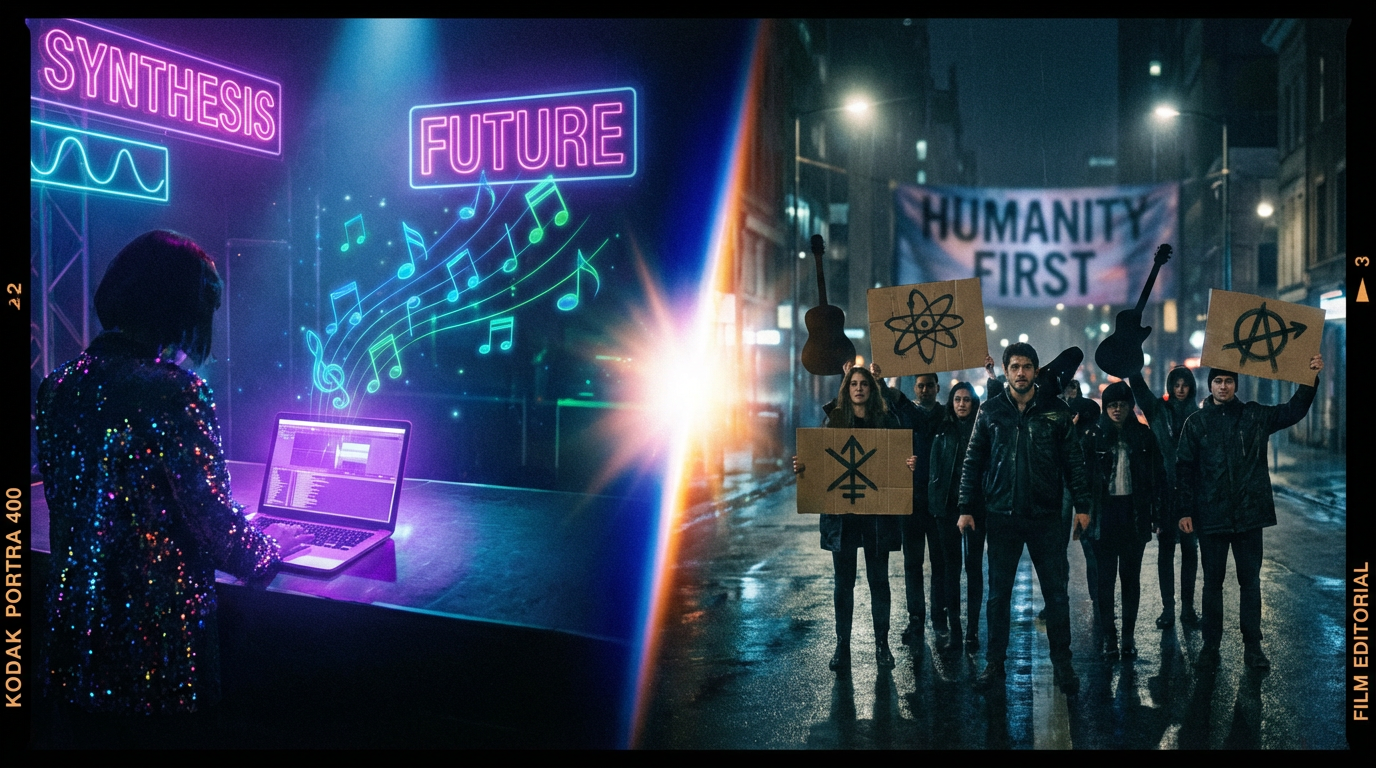
Last week might go down as the most consequential five days in the short, chaotic history of AI music. And if you blinked, you missed a collision of milestones, protests, acquisitions, and existential questions that reshaped the entire landscape overnight.
Let me break down what happened, who won, who lost, and — most importantly — what it all means if you’re an independent musician trying to figure out where you fit in this brave new world.
The Week That Broke AI Music
Here’s the timeline. Try to keep up.
On Monday, February 23, Suno announced the hiring of Jeremy Sirota, former CEO of Merlin, as its new Chief Commercial Officer. That same day, a coalition of artist representatives published an open letter titled “Say No to Suno,” urging the music community to take a position against certain uses of generative AI in music.
On Tuesday, February 24, Google announced the acquisition of AI music start-up ProducerAI.
The AI-powered music-making platform ProducerAI, formerly known as the startup Riffusion, joined the Google Labs family.
Then on Wednesday, the bombshell. Suno CEO and co-founder Mikey Shulman posted about two new milestones: 2 million paid subscribers and $300 million annual recurring revenue (ARR).
This past week might be the most consequential in AI music history. And the timing? Almost poetic. Artists and advocates publicly condemned Suno as a threat to music — and two days later, the numbers proved that millions of people disagreed with their money.
Suno’s Numbers Are Staggering
Let’s talk about what $300 million in ARR actually means.
This is double the subscriber count Billboard reported in November.
Just three months ago, Suno announced a $250 million funding round that valued the company at $2.45 billion. At the time, Suno told The Wall Street Journal that annual revenue had hit $200 million. That’s a 50% revenue jump in roughly 90 days.
Suno has hit $300 million in annual recurring revenue with 2 million paid subscribers — a milestone that puts it among the fastest-growing consumer AI applications.
The numbers tell a compelling story. At $150 per subscriber annually on average, Suno’s monetization rivals established creative tools like Adobe’s consumer offerings while serving a fundamentally different use case.
And the scale of creation is mind-boggling. Publicly revealed data says Suno is used to generate 7 million tracks a day. To put that in context, Suno users generate about 7 million songs daily, creating the equivalent of the entire catalog of music available on Spotify every two weeks.
“Say No to Suno” — The Artists Fight Back
While Suno celebrated, a very different conversation was happening.
In an open letter titled “Say No to Suno,” the artist reps described the company as a “brazen smash and grab” platform, accusing it of using “unauthorized AI platform machinery trained on human artists’ work.” Published on the Music Technology Policy blog, the letter was signed by figures including Ron Gubitz, Executive Director of the Music Artist Coalition; Helienne Lindvall, songwriter and President of the European Composer and Songwriter Alliance; and Chris Castle of the Artist Rights Institute.
The letter didn’t pull punches. The letter argued that the “hijacking of the world’s entire treasure-trove of music floods platforms with AI slop and dilutes the royalty pools of legitimate artists from whose music this slop is derived.”
They even compared Suno’s practices to last year’s Louvre heist — you know, the one where thieves in construction worker disguises made off with $100 million in crown jewels. The metaphor is dramatic, but you can feel the desperation behind it.
And there’s a “walled garden” debate at the center of it all. The letter waded into the ongoing industry debate over so-called “walled gardens” in AI music, criticizing a recent LinkedIn post by Paul Sinclair, Suno’s Chief Music Officer, who argued that closed AI systems limit how people engage with music.
UMG was the first major to settle its litigation with Suno rival Udio, alongside a licensing deal for a new AI platform set to launch in 2026. The concept of a “walled garden” was introduced within that announcement — a model where AI-generated music cannot be downloaded or distributed outside the platform. Udio disabled downloads, with users given a 48-hour grace period to retrieve previously created tracks before the walls went up.
The coalition also raised a genuinely alarming data point. According to data released by Deezer, around 60,000 AI-generated tracks are uploaded to its platform each day, representing approximately 39% of daily deliveries. Deezer reported that up to 85% of streams of AI-generated tracks in 2025 were fraudulent.
Read that again: 85% of AI music streams on Deezer are fraudulent. That’s not a creative revolution. That’s an infrastructure exploit.
The Uncomfortable Middle Ground
Here’s where it gets nuanced — and where most hot takes fall apart.
2 million people are paying real money for Suno because they genuinely love making music with it. At $150 per subscriber annually on average, Suno’s revenue rivals established creative tools like Adobe’s consumer products. These aren’t bots or spam farms. They’re people — lyricists who can’t sing, poets who’ve never touched an instrument, bedroom producers experimenting with new sounds.
The poster child? Telisha Nikki Jones, a 31-year-old woman from small-town Mississippi, who had been writing poems since she was 24 and taught herself how to use AI tools to create a digital persona. She uploaded her poems to Suno, which set them to music.
Soon, Jones had a $3 million record deal, prompting some human musicians — including R&B stalwarts Kehlani and SZA — to cry foul.
Jones explained that she writes all of the lyrics to the songs, taking the words from poems she’s been writing since she was 24 — including her biggest hit, which was inspired by the death of Jones’ father when she was just 8 years old. “There’s real emotions and soul put into those lyrics,” she said.
Is she a musician? Is she a creative director? Is she something entirely new that we don’t have a word for yet? The answer probably matters less than the fact that millions of people are asking the same question about themselves right now.
Google Enters the Chat (Again)
As if the week needed more drama, AI-powered music-making platform ProducerAI joined the Google Labs family in the tech giant’s latest major leap into AI content creation. ProducerAI, formerly known as the startup Riffusion, gained traction for its ability to turn text prompts into short musical clips. Now, as part of the Google ecosystem, its functionality has expanded.
Initially, ProducerAI could only create very short clips. But now the platform enables users to create tracks up to three minutes long. The new version uses Google’s Gemini AI to pull its logic, which allows it to follow more complex instructions. This, alongside the Lyria 3 engine, handles high-fidelity audio generation.
Google acquiring an AI music startup the same week artists launched a campaign against AI music is… well, it tells you everything about the current moment. The industry is simultaneously in revolt and in accelerated adoption. The two trains aren’t slowing down, and nobody knows what happens when they meet.

The Legal Landscape Is a Mess
The legal situation surrounding all of this is… complicated, to say the least.
Udio has since reached settlements with both Universal Music Group and Warner Music Group, signing licensing agreements with each for a new AI music platform expected to launch this year. Warner Music Group settled with Suno in November, but the AI company remains locked in legal battles with Universal Music Group and Sony Music Entertainment, as well as European music rights organizations, including Denmark’s Koda and Germany’s GEMA.
And Suno’s strategy? Fight the suits tooth and nail, continue adding industry execs (most recently former Merlin CEO Jeremy Sirota as chief commercial officer), and simultaneously explore possible resolutions.
There’s also a new legal wrinkle that could have massive implications. Multiple music-sector plaintiffs are now moving to invoke a little-discussed ripping decision in their battles with Suno and Udio. In Cordova v. Huneault, a magistrate judge recently concluded that allegations of bypassing YouTube’s rolling cipher anti-piracy measure to rip audio are sufficient to allege DMCA anti-circumvention violations.
If you’re keeping score: Suno settled with Warner, is still at war with UMG and Sony, is being sued by independent artists in two separate class actions, and is fighting rights organizations across Europe. All while generating $300 million a year and hiring executives from the very industry trying to take it down.
You can’t make this stuff up.
What This Actually Means for Indie Musicians
Okay, enough play-by-play. Let’s talk about what matters: what does this mean if you’re an independent artist trying to build a career in 2026?
1. The visual game matters more than ever
When 7 million AI tracks hit platforms daily, your music alone isn’t enough to stand out. You need a visual identity, music videos, and content that captures attention in the first scroll. This has been true for a while, but the flood of AI-generated music makes it non-negotiable. A stunning music video is no longer a luxury — it’s your primary weapon for differentiation.
2. Authenticity is your moat
Here’s the thing AI can’t replicate: your story. Your face on stage. Your Instagram story about the gig that went wrong. Your connection to your audience. Others argue AI is simply a new tool, like synthesizers or drum machines before it. The reality likely lands somewhere in between — certain types of commercial music production may shift to AI, while human creativity remains central to artistic and culturally significant work.
3. Use the tools, don’t fight the tide
Despite the concerns, Suno is becoming a more common tool among professional songwriters and producers to assist in creating songs and demos, growing more present in songwriter sessions across the industry. Smart artists are already using AI for demos, mood boards, and creative ideation — then layering their human artistry on top. The artists who thrive will be the ones who treat AI like they treated drum machines in the ’80s: as a tool to enhance, not replace.
4. Your visual content pipeline needs to be as strong as your music pipeline
This is where the real opportunity lives. You’ve got your music. Maybe you even used AI to help with production or demos. But can you create a full music video without a $10,000 budget? Can you produce visual content for every platform — TikTok, YouTube, Instagram — at the speed the algorithm demands?
The Road Ahead
While those settlements and deals are still taking shape heading into 2026, one thing seems certain: the music industry has accepted that the AI age is here, and they want to work with — not against — AI.
The question isn’t whether AI music tools will exist. That’s settled. The real questions are: Who gets paid? Who gets credited? And how do we build systems that reward both the human spark and the AI assist?
Responsible AI-generated music must evolve within a framework that respects and remunerates artists, enhances human creativity rather than supplants it, and empowers fans to engage with the music they love. At the same time, AI services must preclude mass distribution of slop and prevent fraudsters from destroying the very ecosystem that has been built to reward and sustain artists and audiences alike.
That’s a goal worth fighting for — no matter which side of the debate you’re on.
Turn Your Music Into Something People Can See
Here’s what we know: in a world drowning in AI-generated audio, the artists who win are the ones who make their music visible. The song is the soul, but the video is the handshake.
That’s exactly why we built OneMoreShot.ai. Upload your track — whether it’s produced in a studio, co-created with AI, or recorded on your phone — and get a professional-quality music video in minutes. No film crew, no $50K budget, no two-month production timeline.
Because in the wildest era music has ever seen, the one thing that hasn’t changed is this: people connect with what they can see and hear. Give them both.