The Complete Guide to AI Music Videos in 2026
In 2024, a study commissioned by the Animation Guild estimated that by 2026, more than 100,000 U.S. entertainment jobs will be disrupted by generative AI. That disruption is here — and nowhere is it more visible than in music videos.
The global AI video generator market was valued at USD 716.8 million in 2025 and is projected to grow to USD 847 million in 2026, reaching USD 3,350 million by 2034. For musicians, this explosion means one thing: you no longer need a five-figure budget to release a professional music video. A laptop, a finished track, and a few minutes are all it takes.
This is the definitive guide to AI music videos in 2026. Whether you’re an independent artist looking to promote your first single, a producer wanting to visualize beats, or an established act exploring new creative frontiers, this resource covers everything — from the best tools and techniques to real-world costs and future predictions.
Let’s dive in.
What Are AI Music Videos?
An AI music video generator is a tool that uses artificial intelligence to automatically create professional music videos from your audio tracks. It analyzes your music and generates synchronized visuals, effects, and animations that match the rhythm, mood, and style of your song.
Unlike traditional music videos — which require location scouting, camera crews, actors, directors, editors, and weeks of post-production — traditional video production workflows like storyboarding, shooting, and editing used to take weeks. AI compresses these timelines into hours by automating sound generation, video editing, and synchronization.
How They Differ from Traditional Videos
The core difference is in the production pipeline. Traditional music videos follow a linear workflow: concept → script → storyboard → film → edit → color grade → deliver. Each step requires specialized professionals and significant budget.
AI music videos collapse that pipeline. In 2026, music video AI systems now support full-scene generation, allowing creators to input prompts like “a sunset city skyline synced with electronic beats” and instantly get coherent outputs with visuals that dynamically react to sound frequencies. AI can detect music mood, rhythm, and transitions, then adjust camera angles, lighting, and pacing accordingly.
A Brief History
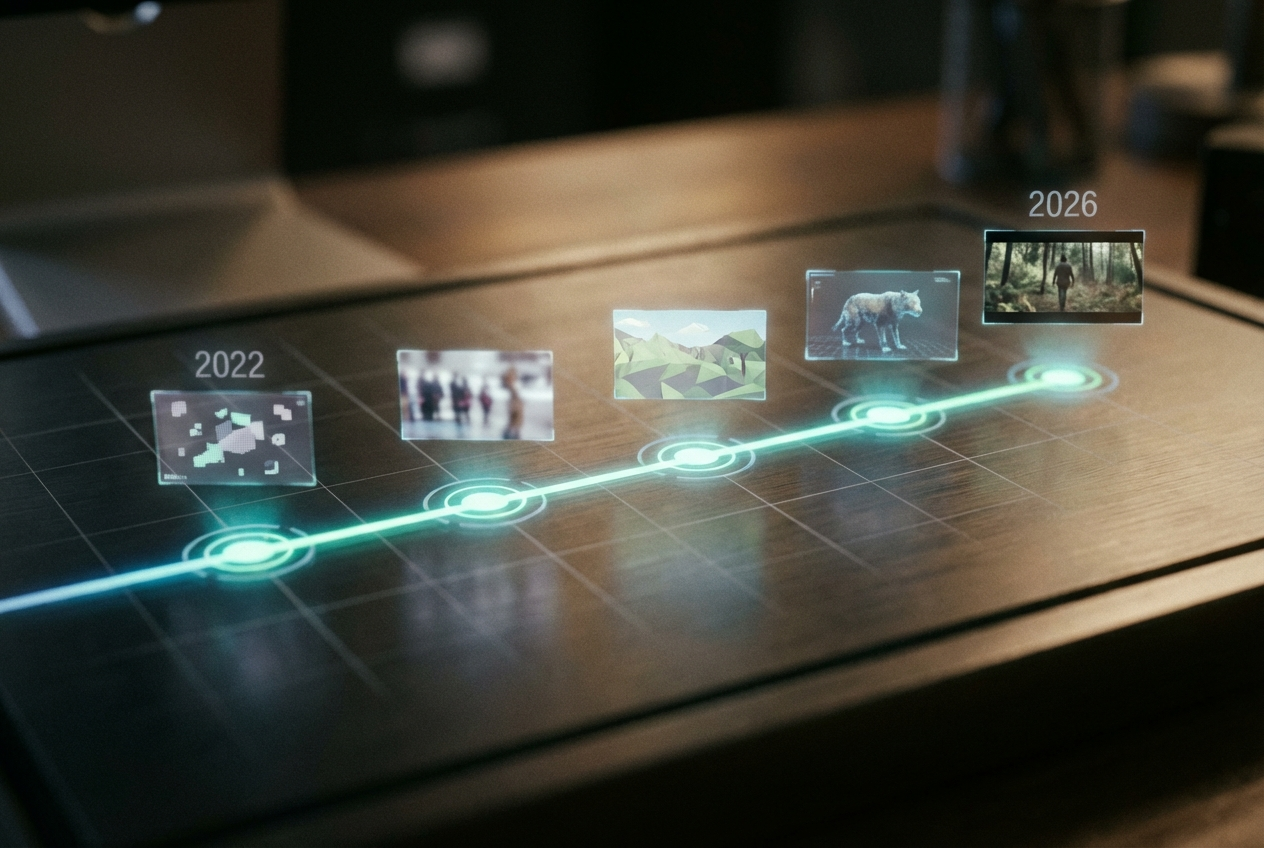
The evolution of AI music videos has been remarkably fast:
- 2022–2023: Early tools like Stable Diffusion and Deforum allowed frame-by-frame AI art that could be strung into music videos, but the process was technical and time-consuming.
- 2024: Runway released Gen-1, the first publicly available video generation model. It enabled an entirely new form of creative expression and a new product category. Kaiber gained attention after powering Linkin Park’s “Lost” music video.
- 2025: The field exploded. Runway’s flagship Gen-4 model, released in March 2025, represented the platform’s most significant advancement in AI video generation quality and consistency. Google launched Veo 3 at I/O 2025, and OpenAI’s Sora entered the market. Purpose-built music video generators like OneMoreShot.ai, Neural Frames, and Freebeat emerged.
- 2026: The technology has matured. AI music video generators are no longer experimental tools — they have become essential resources for independent musicians, marketing teams, and digital creators seeking faster and more scalable visual production.
Top AI Music Video Tools in 2026
The landscape of AI music video tools in 2026 is divided into two categories: purpose-built music video generators (designed specifically for musicians) and general AI video generators (powerful tools that can be adapted for music video creation). Here’s a comprehensive breakdown of every major platform.
Comparison Table
| Tool | Best For | Music Sync | Max Resolution | Starting Price | Lip-Sync |
|---|---|---|---|---|---|
| OneMoreShot.ai | Complete music videos from any track | ✅ Beat-matched | 1080p | Free tier + tokens | ✅ Advanced |
| Neural Frames | Audio-reactive visualizers | ✅ 8-stem analysis | 4K | ~$19/mo | ❌ |
| Freebeat | Fast AI-directed story videos | ✅ Rhythm-synced | 1080p | Free tier | ✅ |
| BeatViz | Beat-synced visual storytelling | ✅ BPM analysis | HD | Free tier | ❌ |
| Kaiber | Abstract/experimental visuals | ✅ Audioreactivity | 4K | $5/mo | ✅ (via models) |
| Runway | Cinematic VFX, pro workflows | ❌ Manual | 4K | $12/mo | ✅ Act-Two |
| Sora 2 (OpenAI) | Photorealistic generation | ❌ Manual | 1080p | $20/mo (Plus) | ❌ |
| Google Veo 3.1 | 4K cinematic with native audio | ❌ Manual | 4K native | $0.15–0.40/sec | ❌ |
| Kling AI | Long-form video, character consistency | ❌ Manual | 1080p (4K in 3.0) | Free credits | ✅ |
| Pika | Short creative clips, VFX | ❌ Manual | 1080p | Free tier | ✅ Pikaformance |
| Luma Dream Machine | Fast ideation, character reference | ❌ Manual | 1080p | Free tier | ❌ |
| LTX Studio | Storyboard-to-screen direction | ✅ Script sync | 1080p | Subscription | ❌ |
Purpose-Built Music Video Generators
OneMoreShot.ai — Best All-Around Music Video Generator
OneMoreShot.ai’s AI-powered platform combines cutting-edge technology with artistic vision to transform your music into captivating visual experiences. It generates stunning music videos in under 5 minutes. Advanced AI analyzes your music’s rhythm, tempo, and mood to create visuals that perfectly match every beat.
What makes OneMoreShot stand out is its dual workflow approach. Choose between fully automatic video generation or build your video scene by scene. Both powered by the same simple token system. Upload your song and let AI generate a complete music video — fast, effortless, stunning results in minutes. Or build your video scene by scene in the editor with full creative control over every clip, transition, and effect.
Key Features:
The most advanced lip-syncing technology available on the market with cutting-edge AI model that delivers perfect mouth movement synchronization with unmatched precision.
Export in vertical, horizontal, or square formats. Perfect for TikTok, YouTube, Instagram, and more.
Supports all major audio formats including MP3, WAV, FLAC, AAC, and OGG. You can also paste a link to your track from platforms like Suno, Udio, or YouTube.
Features Seedance 4.5 and Nano Banana Pro models. Sora 2 is now available in One More Shot AI.
Pricing: Token-based system with subscription options. A subscription plus token packs provide the best value for regular creators.
Best for: Musicians who want a complete, ready-to-share music video with minimal effort — especially artists using platforms like Suno and Udio.
👉 Start creating your AI music video now →
Neural Frames — Best for Audio-Reactive Visualizers
Neural Frames enables creators to make AI music videos with up to 10 minutes at 4K resolution with a few clicks. Thousands of artists have made over two million videos with Neural Frames.
Neural Frames is the only AI music video generator that behaves like a visual synthesizer: every kick, snare and vocal stab drives a cut, zoom or colour flash in real time. True stem analysis: the engine splits your track into eight channels and maps each one to motion parameters for frame-perfect sync.
Pricing: Starts at ~$19/month with a free trial.
Best for: Musicians who want psychedelic, abstract, or audio-reactive visualizers that pulse with every beat.
Freebeat — Best for Fast Story Videos
Freebeat is a purpose-built AI music video generator designed specifically for music-first video generation, not generic text-to-video workflows. It analyzes rhythm, structure, and mood to generate visuals that align with the song rather than applying template motion.
Pick Story Video or Stage Performance, then set style, characters, and creative direction. The agent plans pacing, shots, and atmosphere automatically.
Best for: Artists who need a finished video quickly from a pasted link — ideal for social media promotion.
BeatViz — Best for Beat-Synced Precision
BeatViz aggregates all leading AI video models (Google Veo 3.1, Luma AI, Pika, Kling, etc.) in one place. Access and test every top feature and style for the highest quality creative output from your AI Music Video Generator.
Best for: Producers and beat-makers who need precise BPM-synced visualizers for YouTube or social media.
General AI Video Generators (Adapted for Music Videos)
Runway — The Professional’s Choice
Runway Gen-4.5 is the world’s top-rated video model, offering unprecedented visual fidelity and creative control. It produces cinematic and highly realistic outputs while providing limitless creative freedom.
Runway pricing: Standard — $12/mo (annual). 625 credits/month. Pro — $28/mo (annual). 2,250 credits/month. Unlimited — $76/mo (annual). 2,250 credits/month plus Explore Mode for unlimited relaxed-rate generations.
The trade-off with Runway for music videos: it produces cinema-grade clips, but creating a full music video often involves assembling multiple generated clips. There’s no native audio analysis — you must manually sync visuals to your track in an editor.
OpenAI Sora 2 — Photorealistic AI Video
OpenAI’s Sora 2 has revolutionized AI video generation since its API launch on September 30, 2025.
You need either a ChatGPT Plus subscription ($20/month with unlimited 480p access) or ChatGPT Pro subscription ($200/month for 10,000 credits up to 1080p).
As of January 10, 2026, free users can no longer generate videos with Sora. Only Plus ($20/month) and Pro ($200/month) subscribers retain access.
Google Veo 3.1 — 4K with Native Audio
Google DeepMind released a major Veo 3.1 update on January 13, 2026, introducing true 4K video generation at 3840x2160 pixels, native 9:16 vertical video support for TikTok and YouTube Shorts, and enhanced character consistency through Ingredients to Video.
What’s truly exciting about Veo 3 is its native audio integration. Veo 3 changes that by generating synchronized audio — ambient sounds, music, sound effects, and even dialogue — right alongside the video.
Pricing: $0.40/second (Standard) or $0.15/second (Fast) via API.
Kling AI — Long-Form Video Leader
Kling AI is an advanced AI-powered video generation platform developed by Kuaishou Technology that transforms text descriptions and static images into high-quality cinematic videos. Launched in June 2024, Kling AI has rapidly attracted over 6 million users globally.
The latest iteration, Kling 2.5 Turbo released in September 2025, delivers 40% faster generation times. Extended videos can reach up to 3 minutes in length through the platform’s video extension feature, significantly longer than most competitors.
Kling 3.0 entered its exclusive preview phase on January 31, 2026, and is currently rolling out to selected users globally.
Pika — Creative Effects Powerhouse
Since its explosive debut, Pika has evolved from a simple Discord-based experiment into a full-fledged creative suite at pika.art. With the rollout of the Pika 2.5 engine, the platform has introduced a level of physics-based interaction that was previously thought impossible for generative models.
Tools like Pikaffects, Pikaswaps, and Pikadditions make Pika ideal for creating viral, effects-heavy music video clips.
Luma Dream Machine — Fast Creative Ideation
Ray3 is Luma’s next-generation video model, designed in collaboration with creatives from the entertainment, advertising, and gaming industries. With reasoning-driven generation, best-in-class video-to-video including character reference and keyframes. The latest update, Ray3.14, adds native 1080p generation, 4x faster performance, improved stability, stronger prompt adherence, and 3x lower cost.
Kaiber — The Artist’s Experimental Lab
Kaiber is a strong choice for truly artistic, experimental, and one-of-a-kind music visuals. It’s built a strong reputation, especially after powering Linkin Park’s official “Lost” music video.
Kaiber AI is an innovative platform that empowers users to create captivating videos and animations using artificial intelligence. Designed for a diverse audience — including musicians, visual artists, animators, filmmakers, designers, gamers, marketers, and engineers. Audioreactivity: Kaiber enables users to create visuals that synchronize dynamically with audio.
Pricing: Free trial that includes 100 credits. After the trial, subscription plans starting at $5/month.
How to Create an AI Music Video (Overview)
Creating an AI music video in 2026 follows a surprisingly simple workflow, regardless of which tool you choose. Here’s the high-level process:
Step 1: Prepare Your Track
Have your finished audio file ready. Most platforms accept MP3, WAV, and other common formats. Some tools like OneMoreShot.ai also let you paste a link from Suno, Udio, or YouTube.
Step 2: Choose Your Platform
Select the right tool for your needs based on the comparison above. For a complete, hands-off experience, OneMoreShot.ai is the fastest path. For maximum cinematic control, consider Runway or Kaiber.
Step 3: Upload and Configure
Upload your track and describe the visual style you want. Plan your concept first: before generating anything, define the emotion and environment you want to convey. AI responds best to clear direction.
Step 4: Generate and Iterate
Let the AI generate your video. Review the output, make adjustments to prompts or scenes, and regenerate as needed. Most tools allow you to refine individual scenes or swap clips.
Step 5: Export and Share
Export in the right format for your target platform — vertical for TikTok and Instagram Reels, horizontal for YouTube, square for social media feeds.
📖 For a detailed, step-by-step tutorial, read our full guide: How to Make an AI Music Video
Techniques and Best Practices
Creating a great AI music video requires more than just uploading a track and hitting “generate.” Here are the techniques that separate amateur outputs from professional-grade results.
Visual Style Selection
The most important creative decision is your visual style. In 2026, AI music video tools can produce a wide range of aesthetics:
- Hyperrealistic / Live-action style: Best for hip-hop, R&B, and pop. Requires photorealistic models like Runway Gen-4.5 or Sora 2.
- Anime / Illustration: Popular for electronic music, indie, and J-pop/K-pop. Kaiber and Pika excel here.
- Abstract / Audio-reactive: Perfect for EDM, ambient, and experimental genres. Neural Frames leads this category.
- Cinematic / Narrative: For storytelling-driven videos across any genre. LTX Studio and Freebeat are strong choices.
- Retro / Nostalgic: VHS effects, vintage film grain, lo-fi aesthetics. Achievable through specific prompting on most platforms.
Prompting Strategies
Your prompts are the director’s instructions. Effective prompts should be specific and descriptive rather than conversational, use positive phrasing describing what you want (not what you don’t want), include clear subject motion using active verbs, specify camera movements like “tracking shot” or “low angle,” describe scene motion and environmental elements, and define visual style.
Example prompt for a hip-hop video:
“A confident young artist walks through neon-lit city streets at night, camera tracking from a low angle. Rain-slicked pavement reflects colorful signs. Cinematic, moody, blue and orange color grading.”
Example prompt for an EDM visualizer:
“Abstract flowing liquid metal shapes pulsing with energy, neon pink and electric blue colors, particles exploding outward, dark void background, dramatic lighting.”
Audio-Visual Synchronization
This is what separates AI music videos from generic AI video. The best tools automatically analyze your track’s BPM, energy levels, and structure to time visual transitions with musical changes.
Tips for better sync:
- Use tools with native beat detection (OneMoreShot.ai, Neural Frames, BeatViz)
- Place scene transitions at musical transition points (verse to chorus, drops, bridges)
- Match visual energy to musical energy — calm visuals for quiet sections, dynamic visuals for high-energy moments
- For manual workflows, export individual clips and assemble in a timeline editor
Storytelling Approaches
Even with AI, strong music videos tell stories. Consider these narrative frameworks:
- Performance video: The artist (or AI avatar) performing the song. OneMoreShot.ai’s lip-sync technology excels here.
- Narrative arc: A mini-movie with characters and a plot that unfolds across the song.
- Mood piece: Atmospheric visuals that evoke the song’s emotions without a literal storyline.
- Lyric visualization: Scenes that literally illustrate the lyrics, transitioning with each verse.
Resolution and Format Tips
- YouTube: Export at 1080p minimum in 16:9 landscape format
- TikTok / Instagram Reels: 9:16 vertical format, 1080×1920
- Spotify Canvas: Looping 3–8 second vertical clips
- Square format (1:1): Works across most social platforms
Genre-Specific Approaches
Different music genres demand different visual approaches. AI music video tools in 2026 are flexible enough to serve any genre, but knowing the conventions helps you create videos that resonate with your audience.
Hip-Hop & Rap
Hip-hop videos traditionally emphasize performance, urban environments, and status. AI tools can generate city streetscapes, studio sessions, and dynamic performance shots. Lip-sync technology is critical here — OneMoreShot.ai’s advanced lip-sync ensures your avatar’s mouth movements match your bars perfectly.
📖 Deep dive: AI Music Videos for Hip-Hop
Electronic / EDM
EDM thrives on abstract, audio-reactive visuals. BeatViz’s millisecond beat sync catches every drop and transition perfectly — a video tool that understands EDM rhythms. Neural Frames’ 8-stem audio analysis is also ideal for this genre.
📖 Deep dive: AI Music Videos for EDM
Pop
Pop videos are all about polish, personality, and shareability. Bright colors, dynamic camera movements, and character-driven narratives work best. Tools that offer character consistency across scenes (like Runway Gen-4 or Kling’s Elements feature) help maintain a cohesive visual identity.
Rock & Metal
Rock and metal benefit from high-energy, dramatic visuals — flames, dark environments, concert footage aesthetics, and abstract visual effects. Kaiber’s experimental style and Pika’s Pikaffects (crush, melt, explode) add visceral impact.
Indie / Folk
Indie and folk genres call for more intimate, understated visuals — nature scenes, candlelit interiors, vintage film aesthetics. Soft color palettes and gentle camera movements match the mood.
R&B / Soul
Moody lighting, intimate settings, and cinematic depth of field define R&B visuals. AI generators with strong lighting control and skin-tone accuracy are essential.
📖 Explore more genre guides in our Content Hub
Real-World Examples and Case Studies
AI music videos aren’t just a theoretical concept — major artists and creators are actively using them.
Notable Artist Adoption
Washed Out × OpenAI Sora
Artist, writer, and filmmaker Paul Trillo collaborated with musical artist Washed Out to create a project using OpenAI’s AI model “Sora.” The AI music video features an innovative technique that uses continuous zoom shots to create visual illusions, drawing viewers in. Trillo explained to fans on his social media that he edited 55 clips generated by Sora using Adobe Premiere.
Linkin Park — “Lost”
Kaiber built a strong reputation, especially after powering Linkin Park’s official “Lost” music video, which proves just how professional the results can be.
This official music video uses a mixture of anime scenes using original art, original footage of the band, and AI-generated visuals.
Kanye West & Ty Dolla $ign — “Vultures”
The music video for “Vultures (Havoc Version)” uses a creative approach where image concepts were generated using Midjourney and animated with Runway Gen-2. This method gives the AI music video an eerie and unsettling aesthetic that reflects the atmosphere of the track.
Peter Gabriel × Stability AI
Peter Gabriel partnered with Stability AI to host a music video contest titled Peter Gabriel/Stability AI #DiffuseTogether. Participants used Stable Diffusion to create original animated works inspired by Peter Gabriel’s songs. Winning entries were officially released as music videos for tracks from Gabriel’s new album, i/o.
Mario Novembre (TikTok Star)
Mario Novembre, a popular German TikTok star with 5 million followers, decided to experiment with Neural Frames for his song “Papaya.” Mario, leveraging the power of Neural Frames, crafted a stunning visual representation in merely 2 hours!
AI in Live Performances
In 2026, the integration of artificial intelligence in music and stage production has become central to performance design. AI music videos now power captivating live visuals and background screens that transform concerts, festivals, and immersive showcases into technologically enhanced art experiences.
Artists deploy background LED or digital wall projections generated by AI models that fit the theme, emotion, or tempo of each song.
Costs and ROI
One of the most compelling arguments for AI music videos is the economics. Let’s break down the real numbers.
Traditional Music Video Production Costs
A traditional music video involves location fees, camera crews, lighting, talent, wardrobe, post-production, and color grading. Costs range from $0.50–$30 per minute for AI generation vs. $1,000–$50,000 per minute for traditional production — up to 90% savings.
For independent artists, even a “budget” traditional music video typically costs $2,000–$10,000. Label-backed videos routinely exceed $50,000.
AI Music Video Costs
Most AI music video platforms now operate through subscription models, typically ranging between $5 and $30 monthly depending on video duration, rendering quality, and customization features.
Here’s a realistic cost breakdown for different approaches:
| Approach | Cost | Timeline | Quality |
|---|---|---|---|
| Traditional low-budget video | $2,000–$10,000 | 2–6 weeks | Variable |
| Professional AI production studio | $100–$2,000 | 1–5 days | High |
| Freelancer (AI-powered, Fiverr) | $43–$162 | 2–7 days | Medium-High |
| DIY with OneMoreShot.ai | $10–$50 | Minutes | High |
| DIY with Runway + editing | $28–$95/mo + time | Hours–Days | Very High |
| DIY with free tools | $0 (limited) | Hours | Variable |
The cost of AI-generated music videos on Fiverr typically ranges from $43 to $162, with an average price of $93.
ROI for Independent Artists
The return on investment for AI music videos is extraordinary when you consider:
- Social media engagement: Videos get 1200% more shares than text and images combined
- Streaming platform support: Spotify Canvas, Apple Music Motion, and YouTube all prioritize visual content
- Release velocity: Instead of one video per album cycle, you can create a visual for every single
AI tools reduce costs by 90–99% for many use cases. A 10-video social media campaign might cost $89 with AI versus $100,000+ through traditional agencies.
The AI video generator market, valued at USD 716.8 million in 2025, is projected to soar to USD 3,350 million by 2034. This growth reflects the massive value creators are finding in these tools.
Trends and Future Predictions
The AI music video space is evolving at breakneck speed. Here’s where things are heading in late 2026 and beyond.
Current Trends (Early 2026)
Native Audio Generation: The most groundbreaking advancement is native audio. Unlike earlier AI video models that required third-party tools to add sound, models like Veo 3 generate synchronized dialogue, environmental sound effects, and ambient textures that perfectly align with the visual motion.
4K and Beyond: Veo 3.1 is the first mainstream AI video generator with professional 4K output. With 4K resolution that surpasses OpenAI Sora 2 (capped at 1080p), Veo 3.1 sets a new benchmark for AI video generation quality.
Vertical-First Creation: Vertical video will surpass landscape as the default aspect ratio for AI-generated content by mid-2026. Every major platform now supports native vertical generation.
Multi-Model Access: Platforms like Kaiber and BeatViz now aggregate multiple AI models (Veo 3.1, Kling, Runway, Pika) in one interface, letting creators choose the best model for each scene.
Predictions for Late 2026 and Beyond
Long-Form Narratives: Rumors suggest that Google is working on a “Long-Form Mode” capable of generating consistent 10-minute narratives by late 2026. This would enable full music video creation in a single generation pass.
Real-Time Generation: Industry analysts predict that as rendering speeds continue to decrease, we may soon see tools capable of generating cinematic environments on the fly based on verbal input.
AI-Generated Live Visuals: 2026 has been a landmark year for AI-generated live visuals. The most notable emerging trends include narrative visuals from prompt-based inputs, and cross-modal AI models merging image, video, and audio datasets to enable coherent audiovisual synthesis from a single prompt.
Hybrid Workflows: As 2026 progresses, more mid-size studios adopt hybrid AI-human models: AI generates the core arrangements, while human producers fine-tune details. The same pattern is emerging in video — AI generates the foundation, humans direct and refine.
Market Explosion: The projected global AI video generation market size is $18.6 billion by end of 2026, up from $5.1 billion in 2023. The AI video sector is growing at a 34.2% compound annual growth rate. Venture capital investment in AI video startups reached $4.7 billion in 2025 alone.
Frequently Asked Questions
What is the best AI music video generator in 2026?
It depends on your needs. For a complete, all-in-one solution that takes you from audio upload to finished music video in minutes, OneMoreShot.ai is the best choice — especially with its advanced lip-sync and multi-format export. For audio-reactive visualizers, Neural Frames leads. For maximum cinematic quality with manual assembly, Runway Gen-4.5 produces the most photorealistic clips.
How much does it cost to make an AI music video?
You can create a basic AI music video for free using limited tiers on platforms like OneMoreShot.ai, Pika, or Kling. For professional results, expect to spend $10–$50 per video using a purpose-built tool, or $12–$95/month on a general AI video platform subscription. This compares to $2,000–$50,000+ for traditional production.
Can AI music videos look professional enough for official releases?
Yes. In 2026, AI-generated visuals have reached a quality threshold where they’re being used for official releases by major artists. The key is choosing the right style, crafting strong prompts, and spending time iterating on the output. Many artists now use AI as the primary creation method for music videos destined for YouTube, Spotify, and streaming platforms.
Do I need technical skills to make an AI music video?
No. No experience is needed! Simply upload your music, choose your style preferences, and let the AI handle all the complex video creation and editing automatically. Purpose-built tools like OneMoreShot.ai are designed for musicians, not video editors.
How long does it take to generate an AI music video?
Most music videos are generated in just 2–5 minutes, depending on the length of your track and the complexity of the visuals you choose. More complex projects using manual scene-by-scene editing may take 30 minutes to a few hours.
Can I use AI music videos commercially?
Most paid AI video platforms grant commercial usage rights. However, always check the specific terms of the tool you’re using. Major platforms like Runway, Pika, and OneMoreShot.ai all support commercial use on paid plans.
Will AI replace traditional music video directors?
Not entirely. AI is best understood as a new creative tool, not a replacement for human creativity. AI music video generators are becoming essential creative partners for modern content production. Rather than replacing human creativity, they expand the speed, flexibility, and accessibility of visual storytelling. Many professional directors are now incorporating AI into their workflows as a powerful addition to traditional techniques.
What about copyright and ownership?
AI-generated content ownership varies by platform. Most major tools (Runway, Pika, OneMoreShot.ai) grant you ownership of your outputs on paid plans. It’s crucial to introduce technologies such as these in a responsible way. Videos made with some tools will be marked with SynthID or similar technology for watermarking and detecting content generated by AI.
Conclusion
The AI music video revolution isn’t coming — it’s here. In 2026, any musician with a finished track can create professional-quality visuals in minutes, not weeks. The tools are powerful, the costs are a fraction of traditional production, and the creative possibilities are expanding every month.
Whether you’re an independent bedroom producer releasing your first single or an established artist looking for fresh visual concepts, AI music video generators have fundamentally changed what’s possible.
Here’s what we recommend:
- Start experimenting today. The best way to understand AI music videos is to create one.
- Choose the right tool for your workflow. If you want speed and simplicity, go purpose-built. If you want maximum control, combine general AI tools with an editor.
- Iterate and refine. Your first generation is a starting point, not the final product. Great AI music videos come from creative direction, not just clicking “generate.”
- Stay current. This technology evolves monthly. Bookmark this guide — we’ll keep it updated as new tools and capabilities emerge.
Ready to create your first AI music video? Try OneMoreShot.ai free → Upload your track, pick a style, and have a stunning music video ready to share in minutes. No filming. No editing skills. Just your music, brought to life.
This is the cornerstone resource of our AI Music Video Content Hub. For more in-depth guides on specific topics, explore:
- How to Make an AI Music Video — Step-by-step tutorial
- AI Music Videos for Hip-Hop — Genre guide
- AI Music Videos for EDM — Genre guide
- Free AI Music Video Generator — Budget options