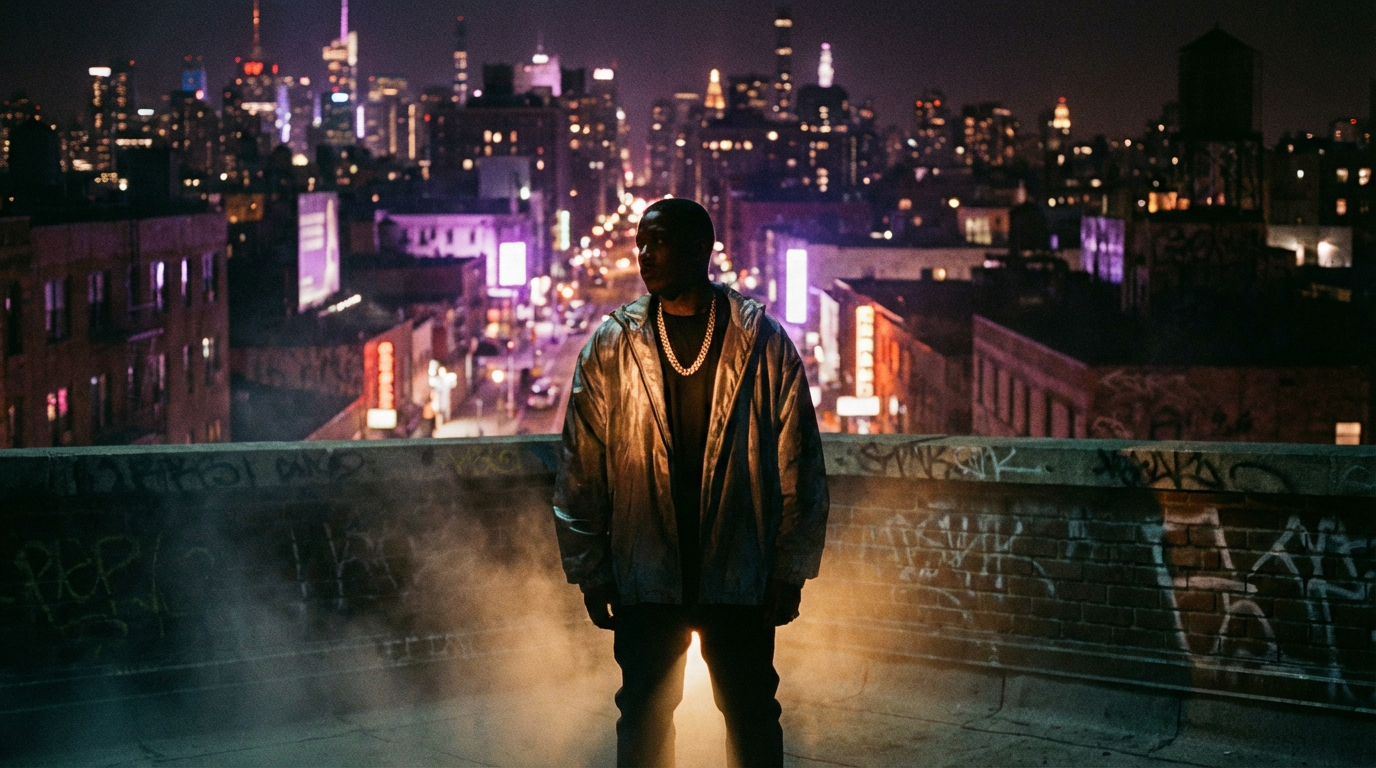
AI Music Videos for Hip-Hop: Complete Guide
AI Music Videos for Hip-Hop: The Complete Guide
Hip-hop has always been a visual culture. From the graffiti-covered walls of the Bronx in 1973 to Hype Williams’ fisheye fever dreams to Kendrick Lamar’s AI face-swapping in “The Heart Pt. 5,” the genre has consistently pushed visual boundaries alongside sonic ones. Now, in 2026, a new chapter is being written — and it’s powered by artificial intelligence.
Creator Jesse Wellens recently made an AI music video for Snoop Dogg’s “Slid Off” — entirely generated with AI, using tools like Seedance 2.0 for key shots.
Another Snoop Dogg video, directed by Wellens, featured AI-generated cameos from a lineup that includes Kobe Bryant, LeBron James, Michael Jordan, Tupac Shakur, Michael Jackson, Nate Dogg, and Warren G, with old photos of Snoop “brought to life” with generative AI software. Meanwhile, rapper Cordae used deepfake technology in his music video for “Doomsday,” featuring the late Juice WRLD, implementing a technique where his face is replaced by Juice WRLD’s face during Juice WRLD’s verses.
The message is clear: AI isn’t replacing hip-hop’s visual culture — it’s amplifying it. And you don’t need a Hype Williams budget to create visuals that hit. Whether you’re an independent rapper dropping a trap single, a boom bap purist with a lo-fi EP, or a drill artist building your visual brand, this guide will show you exactly how to create a hip-hop AI music video that feels authentic to your sound.
For a broader overview of the technology, check out The Complete Guide to AI Music Videos in 2026.
The Visual Language of Hip-Hop
Before you touch a single AI tool, you need to understand what makes hip-hop look like hip-hop. The genre has one of the richest visual traditions in all of music, and every subgenre carries its own distinct aesthetic DNA.
The Foundation: Iconic Visual Conventions
Music video directors like Hype Williams, F. Gary Gray, and Paul Hunter emerged as influential figures in the 1990s, elevating the genre’s visual style. Hype Williams, in particular, became known for his use of fisheye lenses, vibrant colors, and innovative camera angles, setting a new standard for hip-hop music videos.
His signature style — fisheye lenses, banks of lights, unlikely post-production effects and insane color schemes — would help define the larger-than-life look of hip-hop’s jiggy era.
Hip-hop has always been more than music. It’s a visual language — built from graffiti, fashion, flyers, album covers, logos, and now thumbnails, motion graphics, and social content. Long before artists had “brands,” hip-hop was already creating them in the streets: bold lettering, coded symbols, and aesthetics that told you where someone was from, what they stood for, and what era they represented.
Regional and Subgenre Aesthetics
Each subgenre of hip-hop carries a visual signature you should understand before prompting AI:
Boom Bap (East Coast Classic)
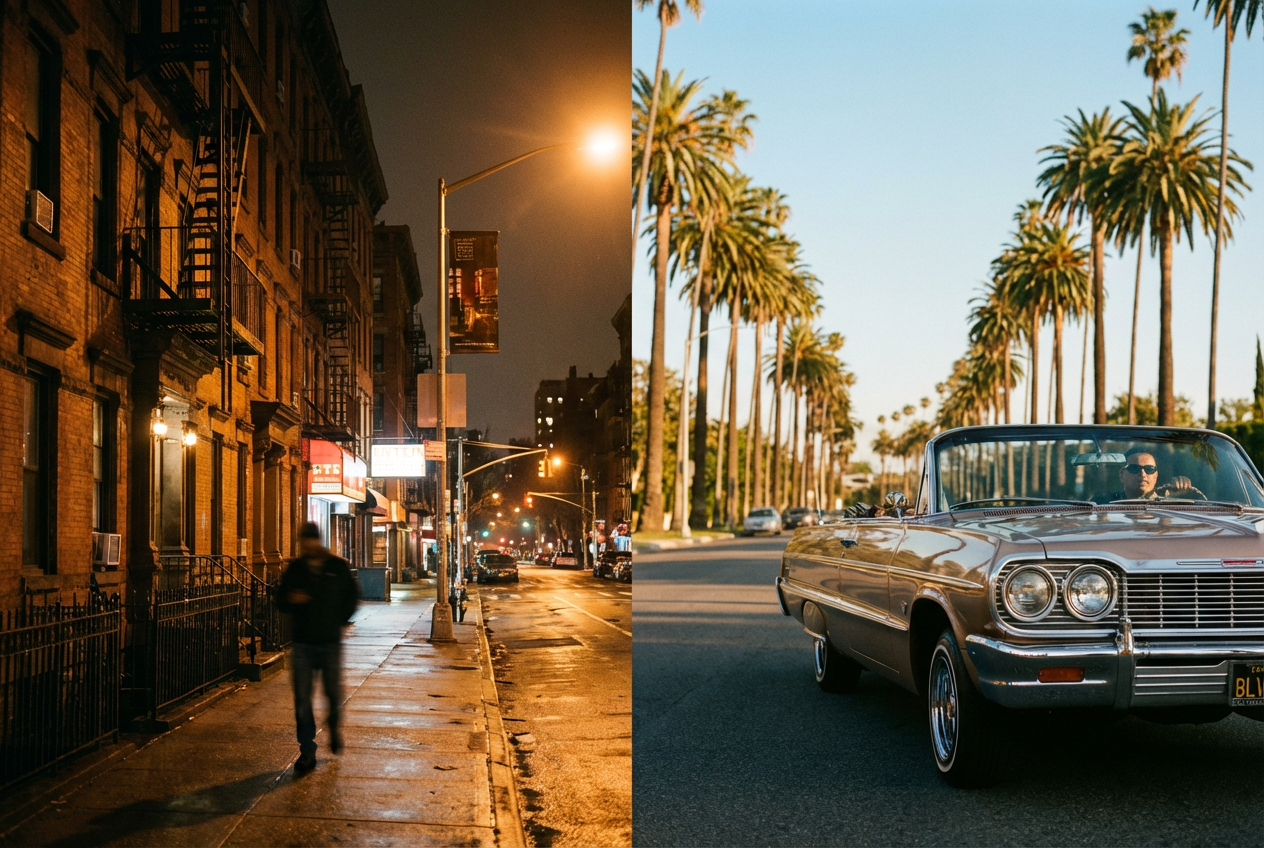
The 1990s saw the emergence of regional styles in hip-hop videos. East Coast videos, like those from Nas or Wu-Tang Clan, often had darker, grittier tones, focusing on urban realism. Think muted color palettes, brownstone stoops, subway stations, film grain, and handheld camera energy. The visual mood matches the chopped samples and hard drums.
West Coast / G-Funk
In contrast, West Coast videos, from artists like Dr. Dre and Snoop Dogg, emphasized a laid-back, sun-soaked aesthetic, often featuring classic cars, palm trees, and party scenes.
Hype Williams’ collaboration with Tupac in “California Love” merges hip-hop with Mad Max-inspired visuals, creating an iconic and futuristic representation of West Coast rap.
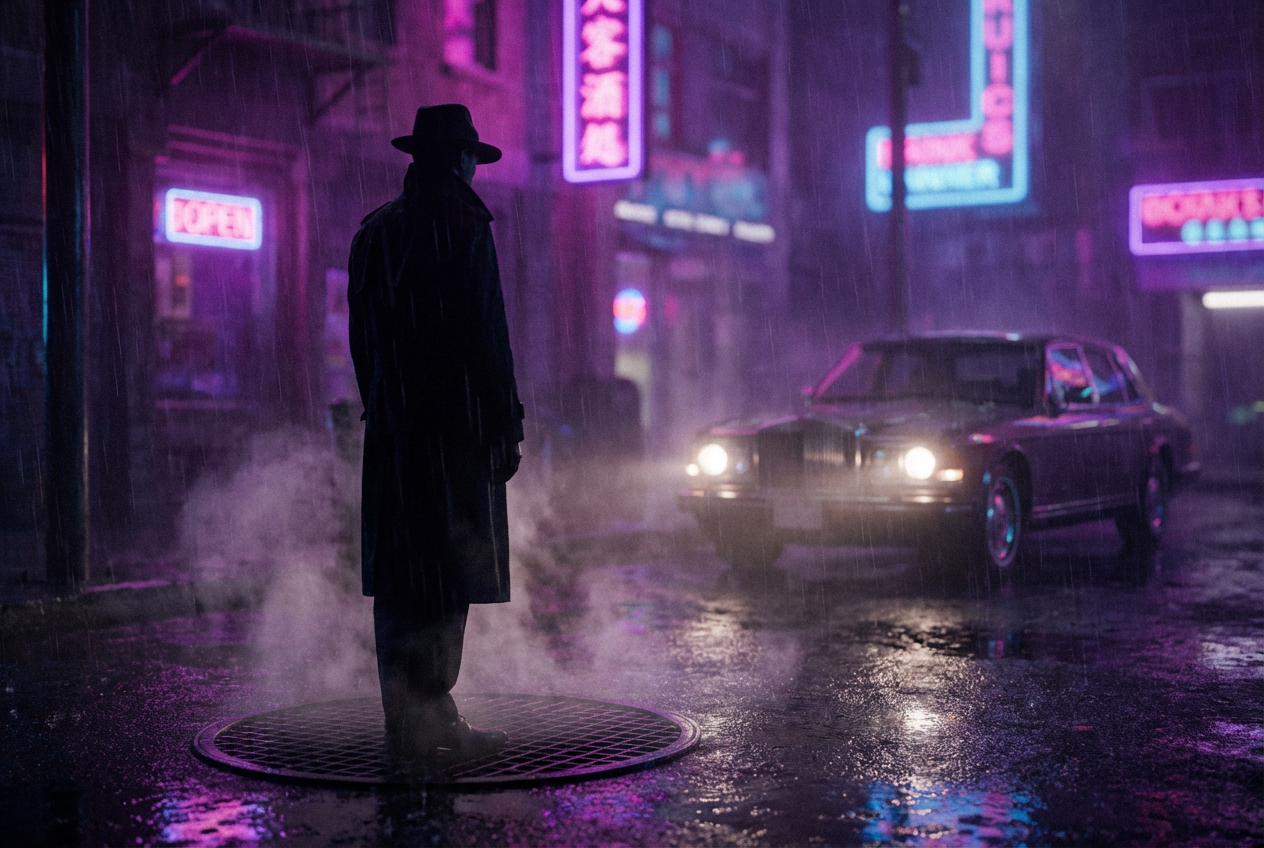
Trap Modern trap visuals lean into excess: neon-lit studios, jewelry close-ups, exotic cars, nightclub lighting, and heavy use of slow-motion. The color palette skews toward purples, deep reds, and gold. Think of the visual world of Migos’ “Bad and Boujee” — which boasted over 1 billion streams on YouTube, featuring the accouterments of handsome and wealthy rappers lavishing in their spoils — beautiful women, insane whips, and bottles of champagne.
Drill Drill (whether Chicago, UK, or Brooklyn) favors raw, unfiltered authenticity. Dark streets, hoodies, balaclavas, council estate stairwells, and low-light cinematography. The visual language is deliberately unflinching — minimal set design, maximum intensity.
Contemporary / Experimental
Artists like Lil Uzi Vert, Doja Cat, and Megan Thee Stallion often incorporate surreal, otherworldly visuals in their music videos, creating a distinct, memorable aesthetic that sets them apart from more traditional styles. Tyler, the Creator has built entire cinematic universes around his albums, while Kendrick Lamar’s videos read like short films.
Best AI Tools for Hip-Hop Videos
The AI video generation landscape in 2026 is mature enough to handle hip-hop’s demanding visual requirements. Here’s how the key players stack up for the genre:
OneMoreShot.ai — Built for Musicians
OneMoreShot.ai is purpose-built for music video creation, which makes it uniquely suited for hip-hop. It generates professional rap and hip-hop music videos with AI, creating cinematic visuals for your tracks with perfect lip-sync and beat matching, ready in minutes.
What makes OneMoreShot particularly powerful for hip-hop:
Choose between fully automatic video generation or build your video scene by scene, both powered by the same simple token system.
Neural networks that understand music theory and visual aesthetics to create truly artistic videos.
Full HD quality downloads with no watermarks, with the ability to share directly to your favorite platforms.
The scene-by-scene editor is a game-changer for hip-hop specifically because you can craft different visual moods for each verse, the hook, and the bridge — just like how a traditional music video director would approach shot planning.
Other Tools in the Ecosystem
AI is transforming how we create and experience music videos. By 2026, AI music video creation has evolved into a streamlined process where musicians, content creators, and digital artists can produce professional-grade visuals synchronized with custom soundtracks using artificial intelligence.
Several other tools deserve mention for specific hip-hop use cases:
- Neural Frames — Offers AI music videos with up to 10 minutes at 4K resolution with a few clicks. Their audio-reactive animations sync visuals directly to your beat’s frequency spectrum.
- Freebeat — A purpose-built AI music video generator designed specifically for music-first video generation, which analyzes rhythm, structure, and mood to generate visuals that align with the song.
For a deeper comparison of the full tool landscape, see How to Make an AI Music Video.
Step-by-Step: Creating a Hip-Hop AI Music Video
Here’s the practical walkthrough for taking your hip-hop track from audio file to finished visual with OneMoreShot.ai.
Step 1: Analyze Your Track’s Visual DNA
Before uploading anything, listen to your track with a director’s ear. Ask yourself:
- What’s the BPM? A 140 BPM drill track demands rapid cuts and aggressive camera movement. A 90 BPM boom bap joint needs slower, deliberate pacing.
- What’s the mood? Introspective? Celebratory? Menacing? Nostalgic?
- What’s the setting? Your lyrics likely already suggest visual environments. “Posted on the block” paints a different picture than “penthouse view.”
- What era are you channeling? A jazzy boom bap sample might call for golden-era New York aesthetics, while a synth-heavy trap beat might scream futuristic neon.
Plan your concept first: before generating anything, define the emotion and environment you want to convey. AI responds best to clear direction.
Step 2: Upload Your Track
Head to OneMoreShot.ai and upload your audio file. The AI will analyze the rhythm, structure, and energy of your track, mapping out the beat drops, verse transitions, and hook patterns.
Step 3: Choose Your Visual Direction
This is where genre knowledge pays off. For hip-hop, consider these approaches:
For Automatic Generation: Let the AI create the full video based on your style prompts. Great for quick social media content or testing visual concepts.
For Scene-by-Scene Control: Build your video like a storyboard. This is the approach for artists who want different visual environments for each section — a dark alley for verse one, a neon-lit club for the hook, and a rooftop skyline for verse two.
Step 4: Craft Your Prompts
This is the most critical step for hip-hop. Your prompts should be vivid, specific, and culturally informed. Here are the key elements to include:
- Setting/Location: “Graffiti-covered subway tunnel,” “Chrome and glass penthouse at midnight,” “Rain-slicked city street with reflections”
- Lighting: “Amber streetlamp glow,” “Neon purple and red club lighting,” “Harsh overhead fluorescent”
- Motion/Energy: “Slow dolly push,” “Handheld aggressive movement,” “Smooth steadicam tracking shot”
- Mood Modifiers: “Cinematic,” “Gritty documentary feel,” “Hyper-stylized,” “Lo-fi nostalgic”
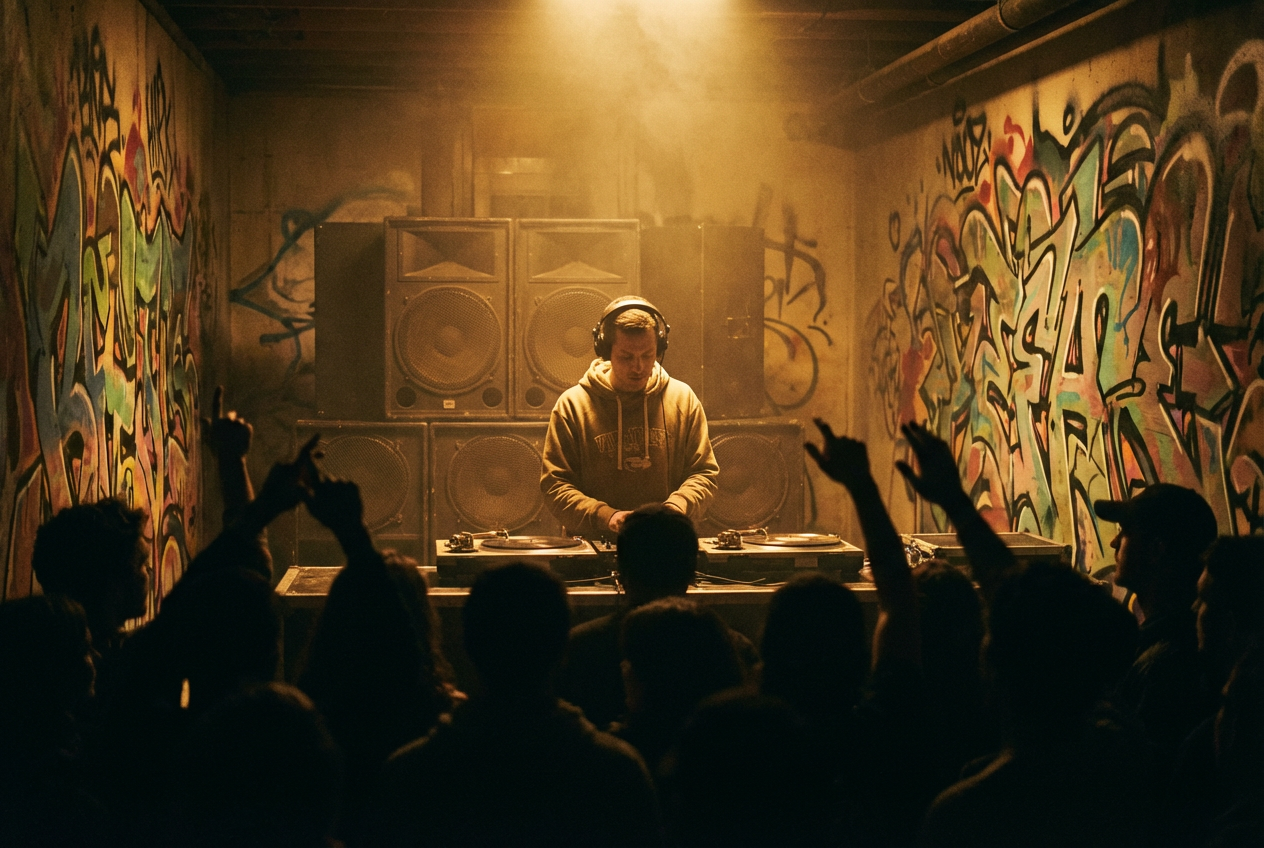
- Cultural Elements: “Classic car in the background,” “Chain-link fence,” “Turntables and vinyl,” “Gold jewelry catching light”
Step 5: Review, Refine, Regenerate
The first generation is rarely the final cut. Review each scene and regenerate anything that doesn’t capture the vibe. Pay special attention to:
- Pacing alignment — Do scene transitions land on beat drops?
- Visual consistency — Does the color palette stay cohesive across scenes?
- Energy matching — Does the visual intensity match the audio intensity?
Step 6: Export and Distribute
Export in the format that matches your primary platform — 16:9 for YouTube, 9:16 for TikTok and Reels, and square for certain social placements.
Prompt Examples for Hip-Hop Subgenres
These are copy-paste-ready prompts tailored to different hip-hop styles. Use them as starting points and customize for your specific track.
🎤 Boom Bap / Golden Era
“Dimly lit recording studio from the 1990s, vintage MPC sampler on the desk, vinyl records stacked against the wall, warm amber lighting, cigarette smoke curling through the air, worn brick walls, nostalgic film grain texture, slow camera pan across the room”
🔥 Modern Trap
“Lavish penthouse interior at night with floor-to-ceiling windows overlooking a city skyline, deep purple and gold lighting, crystal chandelier reflections, marble floors, slow-motion camera movement, luxury and excess, cinematic depth of field”
🗡️ Drill
“Dark urban street corner at 2am, harsh white streetlight casting long shadows, concrete housing block in the background, foggy breath in cold air, raw handheld camera feel, monochrome with slight blue tint, tense and confrontational mood”
🌊 Melodic Rap / Cloud Rap
“Dreamy surreal landscape with cotton candy clouds and pastel gradient sky, lone figure walking through an endless field of lavender, ethereal soft lighting, gentle camera float, vaporwave color palette of pinks, purples, and cyan, peaceful yet melancholic”
🎹 Lo-Fi Hip-Hop
“Cozy apartment window view of a rainy Japanese cityscape at night, desk with open notebook and steaming cup of tea, warm lamplight, raindrops on glass, animated lo-fi study vibes, soft and meditative, vintage film color grading”
🏙️ Conscious / Lyrical Hip-Hop
“Sunrise over an empty city basketball court, chain-link fence draped in morning dew, golden hour light casting long shadows on cracked asphalt, documentary-style camera work, raw and honest, warm earth tones with high contrast”
💎 Southern Trap / ATL Style
“Candy-painted classic car doing donuts in an empty parking lot, sunset behind Atlanta skyline, orange and gold warm tones, dust and tire smoke caught in golden light, wide-angle lens, celebratory energy, summer heat haze”
🌐 Afro / Futuristic Hip-Hop
“Afrofuturist cityscape with towering structures blending traditional African architecture and advanced technology, golden geometric patterns floating in the air, protagonist in flowing garments and futuristic accessories, warm amber mixed with cool blue accents, epic and visionary”
Hip-Hop AI Music Video Inspiration
The intersection of AI and hip-hop visuals is producing some genuinely compelling work. Here are notable examples pushing the boundaries:
Snoop Dogg’s AI Visual Era
The music video for Snoop Dogg’s “Sophisticated Crippin’,” directed by Jesse Wellens, seems to be mostly AI. Generated clips of Kobe Bryant, LeBron James, Michael Jordan, Michael Jackson, Warren G, Nate Dogg and Tupac all appear, alongside some classic photos of Snoop that have been “brought to life” with generative AI software.
Some viewers seem intrigued by the tools used, noting that these AI techniques are now within reach for independent artists and creators. Wellens has continued this approach, creating a music video for Snoop Dogg’s “Slid Off” entirely in AI, using Seedance 2.0 for some shots, posted on February 20, 2026.
Cordae x Juice WRLD — “Doomsday”
The music video, directed by Cole Bennett, sees Cordae making his way down a dimly-lit office corridor and uses deepfake facial recognition technology to morph Juice WRLD’s face onto Cordae’s. The opening of the video uses the same technology to map Eminem’s face onto Cordae’s.
This technique was first introduced to mainstream rap by Kendrick Lamar, who used AI to face-swap between himself, Kobe Bryant, Kanye West, and more in his “The Heart Pt. 5” music video.
KATSEYE — “Gnarly”
AI became ubiquitous in the music industry in 2025, often controversially used to produce videos. The international girl group KATSEYE’s “Gnarly” video drew criticism for its use of AI, though the bizarre visuals felt like a natural match for the noisy hyperpop track’s sound.
The “Love You More” Collaborative Approach
This was a combined effort of the Dor Brothers and a talented team of artists led by Jaron Marquis. The music video leveraged a plethora of AI tools including Ideogram, Luma AI, Kling, Magnific AI, Runway, and Midjourney.
For more examples and breakdowns of hip-hop AI music videos, explore our Hip-Hop AI Music Video Examples Gallery.
Tips for Authenticity
Creating a hip-hop AI music video that resonates means walking the line between leveraging AI’s creative power and honoring the culture that built the genre. Here’s how to keep it real:
Know the Culture Before You Prompt
In hip-hop culture, the synergy between artists and directors in crafting music videos stands as an art form in itself, weaving narratives that transcend mere visuals to become iconic cultural moments. From the gritty streets to opulent sets, hip-hop music videos serve as vivid canvases where artists and directors paint compelling stories that resonate globally.
You can’t prompt what you don’t understand. If you’re making a drill video, study the visual language of directors like JC, who shot Pop Smoke’s early videos. If you’re going boom bap, watch videos by Nas, EPMD, and A Tribe Called Quest. The AI will only be as culturally literate as your instructions.
Avoid Cliché Overload
It’s easy to stack every hip-hop stereotype into a single prompt: gold chains, stacks of cash, luxury cars, beautiful models. But the most memorable hip-hop videos often succeed through restraint and concept. There’s a growing trend toward minimalism and DIY aesthetics in hip-hop music videos. This style emphasizes simplicity, often using a limited set of locations, natural lighting, and handheld camera work to create an intimate, raw feeling. The minimalism allows the music and artist to take center stage.
Match Visual Energy to Lyrical Content
If your verses tell a story about struggle and perseverance, don’t pair them with bottle-popping penthouse visuals. Let the lyrics lead. The most powerful hip-hop videos — from Ice Cube’s “It Was a Good Day” to Childish Gambino’s “This Is America” — work because the visuals serve the narrative.
Use AI’s Strengths Strategically
AI excels at creating environments and atmospheres. It’s phenomenal at generating moody cityscapes, surreal landscapes, abstract visual textures, and stylized settings. Lean into these strengths rather than trying to force photorealistic human performances. Use AI-generated environments as your visual backbone and let your authentic musical performance be the human anchor.
Maintain Visual Consistency
One of the biggest pitfalls of AI-generated video is visual inconsistency between scenes. Combat this by:
- Establishing a strict color palette (no more than 3-4 dominant colors)
- Using the same style descriptors across all prompts
- Keeping lighting direction consistent
- Using OneMoreShot’s scene-by-scene editor to ensure cohesion
Respect the Culture
Not everyone welcomes AI’s infiltration into hip-hop. While fans may enjoy the limitless possibilities, it can cause problems when names and likenesses are used without respect. Be thoughtful about how you use AI in relation to hip-hop’s cultural legacy. Create your visual identity rather than imitating existing artists. Use AI as a creative tool, not a shortcut around artistic intention.
Distribution Strategy for Hip-Hop Audiences
Creating the video is half the battle. Getting it in front of the right eyes requires understanding where hip-hop audiences actually consume content in 2026.
YouTube — Still the Home Base
Hip-hop music videos continue to lead YouTube’s most-viewed charts, with six of the top ten music videos coming from hip-hop artists. YouTube remains the primary destination for full-length music videos. Upload your AI music video in 16:9 at the highest resolution available. Optimize your title with format: “Artist Name - Song Title (Official Music Video).”
TikTok — The Discovery Engine
Hip-hop has been a driving force behind TikTok’s success, with rap songs fueling viral trends and dance challenges. Nearly half of the top viral tracks on TikTok have been hip-hop songs.
In the age of social media, a full four-minute music video is basically long-form content, and short-form clips are rapidly getting more views than their full-length counterparts.
For TikTok strategy:
- Create 15-30 second vertical clips of the most visually striking moments
- Pair the hook section with your most eye-catching AI visuals
- Use trending hip-hop hashtags alongside your content
- Post behind-the-scenes content showing your AI video creation process
Instagram Reels and Stories
Export key scenes as 9:16 vertical Reels. Instagram’s algorithm in 2026 favors visually rich content, and AI-generated hip-hop visuals with their cinematic quality tend to perform well. Use carousel posts to tease different scenes from the video.
Spotify Canvas
Don’t sleep on Spotify Canvas — the looping visual that plays while your track streams. Create an 8-second looping clip from your best AI scene and upload it as your Canvas. It’s free engagement every time someone listens.
Hip-Hop Specific Platforms and Communities
- WorldStarHipHop — Still a major discovery platform for hip-hop content
- Reddit (r/hiphopheads, r/makinghiphop) — Share your process and finished product
- Hip-hop blogs and playlists — Many curators actively seek out visually compelling independent releases
- Discord communities — Hip-hop production and AI art communities are increasingly overlapping
Timing Your Release
Hip-hop’s recent surge of surprise drops — fueled by control-shifting feuds and rule-rewriting acts — have kept audiences engaged. In 2026, the drop strategy matters. Consider releasing a teaser clip 48 hours before the full video, then follow the full YouTube release with a TikTok clip strategy over the following week.
Start Creating Your Hip-Hop AI Music Video
By 2026, this process has become refined enough to support serious artistic work — not just experiments or novelty clips. The growing adoption of AI music video tools is happening for practical and creative reasons.
Hip-hop has always been about taking whatever tools are available and making something that hits harder than anyone expected. From SP-1200s to MPC’s to FL Studio — and now to AI video generation — the culture has always been early to adopt technology and make it its own.
Not every artist has access to professional video production. AI removes that barrier, allowing visuals to exist at the same pace as music.
Artists can explore abstract, cinematic, or performance-driven visuals without additional cost.
Your track deserves visuals. Whether it’s a hard-hitting drill anthem, a smooth melodic rap joint, a lyrical conscious hip-hop track, or a trunk-rattling trap banger, AI music video tools can bring your visual vision to life — today.
Ready to make your hip-hop AI music video? Get started with OneMoreShot.ai →
Upload your track, choose your style, and generate a fully synced music video that matches the energy your music deserves. No editing skills required. No budget needed. Just your music and your creative vision.
For more guidance on the complete music video creation process, explore our resources: