Music's New AI Labels Don't Cover Videos
Two days ago, the music industry dropped what might be the most consequential announcement of the year — and almost everyone missed the most important part.
On July 10, 2026, IFPI, RIAA, A2IM, WIN, IMPALA, The Grammys, SAG-AFTRA, and the Human Artistry Campaign announced a unified approach to voluntary track labeling to give fans clearer information about the use of generative AI in sound recordings. The announcement made headlines everywhere — Rolling Stone, Variety, Hollywood Reporter, France24. Everyone focused on the labels themselves.
But buried in the fine print was a line that should have every musician’s attention: the RIAA and others made clear that their “system does not cover the use of generative AI in lyrics, composition, music videos or cover art at this point.”
Read that again. The biggest AI transparency push in music history explicitly carves out music videos.
That’s not a minor detail. That’s the entire game.
What the New AI Labels Actually Do
Let’s start with the basics, because this labeling system is genuinely interesting — and genuinely flawed.
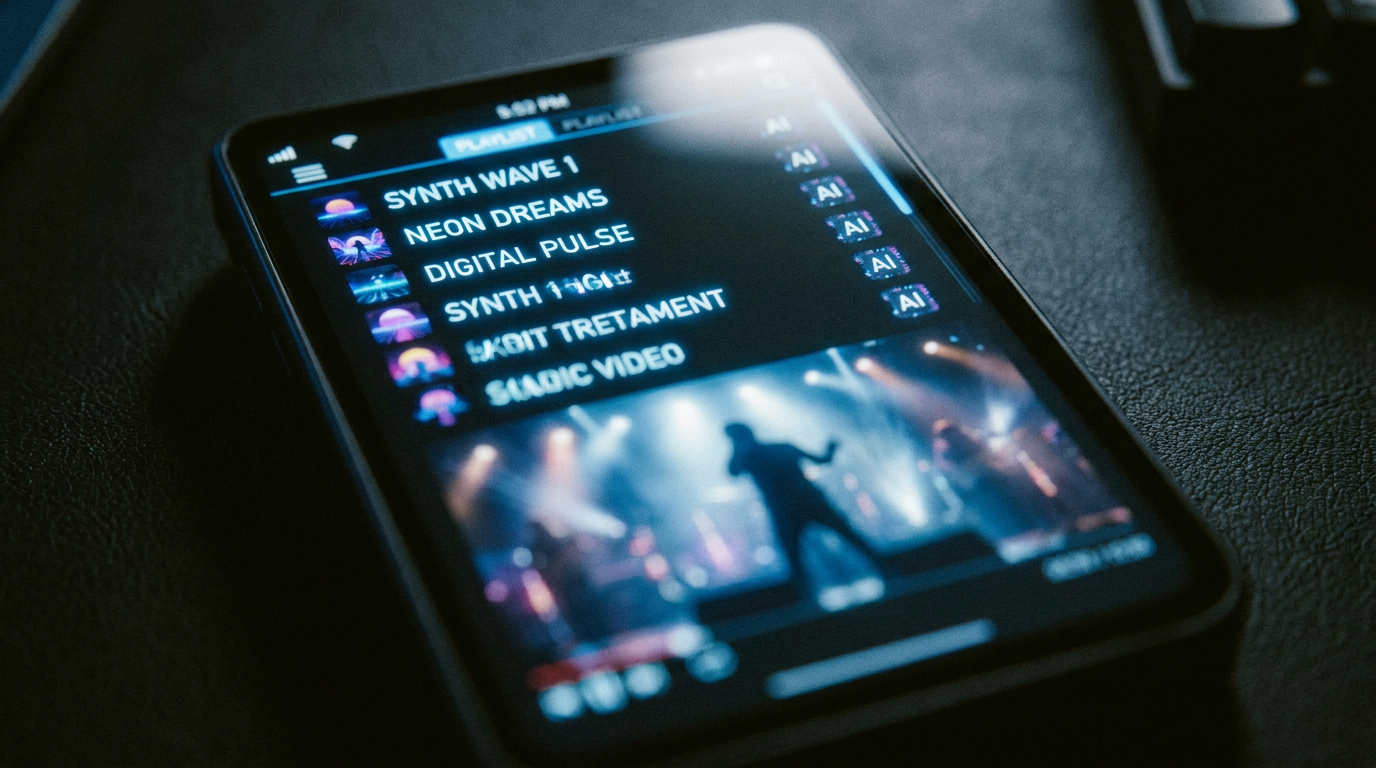
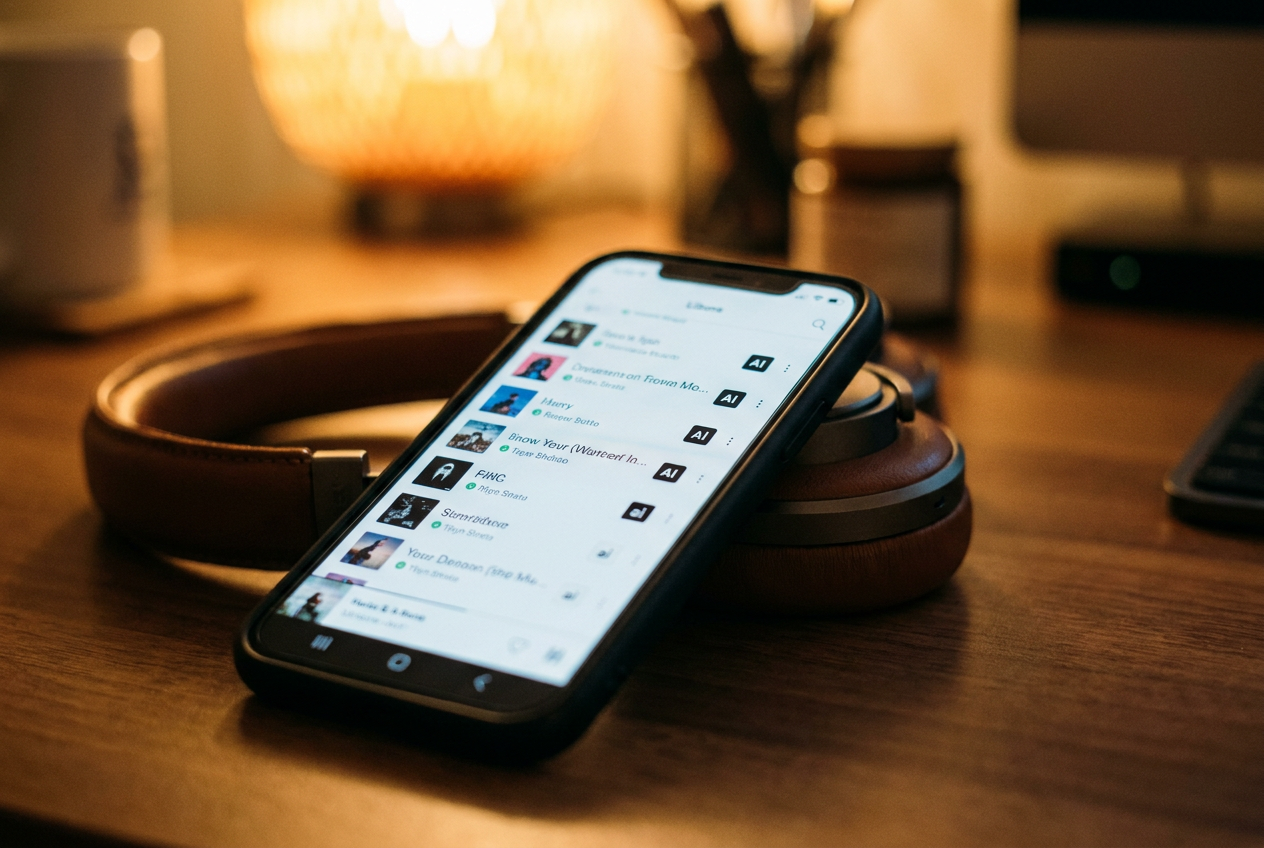
The groups proposed adding digital markers — like those denoting explicit lyrics on streaming services — to songs either entirely created or assisted by AI technology. A black block with large “AI” would signify “AI-Generated” tracks, while a white block with a smaller “ai” would be used for songs that are “AI-assisted.”
Think of it like the “E” for explicit content you already see on Spotify and Apple Music. Except instead of flagging language, it flags whether a machine sang the words.
The system draws a clear line between two categories. The “AI-Generated” label applies when generative AI was used to generate the entirety or the primary portion of the creative elements of the recording, including entirely prompt-generated AI music.
The “AI-Assisted” label applies when the recording was created substantially by humans and expresses human creativity, but generative AI was used for some expressive elements, and humans performed the lead vocal and primary instruments.
The coalition behind this is massive. Among the groups backing the labeling are the Recording Industry Association of America, IFPI, the Grammys, SAG-AFTRA and the Human Artistry Campaign. When you get organizations that normally can’t agree on what day it is to sign the same press release, something significant is happening.
Why Now? The Numbers Are Terrifying
The timing isn’t random. The music industry is drowning in AI content, and the data has become impossible to ignore.
Deezer announced that AI-generated tracks now represent 44% of all new music uploaded to its platform, with the company receiving almost 75,000 AI-generated tracks per day and more than two million per month.
Earlier this year, an Apple Music executive told Billboard that more than one-third of new uploads were entirely created with AI.
Here’s the part that should make every real musician breathe a sigh of relief: the consumption of AI-generated music on the platform is still very low, at 1-3% of total streams, and 85% of these streams are detected as fraudulent and demonetized by the company.
Nearly half the music flooding platforms is synthetic. Almost nobody is voluntarily listening to it. And most of the streams it does get are bots. That’s not a revolution — that’s spam at scale.
Deezer reported receiving around 60,000 AI tracks per day in January, up from 50,000 in November, 30,000 in September, and just 10,000 in January 2025. That’s a 650% increase in twelve months.
The industry had to do something. Labels are the “something.”
The Voluntary Problem
Here’s where the whole thing starts to wobble. AI usage is flagged voluntarily by artists, record labels and distributors.
Voluntary.
As in, the people making AI music have to choose to tell you it’s AI music. How common any sort of voluntary AI disclosure would actually be is unknown as artists have little incentive to self-report given the stigma around AI music, and those using AI for fraudulent purposes certainly aren’t looking to be transparent.
Suno’s response was diplomatically noncommittal. A Suno spokesperson said that while the company believes “transparency is important,” it thinks “it should be up to artists and platforms to decide how to treat these complex issues.”
The streaming platforms themselves were even more cagey. Spotify declined to comment on Friday.
In June, Deezer launched an “AI music detector” which it said is 99.8 percent accurate — but Deezer is the exception, not the rule.
Meanwhile, the Digital Media Association, a trade group representing streaming companies including Apple Music, Amazon and Spotify, said it was following the labeling announcement closely and looks forward to receiving more detailed and accurate AI metadata. Translation: “We’ll watch and wait.”
The EU isn’t waiting. EU AI Act Article 50 enforcement begins August 2, 2026, and requires machine-readable marking on all AI-generated video distributed to EU audiences, with penalties up to €15M or 3% of worldwide annual turnover. But that’s regulation, not a voluntary industry program.
The Music Video Loophole Is the Story
Now we arrive at the part that matters most if you’re a musician making visual content.
The RIAA coalition’s labeling system explicitly does not cover:
- Music videos
- Cover art
- Lyrics
- Composition
It only covers the sound recording itself. So if you’re using AI to generate stunning visuals for your very human music? Congratulations — you’re operating in a space the industry has consciously decided not to regulate.
This isn’t an accident. The organizations behind this initiative are choosing their battles carefully. Audio AI is the crisis — a man from North Carolina pleaded guilty to using hundreds of thousands of AI-generated songs and bot streams to collect more than eight million dollars in royalties. That’s the fire they’re trying to put out.
AI music videos? That’s an entirely different conversation. And the industry isn’t having it yet.
Why This Matters for Musicians Using AI Visuals
If you’re an independent artist creating music the human way — writing, playing, singing, producing — and then using AI to create your music video, you’re sitting in the sweet spot of 2026.
Your audio stays clean. No “AI” badge. No “ai” badge. Just human-made music with human-made credibility.
Your visuals? Created with AI tools that help you compete with artists who have ten times your budget. And the industry’s new transparency framework has nothing to say about it.
This is the fundamental asymmetry that smart musicians should be exploiting right now. The labeling system creates a hierarchy where AI in audio carries stigma, but AI in visuals remains a creative tool — the same way nobody judges a musician for using Photoshop on their album cover.
If you want to explore this approach, our Complete Guide to AI Music Videos in 2026 breaks down the entire workflow. For genre-specific approaches, check out our templates for hip-hop, pop, or indie.
The “AI-Assisted” Gray Zone
The more interesting label is actually the “AI-Assisted” one. There’s sure to be a bit of debate about what constitutes an AI-assisted recording. In the organizations’ own words, audio will fall into this category if it “was created substantially by humans and expresses human creativity; however, generative AI was used for some expressive elements.”
That’s… incredibly vague. If a producer uses AI to generate a background pad, does that trigger the label? What if they use AI to master the track? What if they use an AI plugin for vocal tuning — does that count differently than Auto-Tune?
RIAA Chairman and CEO Mitch Glazier told the WSJ that plenty of fans are happy to listen to AI music, as long as they can tell when a real person is involved. “But flexibility in the creative process also means that artists who want to use AI in the creative process should be able to do so.”
The Recording Academy’s CEO tried to thread the same needle. “As AI continues to be integrated into the creative process, artists and fans alike deserve a clear way to communicate how and when it’s being used. This initiative ensures that creativity, authorship, and artistic intent remain at the center of every song.”
These are fine sentiments. But what happens when a hit song’s producer quietly used Suno to generate the reference track that informed the entire arrangement? If Suno CEO Mikey Shulman’s “Ozempic of the music industry” comments are accurate, plenty of commercially prominent releases were actually pumped out with the assistance of gen AI. The voluntary system means we may never know.
What Smart Musicians Should Do Right Now
Regardless of where you stand on AI in music, the new labeling system changes the calculus for every independent artist. Here’s how to play it:
1. Keep Your Audio Human
This should be obvious, but it’s worth stating explicitly. If you’re a musician — someone who actually writes, performs, and records — your audio is your credential now. The labeling system creates a clear distinction between “made by humans” and “made by machines.” Stay on the right side of that line, and you don’t need to worry about badges or stigma.
2. Use AI Where the Industry Isn’t Looking
The labeling system covers sound recordings. Period. Everything visual is fair game for AI assistance without any disclosure requirements. That includes:
- Music videos
- Album artwork
- Social media content
- Lyric videos
- Promotional materials
- Live show visuals
If you’ve been hesitant about using AI for your music videos, the industry just gave you permission by omission. Learn how to make an AI music video and start experimenting.
3. Build Your Visual Brand Now
With nearly half of all uploaded music being AI-generated, discoverability is harder than ever. You know what still differentiates you? A compelling visual identity. Artists with strong music videos consistently outperform those without — and AI tools have made professional-quality video accessible to everyone.
Whether you’re making R&B, EDM, or country, there’s never been a better time to create visual content that matches your audio quality.
4. Understand the Coming Regulations
The RIAA labels are voluntary today. They won’t be forever. In the long term, there’ll presumably be an opportunity to flip the switch to “mandatory”; the labels are “designed to evolve as technology and requirements change.”
And the EU isn’t messing around. Mandatory AI labeling for content distributed to EU audiences kicks in August 2, 2026. Start building good habits now.
The Bigger Picture: Trust Is the New Currency
Step back from the labels, the badges, and the policy documents, and a clearer picture emerges. The music industry is in the middle of a trust crisis. 97% of people couldn’t hear the differences between AI and human-made music in blind tests, and 80% of people agree that 100% AI-generated music should be clearly labeled.
Listeners can’t tell the difference, but they want to know. That’s remarkable. It means the value of human-made music isn’t purely sonic — it’s emotional, cultural, and relational. People want to know a real person stood behind the song.
This is fantastic news for musicians who are, you know, actually musicians.
The labels are an attempt to restore trust by creating transparency. Whether voluntary labels can accomplish that is debatable. But the direction is clear: the industry is moving toward a world where “made by humans” is a marketing advantage, not just a description.
Your job as a musician? Make human music. Tell human stories. And use every tool available — including AI — to present that music in the most compelling visual form possible.
The Bottom Line
The RIAA’s new AI labeling program is a genuine milestone. For the first time, the world’s major music organizations have agreed on a standardized way to tell listeners whether AI made their music. It’s voluntary, it’s flawed, and it will probably take months to implement.
But the biggest takeaway? The labels cover audio. They don’t cover visuals.
That means the smartest play for independent musicians in 2026 is exactly what it’s been all year: make authentic music with your human hands, your human voice, and your human heart. Then use AI to create the visual content that gets your music seen.
The industry just drew a line between AI audio (stigmatized) and AI visuals (ignored). Musicians who understand that distinction — and act on it — will have a massive advantage.
Ready to start creating visuals that match the quality of your music? OneMoreShot.ai lets you turn your finished tracks into stunning, professional music videos in minutes — no film crew, no five-figure budget, no AI badge required. Your music is human. Your video just got a serious upgrade.