Spotify's AI Chatbot Changes How Fans Find You
Four days ago, Spotify quietly dropped a feature that could reshape how 293 million paying subscribers discover your music. And most musicians completely missed it.
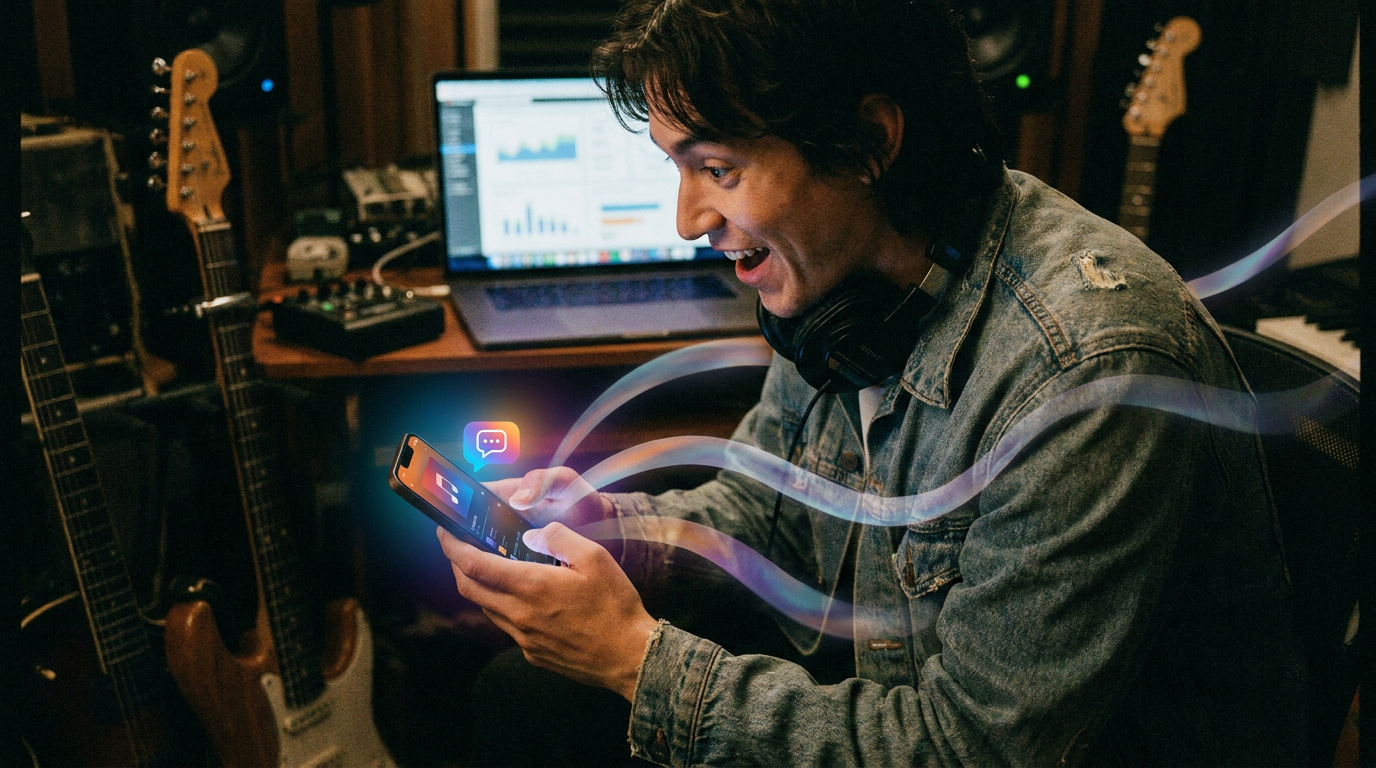
“Talk to Spotify” essentially puts a ChatGPT-style chatbot right inside the Spotify app. The company announced on July 14, 2026, that Premium subscribers can now talk to Spotify the same way they’d talk to ChatGPT or Gemini — except this one already knows what they’ve been listening to for years.
That last part is the game-changer. This isn’t some generic recommendation engine. Spotify’s version cross-references your playlists, favorite artists, repeat listens, skips, and years of listening patterns.
When a listener says “play something I’d like,” it’s drawing on what the company calls roughly 3.4 trillion daily taste signals.
If you’re a musician who wants fans to find you in 2026, you need to understand what just changed — and what to do about it.
How “Talk to Spotify” Actually Works
The feature puts a text-and-voice input field on two of the app’s most-used screens: Home and Now Playing. You type or speak a request, and Spotify responds with actions or answers — then you can follow up, just like a real conversation.
That means you can say something like “play some artists I haven’t heard before,” then refine with “make it more upbeat” or “add some Bad Bunny, just his recent stuff.” You can also tell it to save songs, queue tracks, and follow artists — all without leaving the chat.
Spotify confirmed to TechCrunch that it uses a mix of its own AI technology and models from multiple external providers, based on whatever is best for the task. In other words, this isn’t a half-baked experiment. It’s a full conversational AI layer sitting on top of the most data-rich music platform on earth.
The feature launched in beta on July 14, 2026, for iOS and Android users in the United States, Ireland, and Sweden, with support limited to English for now. But if you think this stays in three countries, I have a bridge to sell you. With 761 million monthly active users and 293 million Premium subscribers as of Q1 2026 , Spotify is building this for everyone.

Why This Is Bigger Than Discover Weekly
Here’s what most people are missing. For the last decade, music discovery on Spotify has been fundamentally passive. You open the app, the algorithm serves you Discover Weekly, Release Radar, Daily Mixes — and you either listen or you don’t. Your job as a musician was to optimize for that system: get playlist placements, trigger saves, pray for algorithmic love.
“Talk to Spotify” flips that model. It replaces passive algorithmic music discovery with an interactive, prompt-based listening experience.
Think about what that means. Instead of scrolling through playlists, a listener now says: “Find me something that sounds like early Radiohead but with electronic production.” Or “Play some angry female rock from the last two years.” Or “I want lo-fi beats for studying but with jazz piano.”
“Talk to Spotify” turns discovery into a highly specific, personalized dialogue that could level the playing field for niche artists.
If a listener asks the AI to “Play a rainy Sunday morning playlist” or “Introduce me to the biggest indie artists in Australia right now,” the AI isn’t just relying on mainstream chart data; it is scraping metadata, contextual tags, and audio profiles.
This is a fundamental shift. The algorithm used to decide what you heard. Now the listener decides — in their own words — and the AI has to find music that matches. That creates completely new pathways for discovery that didn’t exist before.
What This Means for Musicians (It’s Not All Roses)
Let’s get practical. If you’re an independent artist, “Talk to Spotify” creates both enormous opportunities and serious risks.
The Opportunity
Discovery is becoming increasingly conversational, with listeners describing moods, genres, and styles instead of searching for exact song titles. That could create more opportunities for emerging artists whose music closely matches what listeners are asking for.
If your metadata is tight, your genre tags are accurate, and your music genuinely sounds like what a listener describes, you could get surfaced by the AI chatbot even if you have zero playlist placements. That’s wild. A bedroom producer with 500 monthly listeners could theoretically get recommended alongside major-label artists because a listener asked for exactly what they make.
The Risk
If the Talk to Spotify AI assistant doesn’t know your backstory, your specific genre niche, or your lyrical themes, it simply won’t recommend you when a listener asks for it.
That’s the brutal flip side. In a world where listeners are describing what they want in natural language, the AI needs to understand what your music actually is — not just the audio fingerprint, but the story, the mood, the context. If your metadata is lazy (“pop” when you’re really “dark synth-pop”), you’re invisible.
How to Get Recommended by Spotify’s AI
For music marketers, leaning into metadata optimization, deep storytelling, and off-platform SEO are about to become as important as landing on an official editorial playlist.
Here’s your action plan:
1. Fix Your Metadata — Yesterday
This is no longer optional. Your genre tags, mood descriptors, lyrical themes, and artist bio need to be specific and accurate. Don’t tag yourself as “alternative” when you’re making “shoegaze-influenced dream pop with electronic elements.” The more precisely the AI can categorize you, the more likely you’ll surface for specific listener queries.
Check your Spotify for Artists profile. Make sure your bio includes the kinds of words a listener might actually say out loud when describing your music.
2. Build Your Narrative Off-Platform
The AI doesn’t just use Spotify’s internal data. Spotify says the app will be able to chat with users about their listening history and can help them learn more about their favorite music.
That means you could get into questions like what inspired a certain song, or dates of album releases, or even get suggestions of other artists you might like.
Where does the AI get all that contextual information? From everywhere. Your press coverage, your website, your social media, your YouTube descriptions. If no one has written about your music’s story, the AI has nothing to reference.
3. Invest in Visual Content
Here’s where music videos become critical. When a listener discovers you through “Talk to Spotify,” the next thing they do is Google you, check your YouTube, look at your socials. If they find nothing — no music video, no visual identity, no content — they bounce.
A great music video is no longer just a promotional tool. It’s your credibility check. It’s what converts a casual Spotify listener into an actual fan. And with AI tools making video creation accessible to every budget level, there’s no excuse not to have visuals for your key tracks.
Whether you’re making AI music videos for indie artists or exploring templates for hip-hop, pop, or lo-fi, the barrier to entry has collapsed. The question isn’t “can I afford a music video?” anymore — it’s “can I afford not to have one?“
4. Teach Your Fans to Prompt You
This sounds weird, but it’s real. To survive the shift to conversational AI music discovery, optimize your metadata, feed the large language models with consistent PR, and actively teach your fans how to prompt your music.
Tell your audience: “Ask Spotify to play music like [your name].” Put it in your Instagram bio. Say it at shows. Include it in your email newsletters. The more listeners mention you by name to the AI, the more Spotify’s models learn about your contextual relevance.
The Streaming Wars Just Became an AI Race
Apple Music’s Playlist Playground beta already lets users build playlists through chat. Amazon Music’s Maestro does prompt-based playlist generation. YouTube Music has Google’s entire Gemini infrastructure behind it.
And speaking of Google, on Thursday, the tech giant announced an update to Google Vids that will allow you to create a custom digital avatar that looks and sounds like you based on a selfie and a voice recording you upload, alongside bringing Gemini Omni to Vids for video creation.
Every major platform is racing to put AI between the listener and the music. The next streaming battle is not only about content rights. It is about who controls the conversation around what people play next.
This means musicians now need to think about discoverability across AI interfaces, not just playlist placement. Your music needs to be understandable to language models. Your metadata needs to be conversational. Your story needs to be searchable, quotable, and AI-parseable.
That’s a mouthful, I know. But it’s the reality of 2026.
The Suno Connection: Why Trust Matters More Than Ever
The timing of Spotify’s AI launch is interesting given what else dropped this week. Hacked source code from AI music company Suno lists YouTube Music, Deezer, and Genius among the platforms it scraped to build its AI models, according to a report from 404 Media.
The leaked files listed 2,013,545 clips from YouTube Music running to 113,879 hours, 12,287 hours from Deezer, 17,615 hours from Genius, 62,117 hours from Pond5, and around a million hours of audio pulled from roughly 420,000 podcasts.
This isn’t just a Suno story. It’s a trust story. AI music is not dead, but the free-for-all era is ending. When Spotify puts AI at the center of music discovery while the AI music generators are being exposed for mass scraping, the message to musicians is clear: the platforms that curate AI-powered experiences are gaining power, while the platforms that generate AI music are facing accountability.
For independent artists, this split is actually good news. Spotify’s AI chatbot is designed to help listeners find your music — not to replace it with AI-generated tracks. Deezer, which said that 44% of all new music uploaded to its platform daily is AI-generated , is actively fighting back against AI flooding. Spotify is building tools that reward real artists with better discovery.
The key is making sure you’re positioned to benefit.
Your 2026 Visibility Checklist
Here’s what to do this weekend:
-
Audit your Spotify for Artists profile. Is your bio detailed and specific? Does it describe your sound in the kind of language a fan would use?
-
Review your metadata. Ensure genre, mood, and theme tags are accurate across all distributors. Vague tags are death in a conversational AI world.
-
Create or update your music videos. Our complete guide to AI music videos breaks down the full process, or check out how to make an AI music video for a step-by-step walkthrough.
-
Write your story. Press releases, artist bios, blog posts, social media content — all of it feeds the AI knowledge base. If the AI can’t find information about your music’s inspiration, themes, and context, it can’t recommend you intelligently.
-
Build genre-specific visual content. Whether you’re making R&B music videos, rock, or Latin, matching your visual brand to your audio identity helps both human fans and AI systems understand who you are.
-
Tell fans to talk to Spotify about you. Seriously. The AI learns from what listeners request.
The Bottom Line
Spotify just turned every listener into their own A&R rep. Instead of passively accepting algorithmic suggestions, 293 million subscribers can now tell Spotify exactly what they want to hear — in their own words, in real time, with follow-up refinements.
For musicians who’ve done the work — who have great music, accurate metadata, visual content, and a clear story — this is potentially the biggest discovery opportunity since the algorithm-driven playlist era began. For those who haven’t? The AI chatbot won’t find you, and neither will the listeners using it.
The good news is that getting visible doesn’t require a label budget anymore. It requires intention, consistency, and the right tools. Start by making sure your music has the visual backbone it needs. Head to OneMoreShot.ai and create a music video that matches your sound — because when Spotify’s AI finally sends a listener your way, you want to make sure they stick around.