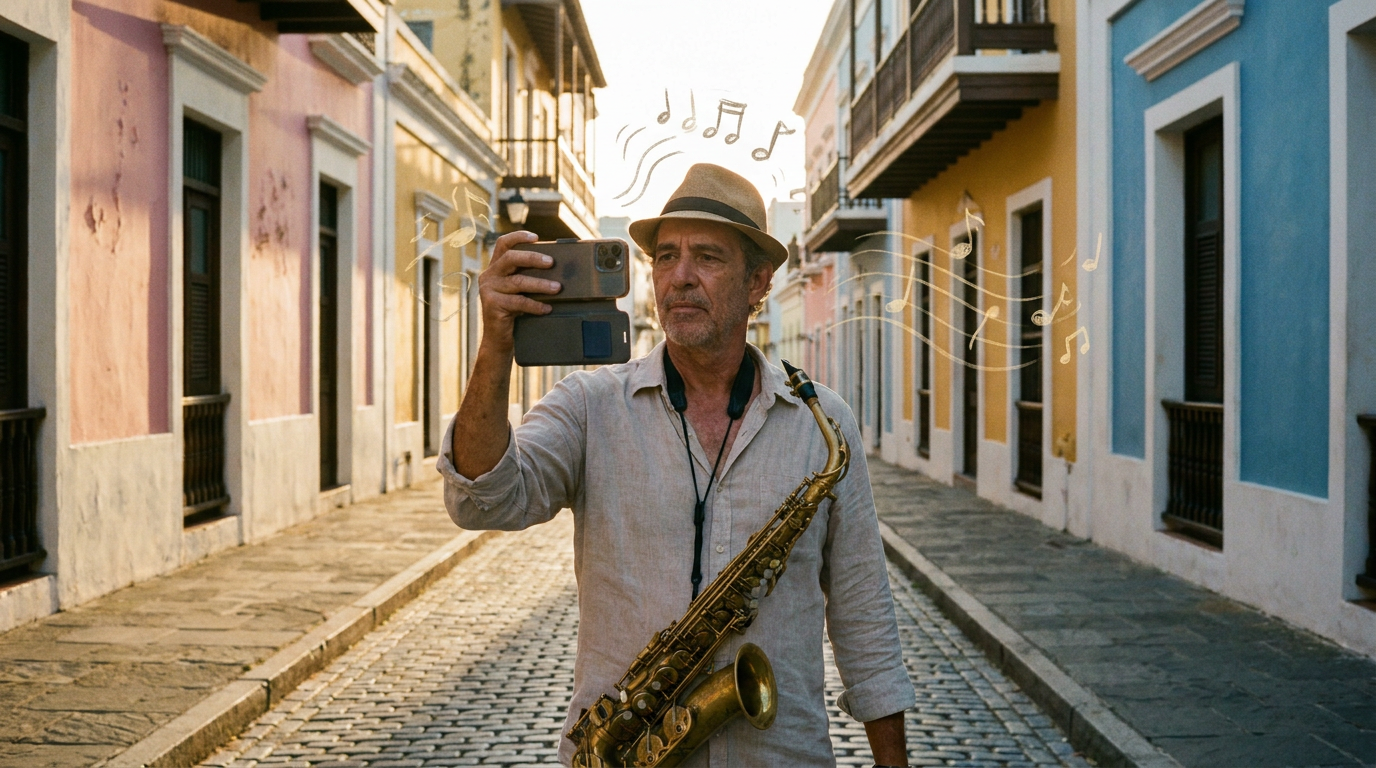
An AI Song Just Landed a Tourism Deal
A Pittsburgh comedian made a Suno song about his trip to Puerto Rico. Three months later, he has 6.5 million Spotify streams, a top-10 iTunes hit, celebrity fans, and an official music video deal with the island’s tourism board.
This is not a cautionary tale. This is a blueprint.
From TikTok Gag to Tourism Campaign
An AI-generated song about Puerto Rico went viral across TikTok, and the man behind the tune — Bill Stiteler of Pittsburgh, Pennsylvania — shared it in a TikTok post in April. His handle is @saxboybilly18, and before this, he was mostly known for making goofy travel content following the Pittsburgh Pirates on the road.
He says the very first city for which he created a song was Altoona, Pennsylvania. That’s when he discovered Suno. “It’s kind of like an auto tuner for lyrics and your voice — you can sing into it, and it can auto tune it into using AI to make music,” he said.
The formula was simple. Visit a city. Walk around. Talk to locals. Write lyrics about what he saw. Sing them into Suno. Post a TikTok with travel footage underneath. Move on to the next city.
He’s done this for dozens of places — destinations like Tempe, Columbus, Niagara Falls, Key West, Rochester, Sheffield, and Sunnyside Queens barely scratch the surface of his content.
Then Puerto Rico happened.
The song racked up over 5.2 million views on TikTok, with more than 116,000 users posting videos using the original audio. On Spotify, it has nearly 6.5 million streams, and it even broke into the top 10 on iTunes.
Let that sink in. A comedian with no music career, using an AI tool that major labels are actively suing, landed a top-10 iTunes position. In 2026.
Why This Song Worked
The song uses a pentatonic scale, a fundamental part of music theory that’s helped produce some of the biggest pop hits since recorded music began. One commenter said it “sounds like all those great 80s sitcom theme songs,” which of course it does, because it’s at a 110 bpm tempo, uses a I-IV-V-VI chord progression, and has perfect pitch.
In other words, Suno did exactly what it was designed to do: it took human-written lyrics and wrapped them in the most accessible, earworm-friendly production possible. That’s not a bug — it’s the feature.
But the real reason “The Puerto Rico Song” broke through has nothing to do with chord progressions. It has everything to do with video.
There is a very human reason it works: people like songs that give them a script. The Puerto Rico Song is not just something to listen to — it is something to perform.
Stiteler’s original TikTok wasn’t just audio. It was travel footage — beautiful shots of San Juan, mundane moments on the bus, a Barack Obama statue spotting. The song gave viewers a reason to stop scrolling. The video gave them a reason to share it. And the combination gave celebrities a reason to hop on the trend.
As Stiteler put it: “I’m waking up, I got [the band] O-Town doing dances to it, like, this is incredible.”
The song became a social media phenomenon, with everyone from influencers to celebrities posting lip-sync videos, with arguably the biggest moment being when Luke Combs belted out his own rendition.

The Tourism Deal That Changed Everything
Here’s where the story goes from interesting to instructive.
What started as a humorous, AI-generated song has grown into a full-scale celebration of Puerto Rico. Stiteler went viral in May 2026. The song reached 5.2 million views on TikTok and caught the attention of celebrities like Gal Gadot, Luke Combs, and Charlie Puth. Now, in partnership with Discover Puerto Rico, Stiteler is transforming the phenomenon into an official music video filmed across the island to showcase its communities, culture, cuisine, music, and landscapes.
Read that again. A government tourism organization partnered with an AI-song creator for a professional music video campaign. The collaboration also includes a sing-along version featuring a playful coquí guide, giving audiences a new way to engage with the song while discovering more about Puerto Rico beyond its most familiar destinations.
This is the “Despacito effect” on fast-forward. When Luis Fonsi and Daddy Yankee’s “Despacito” blew up in 2017, Hotels.com reported that searches for the Caribbean island jumped more than 45 percent after the song launched. It took a global megastar and a Justin Bieber feature to make that happen.
In 2026, it took a comedian, Suno, and a phone.
The Transparency Play
One of the most fascinating parts of this story is how Stiteler handled the AI question. He didn’t hide it. He didn’t deflect. He leaned in.
He includes the “sunomusic” hashtag and the Suno account tag in his captions.
His philosophy around making and sharing AI-generated tunes is pretty simple: “Don’t lie about it. The truth will set you free.”
Initially, Stiteler didn’t want to put any of his Suno-generated songs on streaming platforms “against the actual musicians” because he didn’t see his content as real music, but after pressure from fans and industry insiders who saw both financial benefit and audience appeal, he eventually changed his mind.
This is the part that matters for every musician reading this right now. Stiteler isn’t claiming to be a musician. He’s a content creator who used an AI music tool to enhance his travel content — and the result was a legitimate cultural moment. The transparency didn’t kill the vibe. It made the story more interesting.
If you’re an actual musician — someone who writes, performs, and produces — you already have a massive advantage over what Stiteler did. You have real talent backing you up. The question is whether you’re pairing that talent with a visual strategy that matches.
What Musicians Should Steal From This Playbook
Let’s break down what Stiteler actually did, because the strategy is replicable even if the virality isn’t guaranteed.
1. He Started With Lyrics, Not Production
He came up with the lyrics while traveling, which for him includes talking to locals, testing out public transit and visiting local landmarks. Then, he jotted them down and sang them into Suno, which produced the track.
The creative spark was human. The production was AI-assisted. This is the model that works in 2026 — and it’s the model that holds up legally.
Entertainment lawyer Don Franzen explains that under United States copyright law, “Only a human can be an author, and only humans can own copyrights.” So when a song is entirely AI-generated, it can’t be protected by copyright. But songs like “The Puerto Rico Song,” in which Stiteler says he came up with the lyrics and went through multiple iterations, create a hybrid that falls into a gray area.
For real musicians, this gray area barely even applies. If you’re writing your own songs and using AI tools to enhance production or create visuals, you’re firmly on the human-authored side of the line. For a deep dive on the legal landscape, see our coverage of The Complete Guide to AI Music Videos in 2026.
2. He Made It Visual From Day One
This is the insight most musicians miss. Stiteler never released “The Puerto Rico Song” as just audio. From the first second, it was a TikTok video — travel footage, personality, and visual storytelling baked in.
That visual-first approach is exactly why it went viral. TikTok’s algorithm doesn’t surface audio in isolation. It surfaces videos that people watch, rewatch, and recreate. The song was the hook. The video was the vehicle.
If you’re releasing music in 2026 without a visual component, you’re handicapping yourself. Every track needs video — whether that’s a full music video, social clips, visualizers, or teasers. Tools like OneMoreShot.ai exist precisely for this reason: to turn your finished tracks into visual content without needing a production crew.
Check out our guides for genre-specific approaches: AI Music Videos for Pop, AI Music Videos for Latin, or AI Music Videos for Indie — whichever fits your sound.
3. He Iterated Fast
For “The Puerto Rico Song,” it took about three iterations to land on a version he was happy with.
Three tries. Not three months of studio time. Not three rounds of mixing notes. Three iterations on Suno.
This speed advantage is real whether you’re using AI for music generation or AI for video creation. The artists winning in 2026 aren’t the ones with the biggest budgets — they’re the ones who can test, iterate, and ship creative work faster than anyone else. Our guide on How to Make an AI Music Video walks through this exact workflow.
4. He Gave People Something to Perform
TikTok virality is about one loopable moment — a chorus drop, a beat switch, one shouted lyric. Songs engineered (or edited) around one perfect clip out-trend objectively bigger tracks.
Stiteler’s song was built for participation. The lyrics are simple, the melody is infectious, and the concept — “I went to Puerto Rico and here’s what happened” — is universally shareable. Over 116,000 users made their own videos with the audio.
For musicians, the lesson is clear: make your music video content participatory. Give fans a visual template they can riff on. Whether that’s a dance, a reaction format, or a visual concept they can recreate, the content that spreads is the content people can join.

The Bigger Picture: AI Songs Need Visual Strategies
The Puerto Rico Song is not the first AI-generated track to chart. We’ve covered the first AI song to chart on TikTok and the broader trend of AI music flooding streaming platforms. But this story is different because it shows the full pipeline from creation to commerce.
Here’s the trajectory:
- Human writes lyrics inspired by a real experience
- AI generates music from those lyrics (Suno)
- Creator pairs it with video (travel footage on TikTok)
- Platform algorithm surfaces it (5.2M views)
- Celebrities amplify it (Luke Combs, Gal Gadot, Charlie Puth)
- Streaming traction follows (6.5M Spotify streams, iTunes top 10)
- Commercial partnership materializes (Discover Puerto Rico tourism deal)
- Professional music video gets produced (filmed on location across the island)
Every single musician reading this can execute steps 1 through 4. You don’t need Luke Combs to repost your song to build a career — you need a consistent visual strategy that gives the algorithm something to work with.
The Debate That Won’t Go Away
Not everyone is celebrating. As the song racks up millions of views and streams, it’s also fueling a growing debate: what does it mean to be an artist in the age of AI, and what counts as art? And who gets credit and ownership when a song goes viral?
AI tools like Suno have raised major questions about copyright, training data, and compensation for artists. Suno has been at the center of legal debate, with Warner Music Group announcing a partnership and settlement in November 2025, while other major-label disputes remain part of a larger industry conversation.
The music industry’s legal battles with AI platforms are far from over. Universal Music Group settled with Udio in October 2025, but UMG and Sony are still litigating against Suno in Massachusetts. Sony is the last major still in court against Udio in the Southern District of New York.
But here’s the uncomfortable truth that Stiteler’s story reveals: audiences don’t care about these debates the way the industry does. Over five million people watched a TikTok, heard a catchy song, and hit share. They didn’t check the liner notes first.
That’s not a defense of AI music replacing human artists. It’s a recognition that the battle for attention is won with visual content and emotional resonance — and musicians who understand that will outperform those who don’t, regardless of what tools they use.
Your Move
The Puerto Rico Song went from phone lyrics to tourism partnership in about three months. The creator wasn’t a musician. He didn’t have a label, a manager, or a video production budget. He had lyrics, a Suno subscription, travel footage, and TikTok.
If you’re an actual musician with real songs, real talent, and a real story to tell, you have everything Saxboy Billy had — plus the authenticity that audiences increasingly crave in a world of AI noise.
What you might be missing is the visual layer. The video content that turns a streaming link into a shareable moment. The clips that feed the algorithm. The music videos that give your tracks a life beyond the playlist.
That’s what we built OneMoreShot.ai to solve. Upload your track, get a music video in minutes, and start giving your music the visual strategy it deserves. Because if a comedian with a Suno account can land a tourism deal, imagine what a real artist with real music can do.