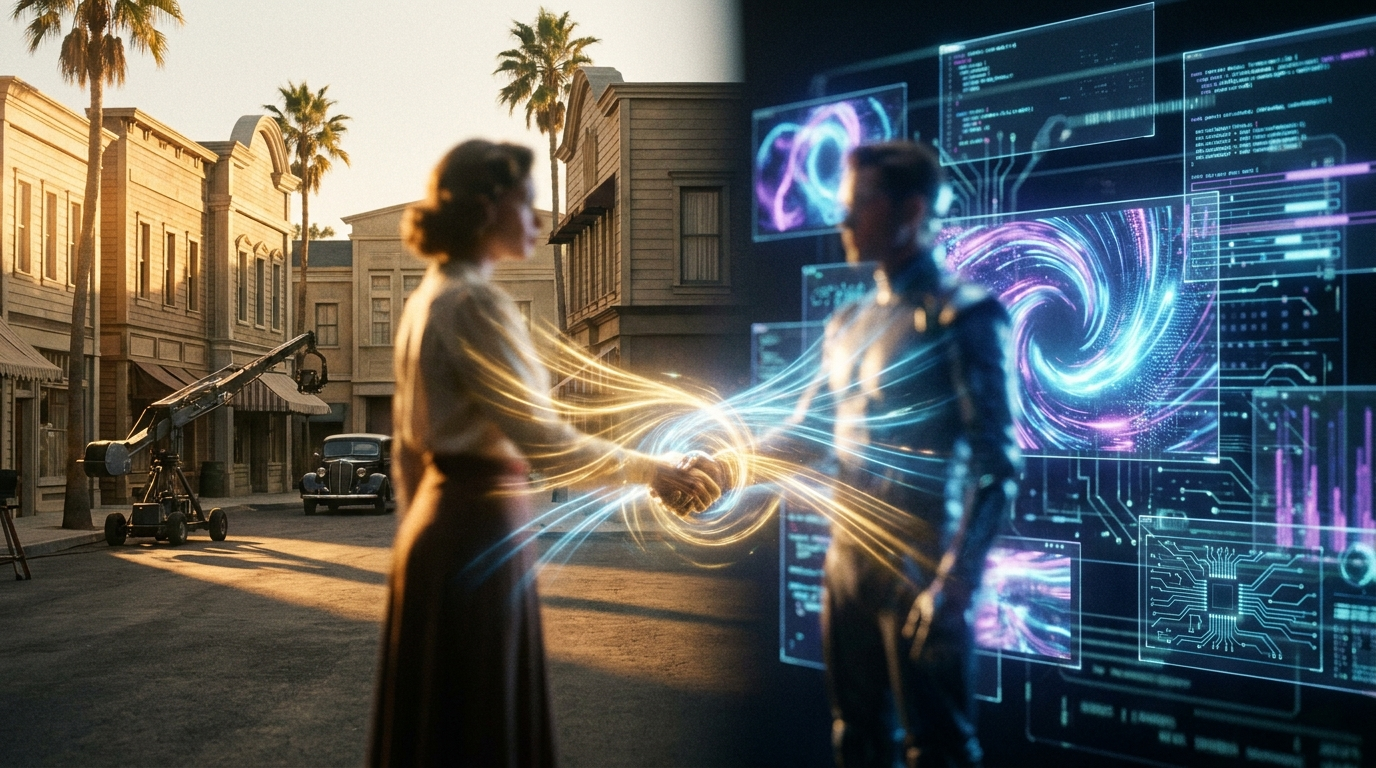
Hollywood Just Made a Deal That Reshapes AI Video
Yesterday, the Motion Picture Association and ByteDance signed a deal that will change how every AI video tool works — including the ones you use for music videos.
On August 17, 2026, the Motion Picture Association (MPA) and ByteDance revealed a global collaboration to enhance intellectual property protections for artificial intelligence technologies that generate video and images. The memorandum of understanding covers every AI tool ByteDance operates: the memorandum applies to all AI models from ByteDance, including those used on TikTok, TikTok USDS Joint Venture, CapCut and Dreamina.
That’s not a minor compliance update. That’s Hollywood writing the rulebook for the world’s most-used AI video platform — and every musician who makes content on TikTok or CapCut needs to pay attention.
From Cease-and-Desist to Handshake in Six Months
To understand why this matters, rewind to February 2026. ByteDance dropped Seedance 2.0, and within hours, the internet was drowning in AI-generated clips of Tom Cruise fighting Brad Pitt, Disney characters doing inappropriate things, and pretty much every IP violation you could imagine.
The MPA’s response was swift: “In a single day, the Chinese AI service Seedance 2.0 has engaged in unauthorized use of U.S. copyrighted works on a massive scale,” said MPA chairman Charles Rivkin. “By launching a service that operates without meaningful safeguards against infringement, ByteDance is disregarding well-established copyright law that protects the rights of creators and underpins millions of American jobs.”
SAG-AFTRA condemned what it called “blatant infringement” that includes “the unauthorized use of our members’ voices and likenesses.”
Shortly after, ByteDance responded by pledging it would strengthen its safeguards around unauthorized use of intellectual property and likeness, even later reportedly suspending Seedance 2.0’s global rollout.
Then something unusual happened. Instead of spending years in court — the route the music industry has chosen with Suno and Udio — Hollywood sat down and negotiated. This agreement represents a shift toward proactive collaboration between Hollywood studios and AI developers before products reach mass market.
The result? ByteDance responded to the backlash by adding watermarking, content credentials, and face-blocking to Seedance and Seedream in subsequent releases. ByteDance added features such as visible C2PA watermarks, embedded content credentials, an “advanced invisible watermarking” mechanism and filters to block generation from real faces and copyrighted characters.
And then they shipped Seedance 2.5 — the upgraded model — with these protections baked in from the start.
What the Deal Actually Says (and Doesn’t)
Here’s where it gets interesting for musicians. Neither the MPA nor ByteDance published a detailed public protocol listing technical controls, thresholds or enforcement procedures in the announcements, and outlets note specific technical details were not readily shared.
That’s a big asterisk. We have a headline-grabbing deal and public statements about “strong guardrails,” but no public documentation of exactly what’s blocked, what’s permitted, and how enforcement works.
What we do know is this: the MPA has secured an intellectual property protection agreement with ByteDance, addressing concerns that emerged after AI-generated deepfakes of major Hollywood stars went viral earlier this year. The memorandum of understanding establishes what the MPA calls “strong guardrails” across ByteDance’s AI video generation tools and consumer platforms.
MPA Chairman Charles Rivkin framed it as foundational: “Today’s agreement illustrates our belief that copyright is a cornerstone of the film and television industry – and reinforces our commitment to protect creative content.”
And from ByteDance’s side, general counsel John Rogovin stated: “ByteDance respects the intellectual property rights that underpin creative industries around the world, and we believe responsible innovation in AI goes hand in hand with meaningful protections for rightsholders.”

Why This Should Terrify the Music Industry
Here’s the uncomfortable question nobody in the music business seems to be asking: Why did Hollywood get a deal in six months while the music industry is still stuck in court after two years?
The RIAA filed against Suno and Udio in mid-2024. Not only have there been no new 2026 settlements — the legal situation has intensified.
Two class-action indie suits against Suno and Udio got real firepower in June when Hagens Berman, the firm that extracted $260 billion from Big Tobacco, joined the plaintiffs’ team.
Meanwhile, the MPA went from a cease-and-desist letter to a signed framework with actual technical safeguards in the product — watermarking, face-blocking, content credentials — in roughly six months. The film industry chose speed and pragmatism. The music industry chose litigation.
Neither approach is wrong, necessarily. But one has produced a framework that’s already changing how the tools work. The other is still waiting for courtrooms to catch up.
And here’s the kicker: that episode mirrors challenges OpenAI faced with Sora, its own video generation model. After Sora launched with numerous unauthorized videos featuring recognizable characters and public figures, OpenAI ultimately discontinued the product earlier in 2026 following pressure to address intellectual property violations. Unlike OpenAI, ByteDance is maintaining its investment in Seedance.
Sora is dead. OpenAI shut down Sora because it was financially unsustainable: it cost roughly $1 million per day to operate but generated only about $2.1 million in total revenue, while active users fell sharply. ByteDance’s willingness to work with Hollywood means Seedance survives. The tools that cooperate with rights holders live. The tools that don’t, die.
Musicians should be paying very close attention to that pattern.
What This Means for AI Music Videos
If you’re a musician making AI-generated content — and you should be — this deal matters in three specific ways.
1. The Tools Are Getting Safer
Seedance 2.5 is one of the most powerful AI video models available right now. It’s ByteDance’s flagship video model released on July 31, 2026: one generation can produce 4K 30-second clips, accept up to 50 reference inputs, and extend through multiple rounds up to 180 seconds.
Within 30 seconds, the model can organize multiple logically connected shots so that a story unfolds through setup, development, turning points, and resolution. For example, in a one-take clip of a singer’s stage performance, the model portrays the full story of the singer interacting with staff in the dressing room, then walking through the backstage corridor, meeting the dancers, and stepping onto the stage with them for the performance.
That’s a legitimate music video workflow. And now it comes with built-in IP protections that make the output safer to distribute. If you’ve been hesitant about using AI video tools because of copyright concerns, this is exactly the kind of framework that should give you more confidence. Check out our complete guide to AI music videos in 2026 for a full breakdown of how to use these tools responsibly.
2. AI Video Is Now Mainstream Production — Not Experimental
This isn’t just about one deal. The broader context is staggering. Netflix has confirmed that generative AI workflows were used in approximately 300 titles in 2026, primarily during post-production.
Co-CEO Ted Sarandos said The American Experiment contains 17 minutes of “AI-enhanced footage,” produced twice as fast and at half the cost of other available methods.
If Netflix is using AI video at that scale for film and television, musicians using AI for music videos aren’t early adopters anymore. They’re just keeping up. Whether you’re making AI music videos for pop, hip-hop, or indie, the stigma is rapidly dissolving when even Hollywood’s biggest streamer is doing it at industrial scale.
3. The “Cooperation vs. Litigation” Template Is Set
The MPA deal creates a clear playbook: work with AI companies to build protections into the product, rather than trying to shut them down after the fact. For independent musicians, this matters because it signals where the industry is heading.
AI video tools that play nice with rights holders will get better, get more widely available, and get safer to use. The ones that don’t will face the same fate as Sora.
When you’re choosing tools for your next AI music video, look for the ones that are building these frameworks. C2PA watermarks, content credentials, and likeness protections aren’t just legal compliance — they’re signals that a platform plans to be around next year.
Where Music’s Rights Holders Should Look Next
The MPA represents Disney, Paramount, Warner Bros. Discovery, Netflix, and the rest of Hollywood’s heavyweights. The MPA, whose members include Disney, Paramount and Warner Bros. Discovery, said that “this agreement represents significant cooperation between the two organizations.”
Now ask yourself: where’s the RIAA equivalent of this deal? Where’s the music industry’s memorandum of understanding with ByteDance, or Google, or any AI video company?
It doesn’t exist. The music industry has been so focused on the audio side — suing Suno, suing Udio, filing against Anthropic — that it has largely ignored the video side of the equation. And yet, AI video is where musicians are actually using AI the most right now.
That gap is an opportunity. If you’re a musician using AI video tools to create content for R&B, country, K-pop, or any other genre, you’re operating in a space where the rules are being written in real time. The MPA just wrote a chapter. The music industry hasn’t even opened the book.
The Bigger Picture: Cooperation Is Winning
Zoom out and a clear pattern emerges in 2026. The entities that chose to work with AI companies are getting results:
- Hollywood (MPA) signed a deal with ByteDance, got IP protections built into Seedance and every ByteDance platform, and the tools are better for it.
- BMG struck a licensing deal with Suno, positioning itself to benefit from AI music rather than just fight it.
- South Korea’s KOMCA reversed its AI ban and created a national framework for AI-assisted copyright.
The entities that chose pure litigation are still waiting:
- RIAA vs. Suno — still in court, no resolution.
- Sony’s $4.5B Udio lawsuit — still in court, no resolution.
- GEMA vs. Suno — got a ruling, but enforcement is uncertain.
Litigation has its place. The GEMA ruling established an important precedent. But litigation alone doesn’t build the guardrails that protect creators right now, today, while the tools are being used by millions of people.
The MPA understood that. And they got a signed deal before most music executives even realized ByteDance’s AI video tools were relevant to their industry.
What You Should Do Right Now
If you’re a musician, here’s how to think about this:
Use AI video tools with confidence, but choose wisely. The tools backed by IP frameworks — like the ones now governing Seedance on CapCut and TikTok — are safer bets than unregulated alternatives. If you’re new to AI music videos, start with our step-by-step guide and explore AI music video templates for your genre.
Add watermarks and content credentials to your own AI-generated content. The EU AI Act already requires labeling. The MPA deal normalizes it further. If you get ahead of this, you look professional. If you get caught behind it, you look shady.
Watch for the music industry’s next move. If Hollywood can get a deal done in six months, the music industry can too — once it decides to try. When that happens, the rules around AI video for music will shift fast.
Make your music videos now, while the tools are powerful and the competition is still figuring it out. AI video generation in 2026 is better than it has ever been. Seedance 2.5 can generate 30-second, 4K, multi-shot music video clips in one pass. Other tools are catching up fast. The window where AI music videos are a differentiator — not a baseline expectation — is closing.
The Bottom Line
Hollywood just showed the music industry how to handle AI: sit down, negotiate, get protections built into the product, and move on. Whether the music business follows that lead — or spends another two years in court — will determine who actually benefits from the most powerful creative tools ever built.
For musicians, the answer is simpler. The tools exist. The frameworks are forming. The only question is whether you’ll use them.
Start creating your AI music video today at OneMoreShot.ai — and put yourself on the right side of where this is all heading.