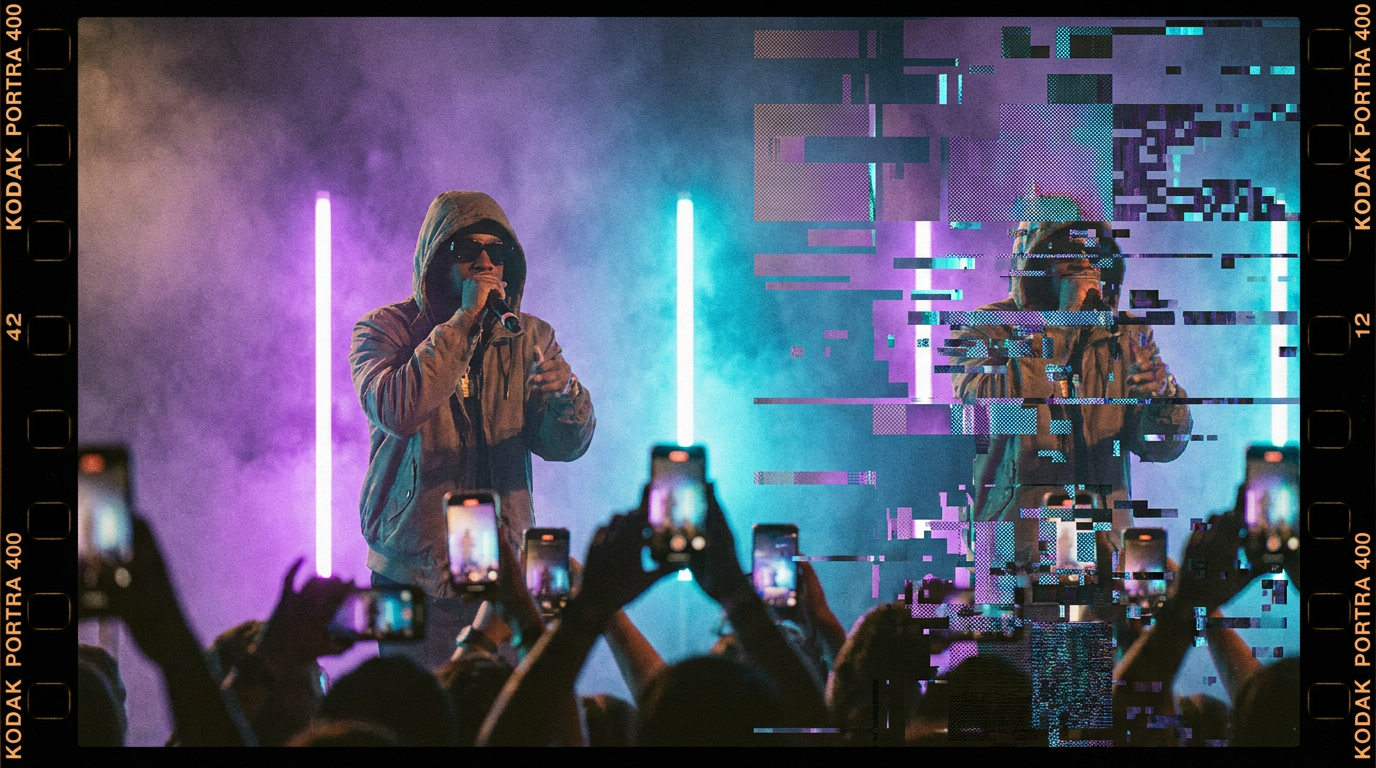
RUBBERZ and the AI Accusation Era in Music
Three weeks ago, a Shoreline Mafia rapper dropped a synth-pop track with a fake British accent, and the entire internet lost its mind trying to figure out if a human actually made it.
Welcome to the AI Accusation Era — the strangest phase of the music industry yet.
The Song Everyone’s Fighting About
“Rubberz” is a song by American rapper Fenix Flexin and producer Purps on the Beat, released on June 5, 2026. It’s a pop rap, synth-pop and dance-pop track inspired by 1980s music.
On it, Fenix Flexin sings in a British accent and flexes in his lyrics.
And almost immediately, the internet decided it was fake.
“RUBBERZ” debuted at No. 66 on the Billboard Hot 100 and is climbing. As of press time it has 9 million streams on Spotify and more than 4 million views on YouTube. It landed on multiple “Song of the Summer” lists. In the unfettered chaos of 2026, one of the first contenders for Song of the Summer is a Smiths pastiche released by a member of Shoreline Mafia that, according to widespread speculation, may actually be the product of generative AI.
Here’s the thing: nobody can definitively prove it either way, and that ambiguity is the entire story.
The Evidence, The Denial, The Chaos
Fenix Flexin has been consistent: The song is not AI. He said so on social media after detection researchers first flagged it. He said so in multiple interviews with Billboard, Andrew Callaghan, and others. He has maintained that he freestyled “RUBBERZ” the way he freestyles all of his songs.
His explanation? “Only difference Is auto tune reverb and me using my fake uk accent lol.”
But the skeptics aren’t buying it. Taylor Gang producer/artist 6AM has been perhaps the loudest voice pushing back, using his Instagram stories as a platform to dissect the song and highlight the potential dangers of widespread AI in mainstream music.
All the musicians one outlet spoke to believe Fenix Flexin used AI on “RUBBERZ,” though each had different opinions on the level of generative technology at play.
Then the detection tools entered the chat.
The AI detection platform HumanStandard, built by musician Rasha Rahman, initially said “RUBBERZ” was human-made. Twice. His artifact detection model returned near-zero AI probability. His hybrid voice model flagged the track as only partially AI. He said so publicly. He was wrong on both counts — because he hadn’t yet heard of Treblo.
Known as Sonauto until earlier this month, Treblo is a totally free AI music platform with high-quality outputs that put it at the top of the pile among generative music tools.
HumanStandard’s updated model then classified “RUBBERZ” as fully AI-generated.
Why This Matters Way Beyond One Song
Let’s zoom out, because “RUBBERZ” isn’t just a gossip story. It’s a preview of the next decade of music.
We’ve entered an era where AI-generated audio is so convincing that research by Deezer and Ipsos found that 97 percent of listeners could not tell the difference between AI-generated and human-made music. The tools have lapped our ability to detect them. And the cultural consequences are hitting fast.
Consider the timeline from just the past few months:
An R&B artist named IngaRose hit #1 on the iTunes charts in the US, UK, France, Canada, and New Zealand. Her song “Celebrate Me” went viral on TikTok, racked up over 300,000 video uses, and she amassed 251,000 Instagram followers and nearly a million monthly Spotify listeners. But IngaRose doesn’t exist — the track was powered by Suno.
Before her, Eddie Dalton held ELEVEN spots on the iTunes top 100 simultaneously, plus the number three album on iTunes.
A reimagined version of Stromae’s “Papaoutai” became the highest new entry on the Global Spotify chart, debuting at No. 168 with 1.29 million streams, using AI technology to recreate and reinterpret Stromae’s distinctive voice and style.
And now “RUBBERZ” — which might actually be human-made — is getting caught in the crossfire.
The Accusation Problem Is a Two-Way Street
Here’s what nobody’s talking about enough: the AI accusation era doesn’t just hurt AI creators who get caught. It hurts human artists who dare to sound different.
Fenix Flexin made a genuinely weird creative pivot — an LA rapper adopting British new wave aesthetics. Back in January, he spoke to XXL and teased his new sonic direction, saying he planned to “completely revamp” his sound. That’s exactly the kind of artistic risk-taking the industry claims to want.
But in 2026, take a creative leap and the first response isn’t “that’s bold” — it’s “that’s AI.” The accusation becomes the story. The art becomes secondary to the authentication debate.
As one writer put it: “Personally, I hope this is exactly what Fenix says it is: a rapper taking a creative risk and confusing everybody in the process. That would be doper than an AI-generated experiment.”
What Musicians Should Actually Do About This
Whether you think “RUBBERZ” is AI or not, the lesson is the same: every musician in 2026 needs an authenticity strategy. Not just for their music — for their entire visual presence.
1. Document Your Process
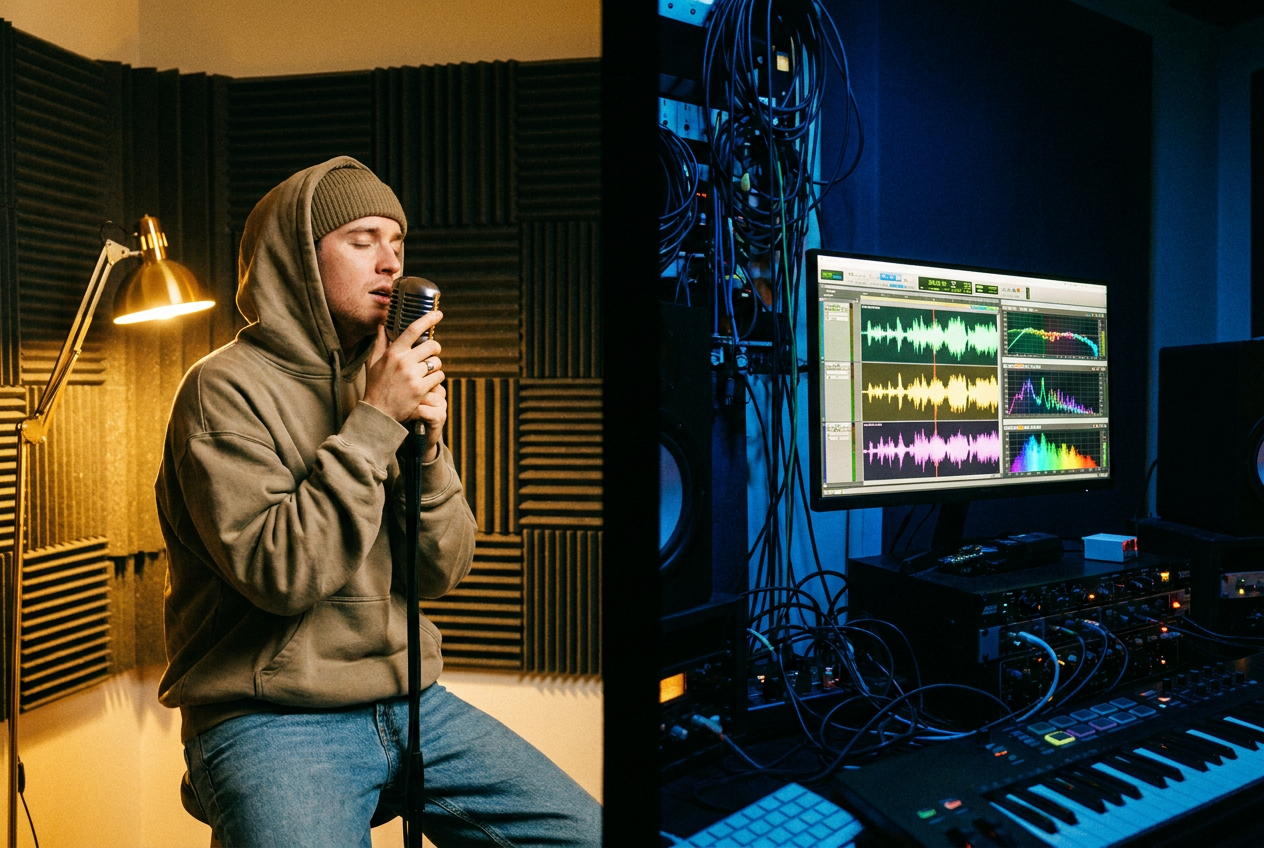
The artists who thrive in the Accusation Era will be the ones who show their work. Film yourself in the studio. Post voice memos. Share early demos. Make the creative process part of your content strategy.
As one industry forecast puts it, AI music creators are entering the “proof era.” Not just proof that a song sounds good — proof of process. Proof of rights awareness.
Fenix Flexin tried this — he did a live On The Radar performance and a Channel 5 a cappella session. A new Channel 5 video showed the rapper singing portions of “Rubberz” a cappella. But even that wasn’t enough to silence the skeptics. Which brings us to the next point.
2. Make Your Visual Identity Undeniable
Here’s where things get practical. If listeners can’t always tell whether your audio is AI, they can tell whether your visual presence is genuine, consistent, and uniquely yours. Music videos aren’t optional anymore — they’re proof of artistic identity.
If you’re an independent musician looking to compete in this landscape, you need to be smarter about visual content. Music videos are no longer optional — they’re how music gets discovered on TikTok, Instagram, and YouTube.
The irony is rich: AI video tools are now the fastest way to build the kind of authentic-looking visual brand that proves you’re a real artist. You need visuals for every single. You need Spotify Canvas loops. You need TikTok content. You need a YouTube presence. And you need it to look consistent — the same character, the same aesthetic, the same recognizable you across everything.
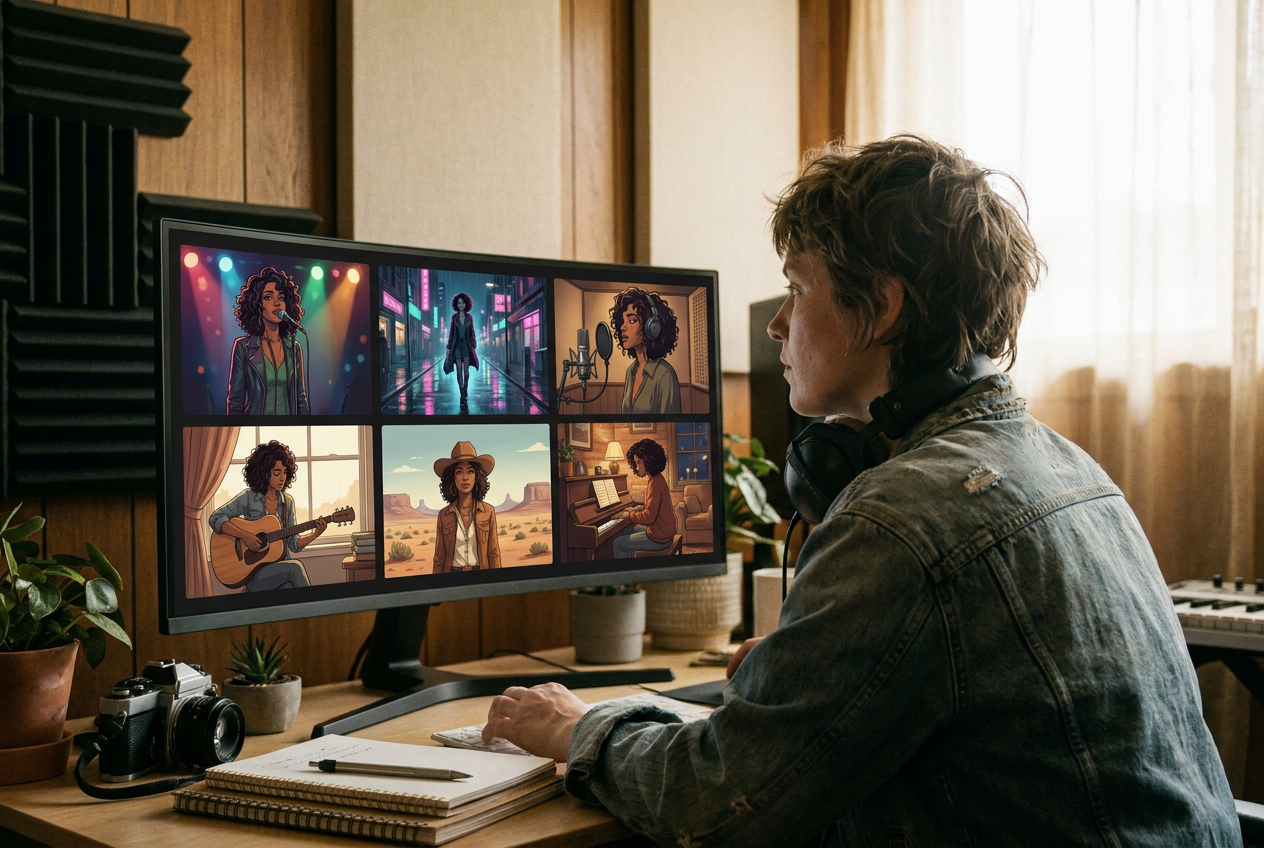
This is where the technology has genuinely caught up. The tools available today can maintain what the industry calls “Identity Locking” — in 2026, top creators use “Character Seeds” or “Reference ID” tags. You upload a reference image of your character, and the AI applies that specific facial and body geometry to every scene generated.
For a deeper dive into building your visual identity with AI, check out our complete guide to AI music videos or jump straight into how to make an AI music video.
3. Match Your Visual Strategy to Your Genre
The accusation dynamic plays out differently across genres. Hip-hop is ground zero right now — “RUBBERZ” proves that — but every genre has its own visual language that AI tools can help you nail.
If you’re in hip-hop, performance videos and street aesthetics matter enormously. Check out our AI music videos for hip-hop guide for genre-specific strategies. For pop artists navigating similar scrutiny, our AI music video templates for pop can help you establish a consistent visual identity fast.
If you’re making indie or experimental music — the exact lane where Fenix Flexin claims to be operating — having strong, distinctive visuals is your best defense against AI accusations. Browse our AI music video examples for indie to see what’s possible.
The Detection Arms Race Is Already Failing
Here’s a sobering reality that the “RUBBERZ” saga exposes: AI detection in music is unreliable, and it’s getting worse.
HumanStandard initially said “RUBBERZ” was human-made. Twice. Then, after training on a new platform’s outputs, it flipped to fully AI-generated. HumanStandard reports that it now detects the platform Treblo at 90% accuracy — achieved with just 1,000 training samples, compared to the 10,000 Suno required when they first tackled that platform.
Think about what that means: every time a new AI music tool launches, detection models have to start from scratch. And new tools are launching constantly. Detection is always playing catch-up with generation.
When asked how he achieved the vocal sound on “RUBBERZ,” one engineer credited Autotune — which he called “basically AI” when pressed — while refusing to name the specific tool. “I’m not going to give away the secret sauce,” he said. There are only so many widely used pitch correction tools on the market. That level of secrecy is hard to square with the answer being a standard plugin.
This is the gray zone every musician now lives in. Auto-Tune is AI? Vocal plugins are AI? Where exactly is the line?
The Bigger Picture: Proof of Humanity as a Feature
The “RUBBERZ” controversy reveals a truth that’s going to define the next era of music: proof of humanity is becoming a feature, not an assumption.
Think about it from a fan’s perspective. When you watch a music video and see an artist performing with conviction — hitting notes, making facial expressions, embodying the emotion of the track — you’re getting something that a text prompt can’t deliver. Not yet, anyway.
That’s why musicians who pair their releases with strong visual content have an inherent advantage. A music video isn’t just promotion — it’s evidence. It’s your face, your movement, your interpretation of your own song. Whether you film it traditionally or use AI tools to create stunning visuals around your authentic performance, the result is the same: you’re proving that a real person with real artistic intent exists behind the music.
The best AI music video generator for independent artists is not simply the one that produces the most visually impressive single clip. It is the one that helps build a recognizable visual identity — a consistent character, a coherent aesthetic, a look that audiences associate with a specific artist across every platform where that music appears.
What Comes Next
The “RUBBERZ” saga isn’t going away. The song’s success has led Fenix Flexin to promise a full album with more of the same. If the AI accusations continue, every track will be dissected. If he proves it’s all human, it becomes the greatest vindication story in modern music. Either way, it’s content. Either way, it drives streams.
And that’s the darkest lesson of the AI Accusation Era: the controversy itself is a growth hack. Whether your song is AI or not, the debate about whether it’s AI drives attention, which drives streams, which drives chart position.
For the rest of us — the musicians making legitimate art, human or AI-assisted — the takeaway is clear:
- Build your visual brand relentlessly. Every release needs video. Every video needs consistency. Your face, your aesthetic, your world.
- Document your creative process. Behind-the-scenes content isn’t optional anymore — it’s your proof of authenticity.
- Use the tools available to you. AI video generation isn’t the enemy of human creativity. It’s the megaphone that lets your authentic artistic vision reach audiences who might otherwise never find you.
- Don’t wait for the industry to figure this out. Tool choice is becoming part of rights strategy. Where you make the song may matter almost as much as what the song sounds like.
The musicians who win in the Accusation Era won’t be the ones who avoid AI entirely. They’ll be the ones who use every available tool — including AI — to build such a strong, consistent, recognizable artistic identity that the question “is this real?” becomes laughable.
Because when your face is on screen, your story is in the lyrics, and your visual world is unmistakably yours, nobody can accuse you of being a prompt.
Ready to build the kind of visual identity that proves you’re the real deal? OneMoreShot.ai lets you turn your tracks into stunning, consistent music videos in minutes — no film crew, no five-figure budget, no ambiguity about who made the art. Upload your song, make it yours, and let the music speak for itself.