
The Walled Garden Era of AI Music Is Here
Two weeks ago, something quietly extraordinary happened. In the span of a single week, Udio revealed its upcoming licensed AI music app called Starstruck, and Spotify announced a licensing deal with Universal Music Group to let Premium subscribers create AI covers and remixes. Add in Suno’s fresh $5.4 billion valuation, Lucian Grainge’s speech this Thursday championing AI as fan engagement, and iHeartRadio’s “Guaranteed Human” policy banning AI vocalists — and you get a picture that should make every independent musician sit up and pay attention.
The major labels aren’t fighting AI anymore. They’re building walled gardens around it. And if you’re an indie artist, the door is closing fast.
What Just Happened (And Why It Matters)
Let’s rewind to the week of May 19–25, 2026. In rapid succession:
Udio revealed its forthcoming licensed AI app called “Starstruck” — a mobile-first, consumer-facing platform that operates as a walled garden, preventing generic AI outputs and disallowing downloads. It offers four modes: Cover, Reimagine, Remix, and Create, letting fans generate new versions of opted-in artists’ songs.
Spotify announced it has partnered with Universal Music Group to allow fans to use generative AI technology to create covers and remixes of their favorite songs. The tool will launch as a paid add-on available only to Premium subscribers, with a revenue share for participating artists.
And just days ago, Sir Lucian Grainge, chair and CEO of Universal Music Group, told a full-house audience at the 2026 Northeastern Global Leadership Summit in London that AI has the power to enrich the musical experience.
UMG has signed a deal with Spotify to allow a tier of premium users to create covers and remixes of songs by participating artists, as part of its AI-enabled superfan initiative.
Meanwhile, Suno raised a $400 million Series D round, valuing the company at $5.4 billion.
None of its legal troubles appear to be slowing its growth. It continues to hover around the top of the App Store charts for music, with users generating over 7 million songs every day.
This isn’t a collection of isolated news stories. This is the architecture of a new era.
The Walled Garden Playbook
Here’s what’s actually happening behind the press releases: the major labels have figured out their AI strategy, and it’s a masterclass in controlled monetization.
Every creation on Starstruck will live exclusively inside the app’s “walled garden” — meaning songs cannot be exported or distributed elsewhere. Udio CEO Andrew Sanchez described three layers of enforcement: stream encryption, inaudible watermarking on every output, and fingerprinting so distributors can check uploaded tracks against Starstruck creations and block any matches.
The fan would not own what they create on Starstruck; they would be paying for the right to create and listen inside Udio’s controlled environment.
Think about that for a second. Fans pay to create. They don’t own what they make. They can’t download it. They can’t post it anywhere else. And the rights holders — meaning the labels — own everything that comes out.
Kobalt executive Bob Bruderman said the deal structure means the songwriter is “paid significantly more than they are in the traditional streaming construct.” That sounds great for established artists signed to major labels. But what about everyone else?

The Two-Tier Music Industry Nobody’s Acknowledging
Here’s the uncomfortable truth: the AI music landscape is splitting into two completely different worlds.
World One is the licensed, walled-garden ecosystem. Udio’s Starstruck platform is built on licensing deals with Universal Music Group (October 2025), Warner Music Group (November 2025), Merlin (January 2026), Kobalt (April 2026), and Believe (April 2026).
Sony Music Group remains the notable holdout, with its portion of the RIAA-led copyright infringement lawsuit still active. Spotify is building something similar with 290 million paying subscribers already in the door. In this world, AI is a tool for fans to remix major-label music, with labels collecting royalties on every generation.
World Two is everything else. Independent artists creating original music, using AI tools for production and visuals, trying to get noticed on streaming platforms that are simultaneously flooding with AI-generated content. Deezer estimates that 50,000 fully AI-generated songs are delivered to its site every day and that 97% of people cannot tell the difference between AI and human-made works.
The labels are building their walled gardens specifically to protect their artists from the flood they helped create. But indie artists? They’re standing outside the wall, fighting for attention in a sea of 50,000 new AI tracks per day.
The Engagement Gap Is Real
The numbers tell the story. Consumption on Udio’s current walled-garden setup has tanked its engagement: the top trending tracks on Udio get only around 100 plays a month. Meanwhile, top tracks on Suno, which still allows social sharing, regularly clear 200,000+ streams in the same window.
As researcher Cherie Hu from Water & Music observed, the walled garden model has a fundamental problem. The most important distinction may be between DSPs and social platforms. While rightsholder-approved remix tools can solve the monetization piece, it is on social and UGC platforms where songs actually breathe new, meaningful life and drive cultural impact at scale.
This creates an ironic opening for indie musicians. The majors are locking their music inside controlled apps. Meanwhile, independent artists can still publish freely across YouTube, TikTok, Instagram, and every other platform where discovery actually happens. The question is: how do you stand out?
Why AI Music Videos Are the Indie Artist’s Best Weapon
Here’s where this gets practical. If you’re an independent musician in mid-2026, you’re competing against an avalanche of AI-generated tracks, major-label walled gardens that suck up fan attention, and “Guaranteed Human” radio policies that may or may not work in your favor. What do you actually do?
You make visuals. Great ones. Fast.
The playing field for AI music video creation has never been more level. While the audio side of AI is getting locked down behind licensing deals, the video side is wide open and getting better by the week.
Veo 3.1 still looks like the safest overall pick. It combines strong realism, good motion, and native audio in a way that makes it feel more complete than most of the field.
As of June 2026, Kling v3 leads the text-to-video leaderboard with an arena score of 2104. And Google announced free Veo 3.1 video generation for all Google accounts, custom AI music generation powered by Lyria 3, and fully directable AI avatars.
In other words: the video generation tools are getting cheaper, better, and more accessible at exactly the moment when indie musicians need them most.
If you want a deep dive on the current state of tools and techniques, check out our complete guide to AI music videos in 2026. It covers everything from choosing a generation model to building a consistent visual identity across your releases.
The Visual Advantage, Genre by Genre
The beauty of AI music videos is that they’re genre-agnostic. Every style benefits differently:
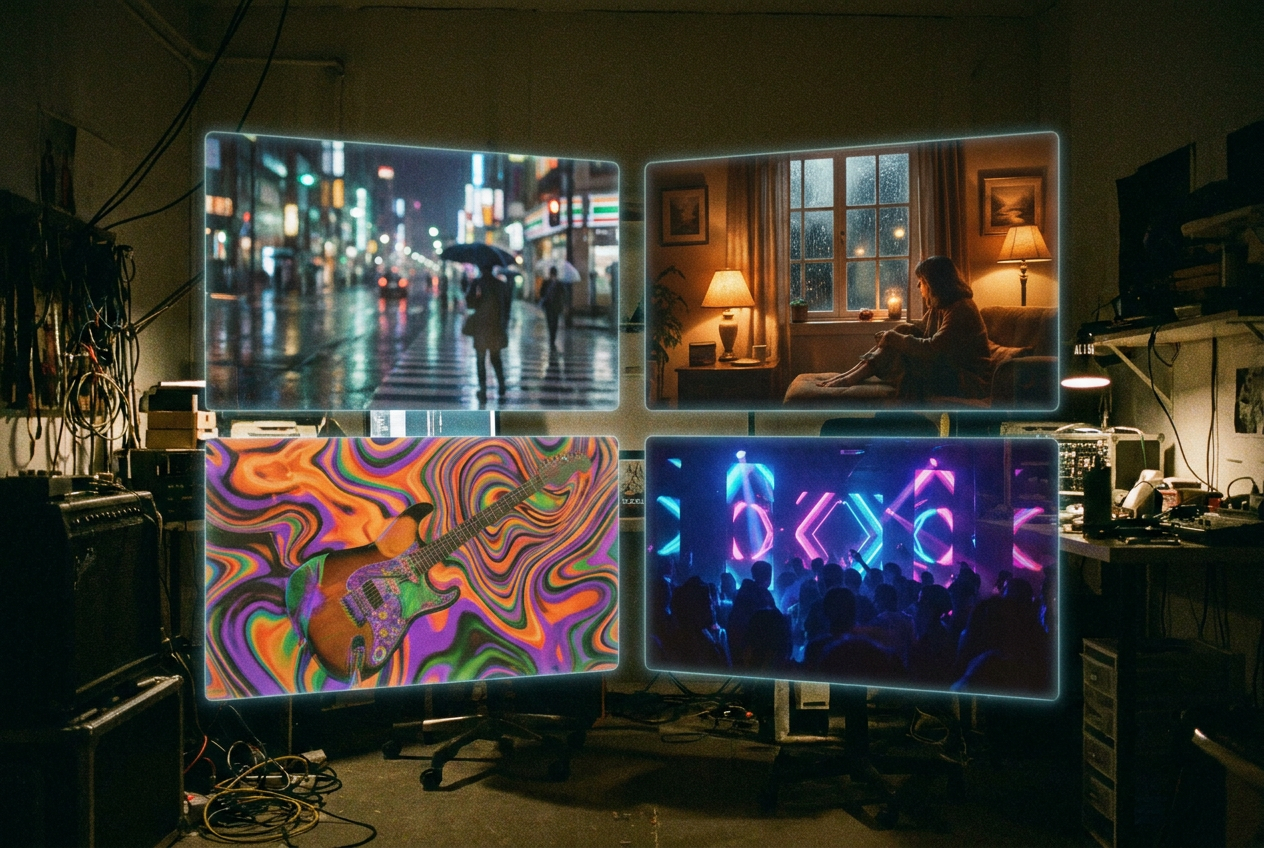
Hip-hop artists can create the kind of cinematic, narrative-driven visuals that used to require five-figure budgets. Think moody street scenes, stylized performance shots, abstract visual metaphors — all generated in minutes rather than weeks. Check out our guide to AI music videos for hip-hop for specific prompting techniques and template ideas.
Lo-fi and ambient creators have perhaps the biggest advantage of all. The dreamy, abstract aesthetic that defines the genre translates perfectly to AI generation. Rainy windows, neon-lit cityscapes, cozy room interiors — these are exactly the kinds of scenes that current models handle beautifully. Our lo-fi music video templates are a great starting point.
Indie and rock artists can lean into the surreal and experimental. AI generation excels at the weird, the psychedelic, the visually unexpected — all hallmarks of great indie visuals. See our indie music video examples for inspiration.
EDM and electronic producers can create the kind of beat-synced, reactive visualizations that turn a track into an experience. Audio-reactive AI generation — where the visuals pulse and shift with the music — is now a real, accessible capability. Explore our EDM music video guide for the workflow.
The Practical Playbook for Mid-2026
So you’re an indie musician reading this. Here’s what I’d actually do right now:
1. Accept the New Reality
The major labels are not going to include you in their walled gardens. Starstruck is for fans remixing Taylor Swift and Charli XCX, not for helping you get discovered. Udio has embraced the “walled garden” model championed by UMG, and UMG’s Chief Digital Officer Michael Nash indicated that the walled garden principle was a key factor in their ongoing strategy. This system is designed for label catalogs. You need a different strategy.
2. Double Down on Visual Identity
In a world drowning in AI-generated audio, your visual identity might be the single biggest differentiator you have. A consistent, striking visual style across your releases — music videos, social clips, album art, live stream backgrounds — creates the kind of brand recognition that no algorithm can replicate.
Learn how to make an AI music video if you haven’t already. The barrier to entry is genuinely zero in mid-2026.
3. Release Music Videos With Every Track
This used to be impossible for indie artists. A single professional music video could cost $5,000–$50,000. Now? You can generate compelling visuals for every release. Not just your singles — every track on your EP, every loosie, every collaboration.
The artists who are winning on YouTube and TikTok right now aren’t the ones with the biggest budgets. They’re the ones with the most consistent visual output.
4. Use the Open Ecosystem While It Exists
Suno has 2 million paid subscribers and $300 million in ARR. It still allows sharing. YouTube isn’t a walled garden for creators. TikTok still rewards organic reach. These open platforms are where discovery happens. Post your AI music videos there. Build your audience where the walls haven’t gone up yet.
5. Own Your Creative Stack
For creators, the story is about more than just the sunsetting of an AI tool; it is a case study in how vendor stability does not equate to product longevity. Sora just died. Platforms come and go. Don’t build your entire workflow on one tool. Use tools like OneMoreShot.ai that let you generate stunning music videos quickly, and keep your source files, your prompts, and your creative direction portable.
What Happens Next
Grainge told his audience that AI offers the opportunity to augment rather than replace the human heart of music. That’s the corporate line, and honestly, there’s some truth to it — if you’re signed to UMG. For everyone else, AI is simultaneously the biggest threat and the biggest opportunity in the history of independent music.
The walled gardens will get bigger. The Starstruck details arrived in the same week as the Spotify-UMG deal. That agreement positions Spotify as a direct competitor to Udio in the licensed AI remixing space — but with the advantage of over 290 million paying subscribers worldwide. More labels will sign more deals. More platforms will offer more controlled remixing experiences. The licensed AI music economy is going to be enormous.
But here’s the thing the labels don’t want you to know: walled gardens don’t make culture. Open platforms do. Fans have been slowing down, speeding up, mashing up, and drenching songs in reverb for years. They built entire aesthetic movements out of it: nightcore, lo-fi edits, the slowed-and-reverbed era that took over TikTok. None of it was legal, and none of the rights holders saw a dollar. Now the music industry is trying to turn that behavior into a business.
Whether they succeed or not, independent artists still have something the labels can’t manufacture: authenticity, creative freedom, and the ability to move fast. Combine that with AI-powered visuals, and you’ve got a formula that no walled garden can contain.
The tools are ready. The window is open. The question is whether you’ll use it before someone builds a wall around that too.
Ready to create your first AI music video? OneMoreShot.ai lets you generate stunning, beat-synced visuals in minutes — no walled garden required. Just your music, your vision, and a few clicks.