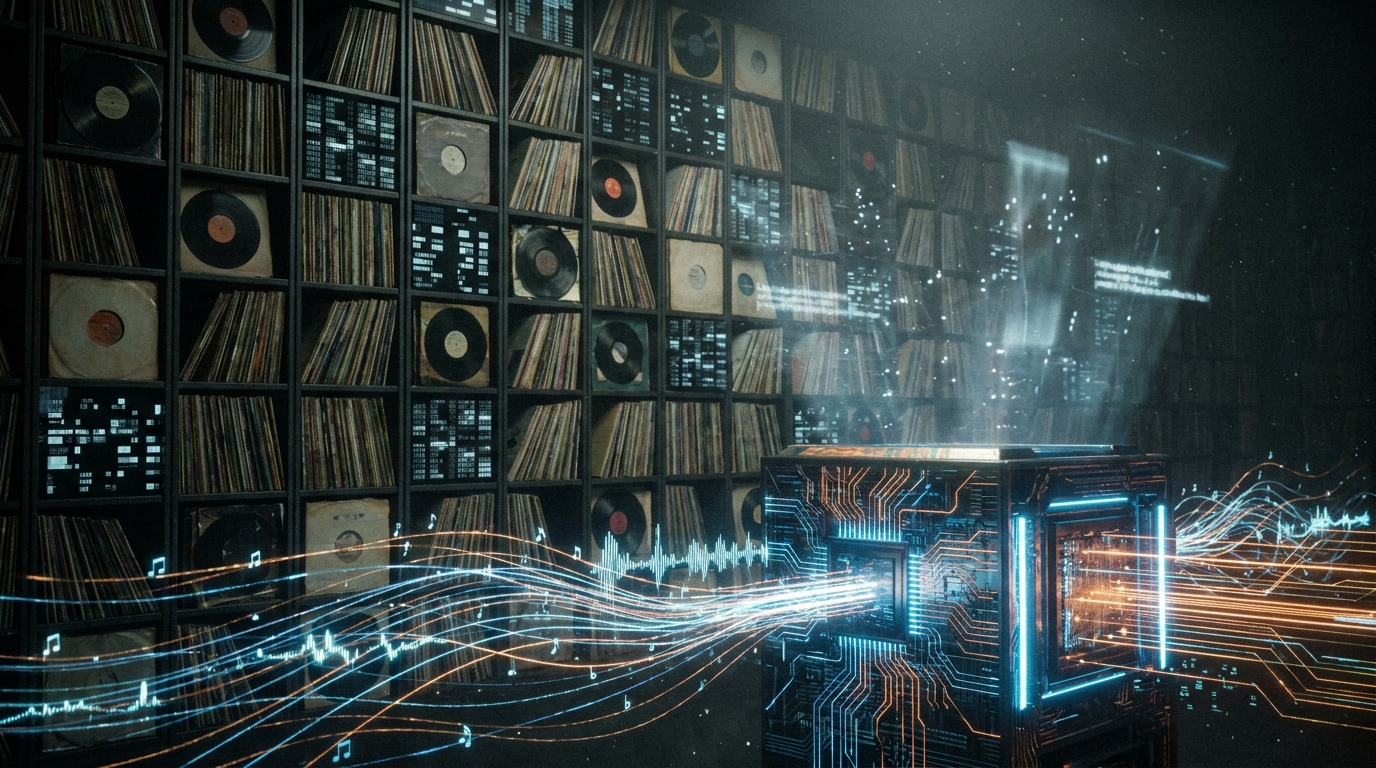
21 Million Songs Exposed in AI Training Data
The music industry just got a receipt. Not a vague accusation. Not a legal brief full of redactions. An actual, searchable, browsable receipt showing exactly which songs have been circulating inside the AI-development community — and the number is staggering.
The Atlantic’s Alex Reisner discovered four massive datasets containing about 21.2 million tracks that were used to train generative AI music platforms.
One archive alone contains 12 million songs.
The records show tracks from major artists including Taylor Swift, Bad Bunny, Billie Eilish, and Nirvana.
And here’s the part that should make every indie musician sit up: we’re talking about a huge selection of excellent music put out by extremely talented indies , not just the superstars.
This isn’t theoretical anymore. If you’ve released music in the last decade, there’s a real chance it’s in one of these databases. And that changes the calculus for how you think about your career, your visual strategy, and your rights as a creator.
What The Atlantic Actually Found
The investigation centers on The Atlantic’s “AI Watchdog” project, which has been examining four “giant datasets of songs that are being shared within the AI-development community.”
Let’s break down the four datasets:
The largest is LAION-DISCO-12M, a collection of more than 12 million tracks released in November 2024 by LAION, a German non-profit that compiles open datasets for AI research.
LAION explicitly warns against deploying its datasets commercially — but once something’s been downloaded thousands of times, that disclaimer is about as effective as a “please don’t copy this” sticker on a DVD.
The second-largest dataset was compiled by AI researchers associated with Sleeping AI.
Google and Stability AI have reportedly utilized tracks from one of the 100,000-song datasets, the Free Music Archive. But the remaining datasets? Owing to “the industry’s secrecy around training data, we don’t currently know who has used the others.”
Roughly 300 Beatles tracks are in each of the two biggest datasets, as are hundreds of songs apiece from Taylor Swift, ABBA, Snoop Dogg, and Michael Jackson.
But what makes this investigation truly different is the searchability. The findings give artists and record labels something they have long wanted: proof. The searchable databases allow rights holders to check whether their music was included in the training data.

Why Indie Artists Should Be Most Worried
Here’s the detail that’s getting buried under the Taylor Swift headlines: the datasets don’t just contain obvious chart-toppers.
The training tracks, some released by an indie artist who’s already litigating against Suno and Udio, probably weren’t selected based on consumption volume. Many of the relevant professionals have impressive streaming followings, but the two biggest datasets also contain years-old releases with hundreds of streams — great music that one would almost have to seek out for its technical characteristics.
Read that again. AI developers aren’t just vacuuming up pop hits. They’re actively seeking out high-quality indie music — precisely the kind of music that fills sync libraries and background playlists. The kind of music that a lot of independent artists depend on for their livelihood.
We’re already seeing the downstream effects. The American Dollar, an instrumental post-rock duo, claims that the resulting flood of AI-generated music has reduced their licensing revenue by nearly 80% since Suno launched its service.
This lawsuit is notable because The American Dollar make the kind of ambient instrumental music that has traditionally been heavily licensed for use in TV shows, films, and adverts, but which is now competing directly with AI-generated music in the sync licensing market.
That’s not an abstract policy debate. That’s a career getting hollowed out in real time.
The Legal Landscape Is a Three-Way Split
The music industry’s response to all this has fractured into three distinct camps — and understanding which camp is winning tells you everything about where this is headed.
Camp 1: Settle and license. Universal Music Group settled with Udio in October 2025, announcing a “compensatory legal settlement” plus new recorded-music and publishing licenses for a jointly developed AI platform set to launch in 2026.
Warner Music Group reached its own settlement and licensing deal with Udio in November 2025, and days later became the first major to settle with Suno.
Camp 2: Keep fighting. Sony Music has settled with neither, and its fair-use cases against Suno and Udio are expected to produce a pivotal ruling in summer 2026 that could set legal precedent for every AI music company.
Camp 3: The musicians who got left out. The American Federation of Musicians is suing UMG and Warner Music Group over the labels’ recent moves to settle their lawsuits with Suno and Udio, arguing that the settlements’ benefits aren’t reaching the musicians themselves.
That third camp is the most explosive. The AFM’s argument is basically: the labels cut deals to protect their own revenue while the session musicians, performers, and studio players whose actual playing trained these models got nothing. Ouch.
Meanwhile, in the Udio case, Udio acknowledged that its models were trained on audio obtained from YouTube.
The labels contend that downloading audio from YouTube by stripping it from the video stream bypasses YouTube’s access controls — and that distinction is legally fatal to Udio’s fair-use defense.
A pivotal summary-judgment hearing is expected in July 2026. Whatever the court decides will ripple through every AI company that ever trained on data it didn’t license.
The Flood Nobody Can Stop
Even as the lawsuits pile up, the AI music deluge continues to accelerate.
Deezer is now receiving almost 75,000 AI-generated tracks per day, representing roughly 44% of the daily uploads. This amounts to more than 2 million AI-generated tracks uploaded per month.
That’s up from 60,000 AI tracks per day in January, 50,000 in November, 30,000 in September, and just 10,000 in January 2025. A 650% increase in 18 months.
The silver lining? Consumption of AI-generated music on the platform is still very low, between 1-3% of total streams. A majority (85%) of those streams are detected as fraudulent and demonetized by Deezer.
Nobody’s actually listening to this stuff — at least not yet. The uploads are largely royalty-farming schemes, not genuine creative output finding an audience. But the sheer volume creates noise that makes it harder for legitimate artists to break through.
And Suno, the company at the center of all of this? Its valuation jumped from $2.45B in November 2025 to $5.4B in June 2026 , doubling in six months while still being sued. More than 2 million paying subscribers as of February 2026 and an annual recurring revenue run rate of around $300 million. The market has clearly decided that lawsuits are a speed bump, not a roadblock.
What This Means for Musicians Making Visual Content
Here’s where the conversation gets practical — and where most coverage of this story drops the ball.
If AI can generate unlimited music that nobody listens to, what does hold value? The answer, increasingly, is the full package: the visual identity, the performance, the story, the brand. The things AI music generators fundamentally cannot provide.
Think about it this way. When 75,000 AI tracks flood streaming platforms every single day, the audio alone becomes a commodity. What differentiates your release is everything around the audio: the music video, the visual aesthetic, the artist persona, the narrative context.
This is why AI music videos aren’t just a marketing nice-to-have anymore. They’re the competitive moat. When a listener can’t tell the difference between your track and an AI-generated one (and 97% of listeners can’t distinguish AI music from human-made tracks according to Deezer’s own study), the visual layer is what says this came from a real person with a real story.
Whether you’re making hip-hop visuals with authentic street aesthetics or crafting dreamy lo-fi visualizers, the visual identity is your proof of humanity — the one thing the training data scrapers can’t replicate.

The Licensed Alternative Is Growing
Not all AI music tools operate the same way, and that distinction matters more than ever.
ElevenLabs Music V2 takes a different approach. The model is trained exclusively on licensed music data, which means the output is cleared for commercial use. That distinction matters enormously if you’re building a product, running ads, publishing content at scale, or incorporating music into any workflow where money changes hands.
ElevenLabs emphasized that the new model is built on licensed data and cleared for commercial use, so users can freely use the tracks.
Striking deals with labels is key, given that other AI music startups, like Suno and Udio, faced court cases over copyright issues.
Similarly, Suno said it would launch “new, more advanced and licensed models” in 2026 and deprecate its current models. The industry is slowly bifurcating into licensed and unlicensed lanes — and tool choice is becoming part of rights strategy. Where you make the song may matter almost as much as what the song sounds like.
For video creators, the parallel is clear. When you make an AI music video, you want to use tools that give you clean rights to the visual output. That’s the same principle — just applied to the visual layer instead of the audio.
How to Protect Yourself Right Now
If you’re an independent musician reading this, here’s what you can actually do:
1. Check the databases
The Atlantic made its databases searchable. Look up your catalog. Know whether your music is in the training data.
2. Document your creative process
AI music creators are entering the proof era. Not just proof that a song sounds good. Proof of process. Proof of rights awareness. Keep records of your sessions, stems, and writing notes.
3. Build your visual brand
Audio is getting commoditized. Your visual identity isn’t. Invest in music videos — even AI-generated ones — that establish a recognizable aesthetic. An artist with a strong visual portfolio signals authenticity in ways that a bare SoundCloud upload simply can’t.
4. Choose your tools deliberately
Not all AI tools carry equal legal risk. If you use AI for any part of your workflow, understand the licensing terms. Use tools trained on licensed data when commercial output matters.
5. Diversify your revenue beyond streaming
If sync licensing is getting undercut by AI-generated production music, diversify. Live performance, merchandise, fan communities, and direct-to-fan models all retain value that AI can’t replicate.
The Bigger Picture
The Atlantic’s investigation isn’t just a data dump. It’s a before-and-after moment. Before this, the music industry suspected AI companies were training on copyrighted music. Now there’s a searchable database that proves it — with specific song titles, specific artists, and specific datasets that have been downloaded thousands of times.
It may also mark a turning point in the growing battle between creative rights and artificial intelligence.
For musicians who make original music and want to stand out in an increasingly AI-flooded landscape, the takeaway is clear: your unique voice matters, your visual brand matters, and the tools you choose matter. The era of “just upload and pray” is over.
The artists who thrive from here will be the ones who pair great music with compelling visual storytelling — using genre-specific templates and creative tools to build a complete artistic identity that no training dataset can replicate.
Ready to build that visual identity? OneMoreShot.ai lets you turn your finished tracks into stunning music videos in minutes — giving your music the visual context that sets it apart in a world where 21 million songs just became training data.