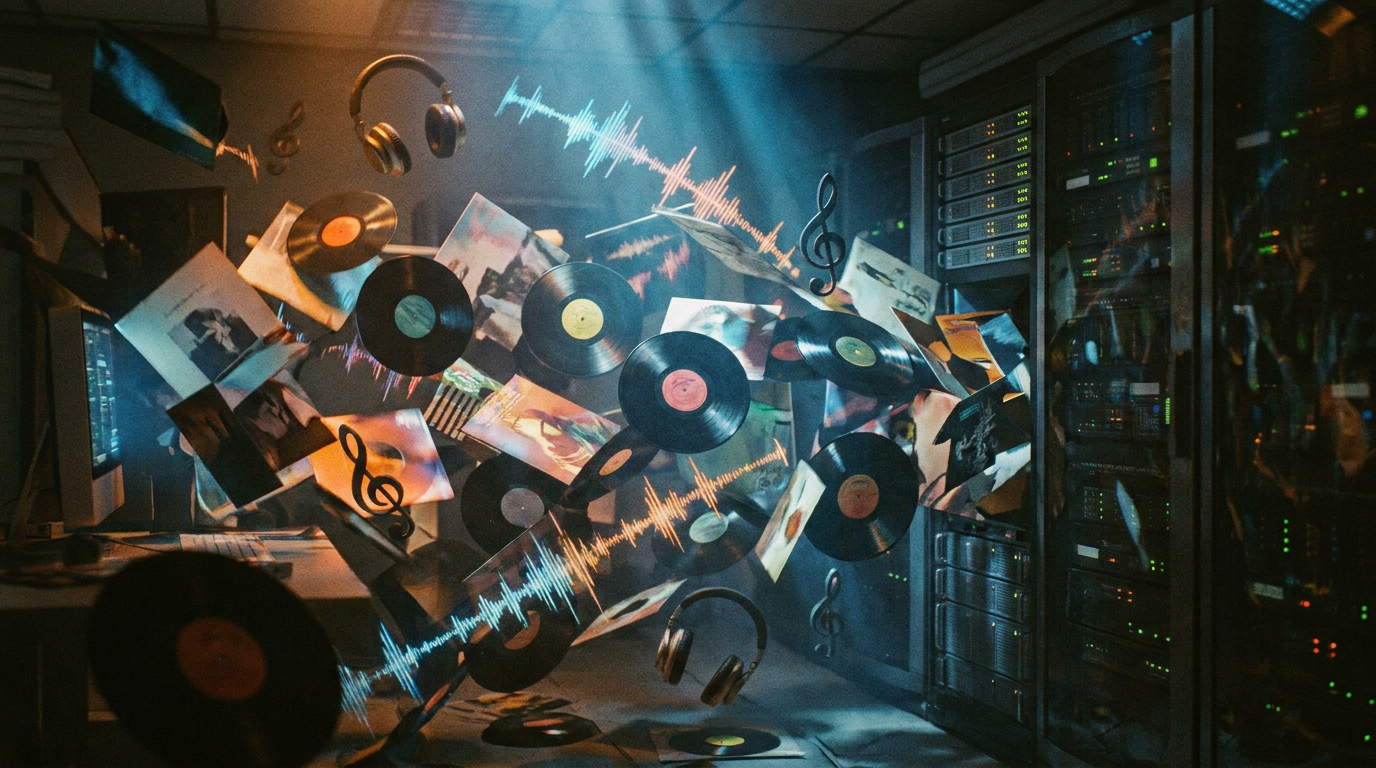
21 Million Songs Were Scraped for AI Training
You know that queasy feeling you get when you realize someone’s been going through your stuff without asking? Multiply that by 21 million, and you’ll understand why the music industry is collectively losing its mind this week.
A new investigation by The Atlantic has uncovered just how much copyrighted music has been fed into AI systems that generate songs. Staff writer Alex Reisner discovered four massive datasets containing about 21.2 million tracks that were used to train generative AI music platforms. And for the first time, artists can actually look up whether their music was included.
This isn’t theoretical anymore. It’s searchable.
The Four Datasets That Changed Everything
The Atlantic’s AI Watchdog project, led by journalist Alex Reisner, did something nobody had managed to do before: it identified and cataloged the actual training data powering AI music generators.
Here’s the breakdown:
The largest is LAION-DISCO-12M, a collection of more than 12 million tracks released in November 2024 by LAION, a German non-profit that compiles open datasets for AI research.
Two of the datasets each contain more than 100,000 recordings, while the other two are far larger, at roughly 9 million and 12 million tracks.
They include hits from major pop artists such as Bad Bunny, Nirvana, Taylor Swift, Billie Eilish, Pearl Jam, and the Beatles, alongside jazz artists and classical composers.
To put this in perspective: The Atlantic’s four datasets comprising 12 million tracks would take 91 years to listen to. That’s not a rounding error. That’s essentially the entire modern catalog of recorded music, scraped and packaged for AI developers.
Three of the datasets directly link to songs on YouTube or Spotify, allowing AI developers to download existing audio available on these platforms using automated tools. So your music didn’t just end up in some abstract training process — it was actively downloaded from platforms where you thought you were just… distributing your songs.
Why This Matters More Than Previous Leaks
We’ve heard about AI training data controversies before. The difference here is specificity. What makes The Atlantic’s investigation different is the level of detail it provides. Instead of broad claims about how AI systems work, the report offers concrete evidence of the songs that helped teach these programs.
The findings give artists and record labels something they have long wanted: proof. The searchable databases allow rights holders to check whether their music was included in the training data.
Previously, the debate around AI music training was all vibes and speculation. Companies would vaguely claim they used “freely available” content. Artists would accuse them of theft. Nobody could prove anything.
Now? “Companies often claim to use only content that is freely available online, but the datasets reveal the quantity of downloadable music that developers can access even though it is not supposed to be free,” wrote journalist Alex Reisner.
That’s the sentence that should keep AI music company lawyers up at night.
The Court Cases Converging Right Now
This investigation didn’t drop into a vacuum. It landed at the most legally consequential moment in the AI music copyright battle.
Sony Music Entertainment is the last major record label still in court. Universal Music Group settled its copyright case against Udio in October 2025. Warner Music Group settled with Suno in November 2025.
But Sony? Sony is digging in. The Sony v. Suno hearing scheduled for July 2026 is the first case to bring this question squarely before a federal judge in the context of music training.
And the stakes couldn’t be higher. If Suno wins on fair use, it blows up every licensing deal in the AI music space. If it loses, the UMG-Udio template becomes the industry standard.
Think about that for a second. Warner and Universal already settled — presumably for significant sums and future licensing arrangements. If a court now rules that training on copyrighted music was legal all along under fair use, those companies essentially paid for something they didn’t need to.
Sony, UMG, and Warner have filed lawsuits against Suno and Udio seeking up to $150,000 per song in statutory damages. When you’re talking about datasets of 21 million songs, that’s not a legal dispute — it’s an extinction-level financial event.
What Suno Has Already Admitted
Let’s be clear about something: this isn’t a case of “we think they might have used copyrighted music.” Suno admitted in a court filing that it did, in fact, train its AI model using copyrighted songs.
Their defense? “It is no secret that the tens of millions of recordings that Suno’s model was trained on presumably included recordings whose rights are owned by the Plaintiffs in this case.” The company argues this constitutes fair use — citing the Second Circuit’s 2024 decision in Bartz v. SoundAI, arguing that its model doesn’t store or reproduce copyrighted recordings — it learns musical patterns and generates new compositions.
Meanwhile, Reisner also cited Suno’s 2024 court filings where the company wrote that its models trained on “essentially all music files of reasonable quality” that could be downloaded from the internet.
“Essentially all music files of reasonable quality.” Let that sink in.
The Supreme Court Already Weighed In (Sort Of)
Here’s a detail that often gets lost in the noise: On March 2, 2026, the US Supreme Court denied certiorari in Thaler v. Perlmutter. For anyone tracking AI copyright, this was the definitive moment.
By denying certiorari, they let the lower court ruling stand: AI cannot be an author under US copyright law.
The door is closed on purely AI-generated works receiving copyright protection through the courts.
This creates a fascinating paradox: AI music generators consume copyrighted material to produce output that can’t itself be copyrighted. The input is protected; the output is not. If you’re a musician who spent years perfecting your sound, your work may have been ingested by a machine that produces knock-offs with zero legal protection for anyone involved.
What This Means for Musicians Right Now
Let’s get practical. If you’re an independent musician reading this, here’s what you should be thinking about:
1. Check if Your Music Was Scraped
The Atlantic’s databases are searchable. If you have even a modest catalog on Spotify, YouTube, or anywhere on the open internet, there’s a meaningful chance your work appears in one of these datasets. They are filled with copyrighted music, spanning household names and tens of thousands of lesser-known independent artists.
This isn’t just about Taylor Swift. It’s about you.
2. Understand the Two-Lane Future
AI music creators are entering the proof era. Not just proof that a song sounds good. Proof of process. Proof of rights awareness. Proof of human direction. Proof of metadata. Proof that the creator is not just flooding platforms with disposable AI output.
The AI music space is splitting into licensed and unlicensed tracks. Tool choice is becoming part of rights strategy. Where you make your content matters almost as much as what it sounds like.
3. Lean Into AI Where It’s Clean: Visuals
Here’s the thing nobody is talking about enough: while AI music generation is drowning in legal uncertainty, AI video generation is in a completely different position. If you check out our Complete Guide to AI Music Videos in 2026, you’ll see why the visual side of AI has largely sidestepped these landmines.
When you use AI to create visuals for your own original music, you’re not dealing with any of these training data controversies. Your song is yours. The AI is just generating images and motion to accompany it. Nobody’s suing anyone over AI-generated video aesthetics applied to legitimately created music.
Why AI Music Videos Are the Smart Play
The irony of this whole situation is beautiful in a tragic sort of way. The same week that AI music training data scandals are blowing up, AI video generation is hitting its stride:
In 2026 three models lead the field — Google’s Veo 3.1, Kuaishou’s Kling 3.0, and ByteDance’s Seedance 2.0 — and each is the best at something different.
All three can produce synchronized dialogue, ambient sound, and background music inside a single generation.
Kling 3.0 offers music synchronization features that let you upload a music track and have the AI generate video that moves in rhythm with the audio.
This is the kind of technology that musicians should be embracing. Not AI that replaces your creative output, but AI that amplifies it. You write the song. You own the song. Then you use AI to create stunning visuals that would have cost thousands of dollars and weeks of production time just two years ago.
Whether you’re making hip-hop videos, EDM visualizers, or indie aesthetics, the tool is working for you instead of learning from you without permission.
The Bigger Picture: Trust Is the New Currency
Does training AI on millions of copyrighted songs count as transformative use, or is it simply digital piracy? That question will be answered in a courtroom next month.
But regardless of how the legal chips fall, the trust damage is already done. The discovery comes at a crucial time for the music industry, which is struggling to deal with an explosion of AI-generated songs online.
The artists I talk to aren’t confused about whether AI is useful — they know it is. What they’re confused about is which AI tools they can trust. The ones that scraped their catalog without asking? Or the ones that help them build their visual identity?
If you’re looking for a template to get started with AI-powered visuals for your music, we’ve got genre-specific guides for everything from pop to rock to Latin music. The learning curve is shallow, and the creative payoff is massive.
What Happens Next
A fair-use ruling is expected in summer 2026. If the court rules that training on copyrighted recordings is fair use, Suno’s business model is validated. If it doesn’t, we’re looking at an industry-wide reckoning that makes the Napster era look quaint.
The databases from The Atlantic may serve as valuable resources for the music industry in pursuing future lawsuits related to copyright infringement. Every indie artist whose track shows up in those 21 million songs now has documentation that didn’t exist last week.
The music industry moves slowly — until it doesn’t. We just went from “we think they’re training on our music” to “here are searchable databases proving it” in a single investigative report. The July hearing will determine whether those 21 million data points amount to fair use or the largest copyright infringement case in history.
For musicians, the smartest move right now is simple: keep making your own music, protect your rights, and use AI where it works in your favor. That means AI visuals, not AI music generation built on someone else’s catalog.
Ready to turn your original music into stunning visuals without any of the legal drama? OneMoreShot.ai lets you create professional music videos from your own tracks in minutes — no scraped datasets, no copyright headaches, just your music brought to life. Check out how to make an AI music video and start creating today.