75,000 AI Songs a Day Are Drowning Real Music
Here’s a number that should make every independent musician sit up straight: 75,000 fully AI-generated songs are now uploaded to Deezer every single day.
That’s not a projection. That’s not a “could happen by 2030” think-piece number. Deezer, the global music experiences platform, is now receiving almost 75,000 AI-generated tracks per day, representing roughly 44% of the daily uploads.
This amounts to more than 2 million AI-generated tracks uploaded per month.
Let that sink in. Nearly half of all new music hitting one of the world’s major streaming platforms wasn’t made by a human being. And the growth curve? It’s terrifying.
The 650% Surge Nobody Warned You About
Deezer reported receiving around 60,000 AI tracks per day in January, up from 50,000 in November, 30,000 in September, and just 10,000 in January 2025, when it first launched its AI-music detection tool. That’s a 650% increase in 18 months.
And here’s the kicker: if 75,000 AI tracks are 44% of the daily intake, then Deezer’s total daily intake is currently running at roughly 170,000 tracks a day. Importantly, the volume of human-made music among this mass has stopped growing. Human uploads are essentially flat-lining while the synthetic flood accelerates around them.
Music Business Worldwide’s Tim Ingham wagered back in June that by the time the 2026 World Cup rolls around, fully AI-generated tracks could account for 50% of all music uploads to audio streaming services. Eight days away from kick-off, he may yet be proven right.
So the question isn’t whether AI music is flooding streaming — it’s whether you’re ready for a world where your next release competes with 2 million synthetic tracks a month.
The Fraud Machine Behind the Flood
Let’s be clear about what most of these uploads actually are. This isn’t a million bedroom producers experimenting with Suno for fun. The consumption of AI-generated music on the platform is still very low, at 1-3% of total streams, and 85% of these streams are detected as fraudulent and demonetized by the company.
Read that again. 85% of the streams on AI-generated music are bot fraud. The economics are straightforward — upload thousands of AI tracks, generate even modest play counts through bot farms or playlist manipulation, and collect royalty payments. Scale that across tens of thousands of daily submissions and you’ve got a serious platform integrity problem.
This isn’t a creative revolution. It’s an industrial-scale heist on the royalty pool that pays real musicians.
A study commissioned by CISAC, the global body for authors’ societies, estimated that generative AI could take 24% of music creators’ revenues by 2028. That equates to a cumulative loss of €10 billion ($10.5 billion) for creators between 2023 and 2028, rising to €4 billion a year by the end of that period.

Why Spotify Thinks This Is Fine, Actually
Here’s where it gets properly maddening. While Deezer is sounding the alarm and building detection tech, Spotify’s leadership has a… different take.
On Spotify’s April 28 earnings call, co-CEO Gustav Söderström was asked about the generative AI music deluge — and reframed it as the opposite of a problem. “The generative market for music is [accelerating the production of] new music, which is happening at scale and quickly increasing [Spotify’s] catalog,” he said. “We think that’s good for a company that aggregates content because it makes the recommendation problem even more important.”
Translation: The bigger the blob becomes, the more users depend on our algorithms. Spotify isn’t fighting the flood — it’s surfing it. More content means more dependency on Spotify’s recommendation engine, which means more leverage over everyone.
Music Business Worldwide noted that Spotify, Apple Music, and Amazon Music have not published comparable data on AI content volumes. Deezer’s transparency makes that silence all the more conspicuous. This isn’t because the problem doesn’t exist on those platforms.
Meanwhile, Spotify took action in March, introducing a new optional feature called Artist Profile Protection, which lets artists review releases before they go live on the platform. “Music has been landing on the wrong artist pages across streaming services, and the rise of easy-to-produce AI tracks has made the problem worse,” Spotify wrote. A welcome move — but “optional profile protection” feels a bit like handing someone a bucket on the Titanic.
The Platforms Drawing the Line
Not everyone is taking Spotify’s approach. The rest of the industry is rapidly choosing sides.
Deezer is the transparency leader. The company claims to be the first streaming platform in the world to independently detect and tag AI-generated music at the platform level — a move it first made in June 2025. It has now detected and tagged more than 13.4 million AI tracks over the course of 2025. They’ve even made their AI detection technology available for licensing to other platforms and industry players.
TIDAL is going further. Music streaming service TIDAL is the latest to take aim at AI-generated music with the introduction of a new policy that will prevent fully AI-generated music from making money on its platform. In addition, TIDAL will use automated tools to remove AI-generated music that attempts to impersonate an artist or a group.
It goes into effect on July 15, 2026 — just nine days from now.
Apple Music launched its Transparency Tags system in March, placing the onus on labels and distributors to declare AI-generated content at the point of delivery.
And the broader creative community is mobilizing. Just last week, Australia’s leading music and creative organisations launched a united campaign calling on the Federal Government to protect creators’ rights. The APRA AMCOS CEO called it “the largest theft of intellectual property in the history of our industry.”
The Listener Problem: Nobody Can Tell the Difference
Here’s the stat that keeps me up at night. Deezer commissioned a unique international study on attitudes towards AI-music, which revealed that 97% of people couldn’t hear the differences between AI and human made music.
Ninety-seven percent. If your only differentiator is sound, you’ve already lost. The audio arms race is over, and the bots won. AI-generated music has become indistinguishable from human-made tracks in blind listening tests, which means your ears alone can’t protect your royalty pool.
But here’s the thing: 52% of respondents said 100% AI-generated songs shouldn’t be included in charts alongside human-made songs in the main charts. Meanwhile, 80% said 100% AI-generated music should be clearly labeled for listeners.
Listeners want to know. They want to support real humans. They just can’t tell by listening alone.
So how do you prove you’re real?

Visual Identity Is Your Proof of Humanity
This is where the whole conversation pivots. When 97% of listeners can’t distinguish AI audio from human audio, sound alone is no longer enough to build an artist identity. But visuals? Visuals are a completely different story.
Think about it. The AI music flood is faceless by design. Those 75,000 daily uploads don’t come with music videos. They don’t come with visual narratives. They don’t come with a human face behind the art. They’re algorithmically generated, uploaded in bulk, and designed to game stream counts — not build fanbases.
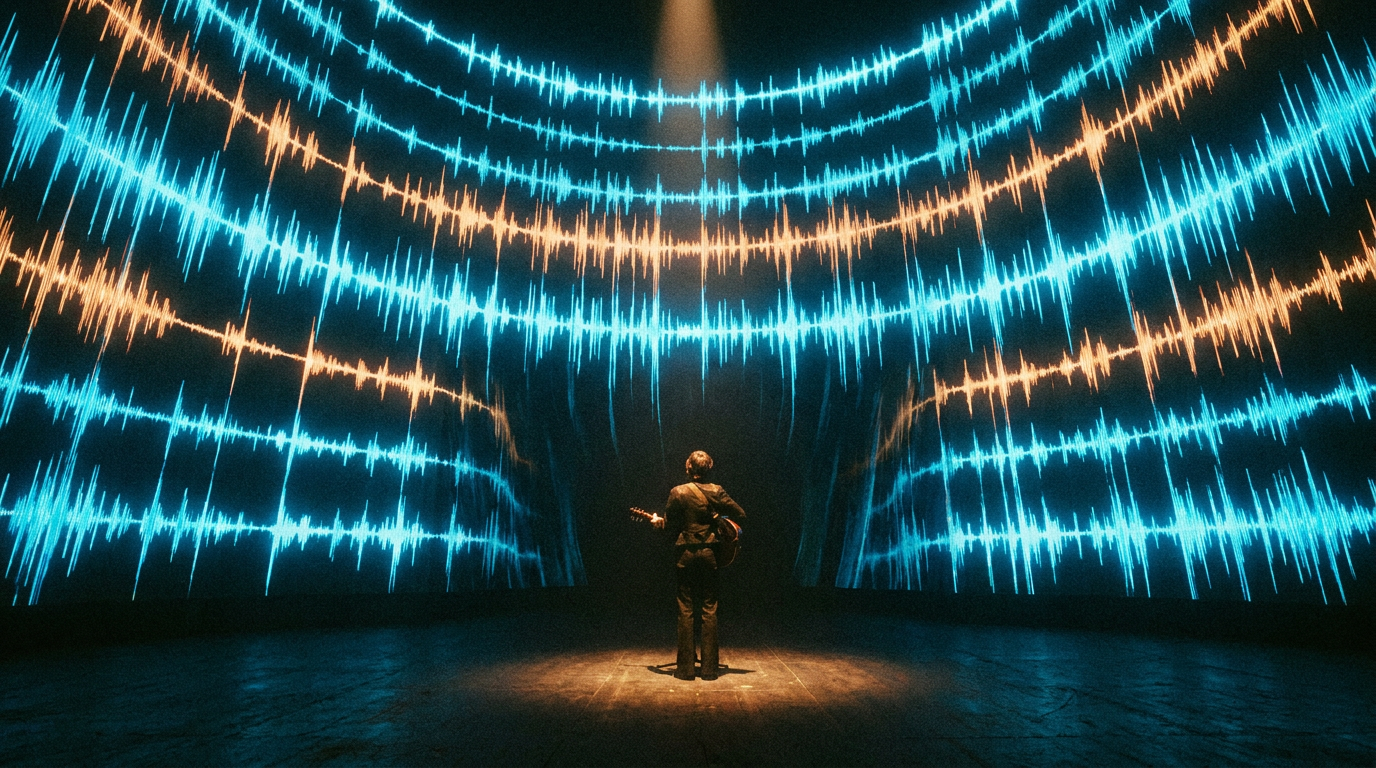
Real musicians have something bots never will: a visual presence. A face. A story. A world that extends beyond the audio waveform.
This is why music videos have never been more important than they are right now. Not as a marketing nice-to-have, but as proof of existence — proof that a living, breathing human is behind the music in your earbuds.
If you’re an indie artist competing against 2 million synthetic tracks a month, your music video is your ID card. Check out our complete guide to AI music videos in 2026 for a deeper dive into why this shift is happening.
How Smart Musicians Are Fighting Back
The irony is delicious: the best weapon against the AI music flood is AI-generated visuals. Not AI audio — AI video. Here’s why.
Traditional music video production costs $5,000 to $50,000+ and takes weeks. For independent artists who are already watching their streaming royalties get diluted by synthetic fraud, that’s an impossible ask. But AI-powered video tools have democratized visual production the same way home recording democratized audio production two decades ago.
The difference? AI video helps human artists stand out. AI music buries them.
With tools like OneMoreShot.ai, you can create a professional music video in minutes, not months. That means every single on your release calendar can have a visual identity. Every track can have a face, a mood, a world.
Whether you’re working in hip-hop, pop, indie, or R&B, the visual layer is what separates you from the noise. And right now, there is more noise than ever.
The Strategic Playbook for Surviving the Flood
Here’s what the 75,000-tracks-a-day reality actually means for your release strategy in the second half of 2026:
1. Never Release Audio-Only
Every release needs a visual component. A lyric video, a visualizer, a full music video — anything that anchors your track to a human identity. The days of uploading a track with a static cover image and hoping the algorithm finds your audience are over. Those algorithms are now drowning in 170,000 tracks a day.
Learn how to make an AI music video if you haven’t already. It’s the single highest-ROI skill you can develop right now.
2. Double Down on Visual Platforms
YouTube doesn’t have a synthetic music flood problem the way audio-only platforms do. Why? Because video is inherently harder to fake at scale. A bot can generate and upload 100 audio tracks in the time it takes to produce one convincing music video. That friction is your friend.
YouTube, TikTok, and Instagram Reels reward visual content from real creators. Lean into that.
3. Build a Visual Language for Your Artist Brand
The best defense against being mistaken for AI is having a distinct visual identity that fans recognize across platforms. Consistent color palettes, recurring visual motifs, a recognizable face and aesthetic — these are the things that bots can’t replicate at scale.
If you need inspiration, explore our genre-specific templates for EDM, rock, country, or lo-fi to find a visual starting point.
4. Be Transparent About Being Human
This might sound absurd, but in 2026, being loudly, proudly human is a marketing strategy. Show your process. Film your studio sessions. Let fans see the messy, imperfect, gloriously human work that goes into your music. The more AI-generated content floods the market, the more valuable authenticity becomes.
As one artist put it in a recent Yahoo Music interview: “It almost feels like the more artificial things become, the more people crave work that actually has a nervous system behind it.”
The Clock Is Ticking
The trajectory is unmistakable. From 10,000 AI tracks per day in January 2025 to 75,000 in April 2026 — and likely past the 50% threshold by the time you read this. The CISAC/PMP Strategy study projects 25% of creator revenues could be at risk by 2028. That may prove conservative if AI upload volumes continue their current trajectory.
Meanwhile, the industry response is fractured. Deezer is building detection tools. TIDAL is banning monetization. Spotify is shrugging and saying the flood makes their algorithms more important. Apple is asking uploaders to self-report. And most of the other platforms are doing… nothing.
You can’t control what Spotify does. You can’t stop people from generating 75,000 synthetic tracks a day. What you can control is how you present yourself to the world.
In an ocean of faceless, synthetic audio slop, a musician with a visual identity — a face, a story, a music video — isn’t just differentiated. They’re undeniable proof that real music still matters.
The bots are prolific. The audience isn’t interested. Make sure your audience sees you.
Ready to make your music undeniably human? Create a stunning music video in minutes with OneMoreShot.ai — and give your music the visual identity it deserves in the age of 75,000 daily AI tracks.