AI Music Hit 44% of All Uploads. Now What?
Three days ago, Deezer dropped a number that should make every musician sit up straight: 44% of all new music uploaded to their platform is now fully AI-generated.
That’s not a projection. Not a think-piece hypothetical. Deezer is now receiving almost 75,000 AI-generated tracks per day, representing roughly 44% of the daily uploads.
This amounts to more than 2 million AI-generated tracks uploaded per month.
And just days before that bombshell, an AI-generated song climbed to the top of the US and global iTunes charts — “Celebrate Me” by IngaRose, a synthetic R&B performer who does not exist in real life, created using Suno.
Meanwhile, Michael Smith of North Carolina pleaded guilty to one count of conspiracy to commit wire fraud for using AI-generated songs and bot streams to pocket over $8 million in royalties, with sentencing scheduled for July 29.
This isn’t the future anymore. This is this week. Let’s break down what’s actually happening and what it means for real musicians trying to make real music videos and build real careers.
The Deezer Bombshell: From 10,000 to 75,000 in 15 Months
The growth curve here is genuinely staggering. The new figures mark a sharp escalation from the 60,000 tracks per day the company reported in January, when synthetic content represented 39% of daily deliveries. It also marks a significant jump from the 50,000 AI tracks Deezer was receiving per day in November, 30,000 in September, and just 10,000 when it launched its patent-pending AI detection tool in January 2025.
Read that again. In just over a year, the daily volume of AI-generated music hitting one single streaming platform went from 10,000 to 75,000. That’s a 650% increase.
But here’s the plot twist that keeps this story from being a pure doomsday scenario: consumption of AI-generated music on the platform is still very low, between 1-3% of the total streams. In addition, a majority (85%) of these streams are detected as fraudulent and are demonetized by Deezer.
So nearly half of all new uploads are AI, but almost nobody is listening. And most of the “listening” that does happen is bots listening to other bots. As one writer memorably put it, “Deezer has flagged a staggering 85% of these AI streams as fraudulent. Essentially, bots are playing bots for bots, creating a hollow loop of financial drain rather than cultural enrichment.”
IngaRose: The Fake Artist Who Beat Real Ones
While Deezer was sounding the alarm about AI floods, something arguably more unsettling was happening on iTunes.
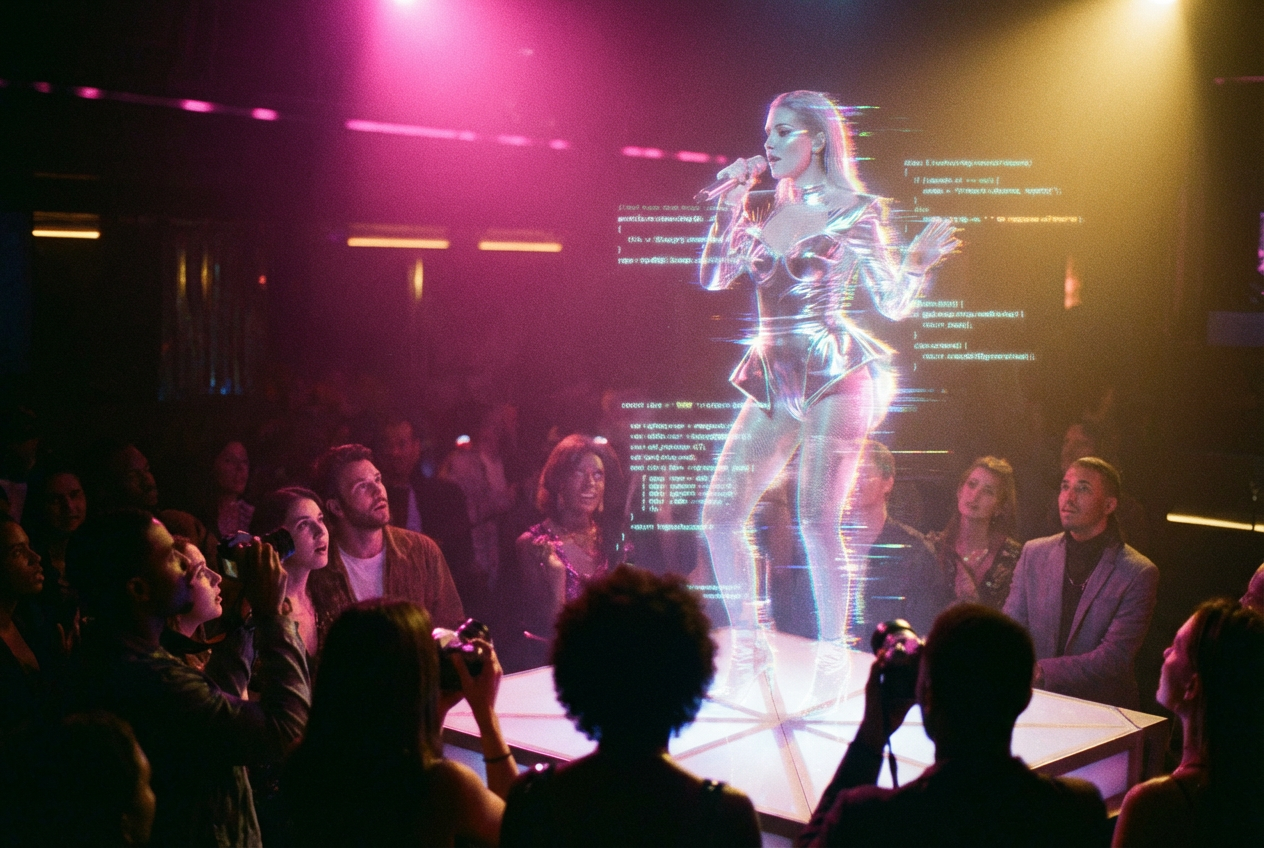
On April 17, 2026, the global iTunes chart had reached a new low: the number one song was performed by a singer who does not exist. By the end of the day, Olivia Rodrigo had fixed that. The song that “drop dead” displaced was “Celebrate Me” by IngaRose, an AI-generated R&B performer who does not exist. IngaRose has a full Apple Music artist page, a YouTube presence with dozens of videos, and 228,000 Instagram followers.
IngaRose has more than 240,000 followers and 1.4m likes on TikTok; 251,000 followers on Instagram; more than 90,000 subscribers on YouTube; and more than 942,000 monthly listeners on Spotify.
To be fair, there’s some nuance here. The project’s Spotify profile reveals that the human behind IngaRose is a songwriter called Ingrid for whom “this is her way of getting her work out into the world”.
The invitation to artists who want to record the songs or work with a songwriter emphasises the fact that this is a “Suno as calling card” strategy.
So is IngaRose a scam, an art project, or a legitimate new way for songwriters to showcase their work? The answer might be “yes to all three,” and that ambiguity is exactly what makes this moment so disorienting for musicians.
The $8 Million Crime That Proved the System Is Broken
If IngaRose lives in the gray area, Michael Smith’s operation was pitch black.
Smith admitted to inflating streaming numbers for hundreds of thousands of AI-generated songs by deploying thousands of fake accounts across major platforms, including Amazon Music, Apple Music, Spotify and YouTube Music. He worked with a co-conspirator and the chief executive of an AI music company to acquire a vast catalog of computer-generated tracks.
He used automated software to direct bot accounts to continuously play the songs, generating billions of streams between 2017 and 2024. To avoid detection, the activity was spread across thousands of tracks and routed through virtual private networks to mimic legitimate listeners.
The scheme netted him over $8 million — royalty payments that would otherwise have gone to legitimate artists and songwriters.
This wasn’t a victimless crime. Every dollar Smith siphoned from the streaming royalty pool was a dollar taken directly from real musicians. As U.S. Attorney Jay Clayton put it: “Michael Smith generated thousands of fake songs using artificial intelligence and then streamed those fake songs billions of times. Although the songs and listeners were fake, the millions of dollars Smith stole was real. Millions of dollars in royalties that Smith diverted from real, deserving artists and rights holders.”
How the Platforms Are Fighting Back (Sort Of)
Credit where it’s due: some platforms aren’t just wringing their hands.
Deezer remains the only major streaming platform to independently detect and tag AI-generated music at the platform level. Alongside the new data, Deezer has announced a fresh operational measure: the platform has now stopped storing hi-res versions of AI-generated tracks, on top of its existing policy of removing such content from algorithmic recommendations and editorial playlists.
Deezer began commercially licensing its AI detection technology in January this year, with French collecting society Sacem as its first partner. The company then rolled out the tool to third parties more widely in March.
Spotify launched its Artist Profile Protection feature in beta on March 24. It’s an approval stage that allows artists to review eligible music releases before they’re uploaded to Spotify, shielding them from AI impersonation and ensuring that listeners are streaming legitimate music.
Apple Music went a different route. Apple Music launched its Transparency Tags system in March, placing the onus on labels and distributors to declare AI-generated content at the point of delivery.
And Bandcamp, in characteristically punk fashion, just banned AI-generated music entirely.
But here’s the uncomfortable truth: it’s hard to imagine competitors like Spotify, Apple Music, and Amazon Music aren’t facing similar pressures to what Deezer is publicly reporting. Deezer is just the only one being transparent about it.
The Revenue Apocalypse Nobody’s Ready For
This isn’t just about chart positions or philosophical debates. It’s about money.
According to a study conducted by CISAC and PMP Strategy, nearly 25% of creators’ revenues are at risk by 2028, which could amount to as much as €4 billion by that time. This represents a colossal, even critical, challenge for the music creation sector as a whole.
And the public? 97% of people couldn’t hear the differences between AI and human made music, and 80% of people agree that 100% AI-generated music should be clearly labeled to listeners.
That’s the paradox: people can’t tell the difference, but overwhelmingly think they should be told. The technology has outrun our ears, and now our policies need to catch up to our ethics.
What This Means for Independent Musicians
If you’re an indie artist reading this and feeling the existential dread creeping in, let me redirect your energy toward something productive.
The AI flood is primarily an audio problem — millions of faceless, contextless tracks uploaded to game streaming economics. The antidote isn’t trying to out-produce the machines. It’s building something machines fundamentally can’t replicate: a visual identity, a personal brand, and a real connection with your audience.
This is exactly why music videos have become more important than ever. When every SoundCloud rapper and Suno bot can flood Spotify with passable audio, the artist who shows up with a compelling visual story wins the attention war. And with tools like AI music video generators, you don’t need a $50,000 budget to compete visually.
The Visual Advantage
Think about it: a bot can upload 75,000 audio tracks a day, but it’s not creating coherent multi-shot music videos with narrative arcs. It’s not showing personality on camera. It’s not building the kind of visual brand that makes fans say “that’s my artist.”
Whether you’re making hip-hop visuals with cinematic street scenes, dreamy lo-fi loops with hand-drawn aesthetic, or R&B mood pieces that capture the vibe of your track — the visual layer is your proof of humanness in a sea of synthetic audio.
Protect Your Identity
Numerous jazz musicians, including American pianist Jason Moran, and Danish musicians Carsten Dahl, Thomas Blachman, and Chris Minh Doky, face a deluge of AI-generated tracks — often entirely unrelated to their own work — uploaded to their official streaming profiles without consent. “There’s not even a piano player on this whole damn record,” Moran remarked on a fake EP that appeared on his Spotify profile.
If you haven’t already, turn on Spotify’s Artist Profile Protection beta. Claim and monitor your profiles across every platform. And start building a visual catalog that makes your authenticity unmistakable.
Use AI as a Tool, Not a Crutch
Here’s where things get nuanced. The same AI technology that enables fraud also enables genuine creative breakthroughs. Several songwriters acknowledge that they’re seeing their peers use AI platforms like Suno more frequently. Career songwriter Autumn Rowe says many of her peers have used Suno to make demo productions of songs they wrote and have managed to get those songs placed with recording artists. Once an artist takes it, the demo is produced by an actual producer.
The smart move isn’t to reject AI entirely — it’s to use it where it accelerates your creative process while keeping your human artistry front and center. Use AI to create stunning music videos for tracks you wrote and performed. Use it to visualize concepts faster. Use it to compete with artists who have ten times your budget.
Just don’t let it replace the thing that makes your music yours.
The Bottom Line
We’re at an inflection point that arrived faster than anyone predicted. Deezer’s disclosure reveals a music industry inflection point that’s arrived faster than anyone expected. AI-generated content isn’t a future problem — it’s already dominating upload queues and forcing platforms to choose between openness and quality control.
The 44% number is shocking, but here’s what gives me hope: despite the massive influx of AI tracks averaging roughly 75,000 new uploads per day, actual listener engagement remains disproportionately low. Statistics show that these tracks currently represent only 1% to 3% of total streams. This gap suggests that while generative tools have made it easier to saturate the market with automated music, these tracks have yet to capture a meaningful share of the listening audience’s attention.
People still want real music from real artists. They just need help finding it through the noise. And the best way to cut through that noise? Show your face. Tell your story. Make the visual.
If you’re ready to turn your tracks into music videos that prove you’re the real deal, OneMoreShot.ai lets you create professional AI-powered music videos in minutes — no film crew, no five-figure budget, no bots required. Just your music, your vision, and the visual identity that no algorithm can fake.