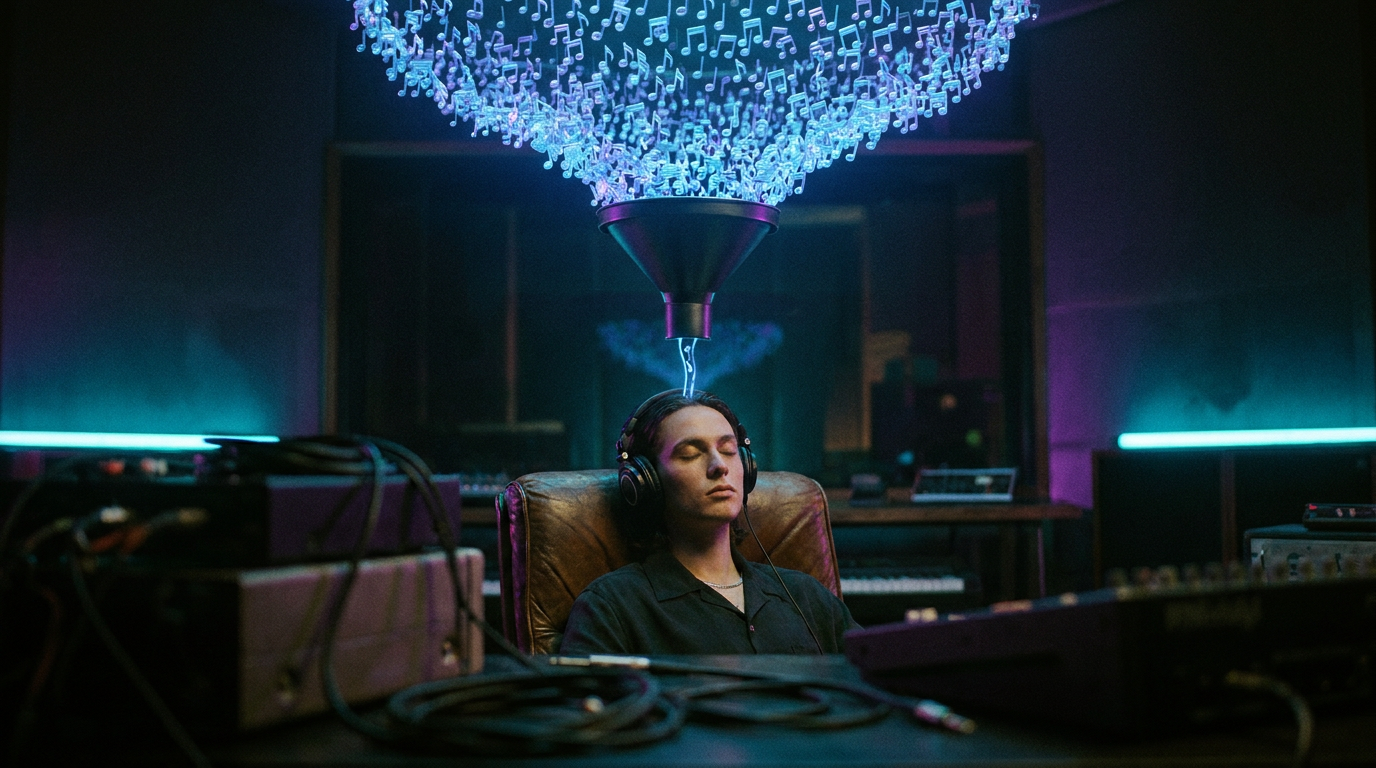
AI Music Is 33% of Uploads but 0.5% of Plays
The most important number in music right now isn’t a chart position, a streaming payout, or a valuation. It’s a ratio: 33% to 0.5%.
In May 2026, Apple Music’s senior vice president of music Oliver Schusser publicly disclosed that more than 33 percent of new uploads to Apple Music are now fully AI-generated, yet AI tracks account for less than 0.5 percent of total listening time on the platform.
Read that again. One-third of everything being uploaded. Almost none of it being played.
If you’re an independent musician who’s been staring at the AI tidal wave wondering whether you’re about to get washed away — this is the data that should let you breathe again. And more importantly, it should change how you think about your strategy for the rest of 2026.
The Supply-Demand Gap Nobody Expected
We’ve spent the last two years hearing that AI music would drown out human artists. That the sheer volume of AI-generated tracks would make it impossible for real musicians to compete. That the streaming platforms would be so flooded with synthetic content that listeners would never find your stuff.
The flooding part? That’s happening. Apple Music receives roughly 100,000+ new tracks per day across its distribution partners. A 33 percent AI share implies 33,000+ synthetic tracks uploaded daily to Apple alone.
And Apple isn’t even the worst hit. Deezer reports receiving approximately 60,000 AI-generated tracks per day, roughly 39 percent of all uploads.
Deezer’s 2025 transparency report put AI uploads at roughly 50 percent of new daily uploads.
But here’s where the narrative falls apart: AI uploads are flooding streaming services. AI listening is flatlining. The gap between supply and demand is the biggest story in 2026 music streaming.
Listeners simply don’t want AI music. Not yet. Maybe not ever — at least not the way it’s currently being produced.
Why Nobody Is Pressing Play
A fascinating piece of academic research helps explain what’s happening. Researchers Jana Friedrichsen, Julia Schwarz, and Michel Clement explored how generative AI will change the music industry. They found that while consumers enjoy and even prefer AI-generated music, preferences shift upon learning that the song was AI-generated.
This is the AI music paradox: the music itself can sound perfectly fine — but the moment someone knows it was made by a machine, they lose interest. People are less willing to pay for AI-generated music. The emotional connection evaporates. The “story” behind the song disappears.
It turns out that human listeners want human music. They want to know there’s a person behind the sound — someone who felt something, went through something, chose every note for a reason. That’s what streaming data is screaming at us right now.

The Platforms Are Taking Sides
What makes this moment even more significant is how the streaming platforms are responding. They’re not treating AI music as just another format. They’re actively building walls.
Apple Music’s Schusser disclosed that the company has developed in-house technology to identify the AI models used in music submissions. Apple will also introduce ‘Transparency Tags’, a metadata system allowing labels to disclose whether AI was used in a song’s production.
Deezer has taken the most aggressive approach. The platform uses proprietary detection technology to automatically identify AI-generated music and excludes it from algorithmic recommendations and editorial playlists.
Their stance is clear: AI music can exist on the platform, but it will not be promoted alongside human-created music.
Even Spotify, which has been the least transparent about its AI data, has been quietly cleaning house. Spotify has removed millions of AI-generated tracks in the past year under its updated content policy.
The message from every major platform is the same: if you’re making real music, you are more valuable than ever. The platforms need you, because you’re what keeps listeners subscribed.
What This Means for Your Music Video Strategy
Here’s where this gets tactical. If streaming platforms are actively deprioritizing AI music while human-made music holds its value, your biggest competitive advantage isn’t just making better music — it’s proving you’re real.
And nothing proves authenticity like visual content.
Think about it: an AI can generate a three-minute track in seconds. But a music video with a consistent visual identity, a narrative that matches your artistic vision, scenes that feel genuinely connected to the emotion of your song? That’s the kind of content that signals to listeners — and to algorithms — that there’s a real artist here.
This is exactly why tools like OneMoreShot.ai exist. You don’t need a $50,000 production budget to create a stunning music video. But you do need visuals that tell your story. If you’re looking for a starting point, our complete guide to AI music videos breaks down the entire process, and our step-by-step guide on how to make an AI music video walks you through it from upload to export.
The irony is delicious: the best response to the AI music flood is to use AI for your visuals while keeping your music authentically human. AI-generated video enhances a human song. AI-generated music replaces the human entirely. One builds your brand. The other commoditizes it.
The Global Dimension: China Is a Warning
If you think the AI upload flood is a problem in the West, China is a glimpse of what happens when it goes completely unchecked.
The Chinese music streaming market is facing “industry chaos” due to platforms allowing masses of copyright-infringing, AI-made tracks to fill up their catalogs. That’s the verdict of Tencent Music Entertainment’s Executive Chairman, Cussion Pang, and CEO, Ross Liang, delivered during TME’s Q1 2026 earnings call on Tuesday (May 12). Their comments represent one of the most direct warnings yet from industry leaders over the damage AI-generated content is doing to streaming subscription businesses in China.
Tencent Music’s CEO didn’t mince words. Liang accused competitors of using infringing AI content “to quickly fill their music libraries” in a bid to attract users. He called the practice “an exhaustion of the economic value of this industry.”
Tencent’s leadership declared: “Strengthen enforcement to prevent AI from becoming an excuse for infringement. In response to industry chaos, we have established a dedicated rights protection mechanism to resolutely safeguard the legal interests of our platform, copyright owners and creators. We welcome tech innovation, but we’ll do everything in our power to suppress song washing and other infringing behaviors.”
“Song washing” — that’s the term you need to know. It’s the AI equivalent of money laundering: taking copyrighted material, running it through an AI model, and pumping out “new” tracks that sound suspiciously similar to the originals. It’s happening at industrial scale, and it’s why platforms are scrambling to build detection tools.
The Licensed AI Future Is Here
The industry’s answer to the chaos isn’t to ban AI entirely — it’s to put it on a leash.
One of three major labels is officially done fighting AI music — Warner Music Group is instead partnering with Suno, the biggest AI-music platform.
Under the deal, Suno will replace its current models with licensed alternatives in 2026. Warner’s artists and songwriters will have full control over whether and how their voices, names, likenesses, and compositions appear in AI-generated music.
Meanwhile, Believe is partnering with Google to offer the tech giant’s AI music creation platform, Google Flow Music, to artists across Believe and TuneCore. Under the deal, Believe will offer Flow Music — the Google Labs-housed AI music tool formerly known as ProducerAI — to its artists, producers and songwriters as what the companies describe as a “creative collaborator.”
Believe’s CEO described the strategy as a two-pronged approach: the company is automatically blocking the distribution of AI-generated tracks produced on unlicensed “pirate studios” — while simultaneously investing in what it calls “value-creative AI” tools designed to enhance artist creativity.
This is the future taking shape: AI as a creative tool for artists, not a replacement for them. The distinction between “AI-assisted” and “AI-generated” is becoming the defining line of the industry.

The Royalty Pool Math Actually Works in Your Favor
Here’s the part that should genuinely reassure you. If AI tracks are 33 percent of the catalog but generate 0.5 percent of streams, then 99.5 percent of the pool still flows to the 67 percent of uploads that are human-made. Per-stream payouts to human artists do not get diluted by AI flooding the catalog, at least not at current consumption levels.
The fear was always that AI music would steal your streams. Right now, it’s just stealing shelf space — and nobody’s browsing that shelf. Your per-stream payout is essentially unaffected because AI tracks aren’t competing for actual listener attention.
But this doesn’t mean you can sit back. The data also shows something important about what separates the AI tracks that do get played from the ones that don’t: AI-generated tracks show up in roughly 18 percent of independent catalogs audited, but underperform human releases by 25 to 40 percent on save rate and 15 to 25 percent on completion rate.
Save rate and completion rate. Those are the engagement metrics that matter, and they’re where human music dominates. When someone saves your song to their library, that’s a signal of genuine connection. When they listen all the way through, that’s attention you’ve earned. AI tracks get skipped. Human tracks get saved.
Your 2026 Playbook: Stand Out in the Flood
So what should you actually do with this information? Here’s the strategic play:
1. Double Down on Visual Identity
Every genre has its visual language. Whether you’re making hip-hop, EDM, or indie, consistent visuals across your releases signal authenticity and artistic intentionality — exactly the qualities that separate you from the AI flood.
2. Embrace AI Where It Helps You
Using AI to create music videos, generate social content, or design album artwork isn’t the same as using AI to replace your songwriting. The platforms know the difference. Your fans know the difference. Use AI tools to amplify your human creativity, not to substitute for it.
3. Be Transparent About Your Process
With Apple rolling out Transparency Tags and Deezer flagging AI content automatically, transparency isn’t optional anymore — it’s a competitive advantage. If your music is human-made, say so. Loudly. Make it part of your brand.
4. Focus on Engagement, Not Just Streams
The data is clear: save rates and completion rates are where human music crushes AI. Create content that encourages saves — storytelling in your music videos, behind-the-scenes content, anything that deepens the listener’s connection to your art.
5. Release Consistently With Visuals
A song without a video in 2026 is invisible. Full stop. The platforms are prioritizing video content, and a music video is the strongest signal you can send that you’re a serious, invested artist. Explore genre-specific templates for pop, R&B, or rock to build a visual catalog that matches your sonic identity.
The Bottom Line
The AI music flood is real. The numbers are staggering. But the most important statistic in the entire conversation is the one that gets the least attention: almost nobody is actually listening to it.
The supply of AI music is exploding. Listener demand for it is not.
That’s not a crisis for human musicians. That’s a moat.
Your job in 2026 isn’t to outproduce AI — you’ll never win that game. It’s to out-connect. Make music that humans want to save, share, and come back to. Pair it with visuals that tell your story. Build a presence that no algorithm can generate.
Ready to build that visual presence? Start creating your AI music video with OneMoreShot.ai and turn your human-made music into something listeners — real, human listeners — can’t scroll past.