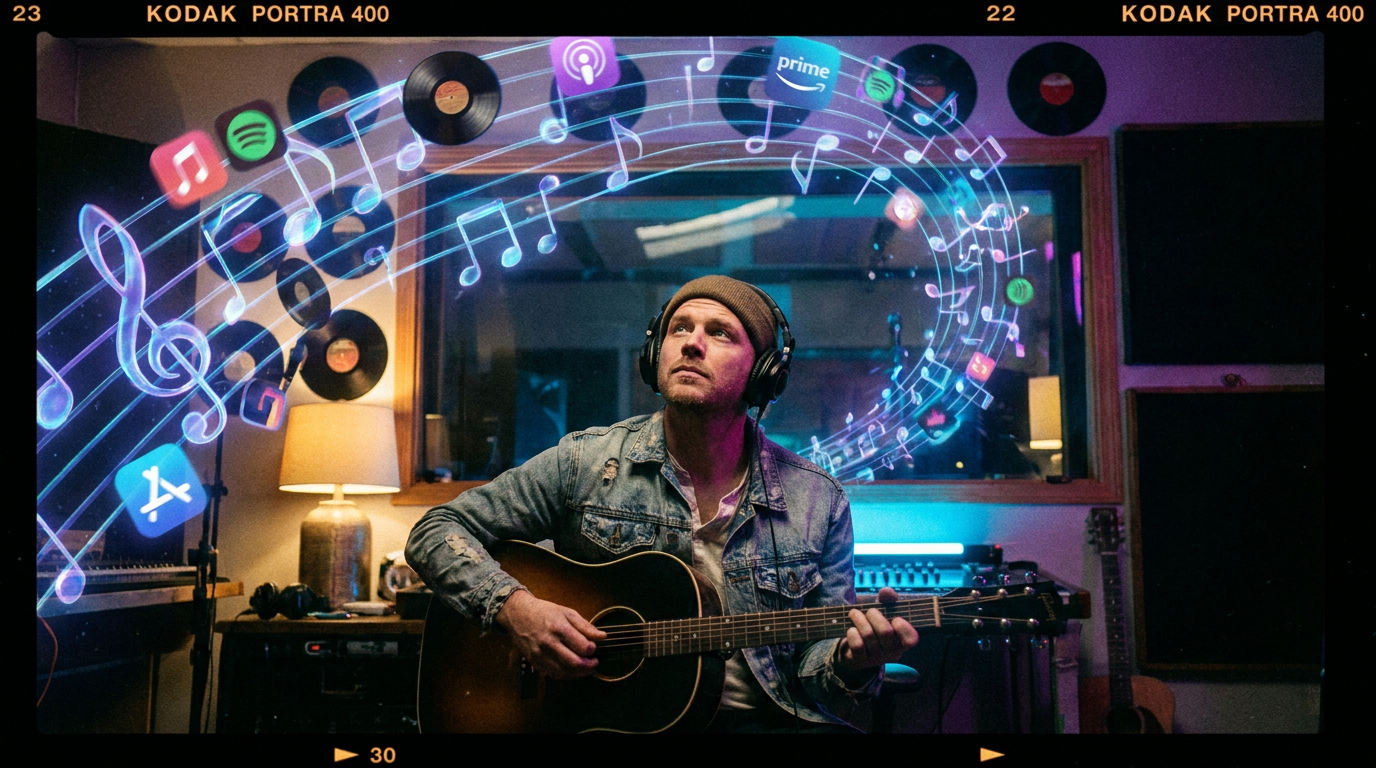
AI Music Now Half of All Streaming Uploads
The numbers dropped this month like a bomb on the music industry, and if you’re an indie musician trying to build an audience in 2026, you need to pay attention.
Deezer is now receiving almost 75,000 AI-generated tracks per day, representing roughly 44% of the daily uploads.
That amounts to more than 2 million AI-generated tracks uploaded per month. Days later, Apple Music VP Oliver Schusser confirmed that more than a third of tracks delivered to the service are “100% AI,” but listening remains below 0.5%. And Spotify’s Sten Garmark revealed that the platform removed “over 25 million AI tracks” in the last year.
Let that sink in. Nearly half of all new music hitting streaming platforms isn’t made by humans anymore. And the gap between what’s uploaded and what’s actually listened to tells us something fascinating — and ultimately hopeful — about where real musicians fit into this AI-saturated future.
The Scale Is Staggering (and Accelerating)
If you’ve been watching the AI music space casually, you might think this is a gradual trend. It’s not. It’s exponential.
Deezer reported receiving around 60,000 AI tracks per day in January, up from 50,000 in November, 30,000 in September, and just 10,000 in January 2025, when it first launched its AI-music detection tool. That’s a 7.5x increase in just over a year. At this trajectory, AI-generated uploads will outnumber human-created music on every major platform before the end of 2026.
Deezer reported that AI-generated uploads grew from 28% in 2025 to over 40% by early 2026. And that’s just one platform. Spotify has removed 25 million AI-generated tracks over the past year , but the flood keeps coming.
The driving force? Tools like Suno and Udio that let anyone generate a fully produced track from a text prompt in under 60 seconds. Generative AI and stem separation tools have seen revenue rocket 651% between 2023 and 2025, reaching $333 million USD in 2025 with 63 million monthly active users. That’s a lot of people making a lot of music.
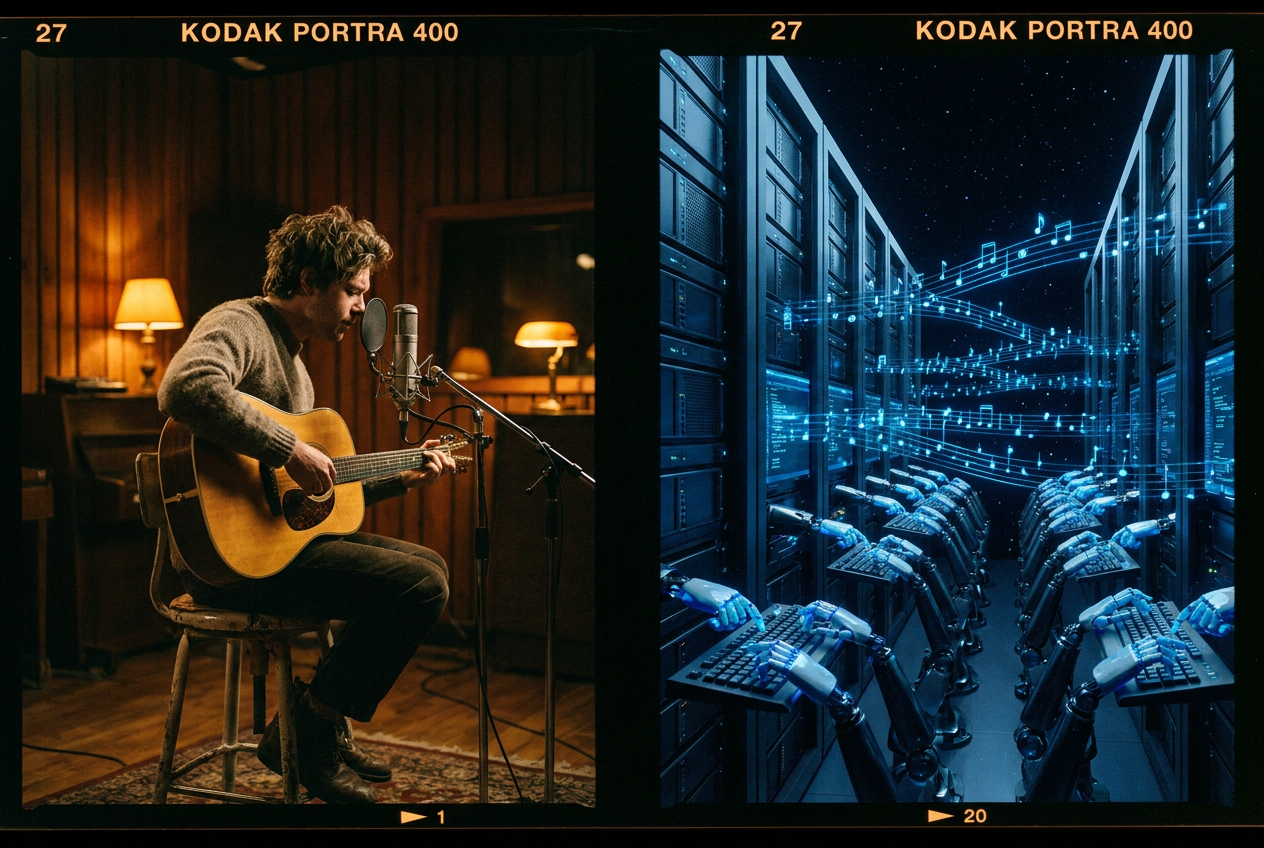
Nobody’s Actually Listening to the AI Slop
Here’s the plot twist that should make every human musician breathe a sigh of relief: consumption of AI-generated music on Deezer is still very low, between 1-3% of the total streams. On Apple Music, Schusser revealed that “the usage of the AI music on Apple Music is really tiny. I’m rounding but it’s below 0.5% of usage.”
So we’ve got a situation where AI tracks represent nearly half of all uploads but less than 3% of what people actually listen to. That’s an absurd supply-demand mismatch — and it tells us something important: people still want music made by real humans.
The problem isn’t that AI is replacing real music. The problem is that it’s cluttering the path between real musicians and real listeners.
This gap highlights a clear trend: while creators are embracing AI for music production, audiences still show a strong preference for human-made content. And the research backs this up — Deezer commissioned a study that revealed 97% of people couldn’t hear the differences between AI and human-made music, and that 80% of people agree that 100% AI-generated music should be clearly labeled.
People can’t tell the difference by ear, but they still care about the difference in principle. That’s a profound insight for any musician thinking about their brand and authenticity in 2026.
The Fraud Problem Is Worse Than You Think
Let’s talk about why all this AI music exists in the first place. It’s not because 75,000 aspiring musicians a day are having a creative breakthrough with Suno.
A majority (85%) of these streams are detected as fraudulent and are demonetized by Deezer. The vast majority of AI-generated uploads exist for one reason: to game the royalty pool. Bot farms generate tracks, bot farms stream them, and real artists lose money.
According to a study conducted by CISAC and PMP Strategy, nearly 25% of creators’ revenues are at risk by 2028, which could amount to as much as €4 billion. This represents a colossal, even critical, challenge for the music creation sector as a whole.
Apple Music has implemented a fraud penalty where “if we catch someone, then we actually take the money and put it back in the pool. We need to monitor AI music because there’s a correlation between AI and fraud.”
Apple has seen a “60% reduction” in fraudulent uploads after implementing the penalty.
This is why the platforms are fighting back — not because they hate AI, but because the economics of streaming fraud threaten the entire ecosystem.
How the Big Platforms Are Responding
Every major platform is now treating the AI flood as an existential priority. Here’s where they each stand:
Deezer: The Industry’s Canary in the Coal Mine
Deezer started tagging AI tracks at the platform level in June 2025, becoming the first streaming platform to do so.
Songs tagged as AI-generated on Deezer are automatically removed from algorithmic recommendations and not included in editorial playlists.
The platform has now stopped storing hi-res versions of AI-generated tracks, on top of its existing policy of removing such content from algorithmic recommendations and editorial playlists.
Deezer began commercially licensing its AI detection technology in January this year, with French collecting society Sacem as its first partner. The company then rolled out the tool to third parties more widely in March.
Apple Music: Secret Tech, Transparency Tags
Schusser revealed: “We have developed — and we’ve never talked about this — but we’ve developed technology in-house that would allow us to exactly see what music people are delivering us, what AI [model] it is and all that.”
Apple’s new system, called “Transparency Tags,” is intended to record where AI has been used across four parts of a release: the sound recording, the composition, the artwork, and the music video. It’s voluntary for now, but the writing is on the wall.
Spotify: 25 Million Removed and Counting
Since sharing its initial approach to AI transparency, Spotify launched a beta feature on April 16 that allows artists to share how they’ve used AI in their music. Where artists have chosen to disclose through their label or distributor, listeners will see credits for specific contributions like vocals, lyrics, or production.
A software developer named Cedrik Sixtus has built an ‘AI blocker’ that labels and filters out AI-generated tracks from listening sessions. The fact that users are building their own AI filters tells you everything about how frustrated listeners are becoming.
Meanwhile, AI Music Just Got Its Own Collecting Society
In perhaps the most surreal development of 2026, Aimpro is pitching itself as “the first PRO designed to serve creators of generative AI works, allowing AI music creators to collect royalties for their work on a global basis.”
One of Aimpro’s co-founders is Steve Stewart, a veteran music manager — including Stone Temple Pilots back in the day — as well as CEO and co-founder of music-tech firms Vezt and SongHub. The other is Joe Berman, who also co-founded SongHub with Stewart, with 25 years in publishing, sync and licensing experience.
Current reporting says AIMPRO includes a free entry level, takes a 15% fee on collected income, and offers a $9.99 per month Pro tier tied to marketplace access.
The reaction from the music community has been… polarized, to put it gently. AIMPRO is attempting to legitimise AI-generated music by advocating for prompters to be treated as creatives entitled to compensation. But these prompters are generating music using systems built on the work of human musicians. They are using words to produce outputs that rely entirely on pre-existing creative labour.
Whether you find this exciting or enraging probably depends on which side of the AI divide you sit on.

What This Means for Real Musicians in 2026
Okay, so the streaming landscape is a dumpster fire of AI slop. What do you actually do about it?
1. Double Down on Visual Identity
Here’s the thing about AI-generated music: it’s faceless. There’s no artist story, no visual world, no persona. That’s precisely why it accounts for nearly half of uploads but almost none of the engagement. Listeners connect with people, not algorithms.
This is where creating a strong visual identity becomes your unfair advantage. An AI music video paired with a human-made track is the exact opposite of AI slop — it’s a real artist using technology to amplify their creative vision.
The irony is delicious: AI video tools are actually more valuable for human musicians than AI music tools are for non-musicians. When you use AI to create visuals for music you actually wrote and performed, you’re enhancing authenticity rather than replacing it.
2. Build a Visual Catalog That Streaming Fraud Can’t Touch
Bot farms can generate 75,000 tracks a day. They cannot generate compelling, story-driven music videos that build a fanbase. If you’re an indie artist competing for attention in the age of AI slop, having a visual presence for every release is no longer optional — it’s survival strategy.
Whether you’re making hip-hop visuals, EDM content, indie aesthetic pieces, or lo-fi visual loops, the point is the same: visual content is proof of creative intent. It tells the algorithm — and the listener — that there’s a real artist behind this track.
3. Use AI Transparency to Your Advantage
Spotify’s immediate goal is to give artists who use AI tools creatively a way to share that process with listeners. As transparency tags roll out across all platforms, the artists who are open about how they use AI — and where they draw the line — will build more trust than those who hide it.
If you use AI to generate your music video but write every note yourself, say so. That combination of human artistry and AI visual tooling is the sweet spot where technology serves creativity instead of replacing it.
4. Don’t Panic — The Platforms Are On Your Side (For Once)
Every major streaming platform is now actively fighting AI slop because it threatens their business model. When fake tracks dilute the royalty pool and frustrate listeners, everyone loses — including the platforms. The measures being deployed right now (detection tools, transparency tags, fraud penalties, demonetization) will continue to get more aggressive.
The platforms’ incentives are finally aligned with human musicians’ interests. That’s rare, and it’s worth appreciating.
The Bottom Line
The current data underscores a market that is physically dominated by AI output but still intellectually and emotionally led by human artistry.
That single sentence is the most important thing any musician can internalize right now. Yes, the numbers are alarming. Yes, nearly half of all new music is AI-generated. But listeners don’t care about volume — they care about connection, story, and authenticity.
The musicians who will thrive in this environment aren’t the ones hiding from AI. They’re the ones using AI tools strategically — for visuals, for promotion, for expanding their creative reach — while keeping the music unmistakably human.
Your track doesn’t need to compete with 75,000 AI songs a day. It needs to connect with the humans who are already ignoring them.
If you’re ready to give your human-made music the visual treatment it deserves, OneMoreShot.ai lets you create stunning music videos in minutes. Because in a sea of faceless AI slop, the artists who show up with a visual world are the ones who get remembered.