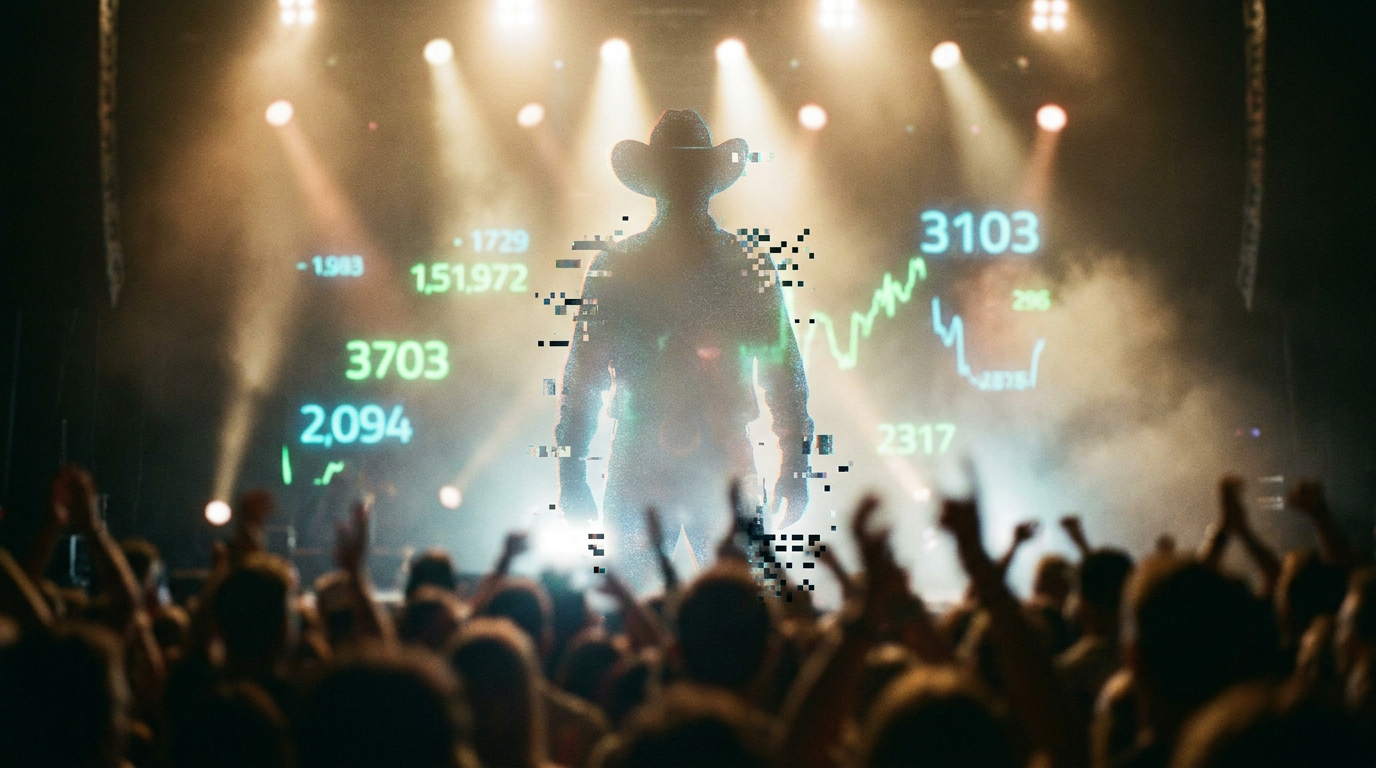
AI Phantom Artists Are Gaming the iTunes Charts
You’ve never heard of River Cain. Neither has anyone at America’s Got Talent — even though his “audition” footage has been watched by millions.
River Cain is a country music act with five singles on the iTunes chart, 12 YouTube videos, a debut album on preorder, and a full social media presence. He also doesn’t exist. River Cain is an AI-created act with no human performer behind the voice.
The songs, the artist photo, and the videos were generated by an unidentified operator. The act does not hide this — its TikTok and Instagram profiles carry AI persona labels, and the cover art reads as AI on sight.
But here’s where it gets weird. And kind of scary.
The operator posted Instagram videos showing River Cain performing for the America’s Got Talent judges and an audience. No such appearance happened.
That’s not a fictional backstory. That’s a fabricated event involving real people, a real show, and a real broadcast — and the deepfake footage is convincing enough that casual viewers have no reason to question it.
River Cain is the latest in a growing wave of AI phantom artists that have been systematically gaming the iTunes charts throughout 2026. And the playbook is evolving in ways that should concern every real musician.
The iTunes Vulnerability
To understand how a nonexistent artist can chart, you need to understand how iTunes works in 2026. The iTunes chart counts purchases. Buy a few thousand downloads and you can land in the top 5, which is why manufactured acts keep choosing it over Spotify or Apple Music streaming counts. Sustained listening from thousands of real accounts costs far more to fake.
This is the fundamental exploit. Spotify’s algorithmic recommendations, playlist placements, and streaming metrics are hard to game at scale. iTunes, on the other hand, still runs on a simple download-purchase model. And that’s an open invitation.
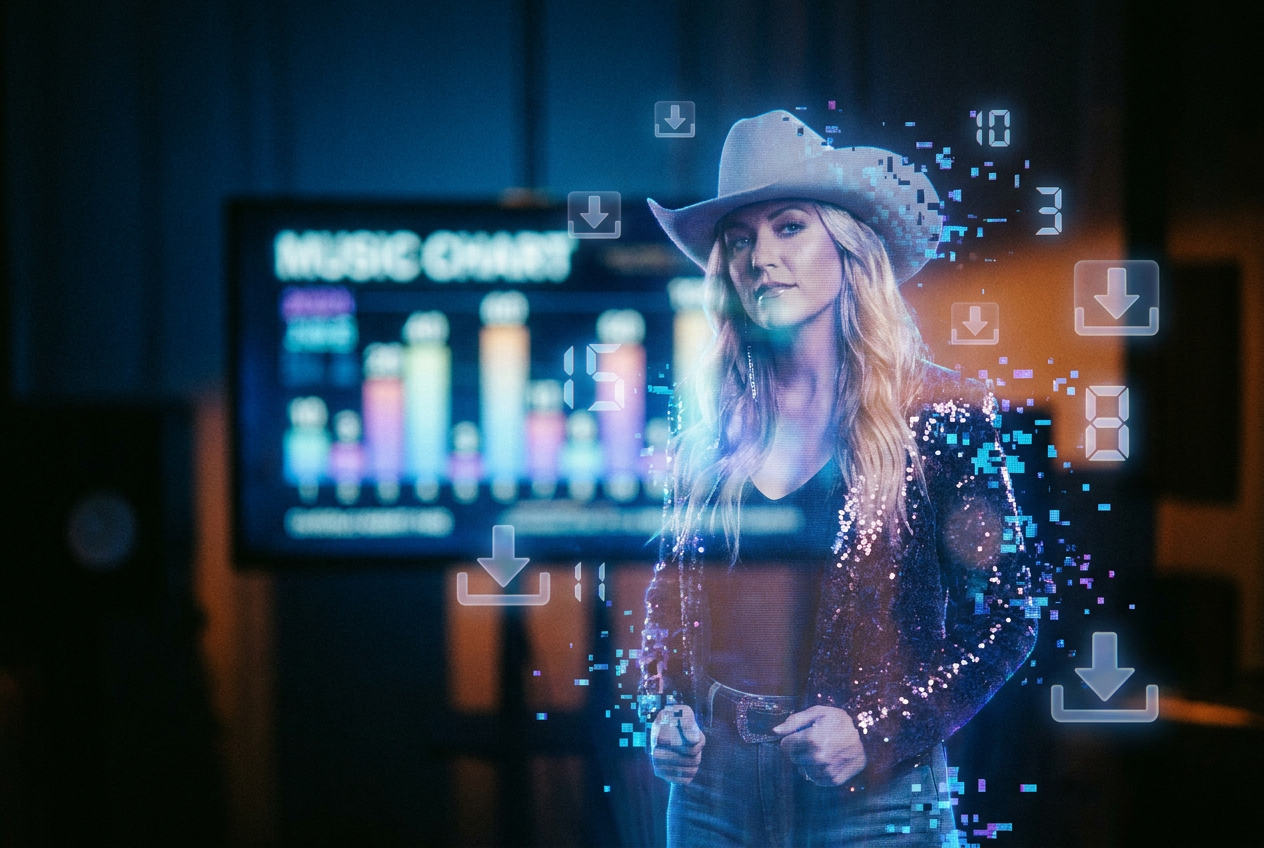
River Cain holds 5 singles on the iTunes chart, with “Hell Out of Me” at No. 3 and “Mama’s Boy” at No. 4. Roger Friedman reported the act on August 16, 2026 and read the chart run as manufactured. The songs went up around December 2025 and April 2026 and sat there. They only started climbing this month.
Around the songs sits an entire promotional infrastructure. Twelve videos filed under the name on YouTube. A credited label, Storm Records, with no verified roster. Instagram clips presenting River Cain as a singing-competition contestant.
It’s not just one track that got lucky. It’s a full-scale content operation.
The Deepfake Talent Show Problem
This is where River Cain crosses a line that previous AI phantom artists didn’t.
An invented backstory asks you to enjoy a fiction. A talent-show clip asks you to believe a specific event happened: a named show, a named panel, a taping date, a room full of people. A viewer scrolling past has no way to check any of it, and the clip is convincing enough that they will not think to.
Lore is invented. A credit is earned, and this one was not. A human singer faking the same footage would be doing the same damage, which is how I know my objection has nothing to do with the AI.
This is the part that should make musicians pay attention. We’ve moved past the phase of “AI-generated music floods the charts” into something more sophisticated: AI-generated artists with AI-generated proof of accomplishments that never happened. The fabricated social proof makes the whole operation more convincing, and it makes it harder for platforms and audiences to distinguish real artists from phantom ones.
The fake AGT clips aren’t isolated. Someone created a completely fake America’s Got Talent performance using AI, and it’s blown up online. The video looks like a real contestant singing in front of the judges and studio audience, but none of it actually happened. Every person, every reaction, every note — it’s all generated by artificial intelligence.
This one fake video got 44 million impressions and half a million likes. That’s more engagement than most real America’s Got Talent performances get on YouTube.
Let that sink in. A fake performance of a fake person on a fake stage is outperforming real performances by real artists on the actual show.
River Cain Didn’t Invent This Playbook
River Cain is the latest chapter in a 2026 story that’s been accelerating all year. The template was established by Dallas Little, a content creator from Greenville, South Carolina, who has been running AI phantom artists on iTunes like a one-person label.
Eddie Dalton doesn’t exist, yet this AI-generated phantom occupies 11 spots on the iTunes Top 100 singles chart and claims the #3 album position. According to Luminate, Eddie’s digital dominance comes from just 6,900 actual track sales — exposing exactly how thin the iTunes charts really are.
Dallas Little operates this musical mirage from Greenville, South Carolina, through his Crunchy Records label. Using AI for everything — songwriting, vocals, visuals, and videos — Little transforms prompts into chart-toppers faster than you can say “streaming algorithm.” While traditional artists spend months crafting albums, his AI assembly line cranks out tracks in hours, not weeks.
And Eddie Dalton was just the start. IngaRose is an artificial intelligence–generated musical act that briefly topped the United States and global iTunes sales charts in April 2026 with the song “Celebrate Me.” Presented online as a female R&B and soul vocalist, the project has no corresponding real-life performer; its music is produced using the generative AI platform Suno. Journalistic investigations have attributed IngaRose, along with a number of other virtual artists, to a South Carolina–based producer named Dallas Little.
AI music and fake artists continue to flood the iTunes Top 100. Currently 10 chart positions are occupied by an AI content creator who continues to infiltrate the system. Three of them are by something called Soul Archive Room, three more from Eddie Dalton, two from Inga Rose, one from Blu Monroe, another from Benny Rivers. They’re all fake. They also have a similar signature which makes them look like they’re coming from Dallas Little’s Crunchy Records.
Whether River Cain is also a Dallas Little creation remains unclear. River Cain follows a slew of fake artists who’ve already wasted chart positions on iTunes this year. It’s unclear who his creator is, or if he’s also from the world of Dallas Ray Little, who invented Eddie Dalton.
Why This Matters for Real Musicians
If you’re reading this and thinking “this doesn’t affect me, I’m on Spotify and Apple Music streaming” — you’re partially right and partially wrong.
You’re right that streaming platforms are harder to game. Spotify’s Verified badge system and AI Persona labels are specifically designed to flag these acts. And the detection infrastructure is getting better across the board.
But here’s the thing: the phantom artist playbook erodes trust in the entire ecosystem. When audiences start wondering whether every new artist they discover is real or generated, it creates a credibility tax that every musician pays. The burden of proving you’re human shouldn’t be part of being a musician, but that’s exactly where we’re heading.
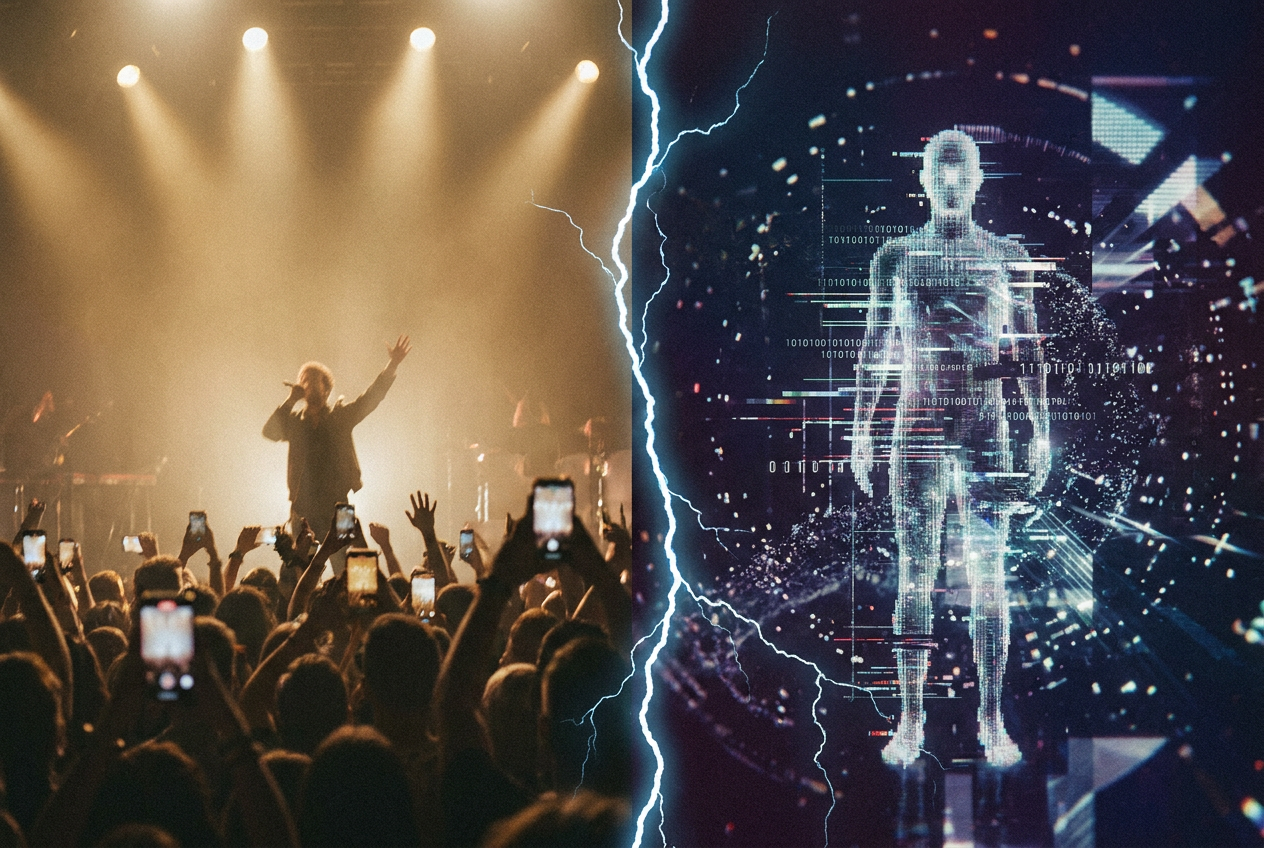
The good news? Real musicians have something no phantom artist ever will: a body, a story, a stage presence, and a fanbase that has shaken your hand. Unlike a real band, Nashville-based country music artist Ben Gallaher said fake AI bands cannot compete with live entertainment.
This is your moat. And it’s why investing in visual content — music videos, behind-the-scenes footage, live performance clips — has never been more important.
The Detection Gap
Here’s where the current system breaks down. Detection tools read audio. They score a waveform for the fingerprints of a generative model, which is what Beatport now runs at ingestion and what Spotify leans on for its AI Persona badge.
None of them asks whether a claimed appearance happened. A rule sorting acts by AI percentage would clear River Cain and flag nothing about the footage, and the footage is the only part anyone can prove is false.
In other words, the industry has built tools to catch AI audio but has almost no infrastructure to verify fabricated visual claims. A deepfake talent show clip doesn’t trigger any existing detection protocol. And as AI video generation gets better — with tools like Seedance 2.5 producing 30-second clips and models generating 1080p footage with cinematic aesthetics — the gap between what’s fake and what’s detectable is only going to widen.
What Platforms Should Do
Apple needs to fix iTunes. That’s the bottom line. So far, iTunes has done nothing to combat AI music taking chart spots from real artists.
When 6,900 downloads can land you 11 spots on the Top 100, the chart isn’t measuring popularity — it’s measuring spend. When an AI act with no touring history, no radio play, and no verified fanbase can sit at No. 3, the chart has lost its meaning.
Some platforms are moving faster. Spotify’s AI Persona badge system is a real attempt to separate human artists from generated ones. Apple Music’s upcoming “Made With AI” labels will add another layer of transparency. And Beatport has outright banned fully AI-generated music.
But none of these solutions address the deepfake video problem. When River Cain posts a fake AGT audition to Instagram, no platform’s AI detection system catches it. No content moderation pipeline flags it. It just sits there, accumulating views and building the legend of an artist who was never born.
How Real Musicians Can Win
Here’s the actionable part. Because while the phantom artists are gaming download charts, they can’t do what you can do.
1. Build an Undeniable Visual Presence
Every piece of visual content you create — music videos, lyric videos, live performance clips, studio sessions — is proof of existence that no AI persona can replicate at the same level. If you haven’t made a music video for your latest release, you’re leaving your strongest authenticity signal on the table. Check out our complete guide to AI music videos for a breakdown of how to create professional visuals without a professional budget.
2. Lean Into Genre Identity
The phantom artists tend to play it safe with genre-generic songs designed to appeal to algorithm-friendly sweet spots. Real musicians can go deeper. Whether you’re making country music, R&B, or indie, genre specificity is your friend. The more distinctive your sound and visual identity, the harder you are to replicate.
3. Use AI Video as Your Authenticity Tool
This might sound counterintuitive, but hear me out. Tools like OneMoreShot.ai let you create music videos that pair your real music with stunning visuals. The result is content that’s unmistakably yours — your song, your artistic vision, your visual narrative — produced at a speed and cost that makes sense for independent musicians. The phantom artists use AI to create fake identities. You can use AI to amplify your real one.
4. Get Verified Everywhere
Spotify Verified, Apple Music artist profiles, YouTube Official Artist Channels — these verification signals are becoming the frontline defense against phantom artists. If you’re not verified on every platform where your music lives, do it today.
5. Document Your Process
Behind-the-scenes content, studio footage, songwriting breakdowns — these are things that phantom artists literally cannot produce authentically. If you want to learn how to make an AI music video that still showcases your creative process, the technology is there. Every piece of process content you share is another data point that separates you from the ghosts.
The Bigger Picture
An AI act charting is not a scandal by itself. The disclosure is there, the following is real, the engagement looks organic, and the chart run followed a release pattern I would recommend to any independent artist.
The scandal is the infrastructure that enables it: charts that can be gamed with pocket change, platforms that don’t verify artist identity, and an AI video landscape that makes deepfake credentials trivially easy to produce.
As AI-generated content floods every corner of the music industry — SubmitHub’s AI detector analysed more than a million releases from July, and discovered that 23.2 per cent were fully generated by artificial intelligence. It also found that 15.3 per cent featured signs of AI-generated audio that had been modified or processed by humans. This means that 38.5 per cent of all music released last month was made with the involvement of AI to some degree.
That number is going to keep climbing. The phantom artists are going to keep multiplying. And the line between “AI-assisted musician” and “AI phantom artist” is going to keep getting blurrier.
Your job, as a real musician, is to make sure that line never blurs when it comes to you. Build the visual content library that proves who you are. Create the music videos and performance clips that no ghost artist can fake. And use every tool at your disposal — including AI video generation — to tell your story louder than the phantoms can tell theirs.
The ghosts are on the charts. But they can’t get on the stage. That’s still yours.
Ready to build the visual presence that separates you from the phantoms? OneMoreShot.ai lets you create stunning music videos in minutes — no studio, no crew, no six-figure budget. Just your music and your vision. Try it today.