Rock AI Music Video Examples & Inspiration
Rock has always been a visual genre. From Pink Floyd’s laser shows to Metallica’s pyrotechnics, the music has demanded imagery as loud and unapologetic as the sound itself. Now, AI is giving every rock musician — from bedroom producers to Grammy-nominated prog-metal acts — the ability to match their sonic ambition with visuals that would have required a Hollywood budget just three years ago.
The global AI video generator market was valued at USD 716.8 million in 2025 and is projected to grow to USD 847 million in 2026, reaching USD 3,350 million by 2034. Rock artists are riding that wave hard. The popularity of AI video formats surged in late 2025, when short-form creators began combining AI music generation with quick visual storytelling. And within the rock genre specifically, major acts like Linkin Park, Periphery, Queen, Within Temptation, and Peter Gabriel have already released official AI-powered music videos — establishing a creative template that thousands of independent rock artists are now following.
This page is your curated gallery of the best AI rock music video examples we’ve found — organized by visual style, broken down by platform, and analyzed for what makes each one work. Whether you’re making alt-rock, prog-metal, punk, or classic rock, you’ll find inspiration here. For a deeper dive into creating your own, check out our full AI Music Videos for Rock genre guide or jump straight to our Rock music video template.
Gallery by Style
Rock is not one aesthetic — it’s dozens. The best AI-generated rock videos lean into specific visual languages that amplify the subgenre’s emotional core. Here are the standout examples we’ve found, organized by visual approach.
🎭 Anime / AI-Enhanced Animation
Linkin Park — “Lost”
This is the video that put AI rock visuals on the map. The early-2000s alternative rock sensation Linkin Park premiered its new music video for ‘Lost,’ a formerly unreleased track from deep within the band’s archives. Prominent Web3 artists Emily Yang (also known as ‘pplpleasr’) and Maciej Kuciara teamed up with the AI startup Kaiber to animate a breathtaking new AI-generated music video.
What makes it extraordinary is the layered approach. AI was trained on original anime art and applied to Linkin Park footage to make the band members look like anime characters. In essence, the AI was used to visually tie the two forms of original content. This is a very simplified description and doesn’t take into account the VFX, editing, and painstaking customization of various scenes. The Linkin Park clips are original footage of the band.
The video doesn’t just slap an AI filter over stock footage. It reimagines archival performance clips as dynamic anime sequences — Chester Bennington screaming into the void becomes a watercolor explosion of emotion, and stadium crowds morph into infinite cascading figures. As Mike Shinoda clarified, Kaiber was trained on original anime art and applied to clips of Linkin Park to make the band members look like anime characters.
- Visual Style: Anime / AI-enhanced live footage
- Tools Used: Kaiber AI, with original art by Shibuya
- Why It Works: It honors Linkin Park’s legacy of anime music videos (“Breaking The Habit”) while pushing into entirely new visual territory. The AI serves the story rather than replacing creative direction.
🌀 Abstract / Surreal
Periphery — “Atropos”
Progressive metal act Periphery took AI visuals into full surrealist territory with “Atropos.” Featuring AI-generated imagery from the Los Angeles-based creative agency Race Service, the video’s got some pretty wild visuals.
The video “delves into a surreal world of darkness with a mix of live action and A.I. processed visuals, motion GFX. The irony of using A.I. to bring a music video about A.I. to life is not lost on us.”
Picture this: morphing organic shapes pulsing with the rhythm of seven-string guitars. Landscapes that dissolve and reassemble with each polyrhythmic shift. Human figures that blur into digital gods hovering above war-torn cityscapes. The music video for Periphery’s Atropos is a groundbreaking fusion of heavy progressive soundscapes and AI-generated footage processed using Stable Diffusion. It’s very stylistic and has many interesting moments. Featuring abstract worlds, morphing environments, and intricate designs, the visuals amplify the themes of chaos and transformation.
- Visual Style: Abstract / surrealist / dark psychedelia
- Tools Used: Stable Diffusion, A.I. processing by Race Service
- Why It Works: The constant visual transformation mirrors the song’s “push and pull between pretty/melodic and dark/chaotic sections.” The AI’s inherent tendency toward dreamlike distortion becomes a feature, not a bug — perfectly suited for progressive metal.
🎬 AI-Animated Narrative
Within Temptation — “Bleed Out”
Dutch symphonic metal band Within Temptation demonstrated how AI can bring cinematic storytelling to a music video on an indie budget. Within Temptation released the music video for their single ‘Bleed Out.’ The video shows an AI-animated story of a woman being suppressed and chased by a malevolent entity, whilst AI-generated band members perform. The band worked together with videographer SetVexy and digital designer RART. SetVexy captured the band’s live-performance and RART molded this performance into an AI-driven, animated storyline.
This isn’t abstract experimentation — it’s full narrative filmmaking. The story follows a woman fleeing a dark, oppressive force, intercut with the band performing in an AI-rendered environment. The political urgency of the track (addressing women’s rights in Iran) finds visual expression through cinematic chase sequences and imagery of defiance. Within Temptation says that AI helps them realize their creative ideas, and thanks to this new technique, it enables them to make animation and CGI style videos at a quality that were previously unaffordable.
- Visual Style: AI-animated narrative / cinematic
- Tools Used: AI animation by RART Digital, live performance captured by SetVexy
- Why It Works: The video proves that AI-generated visuals can carry emotional, story-driven content — not just abstract eye candy. The band’s performance footage gets transformed into something that feels like a high-budget animated short film.
🎞️ Psychedelic / Archival Enhancement
Queen — “The Night Comes Down”
Even rock royalty is embracing AI visuals. Queen released a new video for “The Night Comes Down,” a track on their debut album. The video features archival footage of the band from the ’70s, including shots of them performing onstage. However, according to the band, “Following a collaboration with an artist specializing in AI, some of those images have been given a whole new dimension.”
The result is hypnotic — young Freddie Mercury, Brian May, Roger Taylor, and John Deacon appear in their original 1970s performance footage, but the images ripple and transform with psychedelic AI-generated overlays. Imagine vintage black-and-white concert photography dissolving into kaleidoscopic color explosions timed to the guitar riffs. The AI aspect of the video seems largely to involve psychedelic animation of the footage of the band performing.
- Visual Style: Psychedelic / archival enhancement
- Tools Used: AI-powered psychedelic animation (specific tool not disclosed)
- Why It Works: It doesn’t try to fake or replace the band — it celebrates existing footage by adding a layer of visual wonder that captures the “otherworldly” feeling Queen’s music has always evoked.
🏆 AI Art Competition / Community-Driven
Peter Gabriel × Stability AI — #DiffuseTogether
Rock and Roll Hall of Famer Peter Gabriel took a community-first approach to AI rock visuals. The contest invites participants to submit one animated AI-generated video inspired by and set to the music of Peter Gabriel.
The groundbreaking competition received hundreds of entries from artists invited to create AI-generated animations inspired by and set to the music of Peter Gabriel.
The winning entries are visually stunning. Winners included a double first-place finish from AI artists Junie Lau and Lamson, who chose to create videos for the songs The Court and Panopticon. Lau’s work in particular is remarkable — Lau, a director and production designer whose work has been featured in British Vogue, crafted a dreamscape reminiscent of 70s pulp fiction and film noir.
- Visual Style: Varies — from noir dreamscapes to abstract psychedelia
- Tools Used: Stable Diffusion, DreamStudio, AnimAI, Stability for Blender
- Why It Works: Gabriel understood that AI’s power isn’t just in the output — it’s in democratizing creation. Hundreds of artists created unique visual interpretations of his music, proving that AI can be a community creative tool, not just an efficiency hack.
🎮 Full AI Generation (10,000-Frame Epic)
Director Tristan Holmes — Midjourney Frame-by-Frame
One of the most ambitious rock AI video projects comes from director Tristan Holmes, who took a painstaking frame-by-frame approach. Director Tristan Holmes used Midjourney to create this video using 10,000 frames of AI-generated images, by entering prompts and connecting frames to create a cohesive piece. The music video generation process took 30 days. The hard work really pays off and puts it a level above some of the other AI video productions.
Each frame is an individually generated Midjourney image, meticulously sequenced to create fluid visual motion across the full runtime. The result sits somewhere between a moving painting and a fever dream — every second contains handcrafted compositional choices that no automated pipeline could replicate.
- Visual Style: Frame-by-frame AI illustration
- Tools Used: Midjourney
- Why It Works: It proves that the ceiling for AI rock visuals is as high as your ambition. When you combine a tool like Midjourney with genuine directorial vision and an insane work ethic, the results rival anything coming out of traditional animation studios.
🤖 The Velvet Sundown — Full AI Identity
While controversial, The Velvet Sundown phenomenon is impossible to ignore when discussing AI and rock visuals. An indie rock band with more than a million monthly listeners on Spotify owned up to being an AI-generated music project following days of speculation. Named Velvet Sundown, the digital group became a viral hit, generating ferocious online discussion.
The “real” band confirmed on their official social media accounts that they are a “synthetic music project guided by human creative direction, and composed, voiced, and visualized with the support of artificial intelligence.” “This isn’t a trick,” they added, “it’s a mirror. An ongoing artistic provocation designed to challenge the boundaries of authorship, identity, and the future of music itself in the age of AI.”
Their most popular song, “Dust on the Wind,” a ’70s Southern rock-inspired tune, has nearly 2 million streams. Their entire visual identity — band photos, video content, album art — is AI-generated, creating a fully synthetic rock band experience that fooled millions.
- Visual Style: AI-generated band identity / synthetic artist project
- Tools Used: Undisclosed AI music and image generation tools
- Why It Works (as an example): Whether you see it as art provocation or cautionary tale, it demonstrates how complete and convincing an AI-generated rock visual identity can be in 2026. For legitimate artists, the takeaway is clear: AI visuals are now indistinguishable enough to build genuine fan engagement.
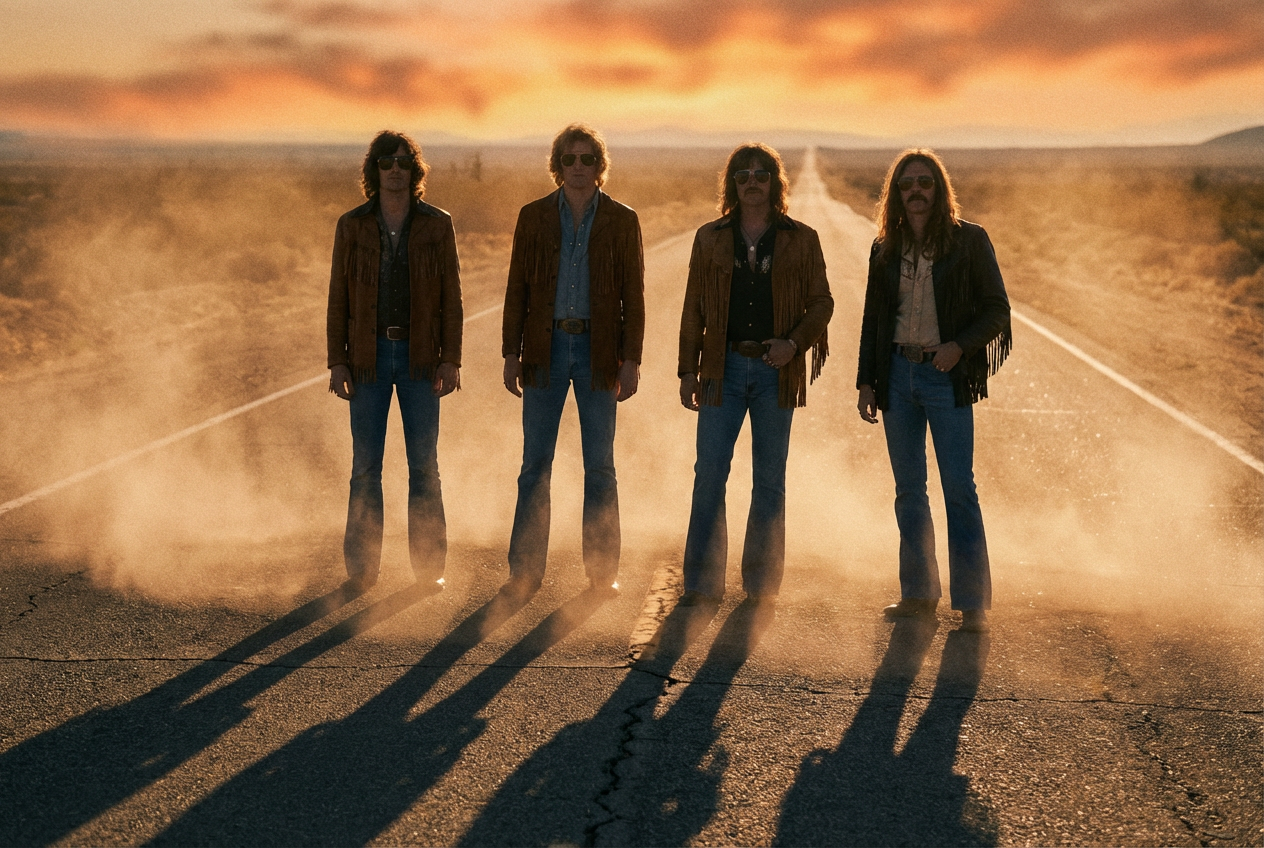
🎸 Independent Creator: AI Pop-Rock Band “Lights Out”
Producer and filmmaker Auki Henry documented the complete process of creating an AI pop-rock band from scratch. He set out to answer the question of whether AI can replicate artistic creation by generating ‘Lights Out,’ an AI pop-rock band, and their debut single, ‘TONIGHT,’ from the ground up — not just a song, but a complete artistic identity, from backstory to music video.
He employed a collaborative AI approach: Osmi AI for initial brainstorming, Gemini for refining and structuring the narrative, and ChatGPT for polishing and adding emotional depth. Osmi AI excelled at generating novel ideas, Gemini at structuring them, and ChatGPT at refining them. The music was generated with Suno, with explicitly defined parameters — not a simple “generate a song” scenario. He stated “pop-rock,” drawing on the platform’s understanding of musical styles.
- Visual Style: AI-generated character-driven music video
- Tools Used: Suno (music), Leonardo AI and ImageFX (character generation), ChatGPT/Gemini/Osmi (creative direction)
- Why It Works: It’s a complete blueprint for indie rock artists who want to create a full visual identity using AI. The transparency of the process makes it an educational goldmine.
Gallery by Platform
Not every AI rock video performs equally across platforms. Here’s what works where, based on the examples we’ve analyzed and broader trends in 2026.
YouTube: Long-Form Narrative and Cinematics
YouTube remains the home of the traditional music video, and AI rock content thrives here in long-form formats. The Linkin Park, Periphery, and Within Temptation examples above all live on YouTube and have accumulated millions of views. As YouTube’s global head of music Lyor Cohen noted, YouTube has evolved “into a comprehensive visual storytelling ecosystem where artists build deep, lasting connections with their global community. With billions of logged-in viewers watching music videos on our platform each month.”
What performs best on YouTube for rock:
- Full-length AI music videos (3–5 minutes) with narrative arcs or visual storytelling
- AI-enhanced lyric videos with cinematic backgrounds
- Behind-the-scenes process videos showing how the AI video was made
- Abstract/psychedelic visualizers for album tracks
The integration of YouTube Shorts with the main video ecosystem has transformed visibility. Short-form clips serve as gateways to full-length tracks, prompting higher click-through rates and boosting playlist placements.
If you’re exploring AI visuals across other genres, our AI Music Video Examples: EDM and AI Music Video Examples: Pop galleries show how different genres optimize for the same platform.
TikTok: High-Impact Clips and Visual Hooks
TikTok-style AI music videos are short-form visual clips that pair generative visuals with custom, AI-made songs or musical sections. Unlike traditional music videos, these AI-powered creations compress the workflow into minutes. Users can input text descriptions, moods, or even full lyrics, and AI engines automatically produce well-arranged songs that synchronize with rhythmic short clips.
For rock specifically, the most viral TikTok AI content tends to be:
- 15–30 second clips of the most visually intense moments from a full AI music video
- AI-generated “guitar solo” visualizers — abstract reactive visuals that pulse with the solo
- Transformation videos showing “real footage → AI-enhanced” side-by-side comparisons
- Quick AI lyric videos with kinetic typography over dark, atmospheric backgrounds
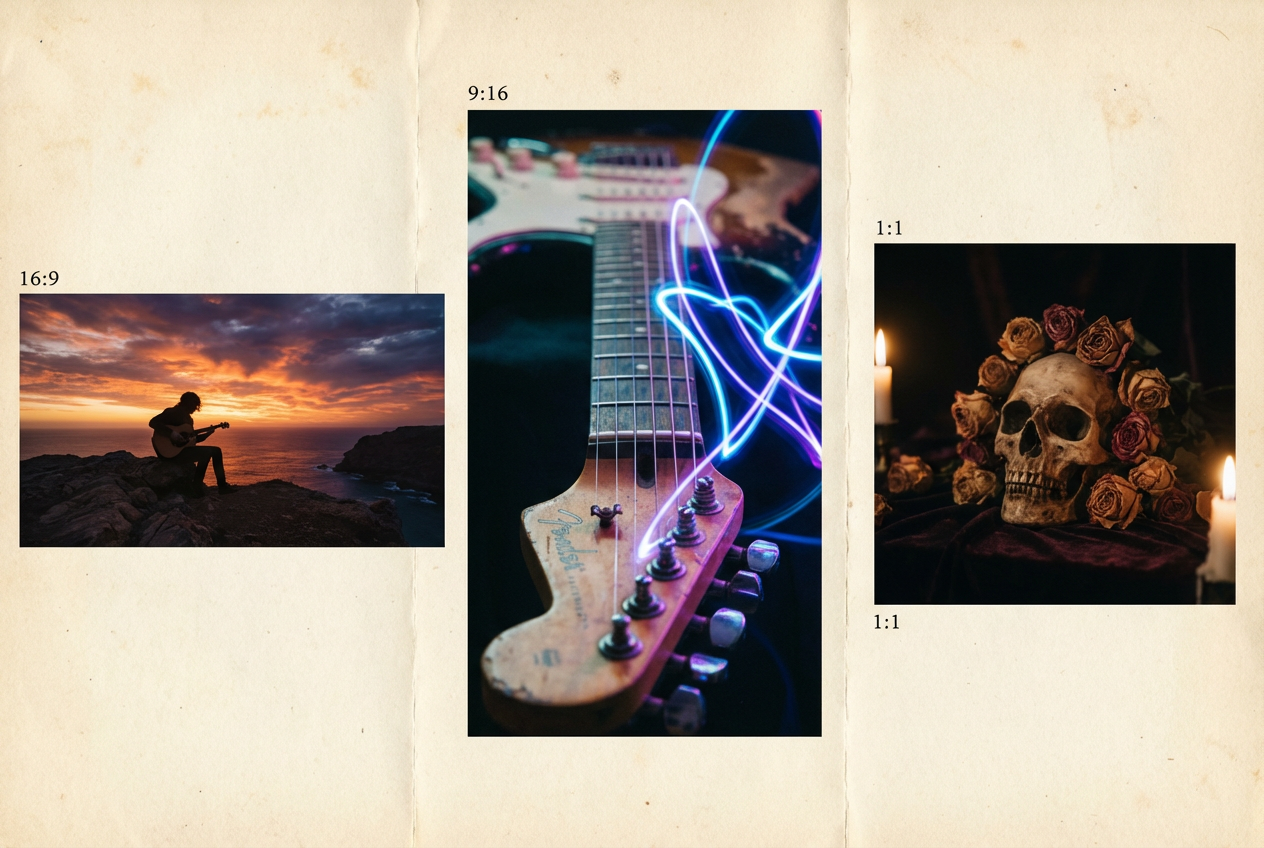
Pro Tip: Rock content on TikTok benefits from the vertical 9:16 format that most AI music video generators now support. Tools like OneMoreShot.ai export in platform-ready formats, so you can generate once and publish everywhere. Our complete guide to AI music videos in 2026 covers multi-platform export strategies in detail.
Instagram Reels: Aesthetic and Mood-Driven
Instagram’s rock AI video landscape skews toward aesthetic, mood-driven content. Think:
- Atmospheric loop visualizers for Spotify Canvas-style promotion
- Short narrative teasers with AI-generated cinematic scenes
- AI-animated album artwork that subtly moves and breathes
- Behind-the-scenes carousel posts paired with a Reel showing the final output
Marketers increasingly use hybrid strategies combining YouTube exposure with Instagram Reels and TikTok teasers. Cross-sharing boosts virality across social video music ecosystems and ensures musicians reach global listeners within days.
Common Techniques Behind the Best Examples
After studying dozens of AI-generated rock music videos, clear patterns emerge in how the best creators work. If you want to learn the full production workflow, our guide on how to make an AI music video walks through every step.
1. Hybrid Approaches Win
The standout rock AI videos almost never rely on a single tool. Linkin Park combined original anime art with Kaiber’s AI processing. Periphery blended live-action footage with Stable Diffusion. Within Temptation filmed real performances and then transformed them with AI animation. The lesson: AI works best as a creative layer, not a replacement for creative direction.
2. Audio-Reactive Sync Is Non-Negotiable
Neural Frames is the only AI music video generator in one review that behaves like a visual synthesizer: every kick, snare and vocal stab drives a cut, zoom or colour flash in real time. True stem analysis: the engine splits your track into eight channels and maps each one to motion parameters for frame-perfect sync.
Rock music is dynamic — quiet verse, crushing chorus, blistering solo. The best AI rock videos match this dynamic range visually. When the distortion kicks in, the visuals should distort too. When the song drops to an acoustic bridge, the palette should soften. This audio-reactive capability is what separates compelling rock AI videos from generic ones.
3. Style Consistency Across the Full Runtime
One of AI’s biggest challenges is maintaining visual coherence across a 3–5 minute video. The best examples solve this through:
- Character locking — training AI models on specific character appearances so band members look consistent across scenes
- Style presets — committing to a single visual language (anime, cyberpunk, photorealistic, abstract) rather than mixing
- Scene-by-scene storyboarding — planning visual shifts that align with song structure transitions
Kaiber gained attention after powering Linkin Park’s “Lost” music video. But the video worked because the creative team storyboarded every scene transition to match the song’s emotional arc — not because they pressed “generate” once and hoped for the best.
4. Subgenre-Specific Visual Languages
The visual approach should match the rock subgenre:
| Rock Subgenre | Best Visual Style | Example Reference |
|---|---|---|
| Alternative Rock | Anime, watercolor, hand-drawn aesthetic | Linkin Park “Lost” |
| Progressive Metal | Abstract, surrealist, morphing environments | Periphery “Atropos” |
| Symphonic Metal | Cinematic narrative, fantasy, dark animation | Within Temptation “Bleed Out” |
| Classic Rock | Psychedelic enhancement of vintage footage | Queen “The Night Comes Down” |
| Punk Rock | Gritty, high-contrast, rapid-cut montage | DIY indie creators |
| Indie Rock | Lo-fi illustration, pastel palettes, minimalist | AI Music Videos for Indie |
| Metal/Hardcore | Dark fantasy, hellscape imagery, aggressive motion | AI Music Videos for Metal |
5. The Right Tools for Rock
Based on the examples above, here are the tools most commonly used in AI rock music videos:
- Kaiber — Best for anime-style transformations and style-transfer over existing footage
- Stable Diffusion / Midjourney — Best for frame-by-frame AI illustration and high-quality still-to-motion pipelines
- Neural Frames — Best for audio-reactive abstract visualizers that sync to rock’s dynamic range
- Runway — Best for high-fidelity cinematic clips and motion-controlled sequences
- OneMoreShot.ai — Best for independent rock musicians who want a complete, music-first workflow that handles everything from upload to export
Create Your Own AI Rock Music Video
Every example on this page started the same way: a finished track and an idea. The difference between these creators and everyone else? They actually made it.
In 2026, you don’t need the budget of Linkin Park or the 30-day Midjourney marathon of Tristan Holmes. For musicians, this explosion means one thing: you no longer need a five-figure budget to release a professional music video. A laptop, a finished track, and a few minutes are all it takes.
Here’s how to start right now:
- Upload your rock track to OneMoreShot.ai — it accepts MP3, WAV, and even Suno/Udio links
- Choose your visual style — dark cinematic, anime, abstract, psychedelic, or any of the styles inspired by the examples above
- Let the AI analyze your song structure — it detects verse, chorus, bridge, and solo sections and adjusts the visuals accordingly
- Refine shot by shot — swap scenes, adjust prompts for individual segments, regenerate specific shots until they match your vision
- Export for every platform — 16:9 for YouTube, 9:16 for TikTok and Reels, 1:1 for social posts
Your rock music deserves visuals as powerful as the sound. Stop waiting for a production budget that may never come. The tools are here. The examples prove what’s possible.
👉 Create Your AI Rock Music Video Now →
Want a head start? Our AI Music Video Template: Rock page gives you pre-built visual frameworks specifically designed for rock subgenres — from grungy alt-rock to epic symphonic metal. And our complete Rock genre guide dives deeper into prompting techniques, style selection, and rock-specific best practices.
Explore more AI music video examples across genres: Hip-Hop Examples · EDM Examples · Pop Examples · Lo-Fi Examples · R&B Examples