AI World Cup Anthems Are Beating FIFA at Its Own Game
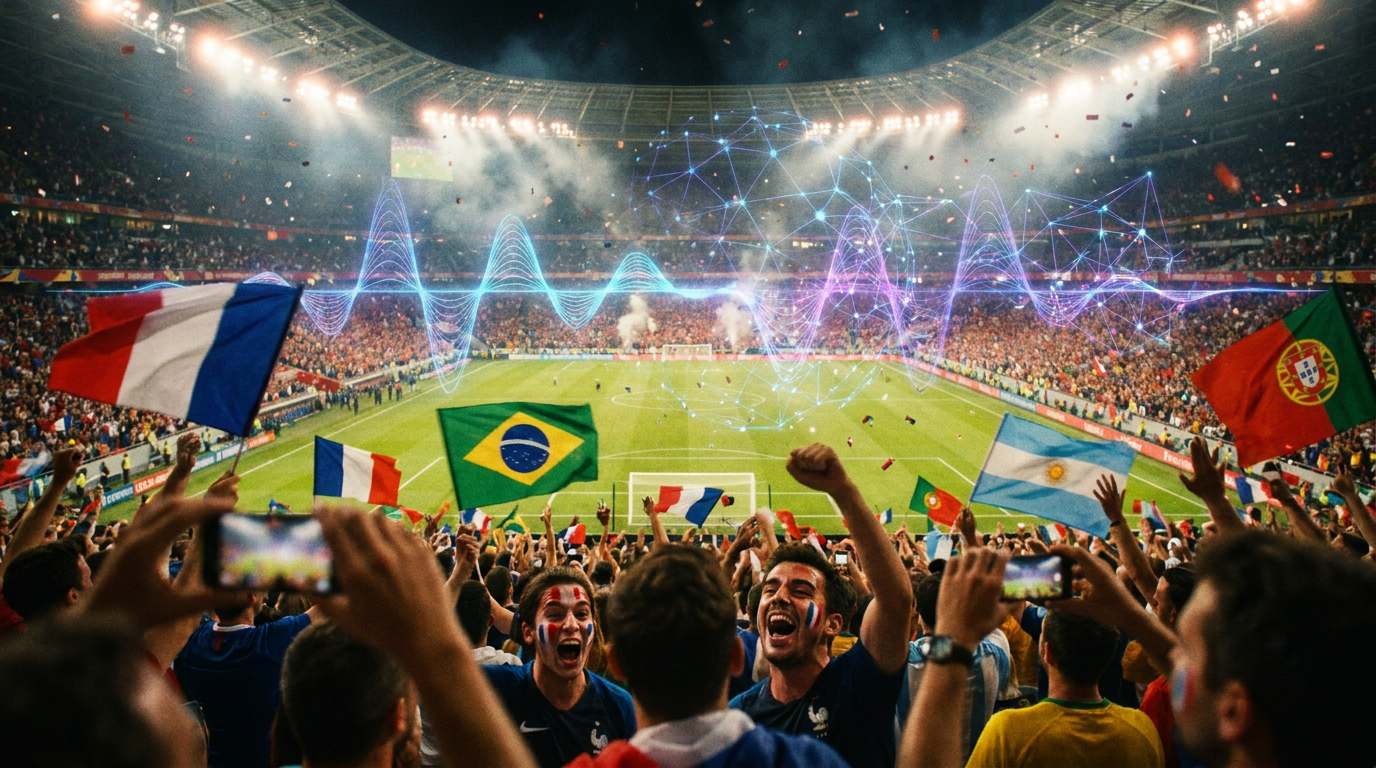
The 2026 FIFA World Cup kicks off in nine days. Shakira dropped her official anthem. FIFA lined up Burna Boy, Daddy Yankee, Tyla, and Jelly Roll for the soundtrack. And yet, the songs fans are actually chanting? They were made by anonymous creators with AI tools and zero production budgets.
Welcome to the most chaotic collision of AI music and global sports culture we’ve ever seen — and it has massive implications for every independent musician watching from the sidelines.
The AI Fan Anthem Explosion, Explained
The trend appears to have started with a song dedicated to the French team, “Imbattables,” released in February by artist Crystalo, who is listed on Spotify as France’s “premier AI musical creator.” The track is a high-energy electronic anthem with a call-and-response format that chants the names of Kylian Mbappé, Ousmane Dembélé, and other French stars.
It caught fire. Then everything escalated.
A Brazilian anthem followed with a similar name-chanting format and a trending phonk melody that producer Guilherme Maia, who goes by the artist name M4IA, said he created by layering together different elements he had put together with the help of AI.
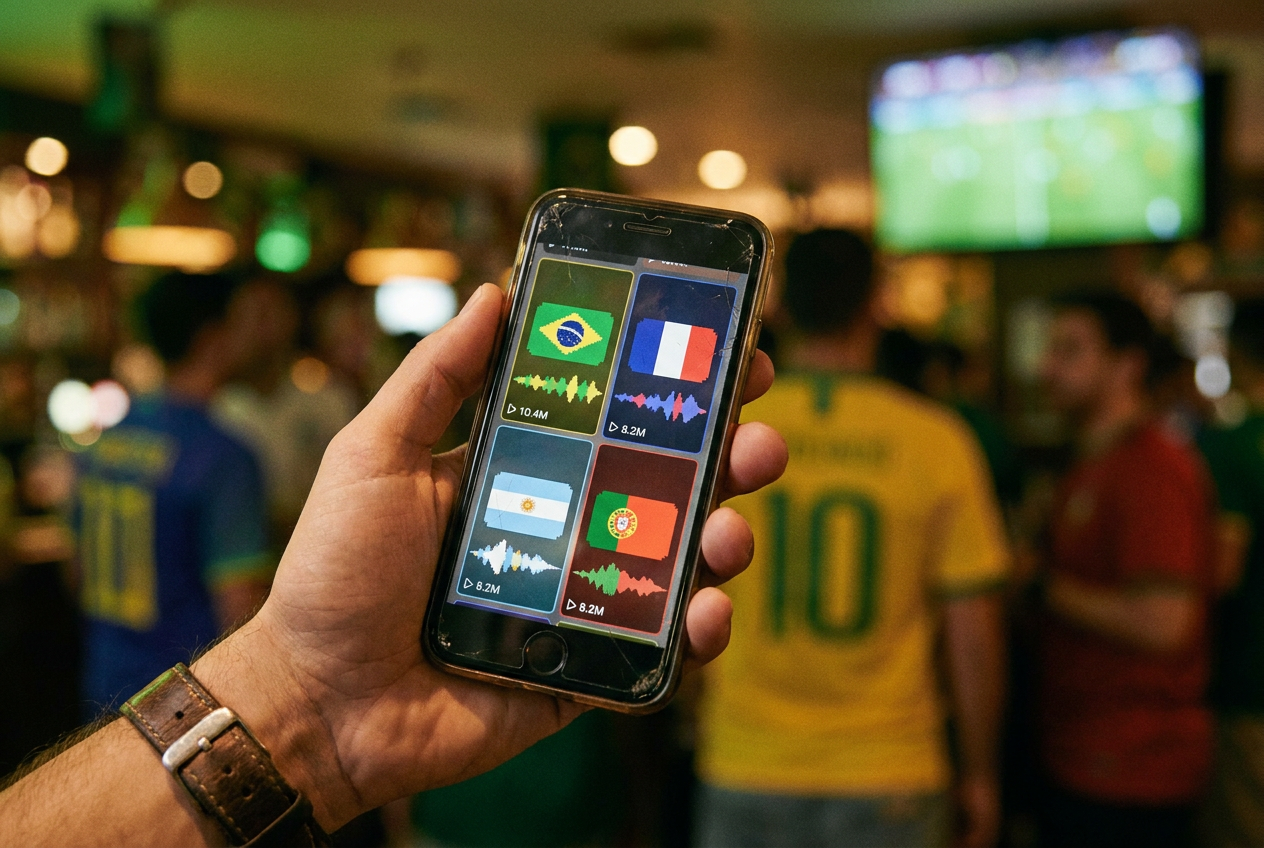
Tracks for top sides Portugal, Argentina and Germany, as well as many others, soon sprang up across platforms, garnering more praise from fans.
Within weeks, virtually every major national team had its own fan-generated AI anthem. As the fan-made football anthems are raking in millions of plays across YouTube, TikTok and Instagram, experts say that the viral tunes raise questions about song ownership, artist compensation and the valuation of human creativity. But many users do not appear to mind, with some even showing a preference for the AI-generated songs over an official anthem football’s world governing body FIFA commissioned from musicians Jelly Roll and Carin Leon.
Read that again. Fans are preferring AI-generated anthems over multimillion-dollar official FIFA commissions from established artists. That’s not a novelty moment. That’s a structural shift.
Why AI World Cup Songs Are Outperforming the Pros
There’s a reason these tracks are resonating and it’s not because the AI is “better” than Shakira. It’s because these songs are doing something the official soundtrack can’t: they’re hyper-specific, deeply communal, and instantly shareable.
Traditional World Cup anthems are designed to appeal to everyone. They’re polished, globally focus-tested, and deliberately universal. The AI fan songs are the opposite — they name specific players, reference specific rivalries, and sound like they were born in the stands, not a Los Angeles recording studio.
Speed Over Polish
A new generation of creators now uses AI music tools to produce football content in minutes. From stadium-style choruses to emotional final-match ballads, fans can generate songs, lyrics, and short-form music videos without professional production skills. When Portugal qualifies for the knockout round at 10 PM, a celebratory anthem can be on TikTok by 10:15. The official FIFA soundtrack doesn’t have that kind of agility.
Community Identity Over Universal Appeal
Each AI anthem becomes a rallying cry for a specific fanbase. It’s your team’s song. You share it because you’re proud of your squad, not because a marketing team told you to. This is the same dynamic that drives AI music videos for hip-hop and AI music videos for Latin — genre-specific, community-driven content that resonates more than one-size-fits-all approaches.
The “Good Enough” Threshold
One professor noted: “I think this is such a significant example because there’s this clear response and you get a lot of commentators saying, ‘I hate the idea of AI, but wow, this is a banging tune.’” The quality of AI-generated music has crossed a critical threshold where emotional impact matters more than production pedigree.
The Hilarious Imperfections Nobody Cares About
Here’s what makes this phenomenon so revealing: the AI songs have obvious flaws, and fans largely don’t care.
For example, a fan-made World Cup song for Portugal was sung with a Brazilian accent, while a Colombian version read James Rodríguez’s first name with an English rather than Spanish pronunciation.
Experts noted that AI often fell short when it came to recognizing cultural nuances, such as accents, which may not be picked up unless the producer is a native speaker.
Aside from Imbattables, which is credited to French AI artist Crystalo, the songs viewed by SBS News did not explicitly state they were AI-generated and were posted by anonymous accounts with small followings. Listeners appear none the wiser with the songs well-received, aside from occasional comments describing them as “AI slop.”
The lesson for musicians? Context and emotional timing trump technical perfection. A song released at the right cultural moment, for the right community, with the right energy will outperform a flawless production that arrives too late or aims too wide. That’s true whether you’re making World Cup chants or indie music videos.
Meanwhile, IShowSpeed Just Chaos-Dunked on Everyone
While AI creators quietly amassed millions of streams, YouTube megastar IShowSpeed took a different approach: he released his own World Cup anthem called “Champions” on June 1st, and the results were staggering.
The high-energy music video, which premiered on YouTube on June 1, racked up over 3.3 million views and hundreds of thousands of likes in less than 24 hours.
IShowSpeed used this hype to make a public push on social media for the world football body to adopt Champions as the official World Cup anthem, and FIFA responded with a “we will be in touch” message.
The comparison is instructive. Speed’s track is a creator-driven anthem, produced outside the official FIFA apparatus, that’s competing directly with songs by Shakira, Rema, Lisa, and Anitta. Supporters of the streamer argue that the song captures the passion and excitement of football fans in a way that feels authentic and community-driven. Many pointed to its massive online engagement as evidence of its popularity among younger audiences.
Between IShowSpeed’s anthem and the AI fan songs, the 2026 World Cup is demonstrating something profound: the traditional pipeline of “FIFA commissions big artist → fans adopt the song” is breaking down. Fans are now creating the cultural soundtrack themselves, and AI is the engine making it possible at scale.
What This Means for Independent Musicians
If you’re a musician reading this and thinking “cool football story, but what does this have to do with me?” — everything. Here’s why:
1. Event-Driven AI Content Is a Massive Opportunity
The World Cup anthems prove that AI music tools work best when they’re aimed at a specific cultural moment. Think about it: every music festival, every award show, every viral TikTok trend, every season — all of these are opportunities to create hyper-targeted tracks and visuals that ride a wave of existing attention.
You don’t need to be a football fan. You need to be fast and specific. AI tools give you that speed. Pair an AI-generated track with a quick music video and you’ve got content that can ride a cultural moment before it fades.
2. Community Anthems Beat Universal Appeals
The biggest takeaway from this phenomenon is that niche wins. A song for French football fans, by French football fans, about specific French football players outperformed a global FIFA commission. Apply this logic to your music: a track that speaks directly to your 500 most dedicated fans will generate more engagement than a generically “marketable” single aimed at everyone.
Whether you’re making R&B, EDM, or country, the lesson is the same — specificity is your competitive advantage.
3. Visuals Multiply the Impact
Notice how every one of these viral World Cup songs comes paired with video — highlight montages, stadium footage, flag-waving edits. Across platforms like TikTok, YouTube Shorts, and Instagram Reels, fans are actively generating AI-powered national team songs, highlight reels, and hype videos for their favorite countries.
The music alone isn’t enough. The visual packaging is what makes it shareable. This is exactly why tools like OneMoreShot.ai exist — to help musicians turn tracks into scroll-stopping visual content without needing a production crew. Check out our complete guide to AI music videos if you want the full playbook.
4. The Copyright Questions Aren’t Going Away
Jason Palamara, an assistant professor of music technology at Indiana University, said that with the way the models exist, there is a lack of clarity over how artists are credited if their copyrighted work is used to train them. The World Cup anthems are raising the same ownership questions that have dogged AI music all year — and they’re not getting easier to answer.
As one industry executive observed, despite concerns over how the industry will adapt to AI, quick-fix songs that can be chanted by fans or featured in advertisements are a clear use case for AI-generated music in its current stage.
For musicians using AI as a creative tool (rather than as a replacement for the entire creative process), the path forward is clearer: write your own material, use AI to enhance production and visuals, and maintain a documented creative process that establishes your human contribution.
The Bigger Picture: Fan Culture Is Becoming Creator Culture
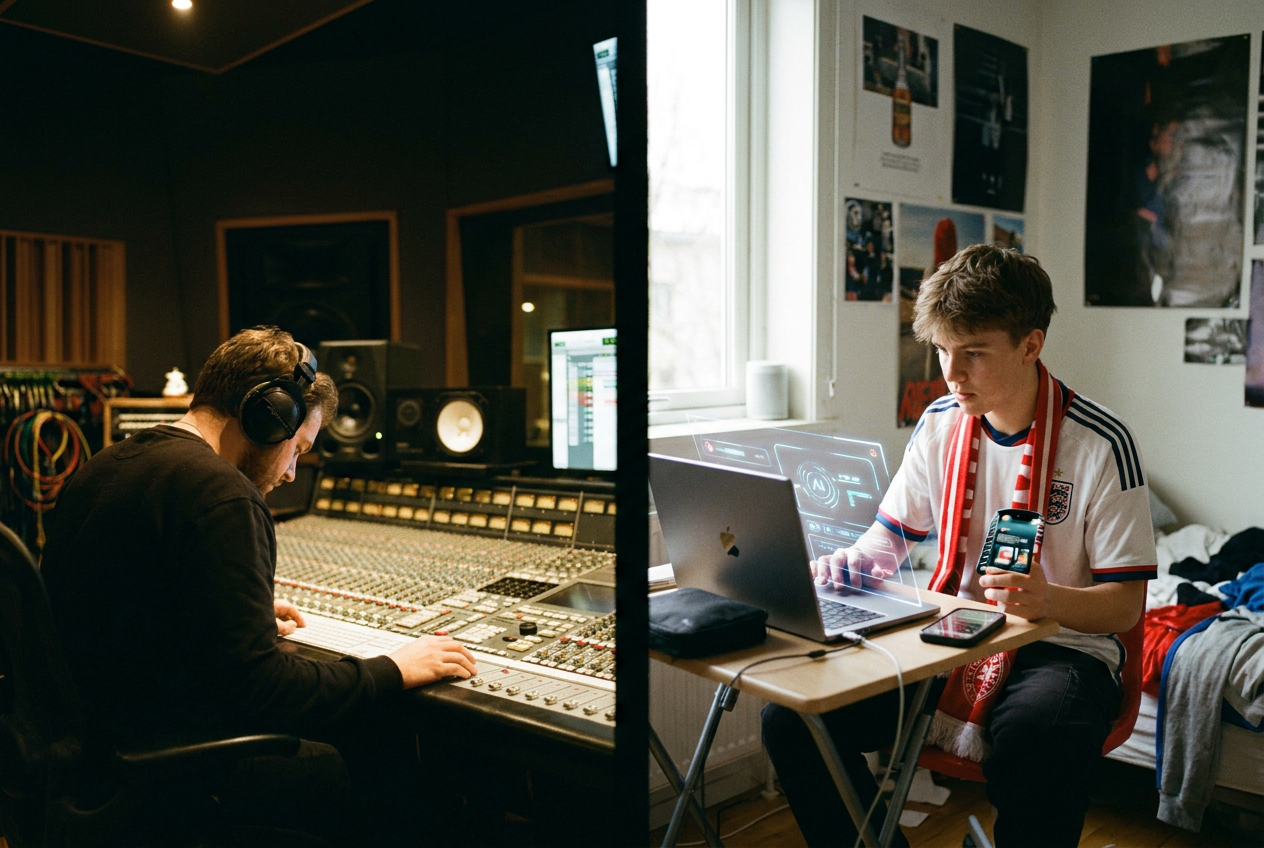
The 2026 World Cup AI anthem phenomenon isn’t really about football. It’s about the collapse of the distance between “fan” and “creator.”
World Cup fans are wielding artificial intelligence to mass-produce viral songs supporting their teams ahead of next month’s tournament. As the fan-made football anthems are raking in millions of plays across YouTube, TikTok and Instagram, experts say that the viral tunes raise questions about song ownership, artist compensation and the valuation of human creativity.
Five years ago, if you wanted to make a World Cup anthem, you needed recording equipment, musical training, and distribution connections. Today, a passionate fan with a laptop can create a song that competes with — and in some cases outperforms — tracks commissioned by the richest sports organization on the planet.
This is the same democratization we’ve seen across music. Research by streaming service Deezer and Ipsos found that 97 percent of listeners could not tell the difference between AI-generated and human-made music.
Streaming services are seeing tens of thousands of new fully AI-generated tracks uploaded daily — according to The Associated Press, up to 20,000 new AI tracks per day on Deezer alone, representing roughly 18 percent of uploads.
The question for professional musicians isn’t whether to be alarmed. It’s whether to adapt. The artists who are thriving right now are the ones who use AI as a creative accelerant — generating visual content, experimenting with production ideas, creating event-specific releases, and moving at the speed of culture.
Your Move
The World Cup starts June 11. That means there are nine more days of pre-tournament hype, then six weeks of the most-watched sporting event on the planet. Every match, every upset, every dramatic moment is an opportunity for timely content.
You don’t have to make a football song (unless you want to). But the principle applies everywhere: find the cultural moment, create something specific and emotional, pair it with stunning visuals, and release it while the iron is hot.
If you’re ready to turn your next track into a visual experience that rides the cultural wave, OneMoreShot.ai can help you create professional music videos in minutes — no production crew, no six-week timeline, no massive budget. Just your music and the AI tools to make it unforgettable.
The fans making World Cup anthems in their bedrooms already figured this out. Now it’s your turn.