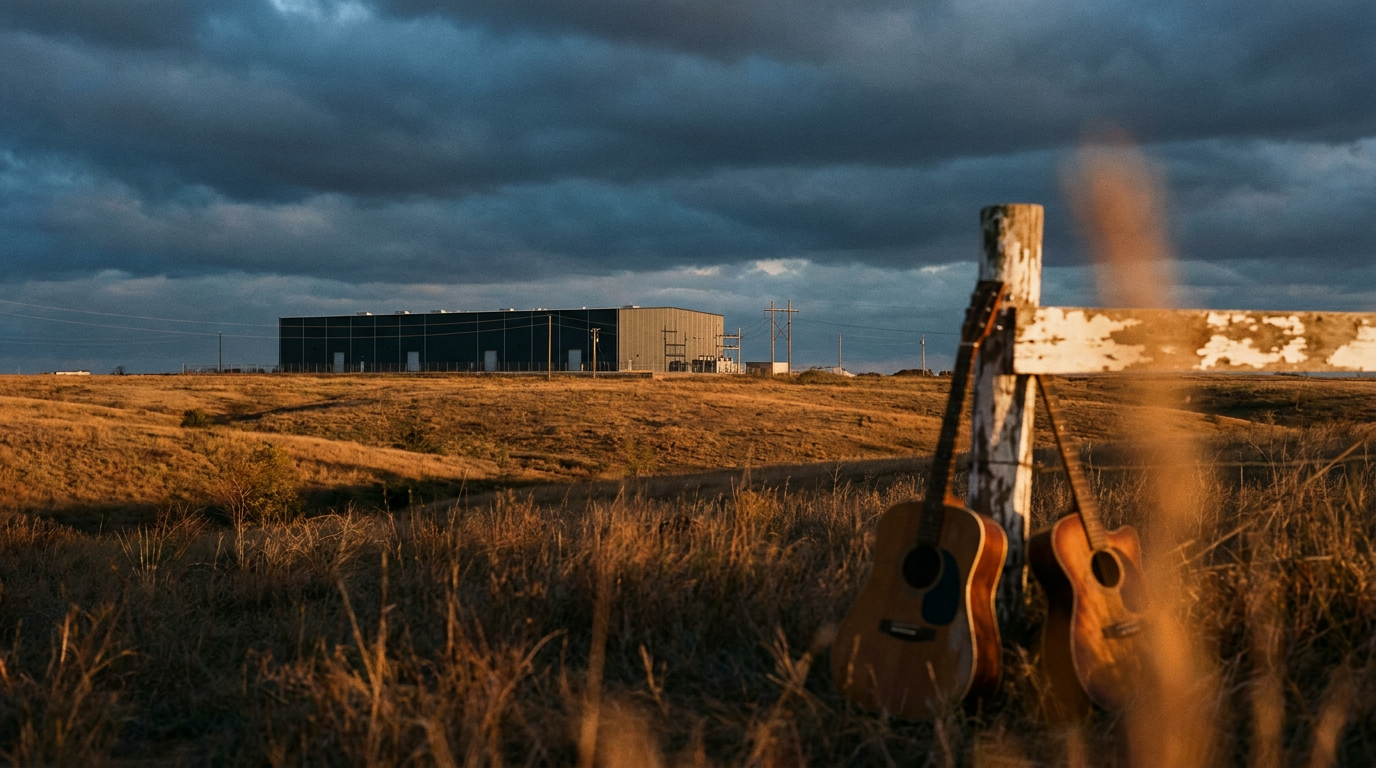
Country Stars Are Fighting AI's Land Grab
Here’s something nobody had on their 2026 bingo card: the most effective resistance to AI expansion isn’t coming from Silicon Valley regulators, EU lawmakers, or even the major labels.
It’s coming from country music.
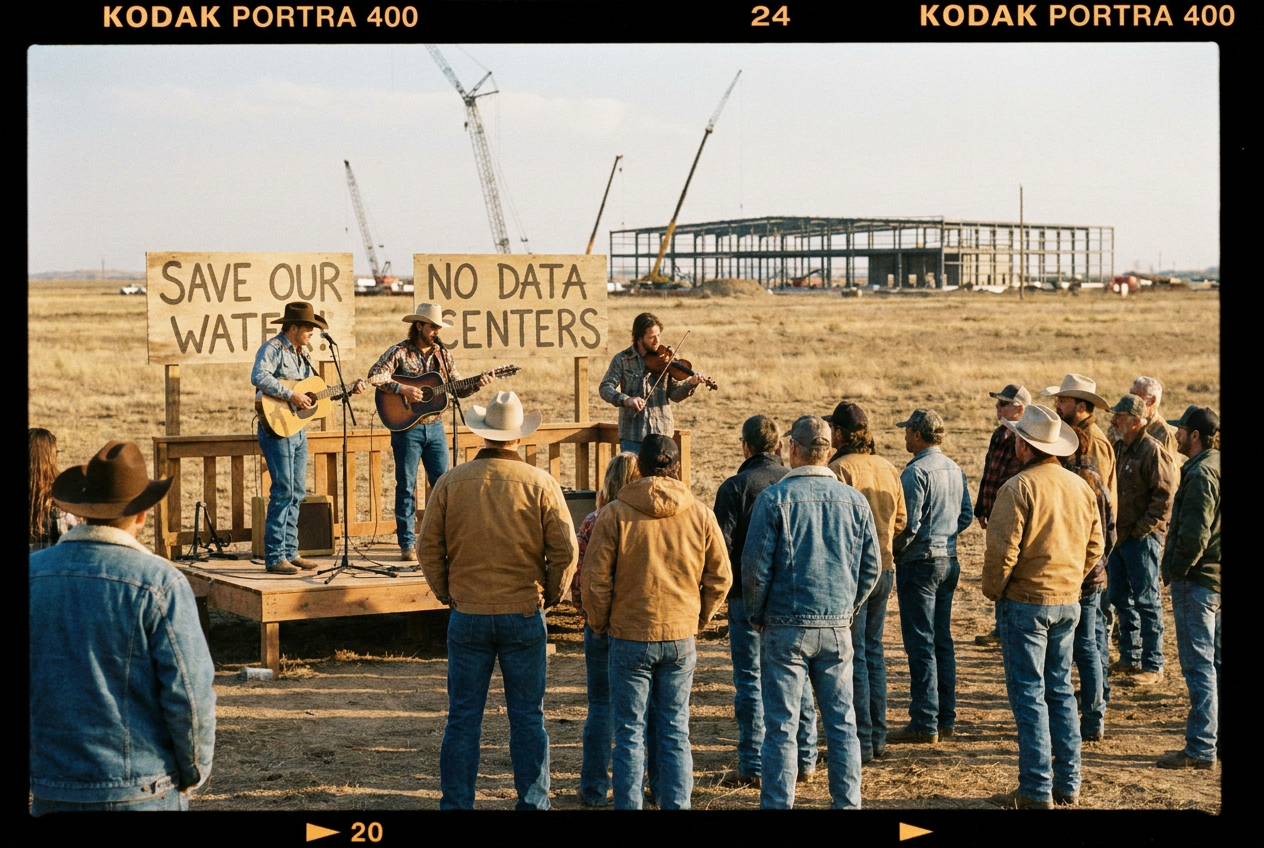
Willie Nelson, Brad Paisley, Tanya Tucker, and Gavin Adcock — artists who agree on almost nothing politically — are leading a nationwide revolt against the AI data centers that are swallowing rural America whole. And it’s working. $64 billion in U.S. data center projects now face delays as 142 groups organize across 24 states.
This isn’t an abstract copyright fight over training data. This is about water, land, noise, and the communities that power the culture these artists sing about. And for musicians navigating the AI era, it’s a masterclass in how artists can shape the conversation beyond just their recordings.
Willie Nelson vs. the Machines
Country music legend Willie Nelson spoke out against plans to build an artificial intelligence data center near his hometown of Abbott, Texas, stating that his community “like many others, needs to fight against data centers invading our land.”
Abbott, Texas isn’t exactly a metropolis. It has fewer than 400 residents, dark skies worth driving hours for, and farmland that’s fed families for generations. Developers want to build as many as 56 data centers nearby.
Nelson, 93 and still not taking any nonsense, didn’t mince words. He said “the last thing we need is a loud, water thieving, light polluting data center anywhere near our town,” adding that “the strength of rural America has never come from industrial footprints. It comes from generations of people, open spaces, local businesses, and a connection to the land.”
When Willie Nelson calls your industry “water-thieving,” you’ve got a branding problem that no amount of PR can fix.
Brad Paisley and 560,000 Signatures
The movement didn’t start in Texas. It started at the Nashville Zoo.
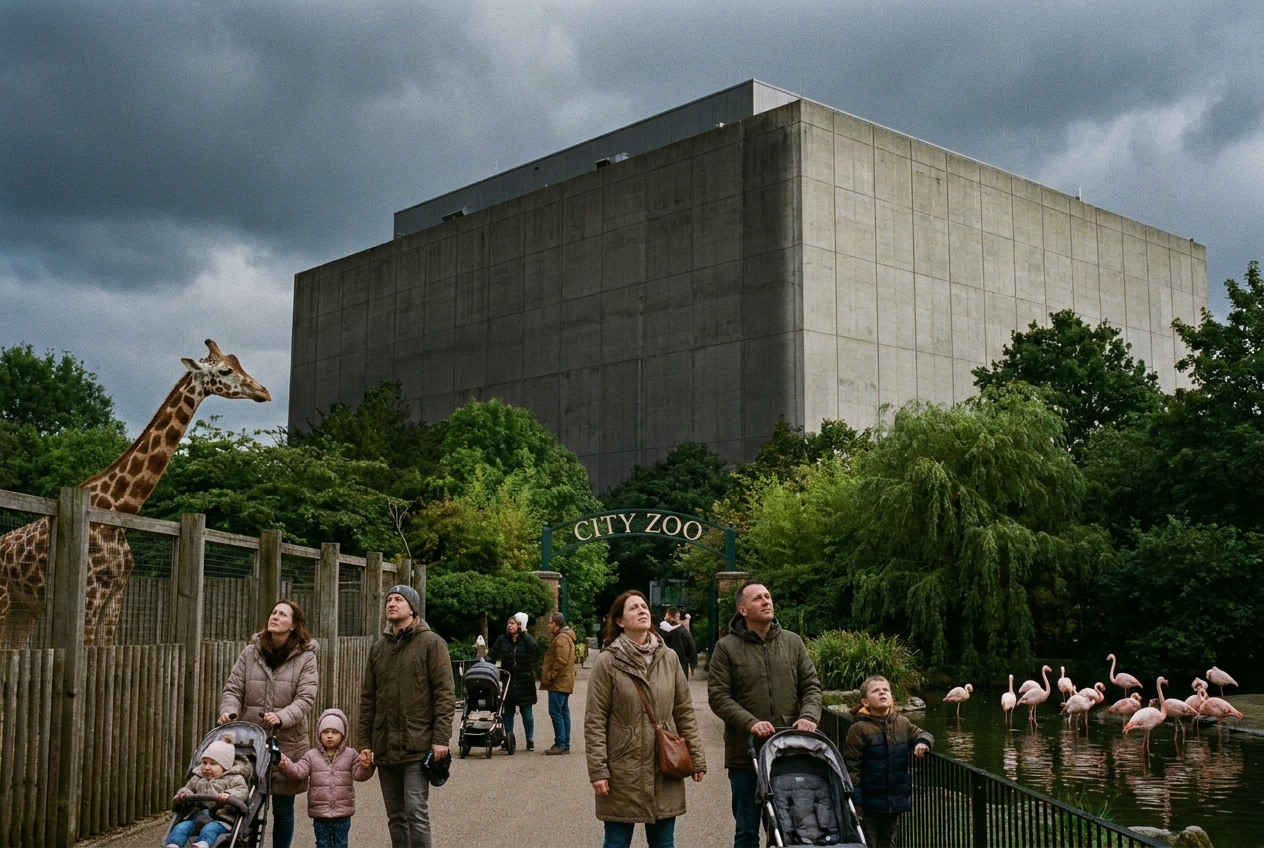
A campaign opposing the construction of a proposed AI data center in Nashville surged past 400,000 signatures following support from Grammy-winning country music star Brad Paisley. The petition challenges plans for a 69,000-square-foot data center proposed to be built close to Nashville Zoo.
Paisley was among the first to draw attention to the issue, opposing a proposed data center in Nashville that would be located about 500 yards from the city’s zoo. He criticized both the scale and the setting of the project, writing: “It would be an enormous monstrosity, an absolute eyesore and detract in every way for not only that zoo, but also that area.”
Brad Paisley’s Nashville Zoo opposition ultimately sparked 560,000+ petition signatures against the proposed facility.
But Paisley went further than just defending the zoo. He drew a direct line to the music industry, writing: “AI is already taking our intellectual property without asking. You feel the effect on Music Row.”
That’s the devastating double punch. The same AI industry that scrapes musicians’ recordings without consent now wants to build industrial plants in their backyards. The irony isn’t lost on anyone.
The Unlikely Alliance
What makes this story remarkable isn’t just that musicians are involved. It’s which musicians.
Few things unite Americans these days, and the same goes in country music, which is virtually split right down the middle by the culture war. But the one thing that’s uniting both sides of the political and cultural divide is opposition to AI and the data centers that are needed to feed its voracious rise — from the oldest and perhaps most famous left-wing country star of all-time, to one of the youngest pro-Trump up-and-comers.
Gavin Adcock — a confrontational and proudly conservative artist who has Facetimed with Donald Trump — also railed against data centers online. In an Instagram video he opposed their construction in rural areas. Adcock spoke to the “rich money-grubbing assholes” pushing for and installing the centers, saying “these people are getting punished for living in the country.”
Tanya Tucker also spoke out about data center construction in Texas, saying “I want Texas to be strong and have a reliable power grid. But I’m concerned about the 765 KV of transmission lines coming through all the ranches in Texas, and destroying our property. It hurts. It’s gonna hurt our health, our wildlife, our water table, our water resources.”
As UCLA’s Megan Mullin put it, “Amid so much partisan division, opposition to data centers seems to be the thing that unites Americans right now… it’s rooted in the one thing that has always united Americans: our deep affinity for where we live.”
The Numbers Behind the Rage
Let’s talk about why these artists aren’t overreacting.
These aren’t cute server closets. AI data centers are warehouse-scale industrial plants requiring enormous amounts of electricity and water for cooling — competing directly with farms and households in drought-prone regions.
About 248 data centers are planned across Texas alone.
A single CoreSite project in Denver could use 300 million gallons of water per year, growing the usage of the entire Denver Water system by 0.5%.
And public opinion is crystal clear: a March Gallup poll found that seven in 10 Americans would oppose the nearby construction of data centers for artificial intelligence, higher than the 53% of respondents who said they would oppose living near a nuclear power plant.
Read that again. Americans are more afraid of data centers than nuclear power plants.
The backlash is already producing real policy changes. The Denver City Council unanimously approved a one-year moratorium on data centers, halting new zoning permits and site development plans.
Oklahoma City approved a similar moratorium, and Tulsa, Oklahoma, also approved a temporary stop on new data center construction.
In Michigan, Huron County approved a three-year moratorium, joining roughly 20 other Michigan communities that have paused data center construction.
Nashville’s Metro Planning Commission held a public hearing on legislation that would ban data centers larger than 500,000 square feet across Davidson County and keep smaller ones at least half a mile from homes, schools, and zoos.
Why Musicians Should Pay Attention
This fight matters for every artist, not just country stars. Here’s why.
The consent pattern is the same
Paisley has drawn a pointed parallel: AI already scrapes artists’ work without meaningful consent. Now the same pattern is playing out with communities and their land.
That connection is powerful. The tech industry’s approach to training data — take first, ask later (or never) — is the same playbook it’s running on land, water, and energy. Musicians who’ve been fighting for their intellectual property rights are uniquely positioned to speak to this pattern.
It’s the physical cost of every AI tool you use
Every time you generate an AI image, render a video, or prompt Suno for a track, a data center somewhere is drawing electricity and water. That’s not a reason to stop using these tools — it’s a reason to understand the full ecosystem. The AI music video you create with OneMoreShot.ai is part of a chain that extends from your laptop to a server rack that might be next to somebody’s ranch.
Country artists are showing the playbook
Country artists represent rural people and farmers, who are poised to bear the brunt of the destructive environmental factors that data centers bring, but they can also speak to AI’s impact on the creative community.
This is what authentic artist advocacy looks like. They’re not tweeting about abstractions. They’re using their platforms to organize petitions, push for legislation, and connect the dots between AI’s digital impact and its physical footprint. Every genre can learn from this approach.
What This Means for AI Music’s Future
The data center revolt connects directly to the AI music conversation that’s been raging all year. The same week country stars were making headlines for opposing AI infrastructure, the AI music industry was busy cutting deals.
Spotify says Merlin, which represents more than 30,000 independent labels and distributors, has joined Universal Music Group in backing its upcoming AI-powered remix and covers product. The paid tool will let fans create AI-generated covers and remixes of participating artists’ music while ensuring artists opt in, receive credit, and are compensated.
Spotify has positioned its AI music product as being significantly different from the more controversial AI music startups. Spotify co-CEO Gustav Söderström told investors that the company’s AI music product will be about “real artists, not fake artists.”
Spotify announced a milestone no audio streaming service has ever reached: 300 million Premium Subscribers, as revenue growth accelerated and gross margin hit an all-time record.
So Spotify is now a $5-billion-per-quarter company building AI tools on top of a 300-million-subscriber base. The AI infrastructure powering all of this has to live somewhere. And increasingly, the communities being asked to host that infrastructure are saying no.
This tension isn’t going away. It’s going to define the next chapter of AI music.
The Smart Musician’s Playbook
So where does this leave you — an independent musician trying to navigate AI in 2026?
1. Use AI tools wisely, not blindly
The data center fight is a reminder that AI has real-world costs. That doesn’t mean you should stop using AI tools — it means you should use them intentionally. Creating an AI music video for your next single is a legitimate, powerful way to promote your work. Flooding the internet with AI slop nobody asked for is not. Quality over quantity was always the right strategy, and now there’s an environmental argument for it too.
2. Strengthen your identity as a real artist
The whole data center revolt is fundamentally about authenticity — real communities, real land, real water, real people. That same energy applies to your music. In a world where AI-generated tracks keep flooding streaming platforms, your identity as a human artist is your strongest asset. If you haven’t already, check out our Complete Guide to AI Music Videos in 2026 for strategies on using AI video to amplify your human artistry rather than replace it.
3. Use your platform for more than promotion
Brad Paisley didn’t just post a hot take. He collaborated with the Nashville Zoo on a coordinated campaign that generated over half a million petition signatures. If you have an audience — even a small one — you have the ability to organize around the issues that matter to your community. AI policy, from copyright to infrastructure, affects musicians directly.
4. Make content that connects to place
Country music’s effectiveness in this fight comes from its deep connection to specific places — Texas ranches, Nashville neighborhoods, small-town America. Whatever your genre, the most resonant music videos connect to real settings, real stories, real emotion. Whether you’re making AI music videos for country, rock, or indie, grounding your visuals in authentic settings hits harder than abstract AI dreamscapes.
5. Follow the policy, not just the headlines
Data center moratoriums, the EU AI Act, streaming platform AI policies — the regulatory landscape is shifting fast. Musicians who stay informed will be better positioned to protect their work and their communities. The artists leading the data center revolt aren’t just angry. They’re organized, informed, and effective.
The Bigger Picture
There’s a deep irony in the AI music story of 2026. On one hand, AI tools are democratizing music creation and visual content in ways that genuinely help independent artists compete. On the other hand, the infrastructure powering those tools is threatening the physical communities where music culture lives.
Willie Nelson fighting data centers near his Texas farm while Spotify signs AI remix deals with 30,000 indie labels — that’s the whole tension of this era in one sentence.
The musicians who thrive will be the ones who can hold both realities simultaneously: using AI tools where they add value, while pushing back on the parts of the AI ecosystem that harm artists and communities.
Country music just reminded us that the AI debate isn’t just about algorithms and copyright. It’s about water tables, zoo animals, and whether the kid growing up on a Texas ranch gets to see dark skies at night.
That’s a fight worth having a soundtrack for.
Ready to create your next music video? OneMoreShot.ai lets you turn your track into a stunning visual in minutes — no data center next to your house required. Upload your song, choose your style, and let your music do the talking.