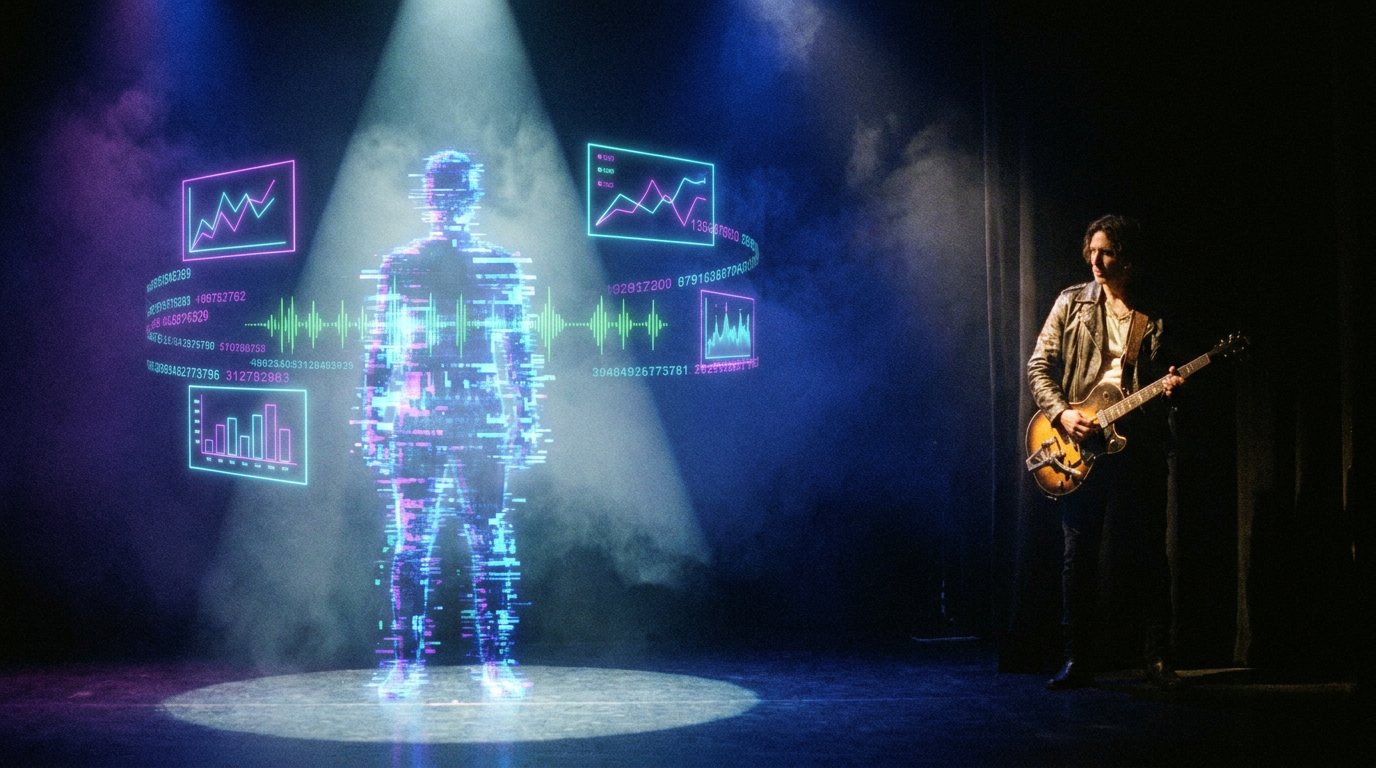
Fake AI Artists Are Topping the Charts in 2026
There’s a blues singer named Eddie Dalton who hit #1 on iTunes in both the US and UK this spring. He had 11 songs simultaneously in the iTunes Top 100. His YouTube videos racked up millions of views. Fans in the comments called him a once-in-a-generation talent.
Eddie Dalton does not exist.
He’s a gray-haired, soulful blues singer with 1.4 million YouTube views, 230,000 Facebook followers, three songs simultaneously in the iTunes top 10, and a number one single in both the United States and the United Kingdom. He is also entirely fictional. Every element of him — his voice, his face, his persona, his music — was generated by artificial intelligence.
And he’s not alone. Welcome to the moment when AI ghost artists aren’t just a curiosity — they’re chart-toppers competing head-to-head with human musicians for attention, royalties, and cultural space.
The Phantom Hitmakers
The Eddie Dalton story was first broken by Showbiz411, which identified the person behind the project as Dallas Ray Little, a content creator based in Greenville, South Carolina, who operates through a company called Crunchy Records. Little produces AI music and videos under a roster of fake artist names. Eddie Dalton is the one that broke through.
But Eddie was just the opening act.
Weeks later, “Celebrate Me” by IngaRose, a synthetic R&B performer who does not exist in real life, reached number one on April 17. Suno, the generative AI music platform, created the track.
The song topped iTunes charts in the United States, United Kingdom, France, Canada, and New Zealand.
It initially gained traction on TikTok, where IngaRose has over 220,000 followers, and more than 300,000 videos on the platform used the song.
Let that sink in: a non-existent AI artist went viral on TikTok, climbed global charts, and built a fanbase of hundreds of thousands — all without a single human vocal performance.
Downloads, not streaming or radio play, drove these chart positions. People bought the music thinking they’d discovered authentic country soul.
Luminate tracking shows Eddie Dalton sold only 6,900 tracks total since creation — numbers that shouldn’t support such massive chart dominance. The iTunes chart, it turns out, is remarkably easy to game with concentrated download bursts.
The 75,000-Track-a-Day Flood
The phantom hitmakers are just the tip of a much larger iceberg. In April, Deezer dropped a stat that should make every musician sit up straight.
Deezer is now receiving almost 75,000 AI-generated tracks per day, representing roughly 44% of the daily uploads. This amounts to more than 2 million AI-generated tracks uploaded per month.
Read that again: nearly half of all new music arriving on Deezer every single day is fully AI-generated.
The new figures mark a sharp escalation from the 60,000 tracks per day reported in January, when synthetic content represented 39% of daily deliveries. It also marks a significant jump from 50,000 in November, 30,000 in September, and just 10,000 when Deezer launched its AI detection tool in January 2025.
That’s a 7.5x increase in just 16 months. The growth curve isn’t linear — it’s exponential.
Here’s the silver lining, though: consumption of AI-generated music on Deezer is still very low, between 1-3% of the total streams, and 85% of these streams are detected as fraudulent and demonetized by Deezer. People aren’t actually listening to most of this stuff. They’re gaming the system.
Deezer also commissioned an international study which revealed that 97% of people couldn’t hear the differences between AI and human-made music, and that 80% of people agree that fully AI-generated music should be clearly labeled to listeners.
That gap — between people’s inability to detect AI music and their strong desire to know when it’s AI music — is where the entire future of this industry lives.
The Research That Changes Everything
A fascinating study from the University of Hamburg confirms what many musicians have intuited. Researchers found that while consumers enjoy and even prefer AI-generated music, preferences shift upon learning that the song was AI-generated.
A peer-reviewed study published in March found that listeners engage less deeply with music labeled as AI-generated — even when the music was actually human-composed.
This is a mind-bending paradox. The label “AI-generated” acts as a psychological repellent regardless of actual quality. Which means authenticity isn’t about sound anymore — it’s about story, identity, and proof of humanness.
For musicians, this isn’t just academic trivia. It’s a strategic roadmap. If you’re a real human making real music, the single most valuable thing you can do right now is prove it visually.
The Legal War Has a Deadline
While phantom artists flood charts, the courts are racing to establish the rules. And the timing is extraordinary.
Universal Music Group settled with Udio in October 2025 and is co-launching a licensed AI music platform in 2026. Sony Music has settled with neither, and its fair-use cases against Suno and Udio are expected to produce a pivotal ruling in summer 2026 that could set legal precedent for every AI music company.
Just two days ago, Sony Music filed to expand its Udio lawsuit, alleging that the AI music platform infringed on over 30,000 recordings in its training.
AI music startup Udio has denied Sony Music’s copyright infringement claims while acknowledging that it used audio scraped from YouTube to train its models. Udio admitted that its models were built by feeding the system with “a vast amount of different kinds of sound recordings” gathered from publicly available sources.
The summer 2026 ruling could fundamentally reshape what AI music companies can and can’t do. But here’s the thing: regardless of how the courts rule, the flood isn’t stopping. The tools are out there. The economics are too attractive. And as we’ve seen, a single person in South Carolina can generate an entire roster of chart-topping phantom artists from a laptop.
The Platform Response (Or Lack Thereof)
Platforms are scrambling to respond, but the approaches are wildly inconsistent.
Songs tagged as AI-generated on Deezer are automatically removed from algorithmic recommendations and not included in editorial playlists. Deezer is the clear leader here, having built proprietary detection technology that can identify 100% AI-generated music from leading generative models including Suno and Udio.
Meanwhile, Apple Music and Spotify have taken a different approach, placing the onus on the supply chain rather than building platform-level detection. Apple Music launched its Transparency Tags system in March, asking labels and distributors to declare AI-generated content at the point of delivery.
YouTube is rolling out “new internal signals” to identify AI-generated content, starting in May 2026. If a creator does not specify whether AI was used, but YouTube’s systems detect “significant photorealistic AI use,” the platform will “automatically apply a label.”
But none of these measures prevented Eddie Dalton from holding 11 simultaneous spots on the iTunes Top 100. Apple Music’s listing for Eddie Dalton on iTunes does not appear to include any label or disclosure indicating the artist is AI-generated. Apple — the company that collects the revenue from these downloads — had zero AI disclosure on the biggest AI music story of the year.
Why Visual Identity Is Now Your Superpower
Here’s where this gets practical for musicians.
In a world where anyone can generate a convincing audio track in seconds, the thing that separates real artists from phantom ones is everything except the audio. Your face. Your story. Your live performances. Your creative vision. And critically, your visual identity.
Think about it: Eddie Dalton’s visual identity was a single AI-generated portrait of a gray-haired man. IngaRose’s visual presence was a handful of AI-generated images. Neither had a real music video. Neither had footage of a real studio session, a real tour, or a real creative process.
That’s the gap.
If you’re reading this as an independent artist, you already have the one thing no AI can replicate: you’re a real person with a real story. But that story needs to be shown, not just told. And this is precisely why the music video has never been more important.
The irony is beautiful: AI itself is the best tool for real musicians to build the visual proof-of-humanity that separates them from AI ghost artists. An AI music video doesn’t replace your authenticity — it amplifies it. You’re still the creative director. You’re still making the decisions. The AI is your production team, not your replacement.
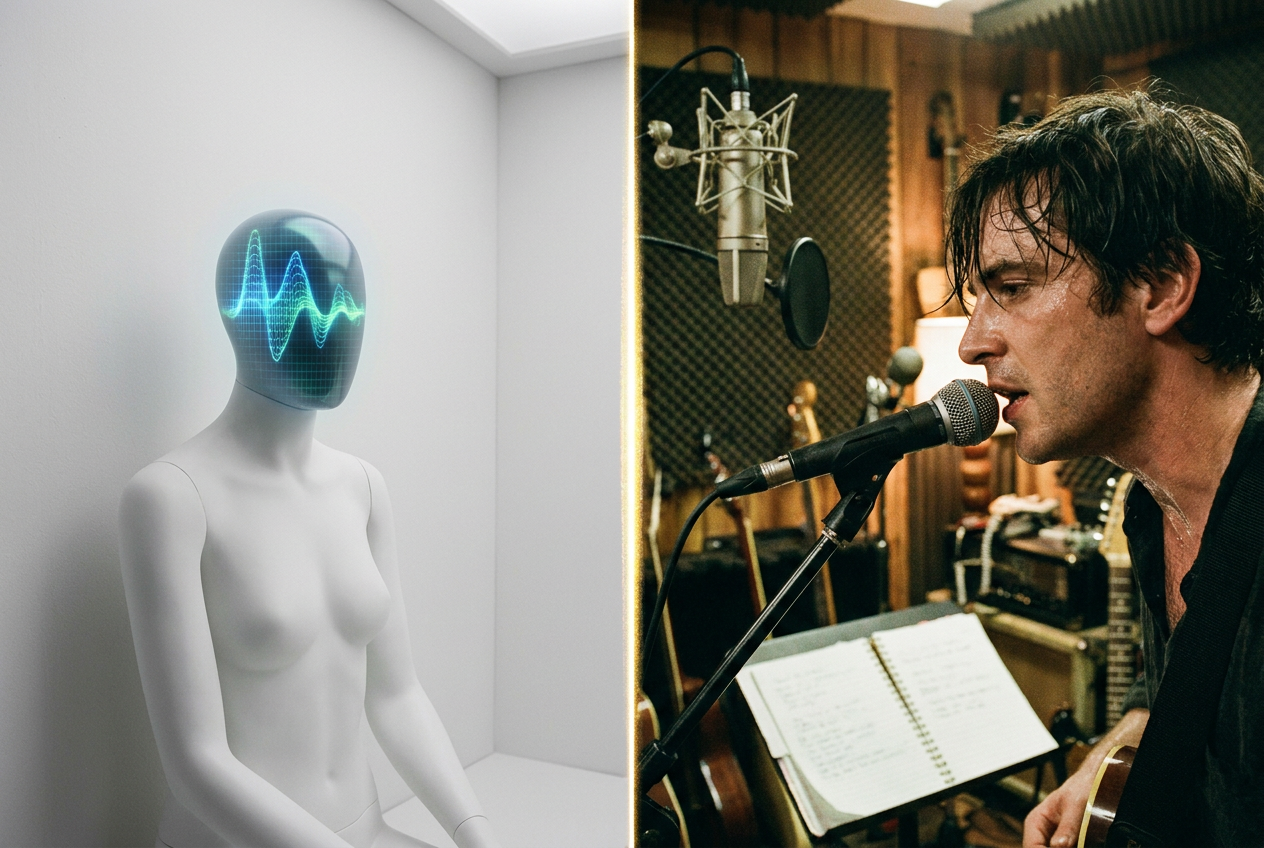
The Five-Move Playbook for Real Musicians
Here’s exactly what smart musicians should be doing right now:
1. Make Your Humanity Visible
Every release should come with visual content that proves a human being made it. Behind-the-scenes footage. Studio sessions. The scrappy, imperfect moments that no AI would ever generate. An AI music video built around your actual creative story is infinitely more compelling than a phantom artist’s generated portrait.
2. Build Visual Consistency Across Genres
Whether you’re making hip-hop, EDM, or indie, your visual brand should be unmistakably you. AI ghost artists have generic visuals because they have no real identity to draw from. Real artists can build visual signatures that compound across every release.
3. Release Visual Content at the Speed of AI
The phantom artists pump out content relentlessly. Eddie Dalton keeps coming with music in a flow that no human musician can keep up with. Little has already said that there are other songs in line. You can’t compete with AI on volume, but you can use AI-powered video tools to dramatically increase your visual output without sacrificing quality.
4. Get Ahead of Disclosure
Every platform is moving toward AI labeling. Smart musicians should embrace transparency proactively. If you used AI tools in your video production but wrote and performed the music yourself, say so clearly. That honest disclosure differentiates you from the phantom artists who deliberately obscure their origins.
5. Own the Live Experience
As one vocalist put it: “AI can’t go live. We’re taking our talents in a way that makes us push ourselves. Creatives are always going to be creative, and we can outdo this model 10 times over.” Document your live performances. Capture those moments. Turn them into visual content that phantom artists can never replicate.
What Happens Next
The music industry is entering what might be the most turbulent summer in its history. The global music industry in the second quarter of 2026 is navigating the most profound structural reorganization in its modern history. The proliferation of highly advanced, text-to-audio generative AI platforms has introduced an unprecedented vector of disruption.
A study from CISAC and PMP Strategy estimates that nearly 25% of human creators’ revenues are at risk by 2028, equivalent to up to €4 billion globally.
Meanwhile, the big platforms are making their moves. Believe is partnering with Google to offer Flow Music — the Google Labs-housed AI music tool formerly known as ProducerAI — to its artists, producers and songwriters as a “creative collaborator.”
Flow Music is powered by Google’s Lyria 3 Pro music generation model, which can generate tracks up to 3 minutes long and can follow prompts for specific structural elements like intros, verses, choruses and bridges.
The message from the industry is clear: AI isn’t going away. The question is whether you’ll use it as a tool to amplify your unique human artistry, or watch from the sidelines as phantom artists eat your lunch.
The Bottom Line
Eddie Dalton and IngaRose proved that AI can fool charts. But they also proved something more important: AI can’t build a real career.
Neither phantom artist has done a live show. Neither has sat for an interview. Neither has a creative story that extends beyond “someone typed a prompt.” Their chart success was built on a quirk of download economics, not on genuine cultural connection.
People are less willing to pay for AI-generated music once they know what it is. Many generative AI programs geared toward creative fields have encountered a common problem: rapid initial adoption, followed by declining sustained engagement.
The artists who thrive in 2026 and beyond will be the ones who lean into their humanity while leveraging AI as a creative accelerator. That means investing in visual storytelling. That means using tools like OneMoreShot.ai to create professional music videos that showcase your real creative vision — quickly, affordably, and at the pace the streaming era demands.
The phantom artists are at the gates. But they’re made of smoke. And smoke can’t hold a microphone.