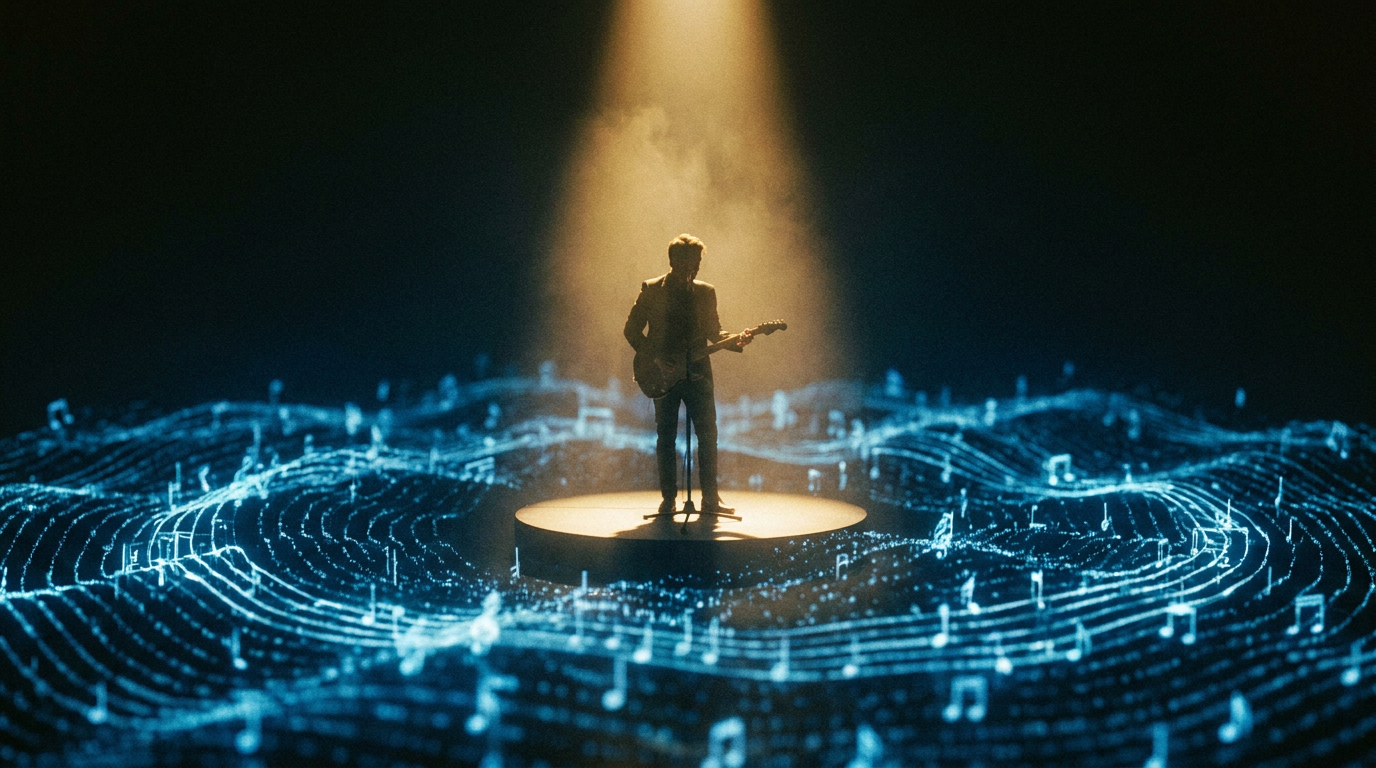
Half of All New Music Is AI. Nobody's Listening.
Here’s a number that should stop every musician in their tracks: Deezer is now receiving almost 75,000 AI-generated tracks per day, representing roughly 44% of all daily uploads.
And here’s the number that should make them exhale: consumption of AI-generated music on the platform is still very low, between 1% and 3% of the total streams, and 85% of these streams are detected as fraudulent and are demonetized.
Read that again. Nearly half the music being uploaded to streaming platforms is synthetic. And almost nobody is choosing to listen to it.
This is the defining data story of 2026 — and it has massive implications for every musician trying to figure out whether AI is a career-ending threat or a creative superpower. Spoiler: the answer depends entirely on which side of the equation you’re on.
The Numbers Are Staggering
Let’s lay it out. The data from the first half of 2026 paints one of the strangest pictures the music industry has ever seen.
In May 2026, Apple Music’s senior vice president of music Oliver Schusser publicly disclosed that more than 33 percent of new uploads to Apple Music are now fully AI-generated, yet AI tracks account for less than 0.5 percent of total listening time on the platform.
That’s Apple’s figure — a third of all new music is AI, and it captures less than half a percent of ears.
Nearly half of all music uploaded to Deezer every day is now AI-generated. Deezer’s latest data puts AI-generated daily uploads at approximately 75,000 tracks, representing 44% of total deliveries. The growth has been steep: in early 2025 the platform reported around 10,000 AI-generated uploads per day (roughly 10%).
That’s a 7.5x increase in AI uploads in barely over a year. From 10,000 a day to 75,000. And 1-3% of total streams are for AI-generated music, and 85% of those streams are reportedly fraudulent.
So when you strip out the bots, the actual human listening to AI music is essentially a rounding error.

The Supply-Demand Gap Nobody Predicted
Music industry analysts predicted a lot of things about AI. They predicted copyright wars (correct). They predicted job losses (happening in some areas). They predicted that AI would flood streaming platforms with cheap content (very correct).
What nobody predicted was that listeners would simply… not care.
Across three studies, Jana Friedrichsen, Julia Schwarz, and Michel Clement explored how generative AI would change the music industry. They found that while consumers enjoy and even prefer AI-generated music, preferences shift upon learning that the song was AI-generated.
This is the “AI music paradox” of 2026. In blind tests, Deezer commissioned a unique international study on attitudes towards AI-music, which revealed that 97% of people couldn’t hear the differences between AI and human-made music. But when they know it’s AI? They bounce.
A Luminate study tracking attitudes from May to November 2025 found that overall interest dropped from -13% to -20% during that time period. Consumers aren’t warming up to AI music. They’re cooling off.
This is why the economic implications aren’t quite as dire as the upload numbers suggest. If AI tracks are 33 percent of the catalog but generate 0.5 percent of streams, then 99.5 percent of the pool still flows to the 67 percent of uploads that are human-made. Per-stream payouts to human artists do not get diluted by AI flooding the catalog, at least not at current consumption levels.
For now.
Why AI Music Fails the Vibe Check
Let’s be honest about why AI music isn’t finding listeners. It’s not because the audio quality is bad — we just established that 97% of people can’t tell the difference in a blind test.
It’s because music has never been just about audio.
Music is identity. It’s culture. It’s the story behind the song, the face behind the voice, the visual world an artist builds. It’s the reason people wear band t-shirts, follow artists on Instagram, and watch music videos at 2 AM.
AI-generated tracks have none of that. They’re audio files with no soul, no backstory, no visual identity. Apple’s Oliver Schusser noted that the usage of AI music on Apple Music is “really tiny,” because interest in music discovery is rooted in cultural relevance, in the artists themselves, and in human-led curation and promotion. These personal and inherently human aspects mean that churned-out, faceless AI tracks don’t have the same reach or relevance.
This should be the biggest wake-up call for musicians in 2026 — not that AI is coming for your job, but that visual identity and personal branding are now your moat.
The artists who will thrive aren’t necessarily the most talented singers or producers. They’re the ones who build complete worlds around their music — and that starts with visuals.
The Visual Advantage Is Real
Think about what separates a song that gets 1,000 streams from one that gets 1,000,000. It’s rarely just the audio. It’s the music video that gets shared. The visual aesthetic that makes someone stop scrolling. The complete artistic package that turns a listener into a fan.
This is exactly where AI music videos flip the script. The same AI technology that’s flooding platforms with disposable audio can be weaponized to make your human-made music stand out.
Consider the economics: Creating AI music costs almost nothing compared to traditional recording. Labels and independent operators can generate hundreds of tracks per day, upload them to streaming services, and collect micropayments every time someone plays them. That’s the spam strategy, and the data shows it doesn’t work.
The winning strategy? Make fewer, better songs — and give each one a visual identity that AI-generated slop can never replicate. If you need a place to start, our guide on how to make an AI music video walks through the entire process.
China Is Showing Us the Future (and It’s Messy)
If you want to see where the AI music flood leads when left unchecked, look at China.
The Chinese music streaming market is facing “industry chaos” due to platforms allowing masses of copyright-infringing, AI-made tracks to fill up their catalogs. That’s the verdict of Tencent Music Entertainment’s Executive Chairman, Cussion Pang, and CEO, Ross Liang, delivered during TME’s Q1 2026 earnings call on Tuesday (May 12). Their comments represent one of the most direct warnings yet from industry leaders over the damage AI-generated content is doing to streaming subscription businesses in China.
TME’s CEO coined a term that’s about to enter every music exec’s vocabulary: “song-washing.” He told analysts that “disorderly price competition within the industry, coupled with the rampant issue of pirated content driven by AI, has introduced uncertainties regarding the future revenue growth of traditional streaming services.”
The takeaway from China’s chaos is that platforms will have to fight back, and they are. Deezer’s AI detection practice began in June 2025 and has now tagged 13.4 million AI-generated tracks.
In September 2025, Spotify removed 75 million AI-generated tracks in a fraud crackdown. And Apple Newsroom reported in early 2026 that the deployment of its AI fingerprint and fraud-detection stack drove a 60 percent reduction in fraudulent uploads year over year.
The platforms are getting better at filtering AI slop. Which means the cream — real artists with real identity — rises faster.

What Smart Musicians Are Doing Right Now
The data is clear: AI audio alone is a losing strategy. But AI as a creative tool is the biggest opportunity independent musicians have ever had. Here’s how the smart ones are playing it:
1. Making Human Music, AI Visuals
The winning formula in 2026 is simple: write and perform your own music, then use AI to build the visual world around it. Tools like OneMoreShot.ai let you generate stunning music videos in minutes, giving every track the visual identity it needs to compete.
This is especially powerful for genres where visual identity is everything. Whether you’re making hip-hop, EDM, or indie, having a visual for every release is no longer optional — it’s the difference between getting discovered and getting buried.
2. Building Visual Consistency
One of the reasons AI-generated music fails to build audiences is that there’s no consistent identity behind it. Smart artists are using AI video tools to develop a recognizable visual language across their releases — consistent color palettes, recurring visual motifs, a signature aesthetic.
If you explore our pop music video templates or R&B templates, you’ll see how establishing visual consistency across releases creates the kind of brand recognition that algorithms reward and listeners remember.
3. Releasing Video-First on Every Platform
YouTube is the world’s biggest music platform. TikTok drives discovery. Instagram Reels build community. Every one of these platforms prioritizes video over audio-only content. Deezer reported that approximately 44% of daily uploads are now AI generated tracks. But when it comes to listening behaviors, there’s no sustained uptick to match; Deezer found that AI songs account for less than 3% of total streams on the platform, and a majority of those streams have been deemed fraudulent.
The AI audio flood makes audio-only platforms increasingly noisy. But video platforms? That’s where human artists still dominate — because a compelling music video requires vision, taste, and intentionality that AI-generated content farms simply don’t have.
The Transparency Reckoning Is Coming
The other trend that should comfort musicians: 80% agree that 100% AI-generated music should be clearly labeled to listeners , and 52% of respondents said 100% AI-generated songs shouldn’t be included in charts alongside human-made songs.
Audiences want to know what’s human. And platforms are responding. Apple introduced “Transparency Tags”, which identify content that was created with assistance from AI.
Deezer started tagging AI tracks at the platform level in June 2025, becoming the first streaming platform to do so.
As labeling becomes standard, the premium on “verified human” music will only grow. Think of it like organic food labels — once people can easily identify the real thing, demand for it increases.
This is where your visual presence matters even more. A music video is the ultimate proof of artistic intentionality. It tells listeners: a human being made this, thought about how it should look, and cared enough to give you a complete creative experience. Even if you used AI tools to generate the video, the creative direction came from you — and that’s the part that matters.
The Bottom Line for 2026
The data tells a story that’s surprisingly optimistic for real musicians:
- AI music uploads are exploding — but nobody’s listening to them
- Platforms are getting better at detecting and demoting AI slop
- Audiences want transparency and prefer human-made music when they know the difference
- Visual identity is your moat — the one thing AI content farms can’t replicate at scale
The flood of AI music is real. But it’s also proving, in real-time, that music without a human story behind it is just noise. The artists who pair their human creativity with AI-powered visuals aren’t just surviving the flood — they’re surfing it.
If you’re sitting on tracks that deserve to be seen and not just heard, stop waiting. Build your visual identity now, while the gap between “real artist” and “AI content farm” is still widening in your favor.
OneMoreShot.ai can help you create professional music videos in minutes — so every release gets the visual treatment it deserves. Because in 2026, the musicians who win won’t be the ones who make the most songs. They’ll be the ones who make each song impossible to ignore.