
K-Pop Just Legalized AI-Assisted Songwriting
Remember when South Korea banned AI from music entirely? That lasted about 16 months.
KOMCA — the Korea Music Copyright Association — just reversed its blanket AI ban. The amended rules took effect on August 3, allowing registration of AI-assisted songs where a human creator played a substantial and leading role in writing lyrics, composing, or arranging the work.
This isn’t some obscure regulatory footnote. KOMCA administers the copyrights in songs — the underlying compositions and lyrics — and the songwriters, composers, and publishers behind almost every commercially released K-pop track register their works with KOMCA, meaning its disclosure rules reach deep into the catalogs feeding HYBE, SM Entertainment, and their peers.
In other words: the organization that controls royalties for 55,000+ members across 110 countries just told the world that AI-assisted music is real, it’s here, and it deserves copyright protection. If you make music — in any genre, in any country — this matters to you.
What Changed and Why
The new standard represents a significant reversal of KOMCA’s March 2025 position. Effective March 24, 2025, KOMCA required all registrants to certify via a checkbox that their submitted works were created solely through human creative contributions, with zero AI involvement permitted. Any AI involvement — even a chord suggestion or a virtual instrument plugin — rendered a work ineligible.
Think about how extreme that was. A chord suggestion from a plugin? Ineligible. An AI-powered arrangement assistant? Your entire song loses copyright protection. Creators who falsely declared human-only authorship faced royalty withholding, work deletion, and legal liability.
The problem, of course, was reality.
The policy drew immediate criticism from working composers who argued it failed to reflect the realities of how modern music is made. AI tools had already become routine fixtures in the digital audio workstations used across South Korea’s music production scene — from chord suggestion engines to generative arrangement assistants.
Then came the audit that blew the whole thing open.
The Audit That Changed Everything
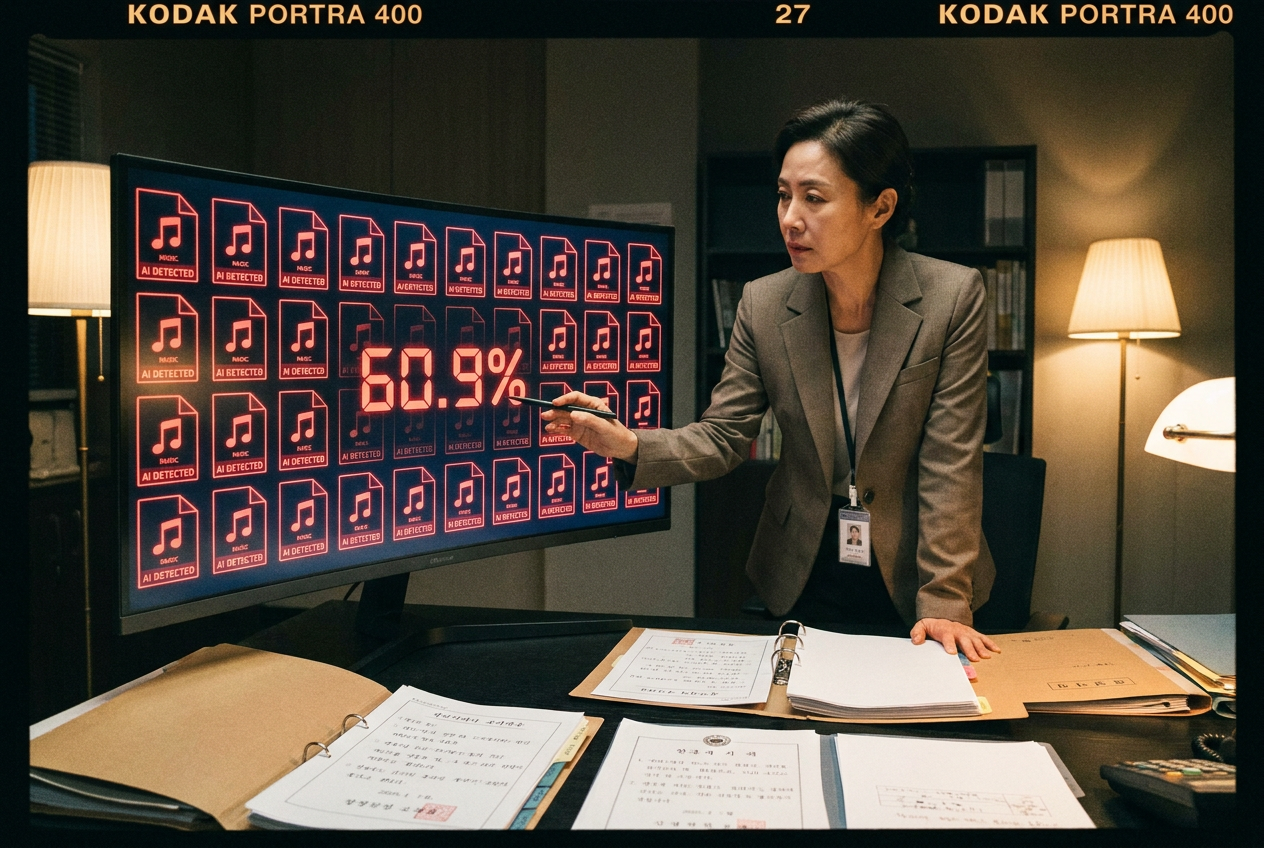
The reversal follows a March 2026 audit that questioned how well the old rule was working. South Korea’s Board of Audit and Inspection sampled 8,540 songs from 29 writers who had each entrusted more than 200 works to KOMCA in 2024. It found that 5,200 of them — 60.9% — were likely composed with the help of AI.
Let that number sink in. Nearly two-thirds of the songs examined had traces of AI assistance. Under the old rules, every single one of those tracks was technically ineligible for copyright — and every royalty payment attached to them was technically improper.
The audit covered 11 Korean copyright trust bodies, and concluded they were registering works and paying royalties without separately checking for AI use. KOMCA had initially defended the ban, arguing that no technology exists anywhere in the world to determine with certainty whether AI was used in a piece of music.
So KOMCA was enforcing a rule it couldn’t actually verify. The old system didn’t work because it relied on an honor code in an industry where AI tools are baked into the default workflow. That’s not a policy — that’s wishful thinking.
The New Framework: What’s Actually Required
KOMCA now allows creators to register songs developed with artificial intelligence if they played a substantial and leading role in writing lyrics, composing, or arranging the work. Songs generated entirely by AI through simple text prompts remain ineligible.
The dividing line is clear: human-led creation with AI tools is in. Typing “make me a K-pop banger about heartbreak” into Suno and uploading the result is out.
The association said the policy sets South Korea’s first clear standard for registering AI-assisted music under existing copyright law. Under the new system, creators registering AI-assisted work must name the AI tools used, explain how they were applied, and certify the accuracy of their disclosure.
This is a disclosure-first framework. You can use AI, but you have to tell everyone exactly how. The spirit is transparency, not prohibition.
By establishing a disclosure-based framework that mirrors the US Copyright Office standard and arrives in the immediate wake of the German ruling and the EU AI Act enforcement deadline, KOMCA has moved from the edge of the global AI music debate to its center.
Why This Matters Beyond K-Pop
You might be thinking: “I’m not a K-pop artist, why should I care?” Because KOMCA’s decision doesn’t exist in isolation. It’s part of a global chain reaction that’s rewriting the rules for every musician.
South Korea’s move comes as the global music industry develops new standards for AI-generated content. On July 30, the International Federation of the Phonographic Industry introduced principles governing the eligibility of AI-assisted recordings for inclusion in its official charts. Under the framework, recordings must use authorized AI services, be substantially human-made, and raise no concerns over streaming or chart manipulation.
Here’s the pattern forming: every major institution is converging on the same basic idea. If a human drove the creative decisions and AI was a tool (not the creator), the work gets protection. If AI did the heavy lifting and a human just typed a prompt, it doesn’t.
This standard is emerging simultaneously in South Korea (KOMCA), Germany (the GEMA ruling), the EU (AI Act Article 50), and the United States (Copyright Office guidance). For the first time, there’s something approaching a global consensus on where the line sits.
For musicians using AI video tools to create visuals for their tracks, this distinction is important. Your song, your lyrics, your vocal performance — those establish your human authorship. The AI music video you build around it? That’s a production tool, not a replacement for your artistry. If you need a primer on how this works in practice, our complete guide to AI music videos in 2026 walks through the full process.
The K-Pop Industry Was Already All-In on AI
KOMCA’s reversal didn’t happen in a vacuum. The biggest companies in K-pop had already gone deep.
Both HYBE and SM have been moving quickly into AI. HYBE took majority control of AI audio company Supertone in a $32 million deal in 2023, a business it moved to wind down in July 2026, and has used AI to translate vocals into multiple languages and to build the virtual group SYNDI8.
SM Entertainment has made AI central to its strategy too. When the labels behind BTS, BLACKPINK, and aespa are building AI into their production pipelines, a copyright body that pretends AI doesn’t exist becomes a liability, not a safeguard.
The 60.9% audit figure proves it. Korean songwriters weren’t waiting for permission. They were using AI tools daily and checking a box that said they weren’t. KOMCA’s old policy didn’t prevent AI use — it just created a culture of silent non-compliance.
The new framework brings those workflows into the open. That’s better for everyone: better for songwriters who can now be honest, better for labels who need defensible copyright chains, and better for the PROs that distribute royalties.

What This Means for Your Music
Let’s bring this home. Whether you’re making K-pop, hip-hop, indie, or country, KOMCA’s reversal sends a clear signal about where the world is heading.
1. AI as a Tool Is Winning
The “zero AI” position is collapsing everywhere. KOMCA tried it for 16 months and found that the majority of songs submitted under the policy were using AI anyway. The US Copyright Office already recognizes AI-assisted works where human authorship is present. The EU AI Act focuses on labeling, not prohibition.
If you’re using AI to assist your songwriting, production, or visual creation, you’re on the right side of history. The key is the word “assist” — you need to be making creative decisions, not outsourcing them.
2. Disclosure Is the New Default
Under KOMCA’s new rules, you name the tools, explain how they were used, and certify the disclosure is accurate. This mirrors what’s happening globally. Spotify already offers AI Credits for voluntary disclosure. The RIAA introduced AI-Generated and AI-Assisted labels. The EU AI Act requires labeling of synthetic content.
The musicians who get ahead are the ones who embrace transparency now, before it’s mandatory everywhere. Use AI tools openly. Credit them. Show your audience that the creative vision is yours — AI just helped you execute it faster.
3. AI Music Videos Are Your Best Transparency Play
Here’s something worth understanding: music’s AI labeling systems mostly focus on audio. The RIAA’s new labels? Audio only. KOMCA’s framework? Compositions and lyrics. The IFPI chart rules? Recordings.
AI music videos exist in a space where AI assistance is already normalized and expected. Nobody accuses you of being a “fake artist” for using AI-generated visuals — they credit you for having a creative vision. It’s the one place where AI makes you look more professional, not less authentic.
That’s why building your visual presence with AI music videos is such a smart move right now. Your song proves your musicianship. Your AI music video proves your vision. Together, they build the kind of artist brand that thrives in the disclosure era.
The Bigger Picture: Suno’s Licensed Model Era
KOMCA’s reversal lands at a moment when the entire AI music ecosystem is lurching toward legitimacy.
BMG and Suno announced a global alliance on August 12 covering BMG’s recorded and music publishing repertoire. The deal is part of Suno’s upcoming launch of its first music model developed in partnership with the music industry. Together, the companies will develop new music experiences, and the agreement ensures that BMG artists and songwriters who opt in have their rights protected and are compensated.
After settling with Warner Music Group last November, Suno announced this partnership and preemptive settlement with the fourth-largest music company, BMG. Leading AI-music generator Suno, which was sued by three major labels in 2024, is whittling down its list of potential enemies.
Warner Music CEO Robert Kyncl confirmed the licensed model remains on track to launch later in 2026.
Here’s what the puzzle looks like when you step back:
- Warner Music: Settled and partnered with Suno ✅
- BMG: Settled and partnered with Suno ✅
- Universal: Settled with Udio, still suing Suno ❌
- Sony: Still suing both Suno and Udio ❌
- KOMCA: Created AI-assisted copyright framework ✅
- GEMA: Won copyright ruling against Suno in Germany ✅
Two of the four biggest music companies are now building with Suno, not fighting it. South Korea’s copyright body just created a legal pathway for AI-assisted music. The EU’s labeling requirements went into effect on August 2. And Suno’s fully licensed models are launching before the end of the year.
This isn’t a chaotic free-for-all anymore. It’s a new system taking shape, and the musicians who understand it early will be the ones who benefit.
How to Position Yourself Right Now
Here’s the practical takeaway for every musician reading this:
Use AI tools openly and honestly. The world is converging on disclosure-first frameworks. Be transparent about what AI tools you use and how you use them.
Keep human creativity at the center. Every framework — KOMCA, the US Copyright Office, the IFPI, the EU AI Act — draws the line at substantial human involvement. If you’re writing the lyrics, performing the vocals, making the creative decisions, and using AI to enhance or accelerate the production, you’re protected.
Build your visual presence now. AI music videos are the one AI-powered content type where there’s zero stigma and maximum upside. While the audio side of AI is tangled in lawsuits and labeling debates, the visual side is wide open. Check out our genre-specific guides for pop, R&B, or Latin to see what’s possible.
Don’t wait for perfect clarity. The rules are still being written, but the direction is clear. Every month brings more structure, more licensing deals, more frameworks. Musicians who start now — building workflows, creating content, establishing their visual brand — will be miles ahead when the dust settles.
The Bottom Line
South Korea didn’t just legalize AI-assisted songwriting. It created a blueprint that the rest of the world is likely to follow: humans lead, AI assists, and everyone discloses.
For musicians, this is genuinely good news. The “ban everything” era was always unsustainable. The new framework acknowledges how music is actually made in 2026 and creates rules that protect the people doing the creative work.
The opportunity is yours. Your songs, your voice, your creative vision — those aren’t going anywhere. AI just makes it possible to do more with them. More visuals. More content. More reach. More fans.
Ready to put that into practice? Start creating your AI music video on OneMoreShot.ai and turn your tracks into the visual content they deserve — no studio, no crew, no permission slip required.