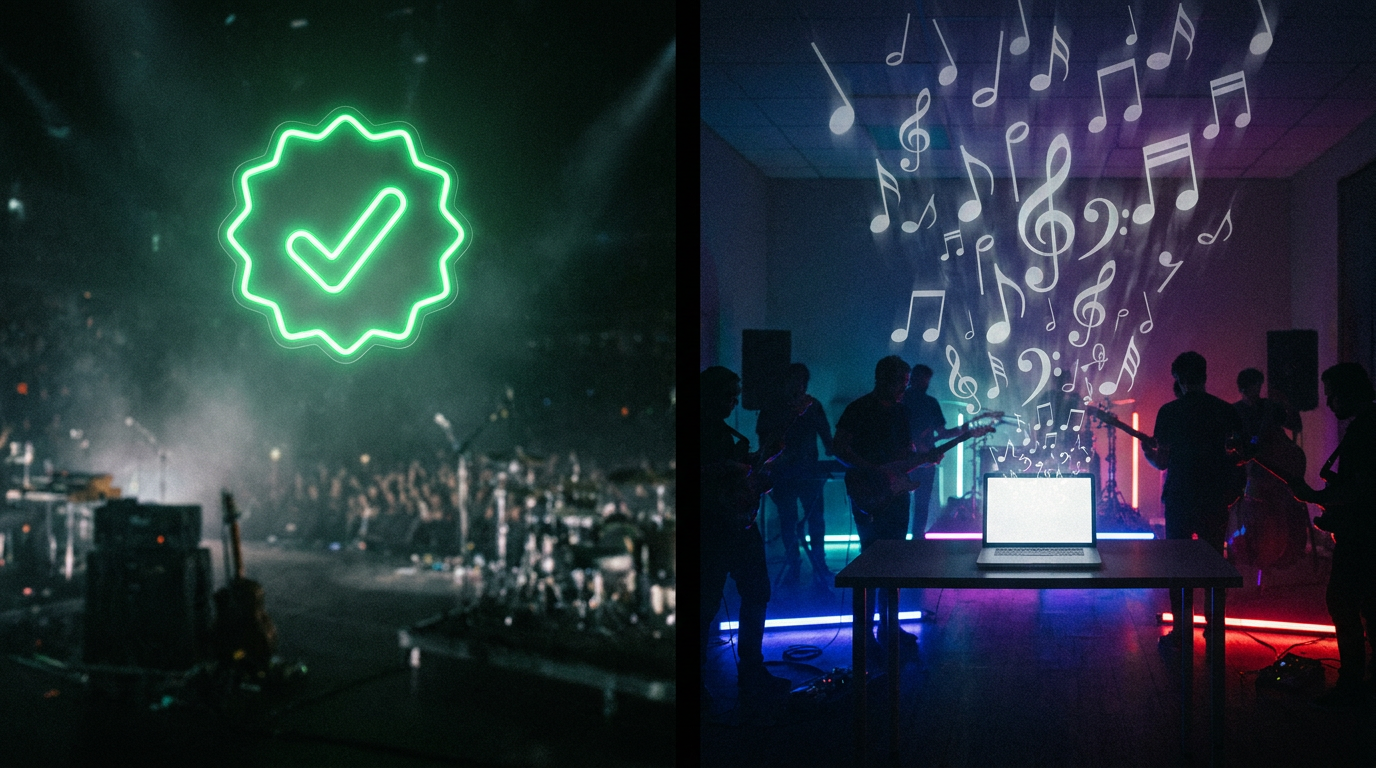
Music's AI Trust Crisis Just Hit a Tipping Point
In the span of fourteen days, every major platform in the music ecosystem made a move. Not a tentative “we’re exploring AI” press release. Not a vague promise about future transparency. Real, shipping features designed to answer a single question that’s haunted the industry since generative AI went mainstream:
Can we still trust what we’re listening to?
The answer, apparently, is “we’re going to build the infrastructure to find out — right now, all at once, whether you’re ready or not.”
Let’s break down the avalanche.
Deezer Drops the Bomb: 44% of Uploads Are AI
On April 20, Deezer published the number that made the entire industry flinch. The global music streaming platform is now receiving almost 75,000 AI-generated tracks per day, representing roughly 44% of its daily uploads.
That amounts to more than 2 million AI-generated tracks uploaded per month.
To put that growth in perspective: in early 2025, the platform reported around 10,000 AI-generated uploads per day (roughly 10%), and a June 2025 analysis showed that had already climbed to 30,000 tracks, or 28%. In barely over a year, the flood has gone from a trickle to nearly half the river.
The good news? Deezer’s detection tools are actually working. Thanks to Deezer’s industry-unique measures, consumption of AI-generated music on the platform is still very low, between 1–3% of total streams.
In addition, a majority (85%) of these streams are detected as fraudulent and are demonetized.
But here’s the kicker that should concern every musician: Deezer commissioned a unique international study on attitudes towards AI music, which revealed that 97% of people couldn’t hear the differences between AI and human-made music. Read that again. Ninety-seven percent. The machines are good enough now that detection has to be algorithmic because human ears can’t do the job.
Deezer is now licensing its AI-detection tech, offering the wider music industry an option to support transparency and reduce the incentive for AI-music fraud. The message is clear: one streaming platform can’t hold back the tide alone.
Spotify’s Double Play: AI Credits and the Green Badge
Spotify didn’t just respond — they shipped two separate features within two weeks of each other.
First, on April 16: Spotify launched AI Credits in beta.
The credits are granular. Instead of slapping a generic “AI-generated” label on the entire track, the system lets you specify exactly which parts involved AI. You can disclose AI-generated vocals, AI-assisted lyrics, AI-produced instrumentals, or AI involvement in post-production.
This matters because, as any working musician knows, the old binary of “human or AI” never reflected how people actually make music in 2026. A producer might use Suno for a demo instrumental but record all their own vocals. A singer might write original lyrics but use AI for mastering. The spectrum is real, and Spotify’s credits finally acknowledge it.
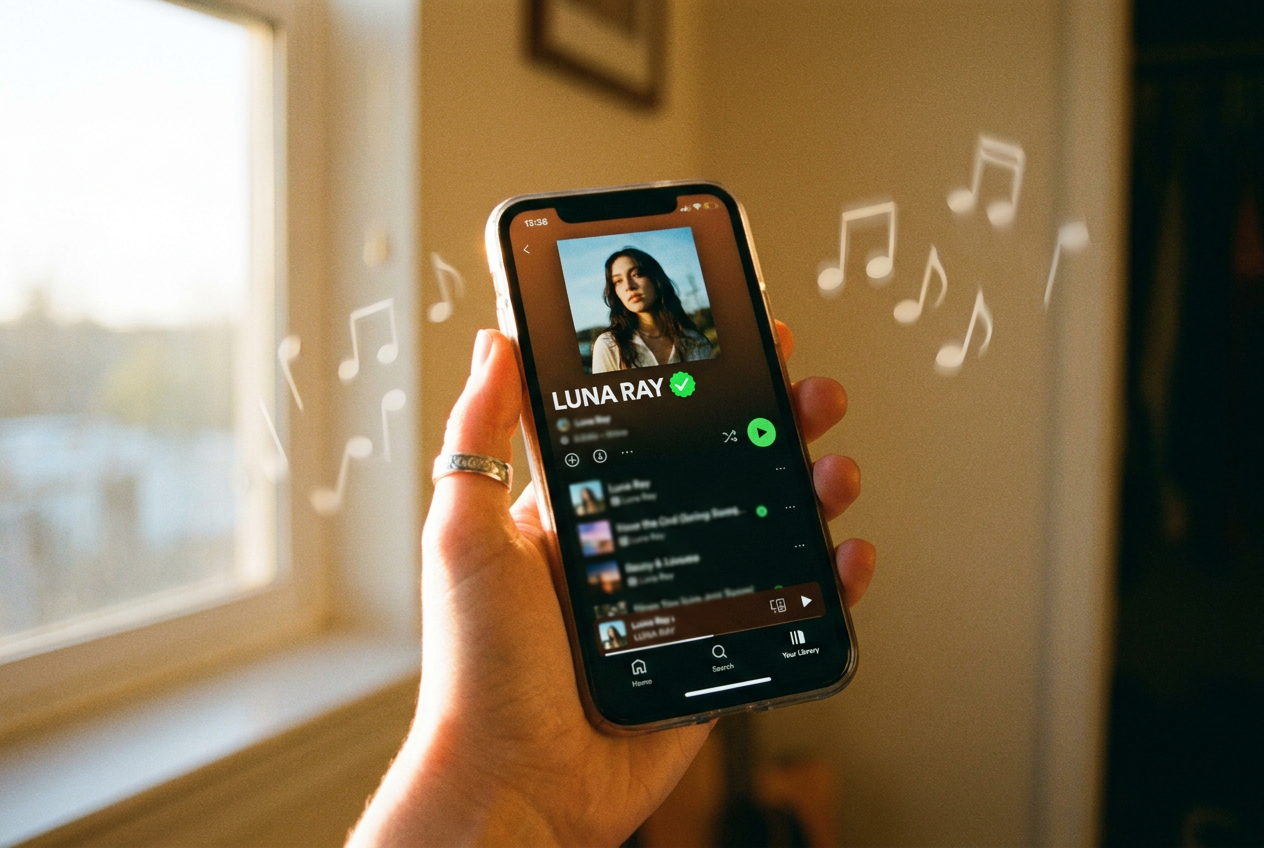
Then, on April 30, came the bigger move: Spotify introduced a new Verified by Spotify badge, as well as additional details about artists’ activity on the platform. These updates build on recent song-level context features like SongDNA, expanded song credits, About the Song, and AI credits.
The verification criteria are pointed. Spotify focuses its review on artist profiles that listeners are actively and intentionally seeking out over a sustained period of time. They look for an identifiable artist presence both on and off-platform, like concert dates, merch, and linked social accounts. At launch, profiles that appear to primarily represent AI-generated or AI-persona artists are not eligible for verification.
In other words: if you’re a real human who tours, sells merch, and has actual fans looking for you — here’s your badge. If you’re a bot farm pushing out AI lo-fi beats to dilute royalty pools — you’re out.
The reaction hasn’t been universally positive. Independent collectives fear a two-tier landscape that favors commercial heavyweights.
Academics caution that consumers might misinterpret the badge as proof a song contains zero AI, eroding trust if synthetic elements emerge later. Valid concerns. But the alternative — doing nothing while 44% of uploads are synthetic — isn’t exactly a comfort either.
YouTube’s Quiet Power Move: AI Music Swaps for Copyright Claims
While Spotify and Deezer were building trust infrastructure for listeners, YouTube was solving a different problem — and potentially disrupting an entire sub-industry in the process.
For years, YouTube creators have been able to swap out music struck with copyright claims with royalty-free alternatives. Now, that process is becoming easier with the help of AI to quickly match and replace audio with a generated royalty-free instrumental track.
Revealed on YouTube’s Creator Insider channel over the weekend, the update adds a new “Create” button to the existing “Replace Song” tool in YouTube Studio.
When selected, the tool generates four royalty-free instrumental tracks that creators can use to replace flagged audio.
This sounds like a simple quality-of-life improvement for creators dealing with Content ID headaches. But the implications run deeper. The move may further complicate the landscape for production music providers such as Epidemic Sound, whose business models have historically relied on offering licensed alternatives to avoid copyright disputes. YouTube’s expanding AI toolkit arrives as its broader subscription business continues to grow, reportedly generating around $20 billion annually.
As Tubefilter noted, that potential scenario is a reminder that major social platforms have the ability to reinvent the third-party companies that pop up around them. We saw that phenomenon in the realm of link-in-bio companies. If YouTube can generate decent background music at the click of a button, why would a creator pay a monthly subscription elsewhere?
For musicians, this is a two-sided coin. On one hand, it means fewer copyright disputes and more videos staying monetized. On the other, it’s another signal that background and production music — a revenue stream that supports thousands of working musicians — is being commoditized by AI. If you’re making music for sync and background placement, the clock is ticking on differentiating yourself from what an algorithm can generate for free.
Taylor Swift Just Trademarked Her Voice
While platforms were building digital infrastructure, Taylor Swift went old-school — and it might be the smartest move of them all.
On Friday, April 24, Swift’s company filed three trademark applications with the U.S. Patent & Trademark Office. Two relate to sound trademarks covering her voice: one is “Hey, it’s Taylor Swift,” and the other is “Hey, it’s Taylor.”
Why trademarks instead of relying on copyright? Because AI broke the traditional model. As trademark attorney Josh Gerben explained, trademark law doesn’t just stop identical uses (like copyright law): it stops anything that is confusingly similar to the registered trademark. That’s a much broader right and more powerful tool in an AI world.
The filings come as traditional copyright laws, which protect artists’ works from imitation, fail to guard against AI-generated content. “AI technologies now allow users to generate entirely new content that mimics an artist’s voice without copying an existing recording, creating a gap that trademarks may help fill,” Gerben said.
Swift isn’t the first — actor Matthew McConaughey filed similar trademarks in recent months to protect his voice and image. But when Taylor Swift does something, the industry pays attention. Gerben expects Swift’s actions to kick off a flurry of similar filings. He called Swift a “leader in the intellectual property space.”
The “trademark yourself” strategy hasn’t been tested in court against AI yet. It remains to be seen if the filings will work as intended. A Federal Court will need a case to stress-test the legal theories behind the filings. That said, the legal theories behind the filings are strong.
For indie musicians, this is a signal: protecting your identity in the AI age isn’t just about making great music. It’s about establishing recognizable visual and sonic branding that’s legally defensible. Think about how your music videos build that brand identity — it matters more than ever.
The Listener Backlash Is Real
All this trust infrastructure isn’t being built in a vacuum. According to Audrey Schomer, a media analyst and research editor at Luminate: “Across the board, what we found is that consumers are net negative. All that means is that people are more likely to feel uncomfortable than to feel comfortable with AI use.”
A recent study compared attitudes toward AI use in music creation from May to November 2025. It found overall interest dropped from -13% to -20% during that time period. The trend is moving in the wrong direction.
And it gets worse for the platforms planning AI remix features. Luminate’s findings indicate that people are least comfortable with AI usage to create new music that mimics the sound or style of existing artists. Schomer says, “If the biggest decline among young users is on that particular kind of activity, it’s the very thing that’s being proposed to happen in these services.”
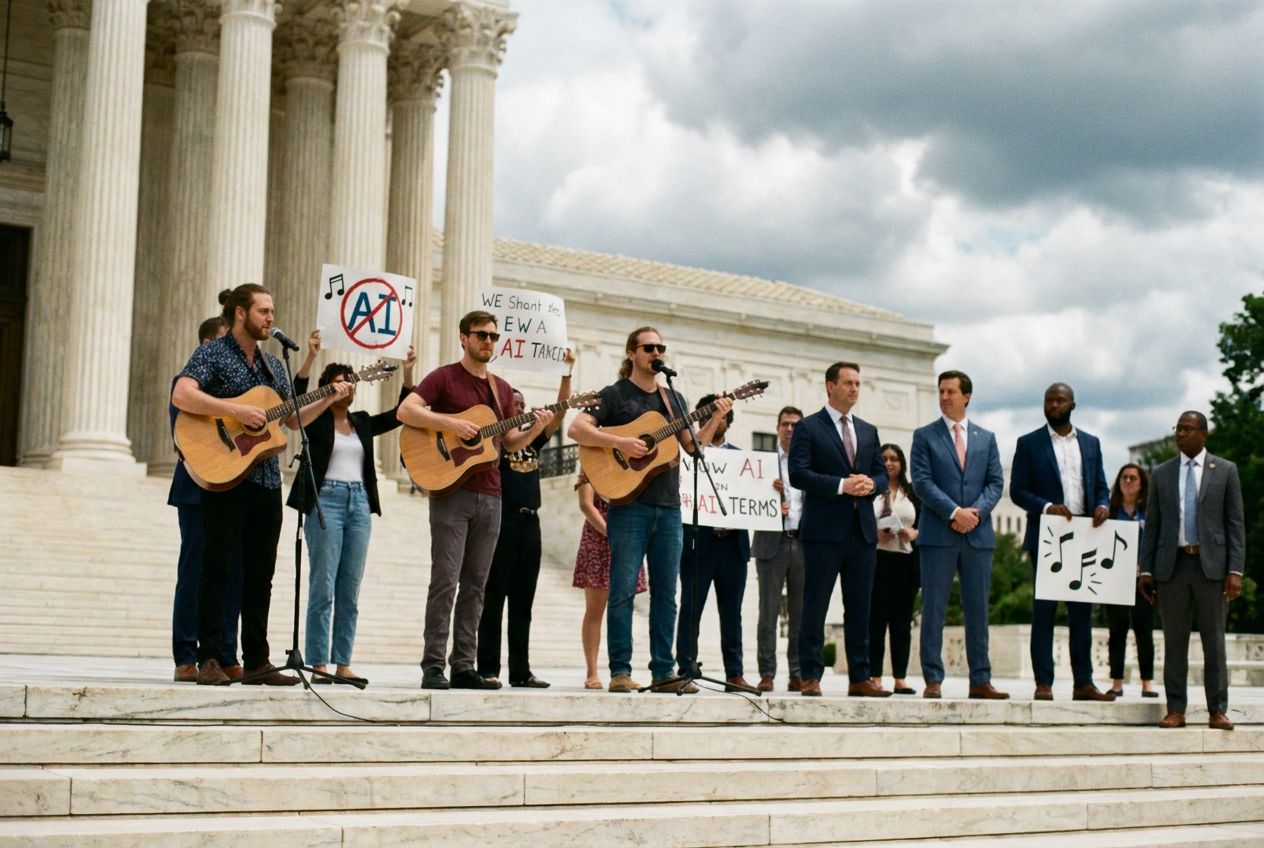
Meanwhile, the Recording Academy brought the fight to Washington. At GRAMMYs On The Hill 2026, the Recording Academy championed three bipartisan bills designed to bring accountability, transparency, and protection into the AI era: the NO FAKES Act, the TRAIN Act, and the CLEAR Act. Together, they form a comprehensive approach to protecting music creators.
What This Means for Musicians Right Now
Here’s the real talk. This two-week blitz wasn’t coordinated. Spotify, Deezer, YouTube, Taylor Swift, the Recording Academy, and the Luminate researchers weren’t all on a group chat deciding to act simultaneously. They each reached their own tipping point independently — and the fact that it all happened at once tells you something about where we are.
The trust problem in music is now the problem. Not a sideshow. Not a future concern. The thing that every platform, artist, and lawmaker is scrambling to solve right now.
If You’re an Independent Artist
Get verified. Spotify’s badge is rolling out now, and it prioritizes artists with real off-platform presence. Make sure your profile links to your social accounts, your merch store, your tour dates. This isn’t just good marketing anymore — it’s authentication.
Consider your visual identity. Taylor Swift trademarked a specific image of herself on stage. You might not need a trademark attorney (yet), but having a consistent, recognizable visual brand across your music videos and social media creates the kind of signal that both algorithms and audiences use to identify authentic artists.
Disclose AI use proactively. If you’re using AI tools in your workflow (and honestly, who isn’t at some level in 2026?), get ahead of it. Most AI music is not 100% synthetic. A producer might write original lyrics but use Suno for the instrumental. A vocalist might record their own voice but use AI for mastering. The new Spotify credits system lets you be transparent about this. Transparency builds trust. Hiding it erodes it.
If You’re Creating Music Videos
This trust infrastructure extends to visuals too. As platforms crack down on AI-generated music fraud, the visual authenticity of your releases matters more. A compelling AI music video that genuinely represents your artistic vision is fundamentally different from AI slop generated to game algorithms.
The distinction is intent and artistry. Using AI as a creative tool — to realize a visual concept for your pop track or bring a moody aesthetic to your R&B single — is exactly the kind of AI usage that listeners are comfortable with. It’s when AI replaces human creativity rather than amplifying it that people recoil.
The Big Picture
We’re watching the music industry build its immune system in real time. Deezer is the diagnostic test. Spotify is the ID badge. YouTube is the workaround tool. Taylor Swift is the legal precedent. The GRAMMYs are the legislative push. And the Luminate data is the patient feedback saying, “We feel this, and we don’t like it.”
None of these solutions is perfect. Spotify’s disclosure is voluntary. Deezer’s detection only catches known AI models. YouTube’s swap tool might hurt production music companies. Taylor Swift’s trademarks haven’t been tested in court. And the bills championed at GRAMMYs On The Hill still need to pass.
But for the first time, the responses are arriving at the speed of the problem. And that matters.
The musicians who’ll thrive in this environment are the ones who lean into authenticity while using AI as a creative amplifier — not a replacement. Build your brand. Verify your identity. Be transparent about your process. And keep making art that only a human could dream up.
Ready to create music videos that showcase your authentic artistic vision? Try OneMoreShot.ai and turn your tracks into stunning visuals in minutes — no crew, no studio, no compromise on your creative identity.