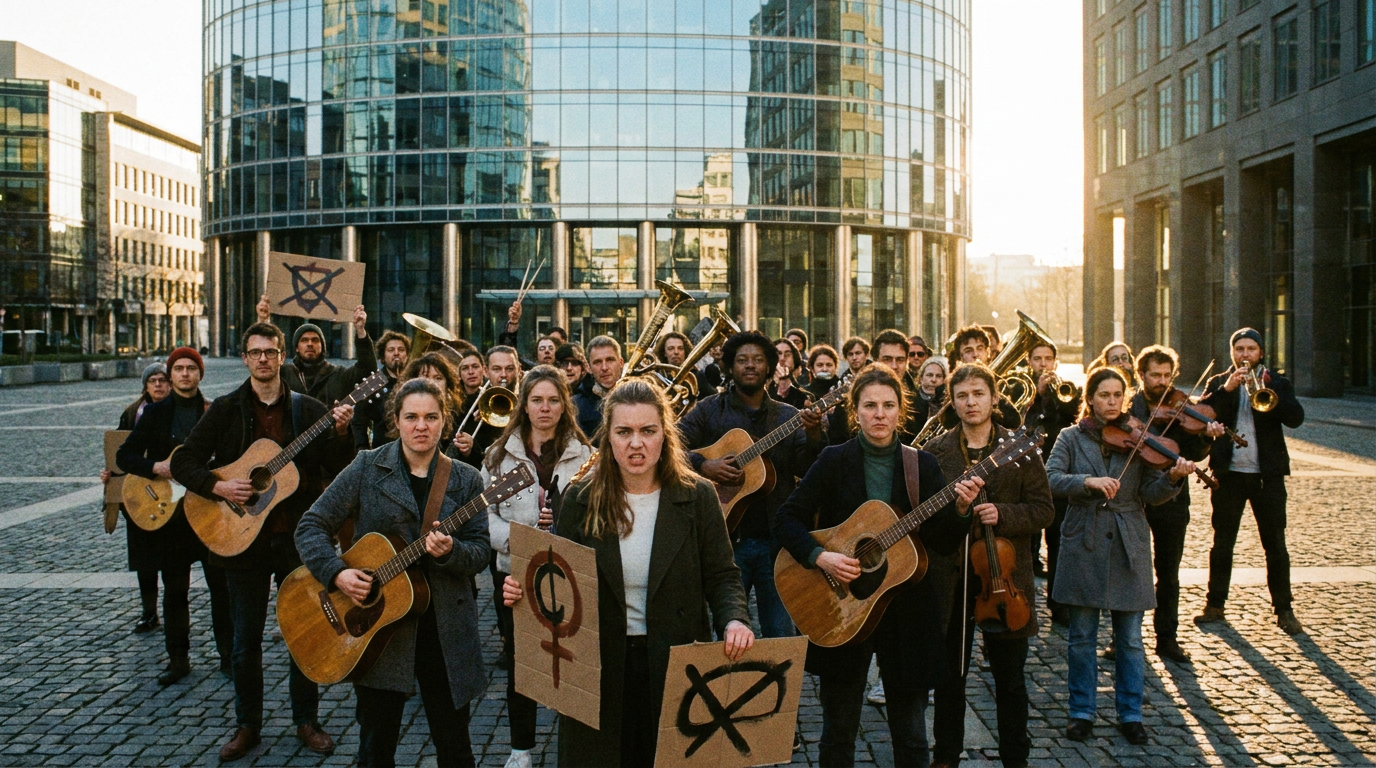
Musicians Revolt Against Labels Over AI Deals
The AI music fight just flipped on its head. For the past two years, the music industry united against AI companies. Labels sued Suno and Udio. Artists protested. The narrative was simple: Big Tech vs. Music.
Now the musicians are turning on their own labels.
In June 2026, the conversation took a major turn. A coalition of 31 organizations representing artists, songwriters, managers, and music creators from around the world issued an open letter warning record labels and music publishers against what they describe as the “misuse” of artist and songwriter rights in AI licensing deals. Just weeks earlier, the American Federation of Musicians (AFM) launched a lawsuit against Universal Music Group and Warner Music Group, alleging the two major labels didn’t compensate musicians when they made licensing and settlement agreements with AI music companies Suno and Udio. The legal action was filed in a New York District Court on June 5th.
This isn’t a polite disagreement. It’s a full-scale revolt — and it changes the calculus for every musician trying to navigate the AI landscape in 2026.
How We Got Here: The Label-AI Pivot
To understand why musicians are furious, you need to rewind about eight months.
The three major record companies — UMG, WMG, and Sony Music — first sued Suno and Udio in 2024, in a case coordinated by the RIAA that alleged “mass infringement” of copyright. Universal Music Group settled with Udio in late October 2025, announcing a “compensatory legal settlement” plus license agreements for a new AI music platform set to launch in 2026. Warner Music Group reached its own settlement and licensing deal with Udio in mid-November 2025. Days later, WMG became the first major label to strike a deal with and settle its copyright lawsuit against Suno.
In other words, labels went from suing AI companies to licensing them their entire catalogs in a matter of months. That’s not unusual in the music industry — you fight, then you make a deal. It happened with Napster, with YouTube, with Spotify.
But here’s the part that made musicians lose their minds: the labels allegedly kept all the money.
The AFM Lawsuit: “Fed Into AI Machines for Profit”
The AFM’s complaint is blunt. The American Federation of Musicians is suing major record companies Universal Music Group and Warner Music Group over the labels’ recent moves to settle their lawsuits with AI music generators Suno and Udio, arguing that the settlements’ benefits aren’t reaching the musicians themselves.
The legal argument hinges on something called the Sound Recording Labor Agreement (SRLA). The SRLA covers AFM members’ contributions to recordings and, via Article 21, purportedly entitles these members to a piece of the pie from any “new use” of the involved works. Gen AI licensing, complete with authorized training and derivative outputs, allegedly constitutes a new use as described in the labor contract.
Think about what that means. A session guitarist who played on an album in 2003 might have their performance feeding an AI model right now — and according to the AFM, they’re not seeing a dime from it.
The complaint reads: “At the same time, they have refused to provide information to the AFM about which recordings and whose work is being licensed.” The labels won’t even tell the union which recordings are being used.
The 31-Organization Coalition: “These Rights Are Not Yours to Sell”
If the AFM lawsuit was a shot across the bow, the open letter was the broadside.
The organizations behind the letter include the Music Artists Coalition (MAC), founded by music industry veteran Irving Azoff, Songwriters of North America (SONA), the Featured Artists Coalition (FAC), the Artist Rights Alliance, the European Composer and Songwriter Alliance (ECSA), and numerous music management organizations spanning Europe, North America, Australia, and New Zealand.
This isn’t a fringe movement. Irving Azoff alone manages artists like the Eagles and Bon Jovi. When his organization signs a letter telling labels to back off, people notice.
The letter’s core argument is devastatingly simple. It argues that artists and songwriters “remain the primary holders of many of the rights at stake, including moral, neighbouring, image and personality rights.” Those rights, it says, are “not label or publishers assets to be licensed without clear authority, consent and accountability.”
The coalition laid out three principles they want respected in all AI deals:
-
Consent and Control — The letter states that consent “cannot be imposed through default opt-ins” and should not be “a condition of signing a new deal,” adding that artists must be able to “say no without fear of penalisation.”
-
Fair Compensation — The signatories wrote: “Artists and songwriters must be consulted and it must be clear which percentage of revenue goes to the creator, to the label and to the AI company.”
-
Clarity and Transparency — Artists need to know exactly what rights they’re giving up, how their work is being used, and what safeguards exist.
The MMF CEO Annabella Coldrick put it perfectly: “With this open letter, we are simply requesting the same courtesy from our label and publisher partners. These rights are not yours to sell.”
The Default Opt-In Problem
Perhaps the most alarming claim in the open letter involves how labels are quietly enrolling artists into AI programs.
The coalition says it is “increasingly concerned that artists and songwriters in existing recording and publishing agreements are receiving letters from major labels and publishers informing them that they will be opted in to AI-related uses by default, with little actual choice offered. At the same time, artists and songwriters signing new agreements are being presented with AI rights clauses as a standard condition of signing.”
Billboard’s reporting adds more detail. Multiple top talent attorneys have been made aware that labels and publishers could feasibly use common contract language in U.S. record deals, related to blanket licensing and exploitation, to opt in artists’ works to train their AI partners’ models without seeking individual artist approval. “Some of the labels have already taken the position that they technically don’t need special approvals to train,” said Jason Boyarski, founding partner at Boyarski Fritz.
If you’re an independent artist reading this, take note: the contract you sign today could determine whether your music trains AI models tomorrow. This is one more reason why understanding the complete guide to AI music videos in 2026 matters — because control over your visual identity is just as important as control over your audio.
The Numbers Behind the Revolt
To understand the scale of what’s at stake, consider this: the organizations cite a WPI Economics study that reports rightsholders and AI developers across creative sectors had struck 274 commercial licensing agreements as of 2026, with music deals including platforms such as Suno, Udio, and Spotify.
That’s 274 deals. And artists are saying they weren’t meaningfully consulted on most of them.
Meanwhile, the flood of AI-generated content keeps growing. Deezer is now receiving almost 75,000 AI-generated tracks per day, representing roughly 44% of daily uploads. This amounts to more than 2 million AI-generated tracks uploaded per month. Consumption of AI-generated music on the platform is still very low, between 1-3% of total streams, with a majority (85%) of those streams detected as fraudulent and demonetized by Deezer.
A CISAC-commissioned study puts the financial impact into stark numbers: generative AI could take 24% of music creators’ revenues by 2028. That equates to a cumulative loss of €10 billion ($10.5 billion) for creators between 2023 and 2028, rising to €4 billion a year by the end of that period.
When musicians see those projections and then learn their labels signed AI deals without consulting them, the anger writes itself.
What the Labels Say
The labels haven’t exactly been silent. They’ve been trying to frame themselves as the good guys.
A UMG spokesperson said the label has “been at the forefront of protecting the rights and advancing the interests of artists and songwriters in the age of AI — striking responsible AI licensing agreements to ensure they are compensated.”
WMG issued its own statement, saying that it is “growing the value of music by establishing guardrails and architecting a healthy AI ecosystem on the behalf of artists everywhere.” They added: “We are disappointed by the AFM’s unproductive action amid our ongoing negotiations.”
The IFPI, which represents the global recorded music industry, tried to keep the peace. Their spokesperson said: “At a time when some tech companies large and small are engaging in the wholesale theft of virtually every song ever recorded, our members have sued infringers, pushed for legislation, and developed new licensing models, all to protect the interests of artists, songwriters and rightsholders.”
Their point isn’t without merit — labels did fight the initial AI lawsuits. But the coalition’s counter-argument is simple: fighting AI companies doesn’t give you the right to license your artists’ work without their knowledge.
Why This Matters for Every Musician
Here’s where it gets personal for independent and emerging artists.
Music rights are rarely owned by a single party. A single song can involve songwriters, producers, session musicians, featured artists, labels, publishers, distributors, managers, and multiple stakeholders across different territories. When AI companies license music for training or generation purposes, determining who should consent and who should be compensated becomes significantly more complex.
If you’re an indie artist, you probably own your masters. That’s the good news. The bad news? If you’ve licensed through a distributor that has AI-related clauses in their terms, you might be opted in without realizing it. Many independent music companies have yet to engage directly with AI licensing. Survey data showed that only 16% of independent BPI member organizations had begun exploring AI licensing partnerships.
This gap between majors aggressively licensing and independents largely sitting on the sidelines creates a strange landscape where your music’s AI destiny depends largely on who distributes it.
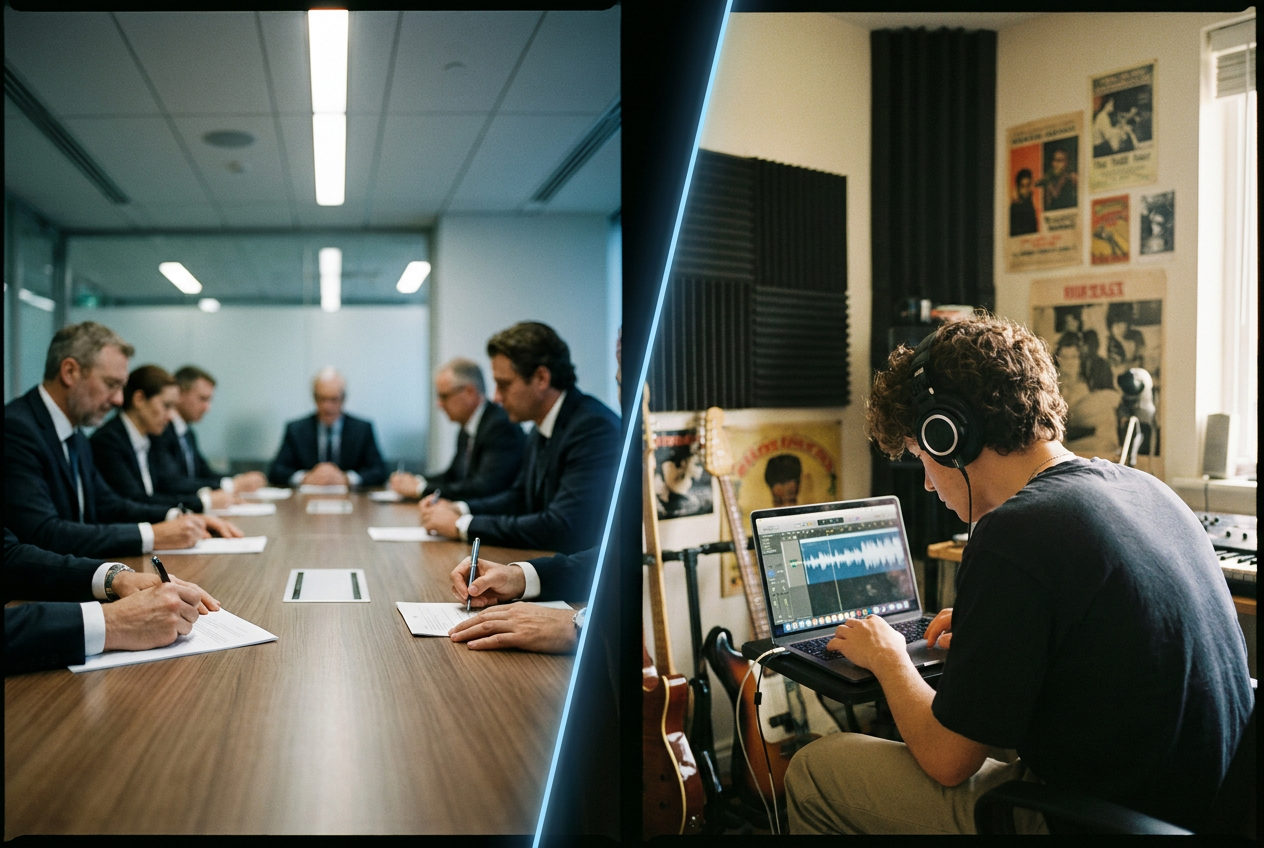
What Independent Musicians Should Do Right Now
The AI revolt is happening at the top of the industry, but its effects cascade downward. Here’s how to protect yourself:
1. Read Your Contracts — All of Them
Check your recording agreements, distribution deals, and publishing contracts for AI-related clauses. Look for language about “new uses,” “emerging technologies,” or blanket licensing provisions. If you see something you don’t understand, ask a music attorney before you sign anything else.
2. Own Your Visual Identity
While the debate rages over audio rights, smart musicians are building visual brands they fully control. Creating AI music videos with tools you choose — rather than waiting for a label to make decisions for you — keeps your visual identity in your own hands. Whether you’re making hip-hop visuals, EDM content, or indie aesthetics, the tools exist today to do it independently.
3. Diversify Your Revenue Streams
If AI really does capture a significant share of music revenue, the artists who survive will be those with multiple income sources: live performance, sync licensing, visual content, merchandise, and direct fan relationships. AI-generated music videos — the ones you create and control — can actually strengthen your position by giving you visual content that drives engagement without surrendering rights.
4. Pay Attention to the Legislation
EU AI Act Article 50 enforcement begins August 2, 2026, requiring machine-readable marking on all AI-generated video distributed to EU audiences, with penalties up to €15M or 3% of worldwide annual turnover. Understanding these regulations isn’t just legal housekeeping — it’s career insurance.
The Bigger Picture: AI Music’s Trust Crisis
What’s really unfolding is a crisis of trust within the music industry itself. For decades, artists have had a complicated relationship with labels. But the AI era introduces a new variable: your recorded performance can now be replicated, extended, and commercially exploited in ways that didn’t exist when you signed your contract.
This lawsuit represents more than a contractual dispute between musicians and record labels. It is a defining test of how society values human creativity in an era increasingly shaped by algorithms.
The irony is thick. Labels sued AI companies for doing exactly what the labels are now doing — using recordings without adequate consent. The AFM’s complaint argues that WMG and UMG have, in effect, allowed Suno and Udio to do precisely what their initial suit warned of: “Training AI models to generate supposedly ‘new’ sound recordings derived from music ingested into their models.”
For musicians caught in the middle, the practical response is to take control where you can. You can’t control what happens in a Manhattan courtroom. But you can control how you create, distribute, and monetize your work.
That means building visual content that’s yours. It means choosing tools that respect your rights. And it means staying informed as the rules of this industry are being rewritten in real time.
What Happens Next
Time will tell whether the pushback fuels changes in the ultra-active AI-dealmaking arena. But more immediately, will this pushback — now consisting of the letter and the AFM lawsuit — keep on intensifying?
All signs point to yes. Sony Music, the third of the major record companies, is not named in the AFM complaint and has not settled with either Suno or Udio. That makes Sony the last major holdout, and its eventual decision — to settle or keep fighting — will be watched closely by everyone in the industry.
Meanwhile, the AI music video landscape continues to evolve at breakneck speed. AI music video generators now handle 83% of production tasks that previously required human specialists, with tools delivering broadcast-ready results in under 8 hours compared to the traditional 3-week minimum.
The musicians who come out ahead won’t be the ones who ignore AI — they’ll be the ones who use it on their own terms.
Ready to create music videos you actually own? OneMoreShot.ai lets you generate stunning, beat-synced music videos from your own tracks in minutes — no label permission required. Your music, your visuals, your rights. Start creating at app.onemoreshot.ai.