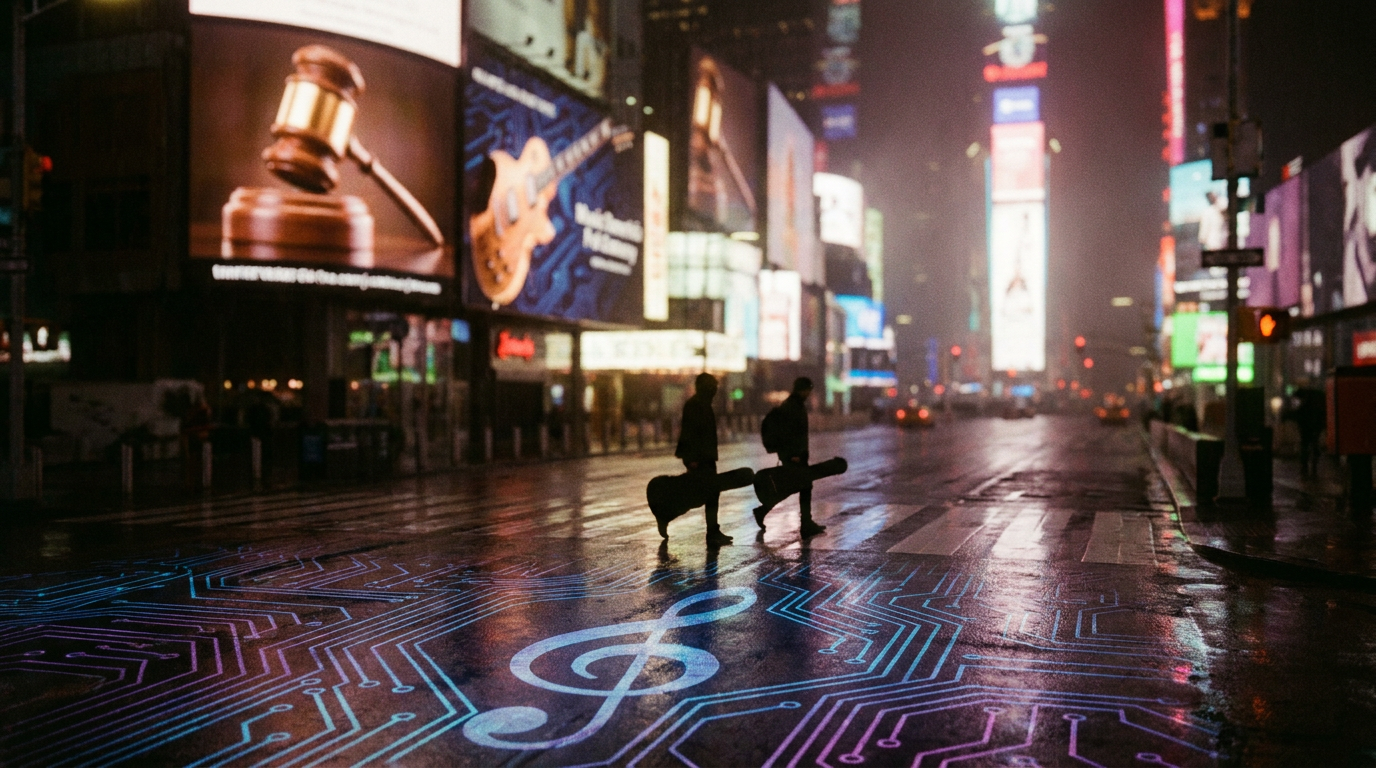
NYC's AI Music Showdown Changes Everything
Right now — literally this week — the entire future of AI music is being decided inside a handful of hotel ballrooms and congressional offices in New York City. And most musicians have no idea.
Between June 8 and 11, three separate events are colliding in Manhattan that will determine whether you can legally use AI to create music, whether your voice and likeness are protected from deepfakes, and whether indie musicians will finally get a seat at the table when billion-dollar AI companies decide how to use their work.
Let’s break down what’s happening, why it matters, and what you should actually do about it.
The Three-Front War Happening Right Now
Here’s what’s converging in NYC this week:
The 18th annual Indie Week conference is taking place June 8-11 at the InterContinental New York Times Square. Supported by A2IM, the event convenes label executives, artists, distributors, technology leaders, attorneys, and global partners, with programming focused on AI, fan monetization, and the evolving economics of independence.
The NMPA’s 2026 annual meeting is taking place at Lincoln Center’s Alice Tully Hall on June 10, featuring Pink as the Songwriter Icon Award winner, and a keynote conversation between Meta president Dina Powell McCormick and NMPA CEO David Israelite.
And just today, the AIMP Global Music Publishing Summit is taking place at Fordham University Lincoln Center, with panels on how AI is being put to work in publishing today, from fraud detection to licensing frameworks.
Three conferences. One city. One week. And AI is on every single agenda.
The Legislation That Could Reshape Your Career
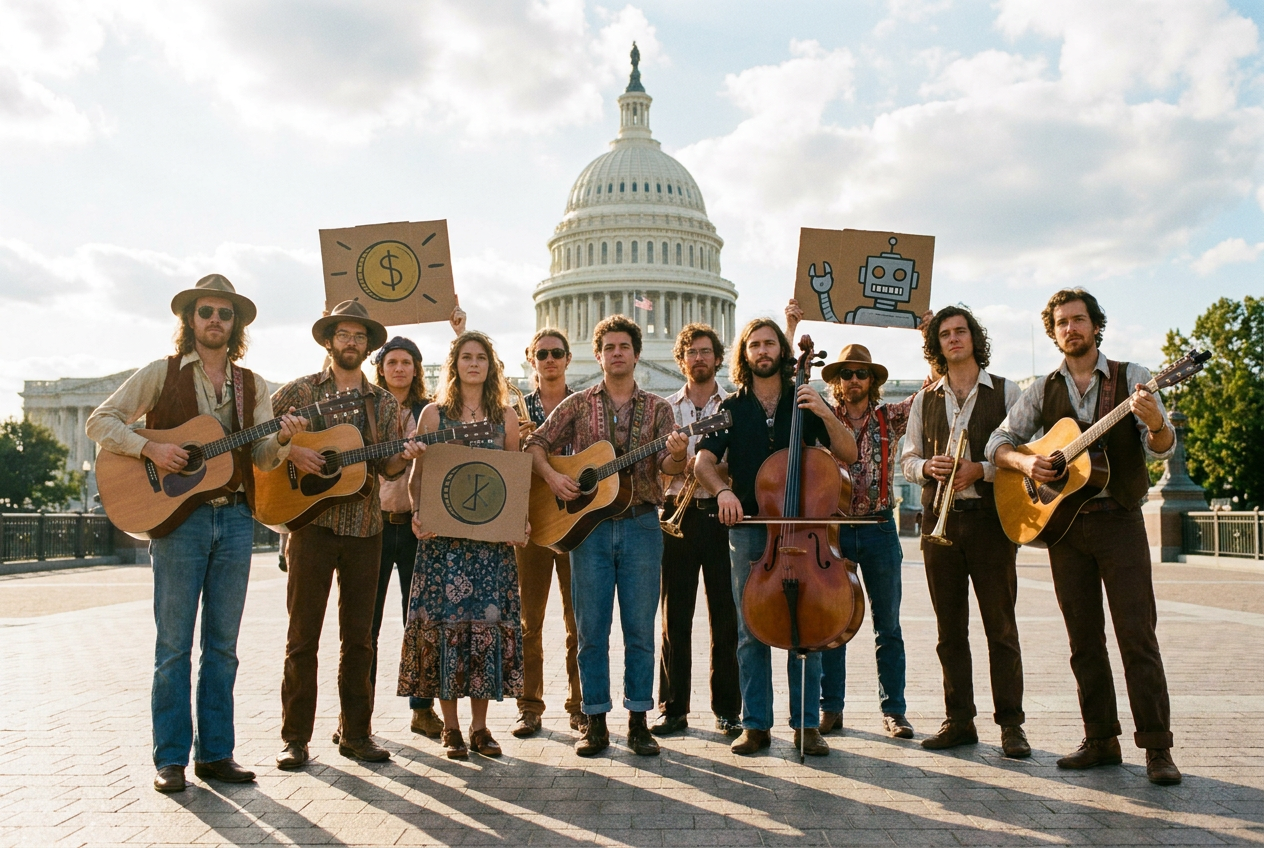
The Protect Working Musicians Act
If you’ve ever felt powerless watching Spotify’s per-stream payouts shrink or seeing AI companies train on your music without asking, this bill is written for you.
The Protect Working Musicians Act of 2026 would give independent artists power to collectively negotiate with corporations like Spotify and AI companies that scrape music. “What our bill does is give the power to the musicians to be able to collaborate, work together, and negotiate with the big guys, and not be picked off one after the other,” said Rep. Deborah Ross at a roundtable event in Raleigh.
Here’s the key detail most coverage misses: the bill aims to allow “any musician or group of musicians, producers, mixers, and sound engineers” to spearhead collective negotiations with dominant platforms — provided they own their recordings and earn less than $1 million per year. These professionals would “not be held liable under the antitrust laws” for engaging in collective licensing discussions, nor for opting “to collectively refuse to license their music.”
Read that again. Independent musicians would be able to collectively refuse to license their music to AI platforms that won’t pay fair rates. That’s a union-scale power play that’s never been available to indie artists before.
The bill is endorsed by A2IM, the Artist Rights Alliance, AFM, Authors Guild, Future of Music Coalition, Recording Academy, Music Managers Forum-US, Music Artists Coalition, Music Workers Alliance, NMPA, SAG-AFTRA, Society of Composers & Lyricists, SONA, Songwriters Guild of America, and United Musicians. That’s basically the entire industry saying: we need this.
The NO FAKES Act
While the Protect Working Musicians Act tackles the money side, the NO FAKES Act goes after something even more personal: your voice and your face.
A new version of the No Fakes Act was introduced in May, in hopes that the legislation will gain momentum. An earlier version was introduced last year, to much fanfare. The legislation gives individuals the right to authorize the use of their voice and likeness in digital replication. The digital replication right does not expire at a person’s death, and can be transferred and licensed by heirs, executors and others. That post-mortem right terminates no longer than 70 years after an individual’s passing.
This matters directly for anyone creating AI music videos. If you’re generating visual content, you need to know where the legal lines are — both for protecting your own likeness and for making sure you’re not accidentally creating someone else’s digital replica without permission.
The RIAA endorsed the NO FAKES Act of 2026, calling it “a widely supported consensus bill developed through a bipartisan, bicameral process.” Their statement noted that “92% of Americans are concerned about the impact of AI deepfakes.”
Even tech companies are on board. YouTube, Amazon and OpenAI backed the earlier version of the bill. When the music industry, labor unions, and Big Tech all agree on something, pay attention.
The $9 Billion Elephant in the Room
While legislation moves through Congress, the courts are handling the same questions at warp speed. And the numbers have gotten staggering.
Sony Music and Universal Music want to expand the formal list of recordings that they reckon Suno copied without licence when training its generative AI model, from 560 tracks to 61,026. Sony also wants to expand its formal list of recordings copied by Udio, adding just over 30,000 more recordings.
Why does that matter? Simple math: Under US law, rights owners can ask for up to $150,000 per infringed work in copyright cases. By expanding the Suno infringement list from 560 to 61,026, the potential damages rise from $84 million to more than $9.1 billion.
And here’s the truly wild part — Suno raised a $400 million Series D round valuing the company at $5.4 billion, more than double its previous valuation just seven months ago. Investors are betting billions that Suno will survive. The labels are demanding billions in damages. Both sides can’t be right.
Suno is fighting on fair-use grounds in the U.S. District Court for the District of Massachusetts, where a key summary-judgment hearing is scheduled for July 2026. That’s next month. Whatever happens there will send shockwaves through every AI music tool, platform, and creator workflow in existence.
Just yesterday, Suno asked the court to block UMG and Sony from expanding the copyright lawsuit to over 61,000 recordings , arguing it would deny them a timely ruling on fair use. The legal chess match is happening in real time.
What This Means for Your AI Music Videos
If you’re a musician using AI tools to create visuals for your tracks, you’re probably wondering: does any of this affect me?
Short answer: yes, but maybe not the way you think.
The legal battles are primarily about AI music generation — tools that create audio from text prompts. If you’re writing and recording your own music, then using AI to generate videos for those tracks, you’re in a fundamentally different (and much safer) position. Your music is yours. The visuals are a creative tool, like hiring a director or an editor.
This is actually the sweet spot that tools like OneMoreShot.ai occupy: you bring the music, AI handles the visuals. No copyright questions about training data. No fair use ambiguity. Your song, your vision, AI-powered execution.
But the broader ecosystem matters to you because:
-
Platform policies are shifting fast. YouTube, Spotify, and TikTok are all updating their rules around AI content. Understanding the complete guide to AI music videos has never been more important.
-
Disclosure is becoming mandatory. AI music creators are entering the proof era. Not just proof that a song sounds good. Proof of process. Proof of rights awareness. Whether you’re making AI music videos for hip-hop or AI music videos for indie, clean metadata and clear documentation of your creative process is becoming essential.
-
The NO FAKES Act directly impacts visual content. If you’re creating AI-generated visuals that depict real people — even stylized versions — you need to understand where the legal lines are drawing themselves.
The Indie Musician’s Survival Playbook
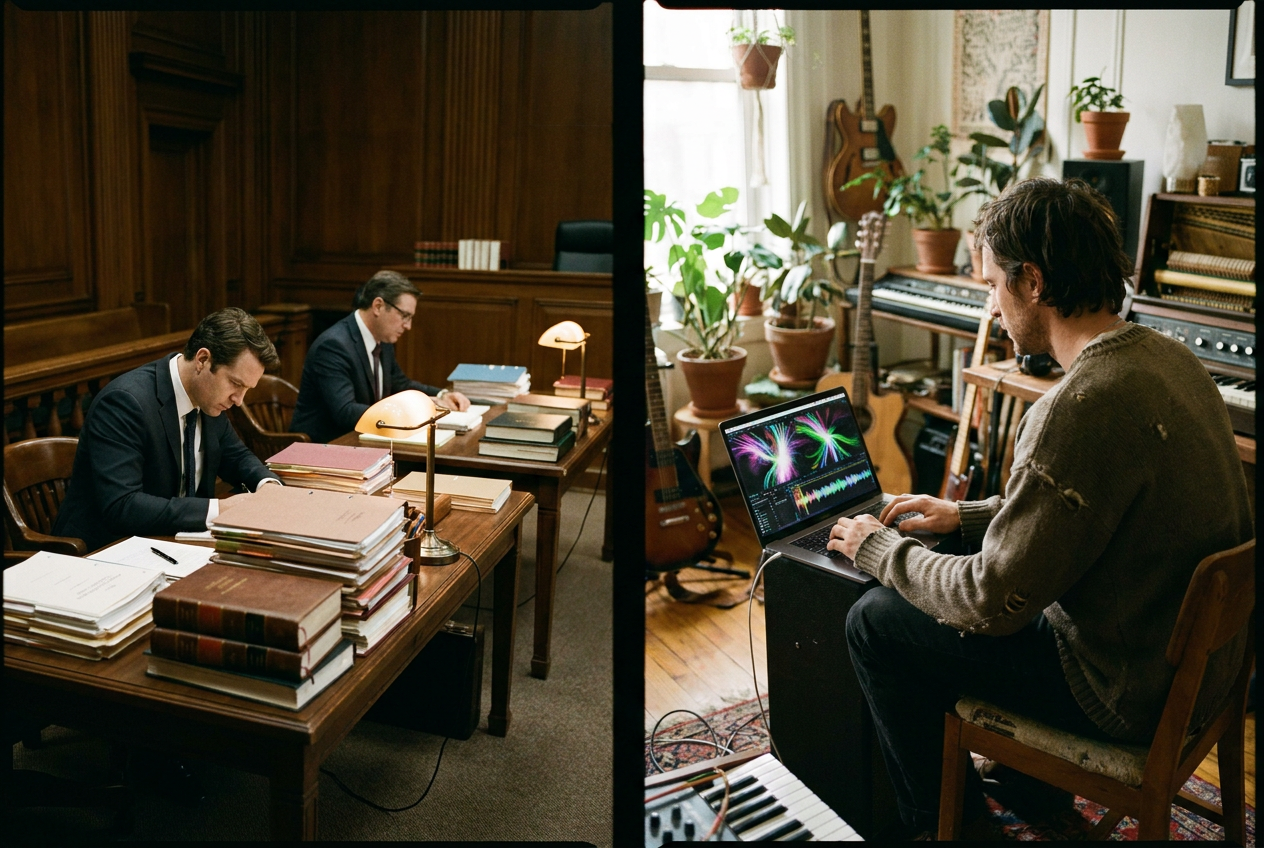
Here’s what I’d tell any independent musician right now, based on everything converging this week:
Own Your Music, Period
The Protect Working Musicians Act only applies to artists who own their recordings. Eligible creators must own their recordings and earn less than $1 million per year from licensing. If you’ve signed away your masters, this legislation can’t help you. If you haven’t — hang onto them.
Document Everything
Creators need to read terms, understand use cases, and avoid treating every tool as interchangeable. Tool choice is becoming part of rights strategy. Where you make the song may matter almost as much as what the song sounds like.
When you create an AI music video, keep records of your prompts, your source files, and your creative decisions. This is your proof of human creativity and intention.
Choose Your Tools Wisely
Not all AI platforms carry the same legal risk. June may continue to separate the AI music market into two lanes: companies fighting over past training data and companies trying to build licensed future creation systems. A fully licensed fan remix environment, an open text-to-song generator, a DAW plugin, a voice model, an AI mastering tool, and a stock-music generator may all have different rules.
For visuals, this is why purpose-built music video tools matter. Whether you’re creating AI music videos for pop, EDM, or R&B, using a tool specifically designed for music video creation — like OneMoreShot.ai — means you’re working within a clean, music-focused pipeline rather than cobbling together general-purpose AI tools with unclear terms.
Watch the July Hearing
Suno is fighting on fair-use grounds with a key summary-judgment hearing scheduled for July 2026. Last month the labels moved to amend their complaint to allege that more than 61,000 additional songs were used for training without authorization.
Whatever the judge decides will set the tone for every AI music tool going forward. If fair use holds, expect an explosion of new AI music platforms. If it doesn’t, expect mass licensing negotiations — and potentially, higher costs passed to users.
Support the Legislation
Whether you lean toward more AI freedom or more artist protection, these bills affect you. The updated version of the Protect Working Musicians Act directly addresses generative AI, positioning itself alongside other proposed legislation designed to increase transparency around AI training data. For independent musicians, this could represent a major shift in bargaining power.
The View From the Eye of the Storm
What makes this week genuinely historic is the convergence. A2IM Indie Week runs June 8-11, 2026 in New York. That makes it one of the most important June events to watch for independent music and AI policy language. The event brings together label executives, artists, distributors, technology leaders, attorneys, and global partners. That mix matters because AI music is not only a tech issue. It affects labels, creators, metadata, licensing, royalty systems, marketing, discovery, and platform policy.
Keynote speakers include Shira Perlmutter, Register of Copyrights and Director of the U.S. Copyright Office, and Charlie Lexton, CEO of Merlin. When the person who literally runs the Copyright Office is keynoting your indie music conference, you know AI has moved from “interesting trend” to “existential business question.”
Meanwhile, Universal Music and Sony Music are aggressively opposing Suno’s request to redact its training numbers from court filings , arguing transparency about what was copied is central to the case.
The independent music community is watching all of this and trying to figure out where they fit. The independent sector cannot simply copy the major-label playbook. Independent artists and labels need systems that protect value without shutting out new creator access.
That tension — between protection and access — is the central drama of AI music in 2026. And it’s playing out right now, in real time, in New York City.
The Bottom Line
If you’re an indie musician using AI for any part of your creative process — whether that’s generating beats, creating visuals, or building a marketing strategy — this week matters more than any product launch or model update.
The rules are being written. Not by engineers in Silicon Valley. Not by AI models. By legislators, judges, label executives, and (if the Protect Working Musicians Act passes) potentially by you and other independent musicians working together for the first time.
The smartest move right now? Make your music. Make your videos. Own your process. And pay attention.
Because by the time the July hearing rolls around and these bills move through Congress, the landscape could look fundamentally different. The musicians who understood the shift early will be the ones who thrive.
Ready to create stunning AI music videos while the legal landscape sorts itself out? OneMoreShot.ai lets you turn your original tracks into professional-quality visuals in minutes — no copyright gray areas, no legal ambiguity. Your music, your vision, beautifully realized.