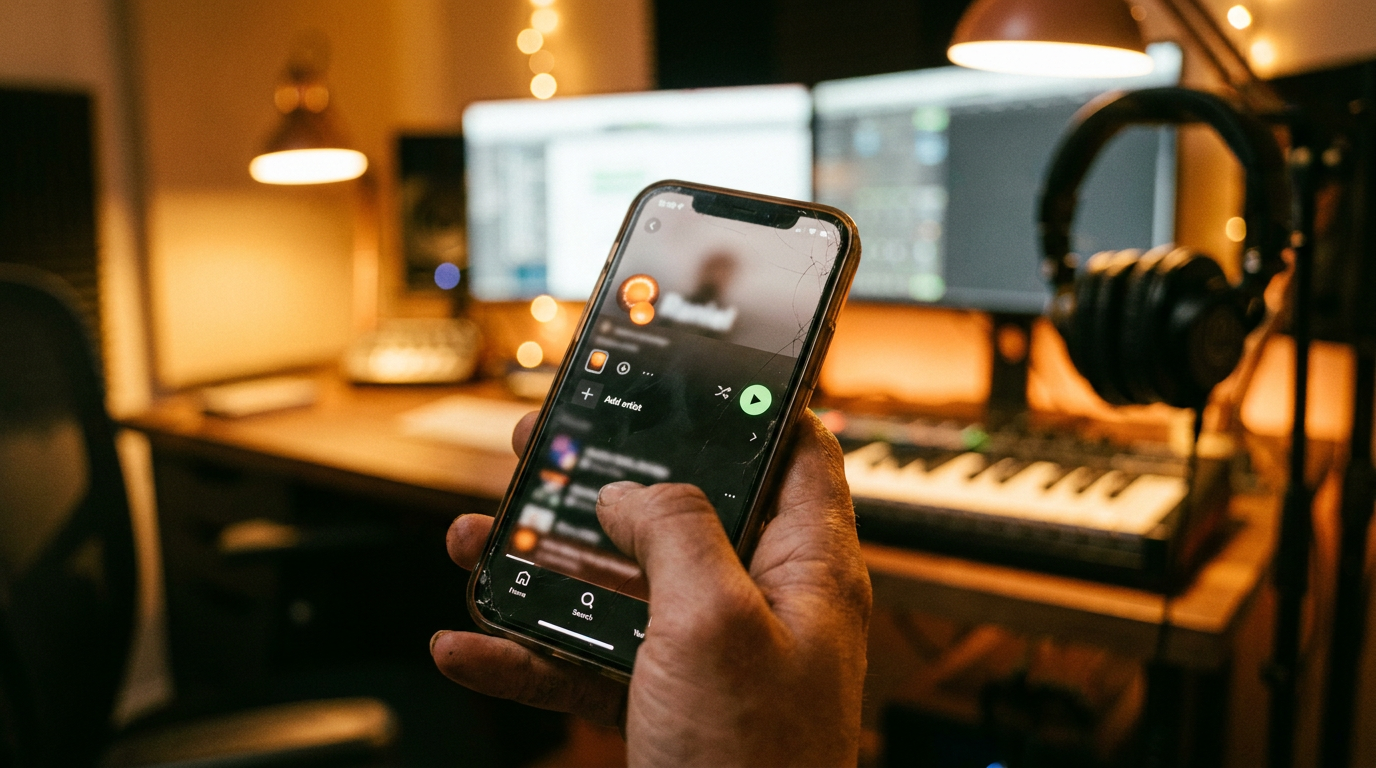
Spotify's AI Persona Badge Is a Win for You
If you’re a real musician who happens to use AI tools, this week brought some genuinely good news.
Spotify announced a new AI Persona badge designed to help listeners identify artist profiles whose public identity may be AI-generated.
Starting mid-September, you’ll begin to see an AI Persona badge on some artist profiles — one that signals to listeners that an artist’s identity may be AI-generated and does not represent a real person.
And here’s the part that actually matters: by default, Spotify will not include AI Personas in any editorial or algorithmic recommendations, meaning you won’t see any music from AI Personas in your personalized recommendations unless you follow them.
That’s not a label. That’s a moat. And for the first time in years, it’s being built around human musicians.
What Is the AI Persona Badge, Exactly?
Let’s get specific, because the details here matter more than the headline.
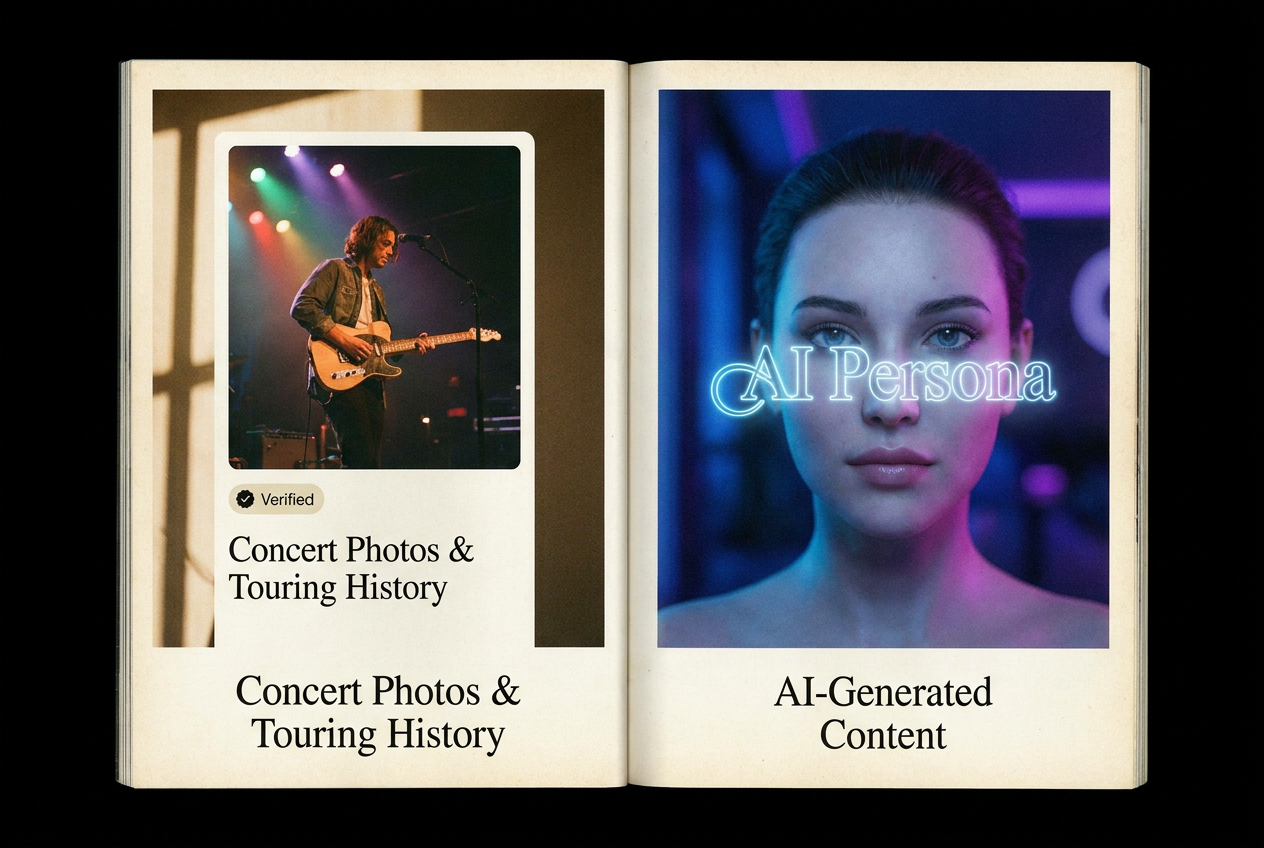
Spotify defines an AI Persona as an artist whose public identity represents an AI-generated photorealistic human. This includes the way an artist presents themselves through their name, profile images, header images, album artwork, or other visual elements.
Think of those uncanny profiles you’ve stumbled onto — flawless headshots, no live performance history, hundreds of ambient tracks uploaded in a single month. The move is an effort to combat the wave of fake, AI-generated accounts that have overrun the service in recent years, with many of those songs generated on AI music generators such as Suno and Udio.
Starting mid-September, Spotify will show the badge on certain artist profiles, including in the profile banner, About section, Search, and track rows across playlists. It’s not hidden in a submenu. It’s everywhere a listener encounters the artist.
The Algorithm Exclusion Is the Real Story
Badges are nice. Getting kicked out of Discover Weekly? That’s structural.
Profiles with the AI Persona badge won’t show up in Spotify’s default personalized recommendations. That means they won’t get pushed into autoplay, mixes, or discovery features, though listeners can still search for them and play them directly.
For human musicians competing for those slots, the policy directly expands the pool of algorithmic recommendations available to them. If you’re an independent artist trying to get onto Release Radar or Discover Weekly, the competition just got meaningfully smaller. Every AI persona removed from the recommendation pool is a slot that opens up for a real musician with a real story.
By banning AI Personas from algorithmic and editorial discovery, Spotify is protecting the platform’s most valuable real estate for actual, human musicians trying to build sustainable careers. For indie artists competing in a crowded landscape, this is a massive win for authentic music discovery.
Why This Is Different From Everything Before
Here’s where things get interesting for musicians who use AI as part of their creative workflow (which, let’s be honest, is an increasing number of you).
The AI Persona badge concerns whether a real person exists behind a profile. It does not concern how the music was made. A human artist who uses AI tools in the recording studio — Suno for beat production, AI mastering software, generative backing tracks — will not receive the AI Persona badge.
Read that again. Spotify is drawing a hard line between who you are and how you create. This is the most important conceptual shift in streaming AI policy in 2026.
The identity-versus-tools distinction is the conceptual innovation here. Prior streaming AI policies — content detection, royalty bans, spam filtering — regulated audio. Spotify’s AI Persona policy regulates the artist profile itself: the name, the imagery, the photorealistic human face presented as the person behind the music.
So if you’re a singer-songwriter who uses AI to generate a music video for your latest single? You’re fine. If you’re a producer who uses AI-assisted mastering? Totally fine. An artist using AI tools somewhere in the creative process is not automatically considered an AI Persona. Spotify already has separate AI Credits for artists who want to disclose how AI was used in the creation of their music.
The people this targets are the anonymous upload farms generating thousands of ambient tracks per month with photorealistic AI faces — not you.
How Spotify Will Actually Enforce This
Spotify isn’t relying on the honor system, which is refreshing.
While Spotify will allow artists to identify themselves as AI Personas, the company says it won’t rely on self-disclosure alone. The enforcement is a two-track system:
Track 1: Self-disclosure. Starting August 11, artists can use Spotify for Artists to disclose that their profile represents an AI Persona. Spotify hopes many artists will do this voluntarily, pointing to the strong adoption of its existing AI Credits feature as evidence that artists are often willing to be transparent when given the right tools.
Track 2: Active investigation. Spotify will also review artist profiles and identify those where the artist’s name and imagery appear to represent photorealistic AI-generated identities. It will begin its review with profiles that have met pre-defined audience thresholds to ensure the more listened-to artists are covered first.
For artist profiles where Spotify’s review team has applied the badge, artists will be notified and given the opportunity to self-disclose or appeal. In the coming months, Spotify will also give listeners the ability to report artist profiles they believe represent AI Personas to their review team.
So it’s a three-layer system: self-reporting, top-down review, and eventually crowd-sourced reporting. That’s about as comprehensive as a streaming platform has ever gotten about this.
The Bigger Identity Toolkit
The AI Persona badge doesn’t exist in a vacuum. In 2026, Spotify has introduced several features designed to give listeners more transparency. Verified by Spotify signals to listeners an artist is a real human presenting themselves authentically. Hundreds of thousands of profiles are already verified, the majority independent artists, representing more than 99% of artists Spotify listeners actively search. AI Credits allow artists to disclose how they used AI in music creation, with tens of thousands of AI credits submitted daily.
Artist Profile Protection is a security feature enabling artists to review and approve incoming releases to prevent misattributed tracks and profile hijacking.
Artist Details provides automatically generated snapshots showcasing authentic platform activity, including release histories, touring schedules, and career milestones.
Put these together and a picture emerges: Spotify is building an entire verification ecosystem where being a real, active, touring human musician isn’t just a nice-to-have — it’s a competitive advantage baked into the platform architecture.

What This Means for Your Strategy Right Now
Let’s get practical. Here’s what you should do before mid-September:
1. Get Verified Immediately
If you haven’t already claimed your Spotify for Artists profile and applied for Verified by Spotify status, do it now. Hundreds of thousands of profiles are already verified, the majority of which are independent artists. The barrier isn’t high. The benefit — being marked as provably human in a sea of AI — has never been more valuable.
2. Use AI Credits Transparently
If you use AI tools anywhere in your production process, disclose it through AI Credits. An actual musician using AI tools during production would not receive an AI Persona badge. Spotify is addressing that separate issue through its AI Credits feature, which allows artists to disclose how AI was used in creating a song. Tens of thousands of AI credits are now being submitted each day.
Being transparent about how you use AI isn’t a liability — it’s a trust signal. It tells Spotify’s systems and your listeners: “I’m real, and I’m being honest about my process.”
3. Invest in Visual Identity
Here’s where this connects directly to what you’re doing as a musician. Spotify says the change is about the identity of the artist, rather than whether AI was used somewhere in the music-making process. That distinction is important. For independent artists experimenting with AI as part of their workflow, this isn’t necessarily a warning label on your music.
Your visual presence — your profile photo, header image, album art, music videos — is now part of how platforms determine your legitimacy. A real photo, a real story, real performance footage: these aren’t just marketing. They’re verification.
This is exactly why AI music videos work for real artists rather than against them. When a human musician uses AI to generate a music video for their single, they’re amplifying a real identity. The song is theirs. The creative direction is theirs. The AI is just the production tool — exactly how Spotify now distinguishes between tools and personas.
If you haven’t explored what’s possible, check out our complete guide to AI music videos in 2026 or dive into genre-specific approaches with our guides for hip-hop, pop, indie, or R&B.
4. Build a Presence That Can’t Be Faked
Your story, your presence, and your connection with your audience are part of the value of your music. This has always been true, but now the algorithm is codifying it.
AI personas can’t tour. They can’t do live sessions. They can’t post studio behind-the-scenes. They can’t collaborate with other real artists. Every piece of authentic content you create widens the gap between you and the bots.
Music videos are a massive part of this. A three-minute AI-generated music video where your song drives the creative concept is content that screams “real artist” in a way that no AI persona can replicate. Learn how to make an AI music video that strengthens your brand instead of diluting it.
The Loopholes Nobody’s Talking About
Let’s be honest about the limits, because no policy is perfect.
AI Persona tags target an artist’s public image, not how the music was made, which could present some issues, as it still leaves room for AI-generated music to slip its way onto the platform. A human who uploads AI-generated music under their real identity and real photos won’t be flagged as an AI Persona. The music might be 100% Suno output, but as long as a real person is behind the profile, the badge won’t apply.
This matters because Spotify’s approach is specifically about identity fraud, not about the broader AI music debate. It’s a precision tool aimed at the most obvious problem — fake artists with fake faces stealing recommendation slots from real people. It’s not trying to solve the entire AI music question, and that’s probably the right call.
The announcement lands ten days after the EU AI Act’s transparency obligations became enforceable on 2 August 2026, requiring that artificially generated audio, image and video content be disclosed across all 27 member states. Between the EU’s regulatory hammer and Spotify’s algorithmic exclusion, the walls are closing in on undisclosed AI content from every direction.
The Visual-First Advantage
Here’s the thread connecting all of this: in a world where platforms are actively building systems to elevate real artists, your visual content has never mattered more.
Every AI music video you create for your single is a piece of evidence in your favor. It says: this is a real artist with a real song and a creative vision they chose to express visually. Whether you’re making a cinematic narrative video or a beat-synced visual experience, the act of creating that content reinforces your authenticity.
This is true whether you’re making country music videos, EDM visuals, or K-pop content. The genre doesn’t matter. The visual output is your proof-of-humanity receipt.
What Comes Next
Voluntary schemes have consistently stalled at the point where someone has to actually apply the label, which is why Spotify’s decision to badge profiles itself rather than wait for disclosure is the operative change. Spotify didn’t wait for the industry to agree on standards. It started labeling on its own.
Expect other platforms to follow, fast. Deezer has already been deleting AI tracks. Apple Music has been quiet but watching. YouTube is auto-labeling AI content. The consensus across platforms is converging: real artists get the algorithm. Fake artists get labeled and sidelined.
For now, Spotify says it is prioritizing what it calls the foundational question: not how music is made, but whether a real person stands behind the artist presenting it. Beginning mid-September, the answer to that question will be displayed as a badge — and it will determine whether that artist’s music can reach a new listener who never went looking for it.
That’s the game now. Your job is to make sure you’re on the right side of the badge.
Ready to create content that proves you’re real? OneMoreShot.ai lets you generate stunning AI music videos in minutes — so your real music gets the visuals it deserves. No fake personas needed. Just your song, your vision, and a video that tells the algorithm exactly who you are.