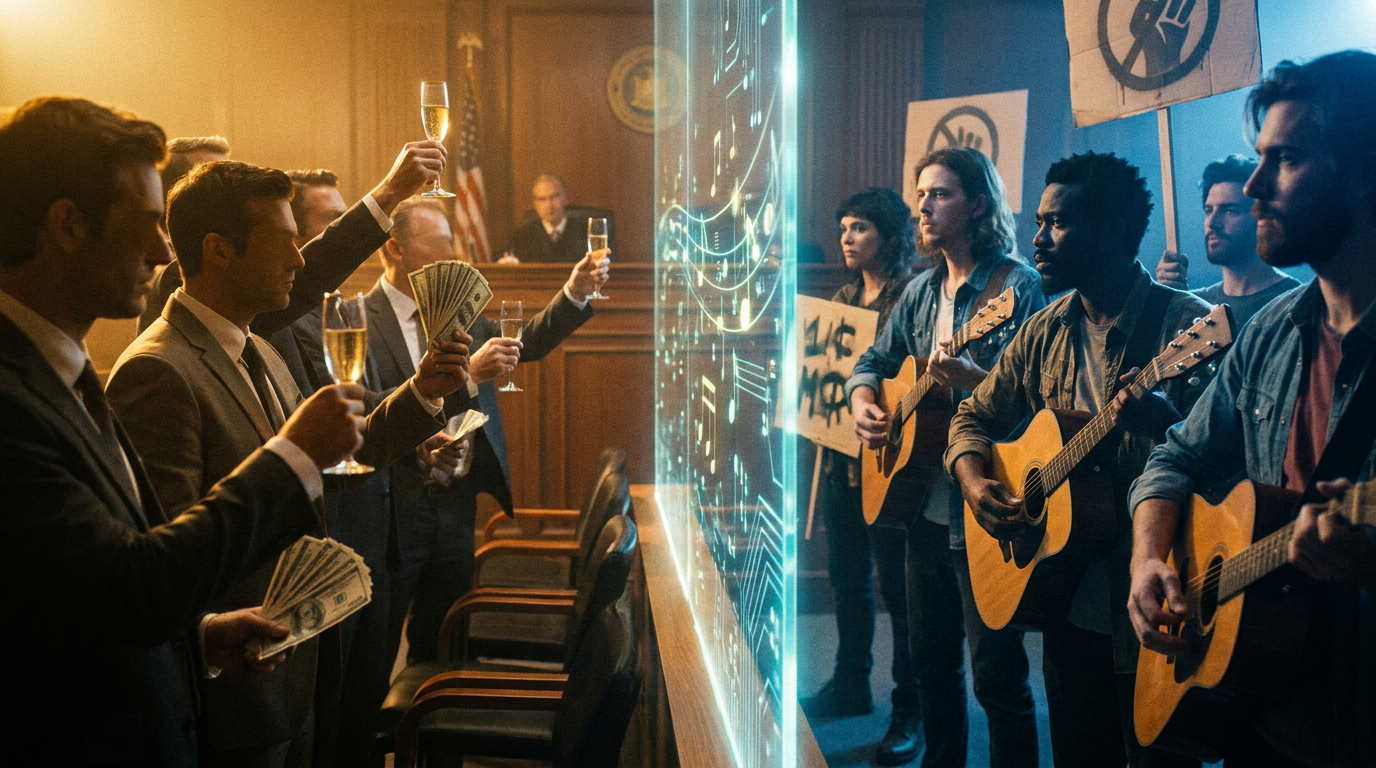
Suno Just Raised $400M While Being Sued for 61K Songs
Yesterday, Suno announced something that would sound like satire if it weren’t real.
The AI music-generation company raised a $400 million Series D round, valuing the company at $5.4 billion. That’s not a typo. The funding more than doubles Suno’s valuation from the $2.45 billion it achieved after closing a $250 million Series C round seven months ago.
And here’s the part that makes this the most fascinating story in music right now: last month, Universal Music Group and Sony Music sought permission from a federal court to add more than 61,000 copyrighted recordings to their case against Suno.
That’s $5.4 billion in investor confidence colliding head-on with 61,000 allegations of copyright infringement. Welcome to the wildest contradiction in the music industry.
The Numbers Are Staggering
Let’s just sit with the trajectory for a moment, because it’s genuinely unprecedented in music tech.
Suno’s annual recurring revenue was $50 million at the start of 2025.
It rose to $140 million by September 30, 2025.
Its annual recurring revenue has now reached $300 million. That’s a 6x increase in roughly 18 months. Suno surpassed 2 million subscribers in February , and users were generating over 7 million songs on Suno every day.
Seven million songs. Per day. For context, Spotify’s entire catalog is around 100 million tracks. Suno’s user base creates that equivalent in about two weeks.
The company currently employs around 200 people and expects to grow its headcount by up to 70 percent before the end of 2026, which would bring the total to roughly 340 employees.
The Legal Storm Hasn’t Slowed Anything
Here’s what makes Suno’s story so different from typical Silicon Valley growth narratives: the company isn’t just dealing with a single disgruntled competitor or a regulatory hiccup. It’s facing a coordinated legal assault from multiple directions.
Copyright holders like Universal Music Group, Sony, and German music collection organization GEMA have continued to pursue legal action against Suno, though Warner Music Group settled and reached a licensing deal with the company last November.
The original lawsuit started relatively small. When Sony and UMG initially sued Suno in 2024, the companies claimed that Suno had trained on 560 of their copyrighted works. That number has since grown meaningfully. Last month, the record labels filed to amend their complaint to allege that over 61,000 more songs were used for AI training without permission.
And it doesn’t stop at the majors. More than 1,800 independent artists have supported class-action lawsuits against Suno and Udio, alleging copyright infringement alongside music labels.
The independent artist lawsuits raise a problem that’s easy to overlook. The class action raises a problem the UMG settlement doesn’t solve: major-label deals only cover major-label catalogs. Independent artists who distribute through DistroKid, TuneCore, CD Baby, and similar aggregators have no seat at the licensing table.
Think about that. Even if every major label eventually settles with Suno, indie musicians — arguably the people most affected — could still be left without compensation.

The Two-Tier System Nobody Wanted
What’s emerging from this chaos isn’t a single resolution. It’s a fractured landscape that musicians need to understand.
The music industry’s AI copyright war has split into three buckets as of April 2026. Warner Music settled with Suno in November 2025 and signed a licensing deal. Universal Music Group settled with Udio in October 2025 and is co-launching a licensed AI music platform in 2026. Sony Music has settled with neither, and its fair-use cases against Suno and Udio are expected to produce a pivotal ruling in summer 2026 that could set legal precedent for every AI music company.
A hearing is scheduled for July 2026. If Suno wins on fair use, it blows up every licensing deal in the AI music space. If it loses, the UMG-Udio template becomes the industry standard.
Let that sink in. A single court ruling this summer could either validate or demolish the entire business model that’s driving $5.4 billion in valuation.
Meanwhile, the deals that have been struck are creating a clear hierarchy. The UMG-Udio platform will be a “walled garden” where AI creations cannot be downloaded or posted externally. UMG artists and songwriters can opt in to training and receive compensation for training data and outputs.
And Suno’s own pivot is coming. In a blog post announcing the raise, CEO Mikey Shulman wrote that “in the coming months, we’ll begin rolling out our first music model developed in partnership with the music industry.”
Under the Warner deal, the new model will allow users to reference and incorporate Warner-owned songs into their creations.
The Ghost Investors
One of the most telling details from yesterday’s announcement was what Suno didn’t say.
Notably, Suno also said “leading artists, songwriters and producers” participated in the round, though the company didn’t disclose who.
The omission is notable; named artist endorsements would go a long way toward defusing the narrative that the music industry is uniformly opposed to what Suno is building.
Think about what this means. Some musicians — potentially well-known ones — have put money into Suno while their peers are suing the company. They’re investing in a platform that 1,800+ independent artists say stole their work. And they won’t let their names be attached to that bet.
Whether you see this as pragmatic (get a seat at the table early) or cynical (profit from the disruption of your own industry) depends entirely on your perspective. But the silence is louder than any press release.
Bond Capital, which counts early Spotify investor Mary Meeker as a partner, led the raise alongside Institutional Venture Partners, Forerunner, Union Square Ventures, Alkeon Capital, and Quiet Capital. Between them, those entities possess interests in Hume AI, ElevenLabs, and Anthropic — besides Uber, SpaceX, Oura, Epic Games, and plenty of other well-known non-AI companies.
The investor list reads like a who’s-who of companies betting that AI will reshape creative industries whether artists like it or not.
What This Means for Musicians Right Now
Here’s where we stop being spectators and start being strategic. If you’re a musician in 2026, Suno’s $5.4 billion moment isn’t just a news story — it’s a signal about where the industry is going.
1. The Licensed Model Era Is Coming
The wild west of AI music is ending. Not because of moral arguments, but because the legal risk got too expensive. Every major AI music platform — Suno, Udio, Spotify’s AI features — is moving toward licensed models. This means your music has value as training data, and you should know your rights around opting in or out.
2. Visual Content Is Your Moat
Here’s the thing that Suno, for all its billions, still can’t do: make you a music video. AI can generate audio that’s increasingly hard to distinguish from human-made music ( research by streaming service Deezer and Ipsos found that 97 percent of listeners could not tell the difference between AI-generated and human-made music ), but the visual layer — your face, your aesthetic, your story — remains distinctly human.
This is why creating AI music videos has become such a critical skill for artists in 2026. When the audio playing field gets leveled by AI, the visual identity becomes your differentiator. The artists who are thriving right now aren’t the ones fighting AI music generation — they’re the ones using AI video tools to amplify their human-created music with visuals that couldn’t exist any other way.
3. Independent Artists Need a Strategy
The Nguyen complaint alleges that Suno’s training data included over 40 million tracks, of which at least 60% came from independent artists. If accurate, the majority of Suno’s training data was created by artists who have no licensing agreement and no pathway to compensation.
If you’re an indie artist, your music is almost certainly already in someone’s training dataset. The question isn’t whether to engage with AI — it’s how. That might mean joining the class action. It might mean opting into licensed platforms where you get compensated. It might mean doubling down on visual content and live performance where AI can’t replicate what you do.
For hip-hop artists, EDM producers, indie musicians, and pop creators alike, the move is the same: use AI as a creative tool on your terms, rather than waiting for it to be used against you.
4. The Fair Use Ruling Changes Everything
The labels argue it is straightforward infringement at industrial scale. A ruling against Suno on fair use would force every AI music company to license training data or shut down.
A ruling expected this summer will determine whether AI companies can legally train on copyrighted music without permission. If fair use holds, Suno’s $5.4 billion valuation looks like a bargain. If it doesn’t, the entire AI music industry has to restructure around licensing — which, ironically, is what the major labels have been pushing for all along.

The Bigger Picture for Music Video Creators
Here’s the thing that often gets lost in the copyright wars: while everyone debates whether AI should generate music, AI’s role in visualizing music has quietly become indispensable.
The complete guide to AI music videos in 2026 outlines how artists across every genre — from country to K-pop — are using AI video tools to create professional-quality visuals without six-figure budgets.
Suno’s story is ultimately about who controls the creation of audio. But for working musicians, the more actionable question is who controls the visual narrative around their music. And right now, that’s still you.
Streaming services are seeing tens of thousands of new fully AI-generated tracks uploaded daily — according to The Associated Press, up to 20,000 new AI tracks per day on Deezer alone, representing roughly 18 percent of uploads. When the market floods with AI-generated audio, the artists who stand out will be the ones with distinctive visual identities — compelling music videos, eye-catching social clips, and a visual brand that can’t be replicated by a text prompt.
Where We Go From Here
Suno’s $400 million raise yesterday wasn’t just a funding announcement. It was a declaration that the market believes AI music generation is inevitable, no matter how many lawsuits pile up.
Daegwon Chae, a General Partner at Bond Capital, compared Suno to coding tools that have enabled non-programmers to build their own applications, telling Bloomberg that the company occupies a similar position in music.
And Suno CEO Shulman himself has claimed: “I don’t meet a lot of producers and songwriters who aren’t using Suno at least a little bit in their workflows.”
Whether that’s true or wishful thinking, the trajectory is clear. AI music generation is scaling faster than the legal system can respond. “2026 is the year of settlements,” as one legal tracker put it. “The legal landscape compressed a decade of traditional copyright litigation into 24 months.”
For musicians, the smart play isn’t to pick a side in the AI music war. It’s to build the parts of your career that AI can’t replace — your voice, your story, your visual identity — while using AI tools to amplify everything else.
That’s exactly what platforms like OneMoreShot.ai are built for. While the industry argues about who owns the audio, you can be creating stunning AI-powered music videos that put your music — human-made, human-felt — in front of audiences who are hungry for authenticity. Because in a world drowning in AI-generated songs, the artist with the most compelling visual story wins.
The $5.4 billion question isn’t whether AI will change music. It already has. The question is whether you’ll use these tools to tell your story, or wait for someone else’s algorithm to tell it for you.