The First AI Song to Chart on TikTok
An AI-generated doo-wop track called “A Million Colors” quietly slipped onto TikTok’s Viral 50 chart — and most people who used it in their videos had no idea it wasn’t made by a human.
That sentence should stop you in your tracks if you’re a musician in 2026.
“A Million Colors” by Vinih Pray became the first-known AI-generated song to hit the TikTok charts, sitting at No. 44 on the TikTok Viral 50.
The doo-wop inspired song was generated using the popular AI music platform Suno, which the company confirmed.
And here’s the kicker: the song sounds so realistic that it fooled a number of unsuspecting users, and some TikTok users have started catching on — on the song’s sound page, videos are being made to call out its use of AI.
This isn’t just a novelty story. It’s a blueprint — and a warning — for every independent musician trying to cut through the noise in 2026.
How a Suno Track Fooled 371,000 TikTok Creators
Let’s look at the numbers, because they tell a story that goes way beyond one viral moment.
The impact of “A Million Colors” is substantial, with over 371,700 creates on TikTok, 819,745 streams on Spotify, and 161,000 views on YouTube. That’s not accidental exposure. That’s a full-blown hit trajectory, driven almost entirely by short-form video.
Adding to its viral spread, Kylie Jenner — one of TikTok’s most popular celebrities — recently featured the song in a makeup tutorial, which garnered 1.5 million likes. When Kylie Jenner unknowingly soundtracks her content with an AI-generated track, we’ve officially crossed a threshold.
According to his Spotify bio, the artist Vinih Pray was born in Rio de Janeiro, Brazil. Since he started posting in April 2024, Pray has released over 110 songs to Spotify in a variety of languages, including Korean, English, and Portuguese.
110 songs in roughly a year. That’s a production velocity that only makes sense with AI tools. And one of those 110 became a genuine viral hit — not because it was algorithmically gamed, but because TikTok creators found it, loved the vibe, and made it their own.
The Visual Made It Happen
Here’s what every musician needs to understand about “A Million Colors”: the song didn’t go viral because of Spotify playlists or radio play. It went viral because people made videos with it.
The song’s success did not go unnoticed. TikTok users began using it in videos, creating trends and strengthening its momentum.
This is the visual-first flywheel in action. A song becomes a sound. A sound becomes a trend. A trend becomes a chart position. And a chart position drives streams everywhere else.
If you’re an independent musician looking at this and thinking “that could be me,” you’re right — but only if you understand that music discovery in 2026 runs through video, not audio.
This is exactly why AI music videos have become essential for independent artists. The old release cycle — record, distribute, hope for playlist placement — is dead. The new cycle is: record, create visual content, seed it on short-form platforms, and let the algorithm do the rest.
The 93% Problem (And How Visuals Solve It)
“A Million Colors” is the exception that proves the rule. For every AI track that charts, tens of thousands vanish into the void.
90,000 AI-generated tracks per day now represent over 50% of all new music uploads on Deezer at peak level in June 2026. That’s a staggering flood. Moving forward, Deezer will systematically take down AI-tracks used for streaming fraud, and those that haven’t been streamed for at least 6 months.
The math is brutal: with 90,000 AI tracks hitting streaming platforms daily, standing out with audio alone is essentially impossible. Research shows 93% of AI music gets zero meaningful traction. What separates the 7% that breaks through?
Video. Every. Single. Time.
Look at TikTok’s own mechanics. TikTok virality is about one loopable moment — a chorus drop, a beat switch, one shouted lyric. Songs engineered around one perfect clip out-trend objectively bigger tracks.
When thousands of videos share one audio, TikTok groups them and surfaces the sound page itself. Early adopters ride the wave up; late posts join an oversaturated pool. The edge goes to whoever catches the sound while the curve is still climbing.
That’s the game. And it’s a game that rewards visual creators — whether you’re making AI music videos for pop, hip-hop, or any genre that plays well on short-form.
Why This Matters More for Human Musicians Than AI Ones
Here’s the twist nobody’s talking about: “A Million Colors” actually makes the case for human musicians to invest in AI video — not AI music.
Think about it. An AI-generated track with no marketing budget, no label, no human vocalist managed to hit the TikTok Viral 50. If a Suno track can do that with zero promotional strategy, imagine what a genuine human-made song could accomplish with a deliberate visual-first approach.
The competitive advantage for real musicians isn’t the music itself anymore — the AI flood has made sure of that. The competitive advantage is identity. A real face. A real story. A real person behind the camera or in the video. And that’s precisely what AI music video tools let you create at scale.
When anyone can generate a track, the value is no longer in the act of generation alone. The value is in the human direction behind the work.
“A Million Colors” went viral despite having no human identity attached. Your music can go viral because of one.
The TikTok-to-Streaming Pipeline Is Real
The numbers back this up beyond one song. Billboard’s Kristin Robinson noted that “A Million Colors” is “the first-known AI generated song to rank on the TikTok charts.” But the bigger story is how TikTok virality translates to streaming revenue.
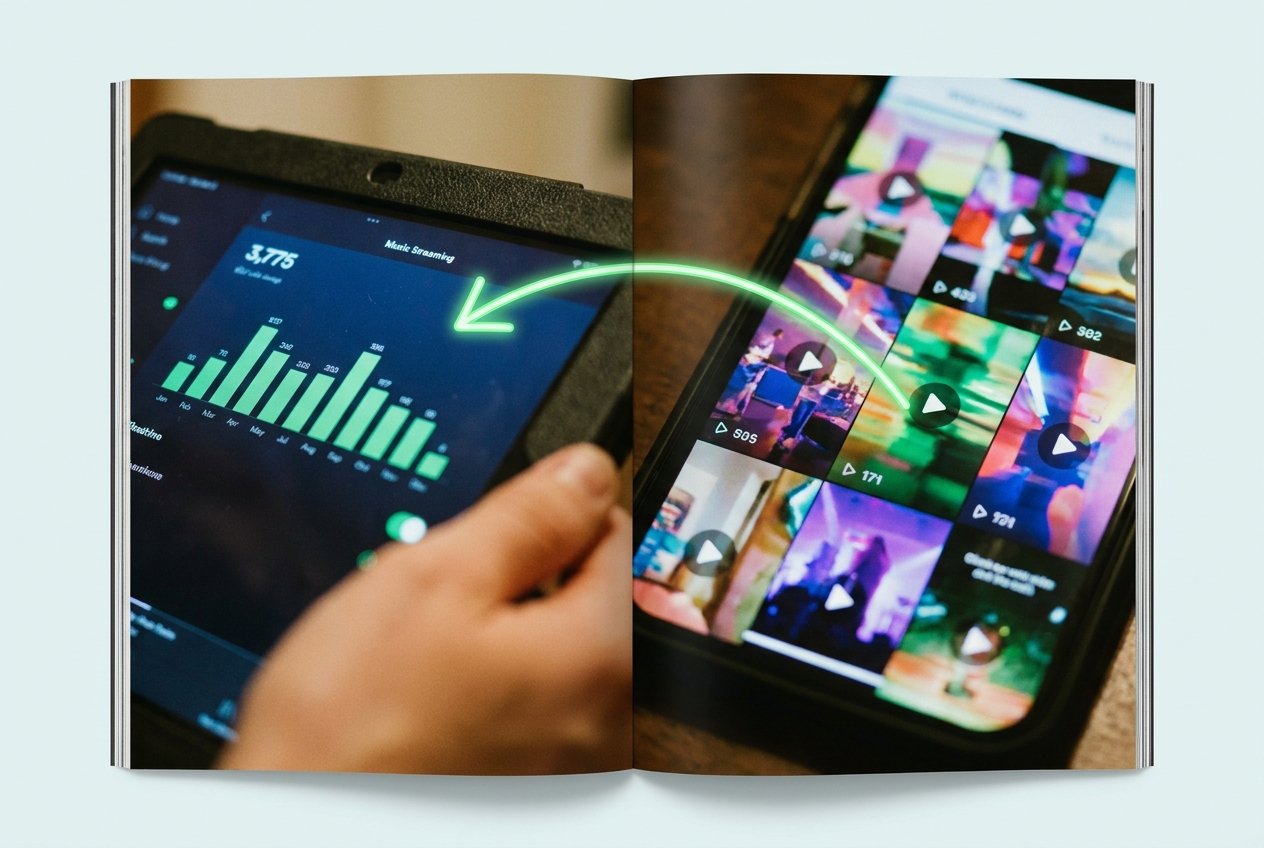
Music remains one of TikTok’s strongest growth engines. And the pipeline flows in one direction: TikTok video → sound page discovery → Spotify/Apple Music streams → revenue.
For musicians, this means your release strategy needs to start with the video, not end with it. The old model was: release song → shoot music video months later. The 2026 model is: create visual content before or simultaneously with your audio release, seed it across short-form platforms, and use the video as the discovery engine.
This is where genre-specific visual strategy matters enormously. A country music video needs different visual language than an EDM video. An R&B visual hits different from a metal video. The artists who match their genre’s visual expectations while adding something unexpected are the ones who break through.
What “A Million Colors” Teaches About AI Transparency
There’s also a darker lesson here. Some TikTok users have started to recognize the AI origins of “A Million Colors.” The sound page now features numerous videos from users pointing out its AI roots. This trend likely gained traction from a popular video by user @americangorls, who expressed unease.
The backlash cycle is predictable at this point: AI song goes viral → someone discovers it’s AI → backlash videos get their own engagement → the conversation shifts from the music to the controversy.
For human musicians using AI for visuals rather than audio, this is actually great news. You’re not replacing your creative core — your voice, your lyrics, your performance. You’re enhancing your visual presentation. Nobody’s going to “expose” you for using AI to generate a moody landscape backdrop for your indie folk track. But they absolutely will expose you for releasing a fully synthetic vocal pretending to be human.
The debate surrounding AI music has entered a new phase. The conversation is increasingly centered on transparency, attribution, and how AI-generated works should be identified when released commercially.
This is why the AI-for-visuals play is strategically superior to the AI-for-audio play in 2026. Your music stays authentically yours. Your video gets a massive production upgrade. And you avoid the transparency landmine entirely.
The August 2 Deadline Adds Urgency
If you’re creating AI-generated visual content that reaches European audiences, there’s a hard deadline approaching. Transparency obligations under Article 50 of the EU AI Act become enforceable on August 2, 2026 — including chatbot disclosure, synthetic content marking, and deepfake labeling.
Deepfakes and manipulated audio, image, or video content must be disclosed as artificially generated.
Violations may result in fines of up to €15 million or 3% of total annual worldwide turnover, whichever is higher.
The good news: if you’re using AI to create stylized music video visuals (not deepfaking a real person’s likeness), compliance is straightforward. Label your content. Use tools that embed proper metadata. Be transparent that your video was AI-assisted. Musicians who do this properly will be ahead of artists who scramble to comply after enforcement begins.
Your Move: The Visual-First Release Playbook
“A Million Colors” proved something important: in 2026, the visual layer is what separates viral from invisible. Here’s how to apply that lesson, whether you’re releasing your first single or your fiftieth:
1. Create Your Video Before Your Release Date
Don’t wait until after your song drops. Build your visual content in advance and launch simultaneously. Tools like One More Shot AI let you create full music videos from your audio in minutes, not weeks.
2. Design for the Loop
TikTok virality is about one loopable moment. When creating your AI music video, identify the 15-30 second clip that captures your song’s emotional peak. That clip is your social seed.
3. Match Genre to Visual Language
The visual expectations differ wildly across genres. A dreamy lo-fi visual with rain-streaked windows and neon reflections works for chill beats. An anime-inspired K-pop visual works for pop crossovers. Know your audience’s visual vocabulary.
4. Be Transparent About AI Use
Don’t hide your process. The musicians thriving in 2026 are the ones who own their workflow. “I wrote and performed this song. I used AI to create the visual.” That’s a confidence statement, not a confession.
5. Volume Matters (But Quality Matters More)
Vinih Pray released 110 songs. One became a hit. You don’t need to match that volume, but you do need to be consistently creating visual content. Every release should have multiple video assets: a full music video, short clips for TikTok and Reels, and maybe even a lyric video.
The Bigger Picture
“A Million Colors” is a milestone, but it’s also a symptom. We’re living through a moment where the barriers between creation and distribution have essentially collapsed. Anyone can make a song. Anyone can make a video. The question is no longer can you create — it’s whether anyone will care.
And in 2026, making people care means showing them something. Not just playing them something.
AI music is not dead, but the free-for-all era is ending. The artists who’ll thrive are the ones who pair genuine creative vision with the tools that amplify it. That means using AI where it adds value — stunning visuals, rapid iteration, genre-specific templates — while keeping the human core intact.
The first AI song to chart on TikTok didn’t have a face behind it. Your music does. That’s your advantage. Use it.
Ready to turn your music into visual content that actually reaches people? One More Shot AI lets you create stunning, genre-matched music videos from your audio in minutes. No production crew. No five-figure budget. Just your song and a visual vision. Start creating today.