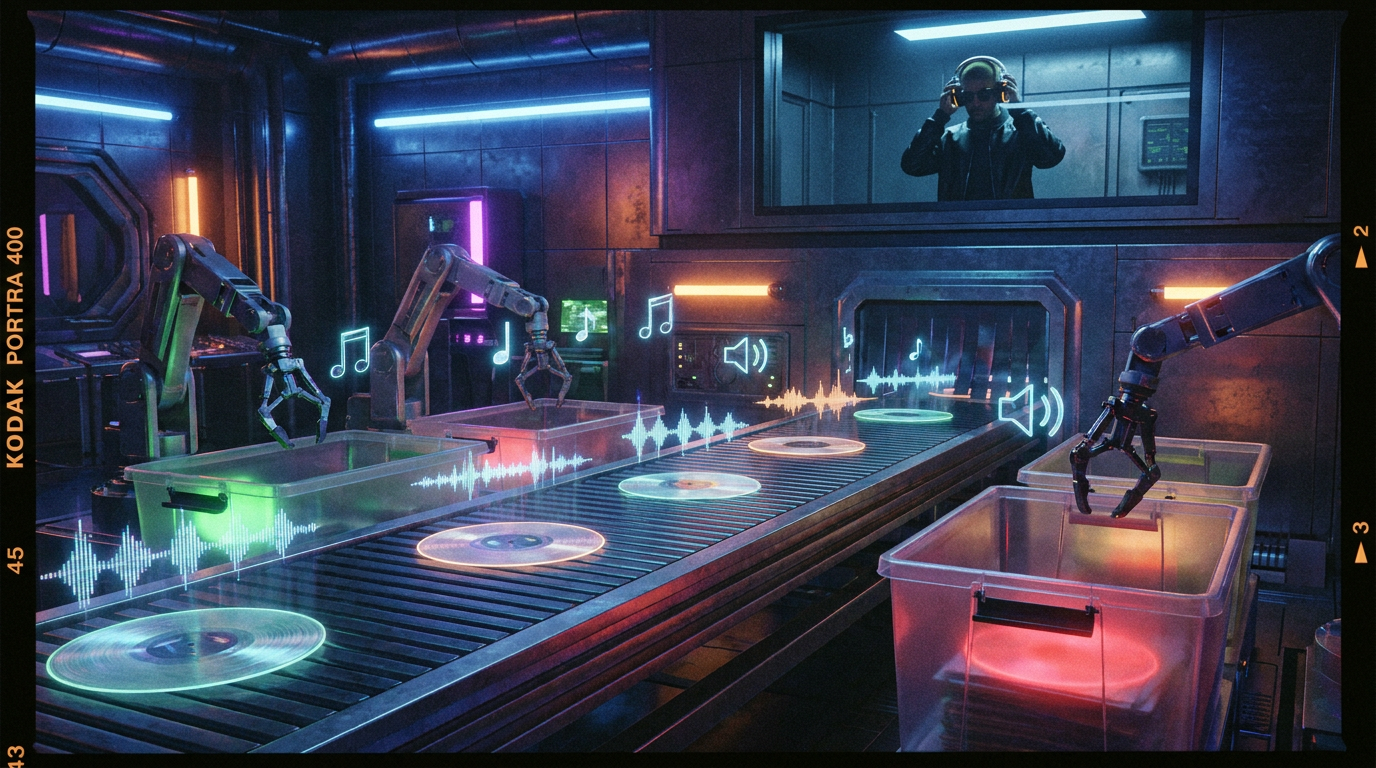
The Great AI Music Sorting Has Begun in 2026
Something big happened in the music industry this week. Not one event — a cascade of them. And when you line them up together, they tell a story that nobody’s talking about clearly enough.
YouTube launched an AI tool that generates royalty-free instrumentals to replace copyrighted music in your videos. Believe and TuneCore started blocking every track made on Suno, calling it a “pirate studio.” Google partnered with Believe to hand artists a sanctioned AI music creation tool called Flow Music. And Deezer confirmed it’s now receiving 75,000 AI-generated tracks per day — with 85% of streams on those tracks flagged as fraudulent.
This isn’t a series of unrelated headlines. It’s the beginning of the Great AI Music Sorting: the moment the industry decided not all AI music is created equal, and started building the infrastructure to enforce that distinction.
If you’re a musician trying to make music, make music videos, and actually get paid — this week changed your playbook.
The Numbers That Broke the Industry’s Patience
Let’s start with the stat that made everyone lose their minds.
Deezer is now receiving almost 75,000 AI-generated tracks per day, representing roughly 44% of daily uploads.
This amounts to more than 2 million AI-generated tracks uploaded per month.
Read that again. Nearly half of all new music uploaded to a major streaming platform is AI-generated. And it’s not even close to slowing down. In January 2025, the figure was 10,000 songs a day; in April 2025, 20,000 songs daily; and in September 2025, 30,000 songs daily.
In January 2026, the figure was reported as 60,000 songs daily.
That’s a 650% spike in about 16 months. An exponential curve that would make a crypto bro weep.
But here’s the twist that actually matters: consumption of AI-generated music on Deezer’s platform is still very low, between 1-3% of total streams, and a majority (85%) of these streams are detected as fraudulent and demonetized. The uploads are exploding, but nobody’s actually listening. The bots are playing the tracks to farm royalties, and real humans are scrolling right past.
Deezer also commissioned a study that revealed 97% of people couldn’t hear the differences between AI and human-made music , yet 52% of respondents said 100% AI-generated songs shouldn’t be included in charts alongside human-made songs, and 80% said AI music should be clearly labeled for listeners.
People can’t tell the difference — but they still want to know. That’s not a technology problem. That’s a trust problem. And the industry is finally responding.

YouTube’s “Replace Song” Move Is Bigger Than You Think
On May 1st, YouTube quietly dropped a feature that could reshape how creators think about music in their videos forever.
YouTube revealed on its Creator Insider channel an update that adds a new “Create” button to the existing “Replace Song” tool in YouTube Studio.
YouTube will generate four royalty-free instrumental tracks that you can use to replace copyrighted audio in your videos and release Content ID claims.
For years, getting a Content ID claim on YouTube felt like a death sentence for a video’s earning potential. You’d either mute the audio (terrible), remove the video (worse), or dig through royalty-free libraries trying to find something that didn’t sound like hold music at a dentist’s office.
Now? YouTube has added a feature that lets creators generate AI instrumental tracks to replace copyrighted audio in their videos, aiming to resolve Content ID claims without forcing creators to delete or edit content.
The feature is currently limited to U.S. users on the desktop version of YouTube Studio, but a global launch and rollout to the Studio mobile app are in the works.
Here’s what makes this interesting for musicians specifically: YouTube creators using tools like ‘replace song’ are probably not including commercially released music in their videos because of its impact on monetization. However, they may well be customers of production music companies like Epidemic Sound. YouTube is essentially saying: “We can generate what Epidemic Sound sells you, on demand, for free, inside the tool you’re already using.”
The big question is how this change will affect companies that provide royalty-free music to creators. The stock-music-for-YouTubers industry just got a very loud wake-up call.
But for musicians making music videos? This is a signal. YouTube is fully committed to AI-generated audio as a legitimate, monetizable layer of content creation. The platform that pays more to the music industry than anyone else just said AI instrumentals are a first-class citizen.
Believe’s Two-Faced (and Brilliant) AI Strategy
While YouTube was rolling out AI music tools for creators, Believe — the global artist development company that owns TuneCore — was playing the most fascinating chess move of the week.
On one hand: Believe’s definition of “pirate studios” includes Suno, which remains the target of active copyright litigation from Universal Music Group and Sony Music Entertainment.
When said model/platform is identified as originating from an unlicensed service, Believe and TuneCore will block distribution of any content.
On the other hand: Believe has also confirmed that it has inked new music licensing agreements with two notable Gen-AI companies: ElevenLabs and Udio.
And then the knockout punch: Believe is partnering with Google to offer the tech giant’s AI music creation platform, Google Flow Music, to artists across Believe and TuneCore.
See what happened? Believe didn’t ban AI. Believe chose which AI gets to exist in its ecosystem. Suno is out. Udio, ElevenLabs, and Google Flow Music are in.
Believe founder and CEO Denis Ladegaillerie told MBW that the company is automatically blocking the distribution of AI-generated tracks produced on unlicensed “pirate studios” — while simultaneously investing in what it calls “value-creative AI” tools designed to enhance artist creativity.
Ladegaillerie said the company can identify the model and platform behind a track with 99 percent reliability. And he didn’t mince words about distributors who keep accepting unlicensed AI output, calling them a “litigation time bomb.”
This is the sorting in action. The industry isn’t anti-AI anymore. It’s anti-unlicensed AI. That distinction matters enormously.
Google Flow Music: The “Approved” AI Creation Tool
The Believe-Google partnership deserves a closer look because it signals where the industry is headed.
Under the deal, Believe will offer Flow Music — the Google Labs-housed AI music tool formerly known as ProducerAI — to its artists, producers and songwriters as what the companies describe as a “creative collaborator.”
The platform is powered by Lyria 3 Pro, Google’s music generation model designed to understand musical composition including intros, verses, choruses and bridges.
The model supports diverse musical styles from amapiano to dream pop and can generate complex rhythms and test vocals in different languages.
Lyria 3 Pro can generate tracks up to three minutes long.
All outputs are embedded with SynthID, Google’s watermarking technology for identifying AI-generated content.
And the kicker: Google added that it “doesn’t claim ownership of the original content generated with Flow Music.”
As part of this partnership, Believe and TuneCore will select a group of artists and producers to meet weekly with the product team. These ambassadors will have the chance to share feedback and influence the future of Flow Music.
This is the new model: AI tools that are licensed, watermarked, transparent about training data, and built in collaboration with artists. It’s the anti-Suno playbook — or at least the “we did it the right way” playbook.
For indie musicians on TuneCore, the practical impact is immediate. You can use Google Flow Music to experiment with melodies, genres, and lyrics. You can use Udio or ElevenLabs for AI-assisted production. But if you export a raw Suno track and try to distribute it through TuneCore, it’s getting blocked at the gate.
What the Sorting Means for Music Video Creators
Okay. So the industry is splitting AI into “approved” and “pirate” categories. Streaming platforms are building detection walls. YouTube is embedding AI music generation directly into its creator tools. What does this mean if you’re a musician who also needs to create music videos?
1. Your AI Music Video Workflow Just Got Simpler (and Riskier)
The good news: you now have a clearer map of which tools are “safe.” Google Flow Music, ElevenLabs, and Udio are on the licensed side. Use them for production assistance, and you can distribute confidently.
The risk: if you’re using Suno to generate beats or stems for your music video’s soundtrack, and that track gets flagged downstream, your video could lose monetization or get pulled. The detection tech is real, and it’s getting better.
If you’re building out a visual identity for your music, check out our complete guide to AI music videos for a breakdown of how audio and visual AI tools fit together in a modern workflow.
2. Music Videos Are Now Your Competitive Moat
Here’s the counterintuitive insight: as AI-generated audio floods streaming platforms, the value of visual content goes up. A music video proves you’re a real artist with a real vision. It’s harder to fake a coherent visual narrative than it is to generate three minutes of lo-fi beats.
This is exactly why tools like OneMoreShot.ai exist. When you can pair your human-made (or human-directed) music with a stunning AI-generated music video, you’re building the kind of artistic identity that algorithms and audiences both reward.
Whether you’re working in hip-hop, EDM, or indie, having a visual component signals authenticity in a market drowning in faceless AI slop.
3. The “Guaranteed Human” Premium Is Real
iHeartMedia’s Chief Programming Officer Tom Poleman recently sent a memo pledging that “We don’t play AI music that features synthetic vocalists pretending to be human,” noting that the company’s research found 96% of consumers think “Guaranteed Human” content is appealing.
That stat should make every musician’s ears perk up. Audiences are actively seeking out human-made music. If you can demonstrate that your work is human-directed — that there’s a real creative vision behind it — you have an advantage that pure AI generators will never match.
A music video is proof of creative direction. It says: “A human imagined this, curated these visuals, chose these scenes, and made artistic decisions.” Even if you used AI to help produce the video itself, the intentionality is what separates art from content.
4. The Distribution Layer Matters More Than Ever
The old game was: make music, upload to DistroKid or TuneCore, hope for streams. The new game has an extra checkpoint.
An indie artist uploading to TuneCore in 2026 has three categories of AI content to think about: (1) tracks made on a fully unlicensed platform like Suno, which TuneCore will not distribute; (2) tracks made on a licensed-partner platform like ElevenLabs or Udio, which TuneCore will distribute provided the output meets the platform’s licensing terms; and (3) tracks where AI tools were used in a composition or production capacity but where the output is meaningfully human-authored.
Your distribution strategy now needs to account for which AI tools you use. That’s new. And it’s going to reshape how musicians think about their entire creative pipeline — audio and visual.
The Listener Rebellion Nobody Expected
Let’s not ignore the elephant in the room. While the industry sorts AI into approved and pirate buckets, listeners are sending their own signal.
A Luminate study compared attitudes towards AI use in music creation from May to November of 2025, finding that overall interest dropped from -13% to -20% during that time period.
Audrey Schomer, who authored the report, says “Across the board, consumers are net negative” — meaning people are more likely to feel uncomfortable than comfortable with AI use.
And artists are amplifying that discomfort. R&B singer SZA told i-D magazine in March that she feels “at war” with AI.
Schomer suggests that musicians speaking out against AI could be moving the needle: “If people have any sort of affinities towards specific artists who have been active in those artist rights campaigns, then perhaps that rising awareness would lead people — particularly young people — to be more anti AI.”
This creates a fascinating dynamic. The technology is better than ever. The tools are more accessible. But the audience is pulling back. The musicians who navigate this gap — using AI tools smartly while maintaining an authentic creative identity — are the ones who’ll thrive.
What Smart Musicians Should Do Right Now
Here’s the practical takeaway from the Great Sorting:
Audit your toolchain. Know which AI tools you’re using and whether they’re licensed. Google Flow Music, Udio, and ElevenLabs are in the “approved” camp for Believe/TuneCore distribution. Suno is not (yet). If you use Suno for brainstorming, don’t distribute raw outputs through TuneCore.
Invest in visuals. As audio content gets commoditized by AI, your visual identity becomes your differentiator. Learn how to make an AI music video that complements your sound. Experiment with genre-specific templates that match your aesthetic.
Be transparent. The disclosure rules are here. In 2026, the “flag” isn’t a ban; it’s a requirement. If you use AI vocals, you must disclose them during distribution. Failure to disclose “Synthetic Content” is what leads to tracks being removed.
Lean into what AI can’t fake. Your story. Your face. Your community. Your live shows. The musicians who build genuine fan relationships — and use AI to amplify, not replace, that connection — are the ones this sorting was designed to protect.
The Sorting Is Just Starting
What we saw this week is the foundation being poured. YouTube, Google, Believe, Deezer — they’re all building the same thing from different angles: a system that distinguishes between AI-as-creative-tool and AI-as-fraud-machine.
The next chapter will be even more dramatic. Google I/O 2026 is around the corner, and Google is currently testing a new “Omni” model for video generation expected to be the centerpiece of the upcoming event. Imagine a world where Google Flow Music generates your track, Google Flow generates your music video, and the whole thing ships to YouTube with embedded provenance data proving every step of the creative process.
That’s not science fiction. That’s Q3 2026.
For now, the smart move is to embrace the tools that are on the right side of the sorting line — and start building your visual identity alongside your sound. Head to OneMoreShot.ai and start creating music videos that prove there’s a real artist behind the music. Because in the age of the Great Sorting, the artists with both vision and visuals are the ones who’ll survive.