Twitch's AI Lawsuit Is a Warning for Musicians
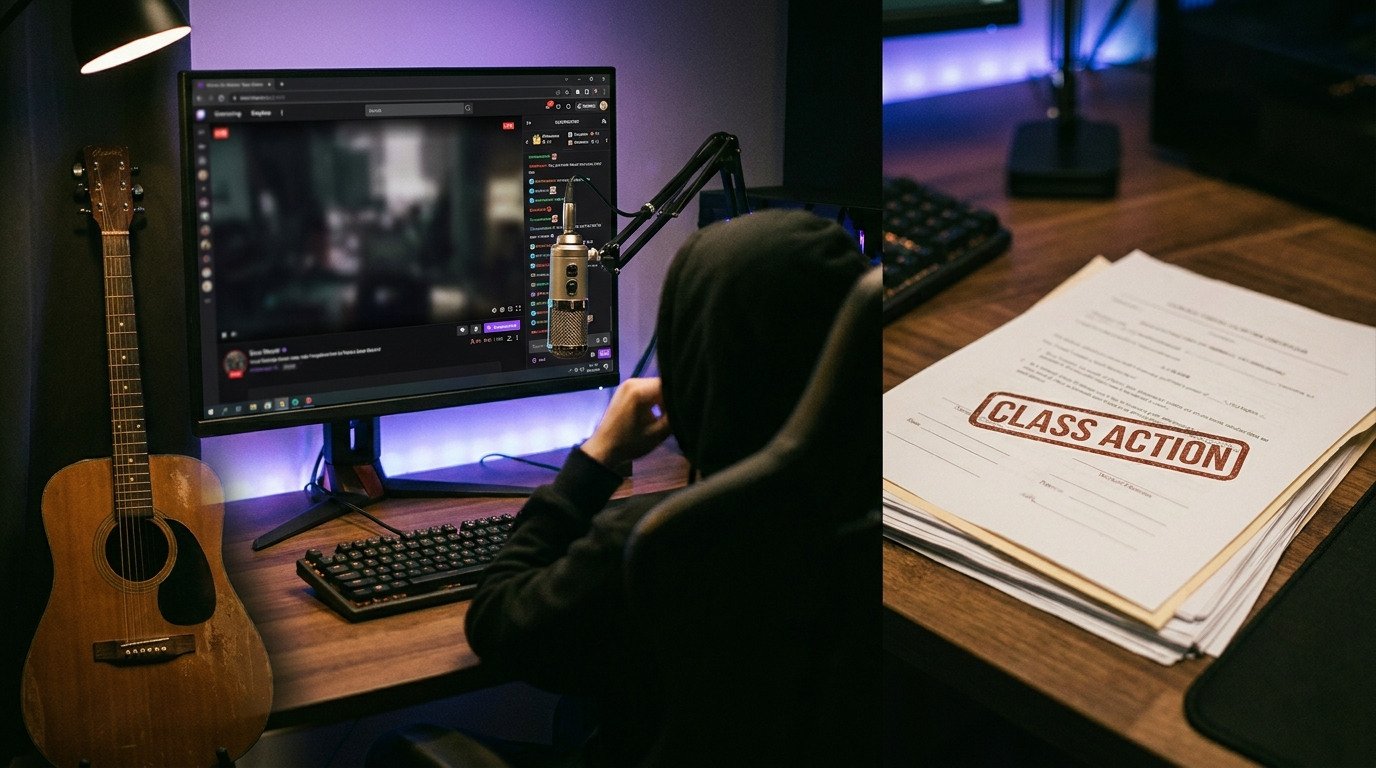
A streamer with 900 followers just filed a class action against one of the biggest companies on Earth. And if you’ve ever gone live on Twitch with your music — even once — you should be paying attention.
On August 20, 2026, Connecticut streamer Warren Pandiscia filed a class action against Twitch Interactive and Amazon.com in the Northern District of California.
The complaint accuses both companies of feeding streamers’ broadcasts, videos, clips, and chat logs into Amazon’s generative AI models without consent — and of doing it “since as far back as 2024,” long before any opt-out existed.
The kicker? The filing lands eight days after Twitch shipped its on-by-default AI training setting. That toggle was meant to calm the community. Instead, it handed a plaintiff’s lawyer a timeline.
If you’re a musician who streams performances, DJ sets, production sessions, or even casual hangs with your fans on Twitch, your content may have already been fed into Amazon’s AI machine. Here’s what happened, why it matters, and what you should do right now.
The Opt-Out That Backfired
On August 12, 2026, Twitch quietly added a “Training for Generative AI” toggle to every account’s settings — enabled by default. The company didn’t send an email, show a pop-up, or make any advance announcement.
In other words, every creator on Twitch woke up one morning already opted in to having their content scraped for Amazon’s AI training. And most of them didn’t even know it.
According to Twitch’s documentation, the data could be used to improve things like speech-to-text systems, captions, and other Amazon products. Sounds innocent enough. But then Twitch’s Chief Product Officer Mike Minton got on a livestream to answer community questions, and dropped what might be the most honest — and most damning — quote of the entire AI era.
“If it was opt-in, nobody would opt in. That’s honestly the answer,” said Minton, explaining the decision.
Read that again. The person running product at Twitch just admitted that they knew creators wouldn’t consent to this if given a real choice. So they didn’t give them a real choice.
What the Lawsuit Actually Claims
The class-action lawsuit alleges that Twitch and Amazon utilized content from streamers to train generative AI without securing proper consent or providing compensation.
Here’s the core argument from the complaint: Pandiscia claims that Amazon’s AI products are commercialized, giving the company a significant incentive to acquire training data on an unprecedented scale. According to the lawsuit, rather than negotiating for lawful licenses or seeking permission, Amazon accessed Twitch streams and videos to create a massive dataset essential for its AI products.
The complaint describes these actions as “an unconscionable attack on the community of content creators whose work fuels the multitrillion-dollar generative AI industry without any compensation.”
The numbers are staggering. Twitch reportedly produced more than 215 million hours of content in the first few months of 2026. That’s an incomprehensible volume of audio, video, and text data — and Twitch distributes more than two million hours of audio and video content daily.
For Amazon, which has been a step behind rivals like Anthropic, OpenAI, and Google in the AI race, recently consolidating several smaller AI models into its new “frontier” Nova model, that data is pure gold.
Why Musicians Should Care Most
You might be thinking: “I’m not a Twitch streamer. This doesn’t affect me.” But here’s why it absolutely does.
The use of Twitch creators’ content by Amazon to train its AI models raises additional concerns, especially for DJs and other musicians who play for audiences on the streaming platform.
Think about what a musician’s Twitch stream contains:
- Your original music played live during streams
- Your voice — speaking, singing, performing
- Your production techniques if you stream studio sessions
- Your interactions with fans in real-time chat
- Cover performances that demonstrate your style and skill
All of this is exactly the kind of rich, multimodal training data that AI companies are desperate for. Audio paired with video paired with text (chat). It’s the holy grail of training data — and Amazon’s use of Twitch content for AI training started before this week’s announcement.
Amazon has owned Twitch since 2014, which means it has over a decade of streams, gameplay footage, and real-time chat to use as material for AI training.
A decade of musician performances. A decade of DJ sets. A decade of production streams. All potentially scraped before anyone had a chance to say no.
The Opt-Out Has Limits (Big Ones)
Even if you rush to Twitch’s settings right now and flip that toggle off, the protection is narrower than you’d think.
The opt-out has limits. It only covers a user’s own channel. Chat messages posted in other streams are still subject to the settings of those channel owners. If you opt out, your chat messages in other channels can still be used for training.
And here’s the real gut punch: Twitch’s documentation says the change applies to future training and does not mention content already used before the opt-out was available.
So if Amazon already trained models on your music streams from 2024 or 2025? That toggle does nothing for you.
Turning it off still leaves Twitch and Amazon free to use channel content in other ways permitted under Twitch’s Privacy Notice, including AI features for sponsorship assistance, recommendation-based discovery, and moderation tools.
This Isn’t Happening in Isolation
The Twitch lawsuit is just the latest in a rapidly escalating pattern. The music industry has continued to fight against the harvesting of copyrighted content for AI training, with lawsuits such as Round Hill’s against Suno and Anthropic and ongoing litigation between the majors and Suno or Udio.
What makes the Twitch case different — and potentially more impactful — is the sheer scale. We’re not talking about a catalog of recordings scraped from a database. We’re talking about a live platform where creators generate millions of hours of new content every month, all funneled into a single company’s AI pipeline with zero transparency.
Most major social and digital platforms turn AI model training on by default and require users to manually opt out. Meta does it. Google does it. And now Amazon has made it explicit that Twitch does it too.
The pattern is consistent: build a platform creators love, wait until they’re deeply invested, then change the terms to harvest their work for AI. It’s the same playbook, different stage.
What This Means for Your Music Strategy
Here’s where this connects directly to your life as a musician in 2026.
1. Your Live Content Is a Target
Every platform you use is either already training AI on your content or actively considering it. Twitch. Instagram. YouTube. TikTok. The question isn’t if your content is being used — it’s which companies are using it and what they’re building with it.
This is why owning your visual content matters more than ever. When you create a music video using a tool like OneMoreShot.ai, you control the output. You decide where it goes, who uses it, and what terms apply. That’s fundamentally different from creating content on someone else’s platform where the terms can change overnight.
2. Opt Out of Everything (But Don’t Stop Creating)
Go to every platform you use and check for AI training toggles:
- Twitch: Settings → Security and Privacy → Generative AI Training
- Instagram/Facebook: Check Meta’s AI settings
- YouTube: YouTube Studio → AI training permissions
But don’t let fear paralyze you. The answer isn’t to stop creating content — it’s to be strategic about where your most valuable creative assets live.
3. Your Music Video Strategy Is Your Insurance Policy
Here’s the real takeaway: in a world where platforms are scraping everything, the content you own outright becomes your most valuable asset.
Your original music videos — whether you create them with AI tools or traditional methods — belong to you. They’re your intellectual property. No platform can retroactively claim them for training data if you host them on your own terms.
If you haven’t started building a visual catalog for your music, now is the time. Check out our complete guide to AI music videos or jump straight into how to make an AI music video to get started. Whether you’re making hip-hop visuals, EDM content, or indie videos, the process is faster and cheaper than you think.
4. The “Consent, Credit, Compensation” Framework Is Winning
There’s a silver lining in all of this. The music industry is not rejecting AI outright. It is rejecting uncontrolled AI. The acceptable model is becoming clearer: licensed catalogs, participating artists, songwriter compensation, visible credit, platform rules, and paid access.
Spotify’s AI remix tool, for example, is built on opt-in consent. Spotify co-CEO Gustav Söderström told investors that the company’s AI music product will be about “real artists, not fake artists.”
The approach is “grounded in consent, credit, and compensation for the artists and songwriters that take part.”
That’s the model. That’s where the industry is heading. The Twitch lawsuit is what happens when a company tries to skip all three.
The Bigger Picture for Independent Musicians
If you’re an independent musician, this moment is actually an opportunity. While major labels and big platforms fight over AI training rights, independent artists who build their own visual content libraries are creating assets nobody can take.
Every music video you produce, every visual you create, every piece of content you own outright — that’s yours. It can’t be retroactively scraped from a platform you posted on five years ago. It can’t be silently opted into training data by a platform that changed its terms.
The musicians who will thrive in this environment are the ones who understand that content creation and content ownership are two very different things. Streaming a set on Twitch is content creation. Making a music video with OneMoreShot.ai and distributing it on your terms is content ownership.
One gives a trillion-dollar company free training data. The other builds your brand.
What to Do Right Now
- Go to Twitch settings and opt out of AI training immediately if you haven’t already. It takes 30 seconds.
- Audit your other platforms. Check Instagram, YouTube, and any other service for similar AI training toggles.
- Start building owned visual content. Your music videos, lyric videos, and visual assets are the content nobody can retroactively claim. Our pop music video templates and R&B templates are good places to start.
- Keep streaming, but strategically. Don’t stop going live. Just understand that anything you create on a platform you don’t own is subject to that platform’s terms — terms that can change at any time.
- Watch this lawsuit. The outcome remains uncertain, particularly given Amazon’s significant influence and resources. The case reflects broader concerns about content creator rights and the ethical use of data in the rapidly evolving AI landscape. But if it succeeds, it sets a precedent that protects every creator on every platform.
The AI training data war isn’t slowing down. It’s accelerating. And musicians are sitting on exactly the kind of rich, multimodal content that AI companies need most.
The question is: will you let them take it for free, or will you build something that’s yours?
Start building your visual catalog today with OneMoreShot.ai — create stunning AI music videos in minutes, own every frame, and keep your creative work in your hands where it belongs.