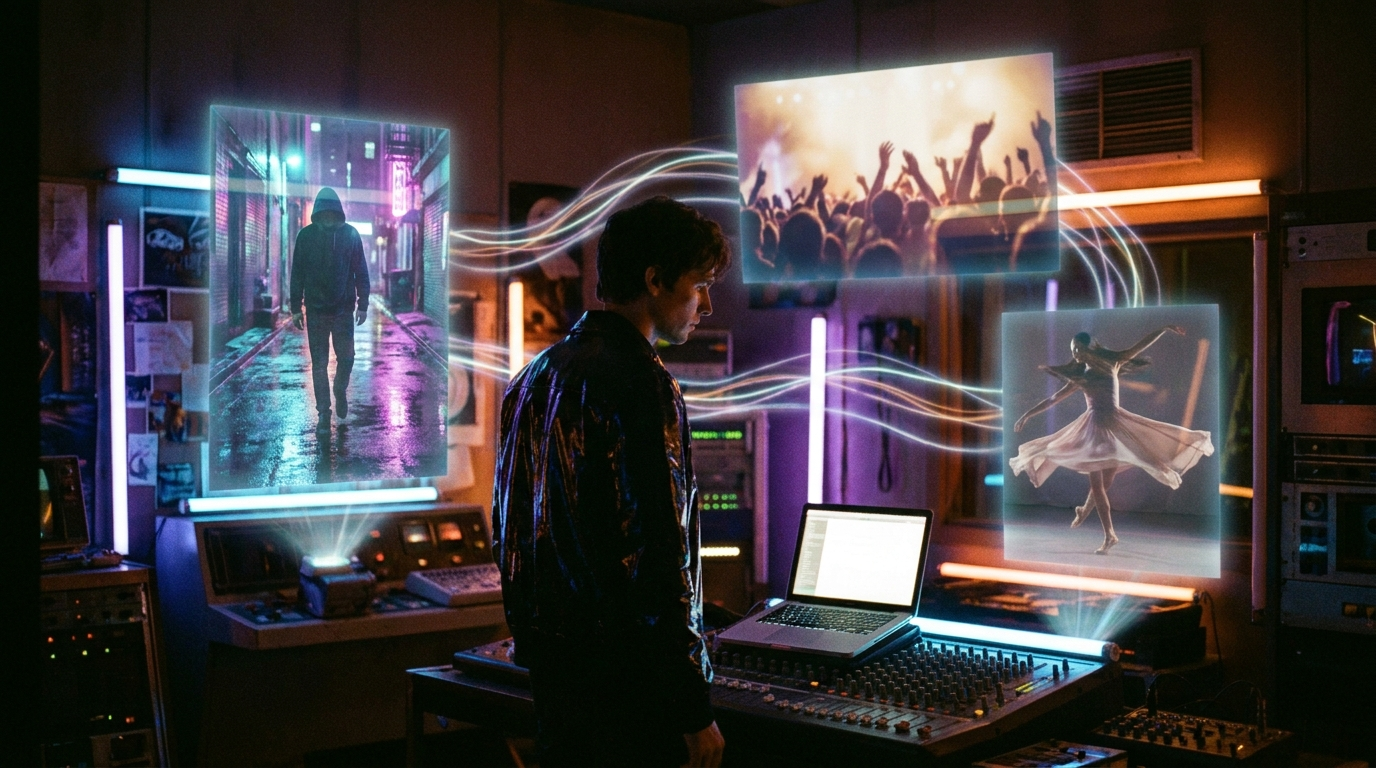
Wan 3.0 Just Dropped 30-Second AI Video Clips
Five days ago, Alibaba quietly changed the AI video game. And if you’re a musician making AI music videos, you need to pay attention.
On August 6, 2026, Alibaba rolled out the beta version of Wan 3.0, an advanced video generation model that supports 30-second video length and multimodal reference inputs. That’s not a typo. Thirty seconds. In a single, unbroken generation pass.
To put that in perspective: the 30-second clip length is double the 15-second maximum of Wan 2.7-Video, the preceding model, and extends beyond the typical few seconds to 15 seconds produced by mainstream AI video generators.
For musicians, this isn’t just a spec bump. It’s the difference between generating a scene and generating an entire verse.
Why 30 Seconds Changes Everything for Music Videos
Here’s the dirty secret of AI music videos in 2026: stitching. Every musician who’s used AI video tools knows the pain. You generate a 5-second clip. Then another. Then another. You pray the lighting matches. You hope the character doesn’t morph into someone else between cuts. You spend more time fixing transitions than actually creating.
Alibaba Cloud opened public beta for Wan 3.0 on August 6, 2026. The headline capability is 30 seconds of video in a single generation pass, which makes continuous camera movement and one-take shot language possible without stitching clips.
Think about what 30 continuous seconds means for a music video. That’s a full chorus. A complete verse. An entire story arc — the girl walks into the club, the lights hit her face, the crowd parts, the beat drops — all in one unbroken take. No cuts. No stitching artifacts. No character consistency nightmares.
Previous versions of the line topped out at 2–15 seconds per generation — Wan 3.0 stretches a continuous clip to 30 seconds in a single pass, with no stitching of short fragments. That’s the kind of long take that usually requires a Steadicam operator and a prayer.
If you’re new to AI music videos, our Complete Guide to AI Music Videos in 2026 covers the fundamentals of how these tools work. But Wan 3.0 is pushing beyond the fundamentals.
The Feature That Nobody’s Talking About
The 30-second clips grabbed headlines, but there’s a feature buried in the Wan 3.0 release that should make every indie musician sit up: document-to-video generation.
The genuinely new input is documents. Alongside text, image, audio, and video, Wan 3.0 accepts doc, xls, ppt, pdf, and md files plus web pages as creative references — turning a slide deck or spreadsheet into video.
Now, I know what you’re thinking — who makes music videos from spreadsheets? Fair point. But think bigger. You could feed it your album artwork PDF and get a video that matches those visual references. You could give it your tour poster design and generate promo content that stays on-brand. You could hand it a mood board document and get back something that looks like your creative director read your mind.
Wan 2.7 split text-to-video, image-to-video, reference generation, and editing across separate models. Wan 3.0 folds reference, editing, replication, and motion driving into one.
That unification matters. Instead of juggling four different tools to get from concept to finished clip, the entire workflow collapses into a single model. For musicians who are already juggling songwriting, promotion, distribution, and trying to have a life — fewer tools is always better.
How Wan 3.0 Stacks Up Against the Competition
Let’s be honest about where Wan 3.0 sits in the crowded AI video landscape, because musicians don’t have time to test every model that drops.
The AI video generation landscape has reached a new level of maturity with four models competing for the lead: Seedance 2.0 from ByteDance, Kling 3.0 from Kuaishou, Sora 2 from OpenAI, and Veo 3.1 from Google. Each takes a fundamentally different approach to video generation. And now Wan 3.0 is crashing the party with a very specific pitch.
Here’s the quick breakdown for musicians:
Wan 3.0 — 30-second single-pass generation. Best for long, unbroken takes. It is positioned for creators and enterprises who want long, coherent, single-shot footage with cinematic camera motion. Currently in beta with limited access.
Kling 3.0 — Major upgrades over Kling 2.6: duration 10s → 15s, resolution 1080p → native 4K (not upscaled), frame rate 48 → 60 FPS. Best for cinematic quality and multi-shot storyboarding.
Seedance 2.0 — Seedance 2.0 moves fast, handles multiple input types well, and produces visually punchy output that suits high-volume social media and marketing work.
It’s the only model supporting audio reference input. That’s huge for musicians — you can feed it your track directly.
Veo 3.1 — Best for realism, native audio, and lip-synced talking video. Google’s muscle is hard to beat on raw quality.
The truth? No single model wins at everything. The right question is not “which is the best model” but which layer matters most. For musicians specifically, beat synchronization is the killer feature, and that’s still Seedance’s territory. But for narrative-driven music videos where you want those gorgeous long takes? Wan 3.0 just became the one to watch.
For a deeper dive into how these tools compare for music-first workflows, check out our How to Make an AI Music Video guide.
The Pricing: Surprisingly Cheap
The official entry confirms text-to-video, image-to-video, first-frame, first-and-last-frame, and reference-to-video workflows, with video up to 30 seconds. The documented Beijing rates are ¥0.30/¥0.60/¥1.20 per output second for 480P/720P/1080P.
Let’s do the math. A 30-second clip at 1080P costs ¥36, which is roughly $5 USD. For thirty seconds of continuous, cinematic AI video. You’d spend more on a coffee in most recording studios.
Even if you needed to generate 10 takes to get the one you love, that’s $50 for a 30-second scene. Try getting a human crew to show up for that budget.
The model is still marked preview or invitation-only, so verify access and the live price in your account before budgeting. Pricing could shift as it leaves beta, but the direction is clear: the cost of AI video generation continues to fall off a cliff.
The Catch: It’s Not Plug-and-Play (Yet)
Before you cancel your other AI video subscriptions, here’s the reality check.
API access is not fully open yet and there are no published weights.
Alibaba said users can apply for testing through Alibaba Cloud’s Model Studio and Qwen Cloud platforms.
Translation: you’re dealing with a Chinese cloud platform, an application process, and an API that’s still rolling out. This isn’t “sign up and start generating in five minutes” territory. It’s early-adopter territory.
What Wan 3.0 is not is equally important. As of its August 2026 beta, Wan 3.0 is not open-source: there are no downloadable 3.0 weights, no Hugging Face checkpoint, no GitHub repo, and no ComfyUI node for it.
That’s a departure from what the community expected. Alibaba pre-announced Wan 3.0 as an Apache 2.0 open-weight release. But Wan 2.5 was pre-announced as open. The weights never appeared. Wan 2.6 shipped as a closed commercial API with no open release at all. When Wan 2.7 finally did release select models under Apache 2.0, it took six months of community pressure and a strategic pivot to get there.
So the skepticism is warranted. For now, Wan 3.0 is a closed beta. That said, the Wan model ecosystem does include some interesting open-source adjacent tools. Alibaba did ship WanSong, Wan-Dancer, and Wan-Streamer under Apache 2.0 in July 2026, but those are adjacent models.
What This Means for Your Genre
The 30-second single-pass capability opens different doors depending on what kind of music you make.
Hip-Hop and R&B — Long tracking shots following an artist through a scene are bread and butter for these genres. Think about a continuous shot through a club, a city block at night, or a house party. Wan 3.0’s single-take capability was practically designed for this. Check out our AI Music Videos for Hip-Hop and AI Music Videos for R&B guides for genre-specific techniques.
EDM and Electronic — Abstract, flowing visuals that evolve and morph are perfect for 30-second continuous generation. No cuts means no jarring transitions that break the visual flow. Our AI Music Video Templates for EDM give you starting prompts that would pair beautifully with longer clip generation.
Indie and Rock — The one-take concert shot. The slow zoom on a band playing in a warehouse. The walk through an empty town at sunrise. These are the shots that define indie aesthetics, and they’re the shots that were hardest to pull off in 5-second clips. See our AI Music Videos for Indie guide for more.
Country and Folk — Sweeping landscape shots, a singer walking down a dirt road, the sun setting behind a barn. Long, unbroken takes are what make country music videos feel cinematic rather than choppy. Our AI Music Videos for Country templates would benefit enormously from 30-second generation.
The Bigger Picture: AI Video Just Entered the Long-Form Era
Wan 3.0’s 30-second benchmark isn’t just about Alibaba. It’s a signal about where the entire AI video industry is heading.
Native audio, 4K, and 60-second-plus durations are now table stakes. Not differentiators.
When Seedance 2.5 hit 30 seconds a few months ago, it felt like a breakthrough. Now Wan 3.0 has matched it with a different architectural approach — single-pass rather than stitched — and at rock-bottom pricing. On February 5th, 2026, Kuaishou dropped Kling 3.0, just 3 days before ByteDance dropped Seedance 2.0. This is no coincidence and the AI video generation space is only getting more competitive by the day.
The race is accelerating. And musicians are the ones who benefit most from this competition.
Why? Because unlike filmmakers or advertisers who can afford to wait for the “best” model, musicians need to ship content constantly. Every release needs a video. Every single needs visual content for TikTok, Instagram, YouTube Shorts. The AI video arms race is driving prices down and quality up at exactly the moment musicians need it most.
AI Video Generation Trends in August 2026 show a clear move from impressive single clips toward controllable, repeatable video production. That’s the shift that matters. It’s no longer about one impressive demo clip. It’s about whether you can reliably produce video after video, project after project, with consistent quality and manageable cost.
The Smart Play for Musicians Right Now
Here’s what I’d actually recommend if you’re a musician reading this today:
Don’t rush to sign up for Wan 3.0’s beta. Unless you’re comfortable navigating Chinese cloud platforms and API documentation, the friction isn’t worth it yet. Third-party platforms will integrate the model soon enough.
Do pay attention to the 30-second trend. Multiple models are converging on this duration. That means your music video production workflow should be evolving too. Start planning for scenes, not clips. Write visual narratives that unfold over 30 seconds, not 5-second snippets.
Keep using what works. Tools like OneMoreShot.ai already let you create AI music videos that sync to your track without needing to wrangle APIs or figure out prompt engineering for raw video models. The best tool is the one that gets your video done and released while the track is still fresh.
Stack your workflow. Use a music-first platform for the heavy lifting — beat sync, scene planning, final rendering — and keep raw models like Wan 3.0 in your back pocket for specific hero shots where you need that long, cinematic take.
The AI video space moves absurdly fast. Six months ago, 15 seconds felt like a luxury. Now 30 seconds is arriving from multiple directions. By the time you read this, someone’s probably demoing 60 seconds.
The musicians who win aren’t the ones using the newest model. They’re the ones who ship videos consistently, build a visual identity, and treat AI video as a creative tool rather than a tech flex.
Ready to make your next music video? Start creating on OneMoreShot.ai — no API keys required, no beta applications, just your music and your vision.