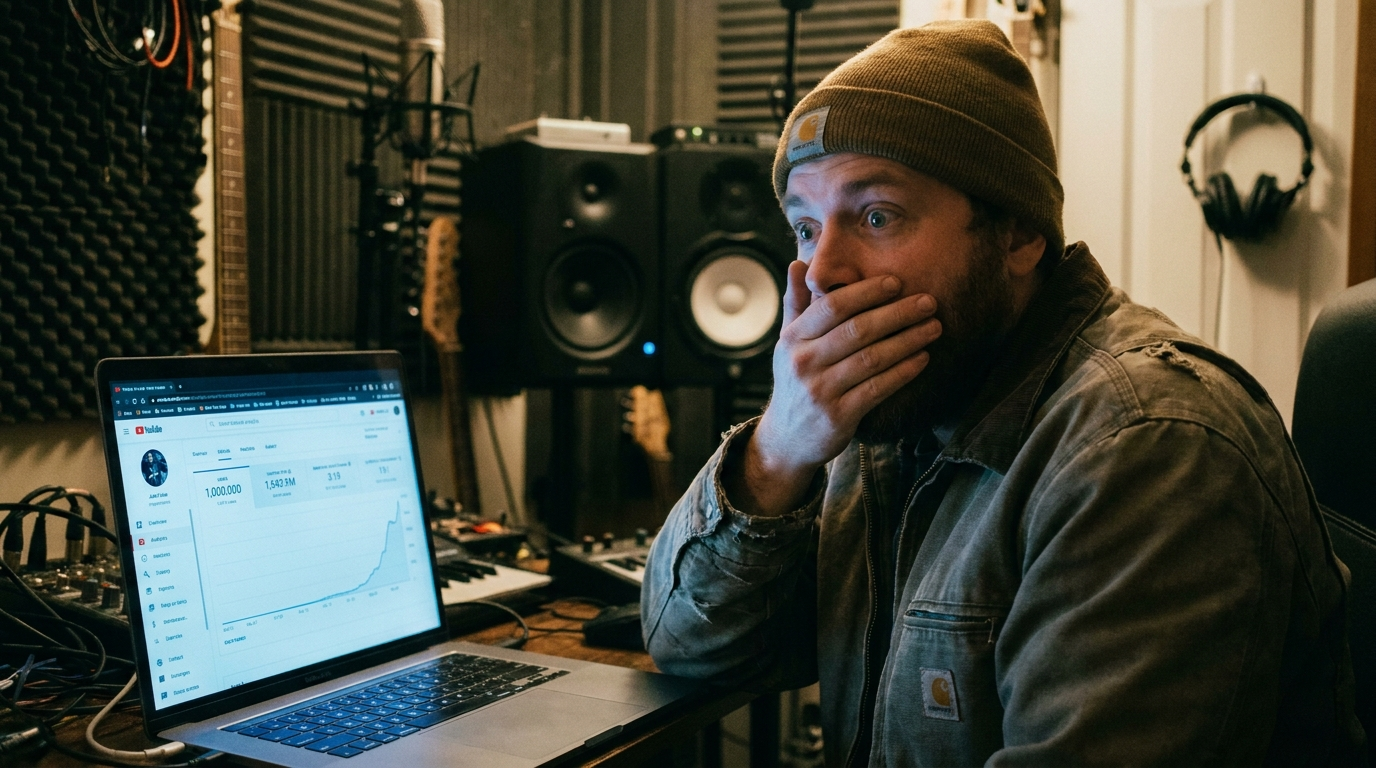
YouTube's New View Counts Change Everything Today
It’s August 24, 2026. Today, YouTube just changed one of the most visible numbers on the internet.
Starting right now, a YouTube view counts the moment your video starts playing. No 30-second threshold. No minimum watch time. First frame, counter goes up. Every format — long-form music videos, Shorts, live streams, podcasts — all unified under one standard.
If you’re a musician, this is the biggest shift in how your music videos are measured since YouTube launched the Partner Program. And if you’re making AI music videos, it’s even bigger.
Let’s break down what actually changed, what it means for your strategy, and how to exploit it.
What YouTube Actually Changed
Here’s the before and after.
Before August 24: YouTube used different view-counting systems depending on the format. Long-form video historically needed roughly 30 seconds of watch time before the public counter moved, though YouTube never officially published that exact threshold. Shorts already counted from the first frame since March 2025. It was confusing, inconsistent, and creators hated it.
After August 24 (today): A public view will be counted the instant a video begins to play, from the first frame, with zero minimum watch time required.
The change will apply globally to long-form videos, Shorts and live streams, replacing the different methodologies YouTube has historically used depending on video format.
YouTube’s reasoning? YouTube explained: “Historically, we’ve used multiple view counting systems across different formats. However, we’ve heard that creators want to eliminate this metric confusion and accurately understand their true exposure.”
Translation: every other platform was already doing this, and YouTube finally caught up. It brings YouTube in line with how TikTok and Instagram already count views.
The Double-Edged Sword for Musicians
Let’s be real about what this does and doesn’t mean.
For independent artists and music marketers, this update is a double-edged sword: bigger vanity metrics mean public-facing numbers on official music videos, lyric videos, and live streams will look much healthier to the average fan, A&R rep, or festival booker.
Your music video that used to show 10,000 views might now show 25,000 or more. That looks great on paper. It looks great when you’re pitching to playlist curators, booking agents, or brand partners. Public view counts often play a major role in sponsorship negotiations, advertising conversations and the perception of a creator’s reach.
But here’s the catch: views and revenue are now two different conversations.
The change does not touch your earnings or your path to the YouTube Partner Program. YouTube confirmed it directly: “This change will not impact creators’ earnings or how they become eligible for the YouTube Partner Program (YPP).”
The change to public view counts will not impact how YouTube calculates monetization. Engaged views — meaning a viewer who continued watching beyond the first frame and for additional seconds — will continue to be used for monetization and revenue calculations across videos.
So your public view count balloons, but your paycheck stays tied to whether people actually watched the thing. This is crucial for musicians to understand: the number under your video and the number that generates revenue are now officially divorced.
Why This Is Massive for AI Music Videos
Here’s where it gets interesting for musicians using AI video tools.
The old 30-second rule punished music videos with slow openings. If your intro didn’t hook someone in half a minute, that play didn’t count. For traditional music videos — which often feature cinematic intros, mood-setting sequences, or narrative buildups — this was brutal.
AI music videos tend to have a specific advantage here: they’re visually arresting from frame one. When you build a music video with AI video generation tools, every scene is crafted for maximum visual impact. There’s no “crew setting up the shot” energy. It’s wall-to-wall visual storytelling from the first frame.
Under the old system, that didn’t matter much because the view still needed 30 seconds. Under the new system, every single play counts — and AI music videos are designed to make that first impression hit hard.
But the real opportunity is volume. When you can create a music video in minutes instead of weeks, you can produce:
- A main music video (landscape, full-length)
- A vertical Shorts cut for mobile
- A lyric video variant
- A live visual version for streaming performances
- Genre-specific edits for different audiences
Every single one of those now registers views from the first frame. Five formats for one song means five times the potential impression count. That’s not gaming the system — that’s smart content strategy in a world where YouTube just told you impressions matter.
The “Engaged Views” Metric Musicians Must Track
Here’s the metric that actually matters now, and most musicians don’t even know where to find it.
YouTube says earnings and Partner Program eligibility are unaffected. And creators can still track “Engaged views” in YouTube Analytics > Advanced Mode (a separate metric that captures more meaningful audience interaction).
Go to YouTube Studio → Analytics → Advanced Mode. That’s where your real performance lives now.
Think of it this way:
- Public view count = your billboard on the highway (everyone sees it, it looks impressive)
- Engaged views = how many people actually walked into the store
For musicians, engaged views tell you who listened past the intro, who made it to the chorus, who stayed for the whole song. That’s your real audience. That’s who’s going to stream you on Spotify, come to your show, and buy your merch.
Don’t let inflated public metrics give you a false sense of security; keep your eyes on the “Engaged views” in the backend analytics to see who is actually listening to the music, and continue optimizing content to hold their attention.
The YPP Bombshell Nobody’s Talking About
Buried under the view count news is something musicians should be paying much more attention to.
The change arrives as YouTube announces separate but similarly major changes to its Partner Program. Beginning February 1, 2027, new creators will need 8,000 qualified watch hours over the previous 12 months or 20 million qualified Shorts views over the last 90 days to qualify for ad and subscription revenue. That’s double the current requirements for existing creators.
Read that again. YouTube is making it easier to accumulate vanity views while simultaneously making it harder to actually monetize them. If you’re a new musician trying to make money on YouTube, you now need twice the engagement you needed before.
This creates a fascinating dynamic: your music video might show 100,000 views but you’re still not eligible for monetization because those views aren’t “engaged” enough.
The solution? Make content people actually want to watch all the way through. And here’s where AI music videos — good ones, not slapped-together slop — earn their keep. A visually compelling music video that matches the energy of your song, changes scenes with the structure of the music, and tells a visual story doesn’t just rack up first-frame views. It holds attention. It converts exposure into engagement.
Whether you’re making hip-hop visuals, EDM content, or indie aesthetics, the principle is the same: make it impossible to look away.
The MrBeast Effect and What It Means for Music
The internet’s reaction to this change has been… entertaining. Creators, noting MrBeast’s recent run of sub-100-million uploads, are calling it a bailout. Whether or not that’s fair, the joke reveals something real: YouTube is optimizing for reach metrics over depth metrics.
For musicians, this is actually a familiar pattern. Streaming services have been doing this for years — counting a “stream” after 30 seconds on Spotify, creating an industry where intro hooks are scientifically optimized to prevent skips.
YouTube just went the opposite direction. Instead of tightening the definition of a view, they loosened it to the absolute minimum. It’s exposure-counting, not attention-counting.
This matters because music videos serve a fundamentally different purpose than most YouTube content. A MrBeast video needs you to watch for 20 minutes to justify its production cost. A music video needs you to discover the song, get hooked, and go stream it somewhere. For discovery, first-frame views are actually a more honest metric than 30-second views.
If someone scrolls past your music video in their feed and it auto-plays for three seconds — that’s an impression. That person saw your artist name, your visual style, maybe heard the first bar. Under the old system, that didn’t count. Under the new system, it does. And for musicians, that kind of micro-exposure is how you build name recognition over time.

Your Action Plan Starting Today
Here’s exactly what to do right now:
1. Bookmark Your Engaged Views Dashboard
Go to YouTube Studio → Analytics → Advanced Mode. Bookmark this page. This is your truth dashboard now. Check it weekly.
2. Optimize Your Thumbnails and First Frames
Under the new system, every auto-play in a feed counts as a view. Your thumbnail gets someone to stop scrolling. Your first frame gets the play started. Make both count. For AI music videos, this means your opening shot needs to be your most visually striking scene — not a fade-in from black.
3. Produce Multiple Formats Per Song
One song, multiple video formats. Use AI music video tools to create landscape and vertical versions, lyric videos, and visual loops. Each format accumulates views independently, and your total reach per release multiplies.
4. Use Inflated Metrics Strategically
Your public view count is now a better pitch tool. Use it when approaching brands, booking agents, and playlist curators. Just don’t believe your own hype — always reference engaged views internally.
5. Front-Load Your Visual Storytelling
The 30-second rule is dead, but the attention economy isn’t. A bigger public number will tell you more about initial exposure, while engaged views and other data can give you a better idea of whether your content actually held someone’s attention. Structure your music videos so the first five seconds deliver something unforgettable — a striking visual, a mood shift, a visual hook that makes people stay.
6. Cross-Reference Platform Metrics
It’s a measurement shift rather than a monetisation one, and its main effect is to inflate the public view counts marketers and creators see. YouTube’s long-form counts previously meant something stricter; from August 24, a YouTube view means roughly what a TikTok or Instagram view means, so cross-platform numbers become more comparable. Use this to your advantage when comparing performance across platforms for the first time on equal footing.
The Bigger Picture
This change doesn’t exist in a vacuum. It’s happening alongside Apple Music’s new AI labeling requirements, Spotify’s AI Persona badges suppressing AI-generated artists from recommendations, and YouTube’s own moves to tighten Partner Program eligibility.
The music industry is splitting into two tracks: one that measures exposure (views, impressions, reach) and one that measures engagement (watch time, streams, saves). YouTube just made this split explicit by putting one number on the public counter and hiding the other in Advanced Mode.
For musicians, the play is clear: maximize exposure to build your brand, maximize engagement to build your income. AI music videos are uniquely positioned to help with both — they give you the visual firepower to stop scrolls and the production efficiency to keep your content pipeline full.
Older videos will keep their existing counts — the new rule applies to future plays only. So everything you publish from today forward plays by new rules. Every music video, every Short, every live stream.
The clock started this morning. Your move.
Ready to turn your music into scroll-stopping visuals that earn views from the very first frame? Start creating with OneMoreShot.ai — and make every play count.