
44% of Music Uploads Are Now AI Slop
Two million AI-generated tracks per month. Seventy-five thousand every single day. Nearly half of everything uploaded to one of the world’s largest streaming platforms is now music that no human ever wrote, performed, or felt.
Welcome to April 2026, where the streaming flood isn’t coming — it’s already here, and it’s rising fast.
The Numbers Are Staggering
Deezer announced on April 20 that it’s now receiving almost 75,000 AI-generated tracks per day, representing roughly 44% of all daily uploads — amounting to more than 2 million AI-generated tracks per month.
Let that sink in. That’s a sharp escalation from the 60,000 tracks per day reported in January (when synthetic content represented 39% of daily deliveries), and from 50,000 in November, 30,000 in September, and just 10,000 when Deezer launched its detection tool in January 2025.
That’s a 650% increase in just over a year.
And Deezer isn’t alone. Apple Music’s VP Oliver Schusser confirmed in an interview with Billboard’s podcast that “when you look at our monthly intake, more than a third of what we get today is actually what we would say is music that’s 100% AI.”
Schusser also confirmed for the first time that Apple Music has developed its own technology to detect AI-generated music when it is uploaded.
So we’re not talking about a niche problem on a niche platform. The two biggest revelations this month tell the same story: AI-generated music is flooding every major streaming service, and the rate of acceleration is terrifying.
Nobody Can Tell the Difference (And That’s the Problem)
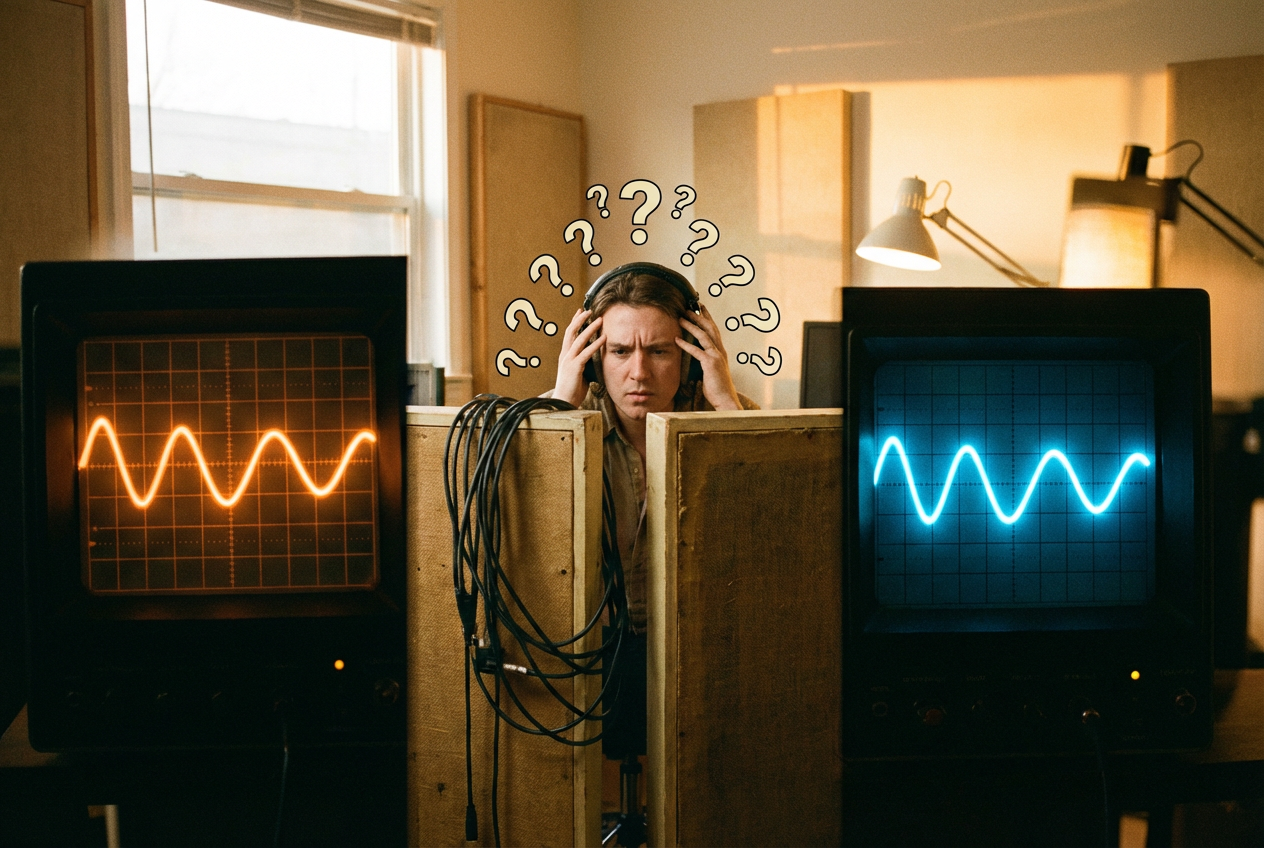
Here’s the stat that should make every musician pause: Deezer commissioned a unique international study which revealed that 97% of people couldn’t hear the differences between AI and human-made music.
Ninety-seven percent. Not casual listeners. Not people half-paying attention at the gym. Almost everyone.
The survey also found that 52% of respondents said 100% AI-generated songs shouldn’t be included in charts alongside human-made songs.
Meanwhile, 80% said 100% AI-generated music should be clearly labeled for listeners.
So the audience wants transparency — they just can’t enforce it with their ears alone. Which means detection and labeling technologies aren’t a nice-to-have. They’re the only thing standing between human artists and total economic erasure.
The Fraud Is Industrial-Scale
If the flood of AI music were just annoying, that would be one thing. But a huge chunk of it is actively criminal.
Deezer has found that up to 85% of the streams generated by fully AI-generated tracks were in fact fraudulent in 2025. When detecting stream manipulation of any kind, Deezer excludes the streams from royalty payments.
Think about what that means: the vast majority of AI music on streaming platforms isn’t there because someone wants to listen to it. It’s there to steal money from real musicians.
The poster child for this problem is Michael Smith, a 54-year-old from North Carolina. According to the DOJ, Smith created “hundreds of thousands of songs with AI” and used “automated programs called ‘bots’ to fraudulently stream his AI-generated songs billions of times.”
Smith pled guilty to one count of conspiracy to commit wire fraud, and is facing a maximum of five years in prison.
He has also agreed to forfeit over $8 million he made on the scheme.
As U.S. Attorney Jay Clayton put it: “Although the songs and listeners were fake, the millions of dollars Smith stole was real.”
Beatdapp estimates 5–10 percent of global streams are fraudulent. Furthermore, IFPI cites 85 percent fraudulent activity on fully AI tracks at Deezer. Industry insiders translate those percentages into up to $2 billion annually.
Two billion dollars. Per year. Pulled from the pockets of every working musician on every streaming platform.
Congress Is Finally Paying Attention
The week before this data dropped, musicians were literally marching on Capitol Hill. The Recording Academy lobbied Congress for 3 AI bills in April 2026. The most consequential? The TRAIN Act.
Congresswoman Madeleine Dean and Congressman Nathaniel Moran introduced a bipartisan bill to help musicians, artists, writers, and other creators determine if their copyrighted work was used to train generative AI models without their permission. The TRAIN Act gives copyright holders access to training records used for AI models. Currently, there is no process to determine if generative AI models use an artist’s work — without consent or compensation — to train its system.
The bill has serious muscle behind it. Joining the effort in the Senate are Senators Josh Hawley (R-Mo.) and Adam Schiff (D-Calif.).
The bill would also ensure that subpoenas are granted only upon a copyright owner’s sworn declaration, and failure to comply creates a rebuttable presumption that the model developer made copies of the copyrighted work.
In plain English: if Suno or Udio can’t prove they didn’t train on your music, the law assumes they did. That’s huge.
The NO FAKES Act would address the harms deepfakes pose for creators, and the TRAIN Act would empower creators to protect their copyrighted works when they are used to train generative AI models.
These bills matter because they acknowledge what every indie musician already knows: the system is broken, and waiting for tech companies to fix it voluntarily isn’t a strategy.
The Industry Is Splitting in Two
What we’re witnessing isn’t just a technology story. It’s a bifurcation.
On one side: There’s a vibe shift happening in how the music industry is coping with its ongoing AI revolution, at least if you believe Suno CEO Mikey Shulman.
“I don’t meet a lot of producers and songwriters who aren’t using Suno at least a little bit in their workflows. I think people are starting to be a little more comfortable being public and upfront about their use, and most importantly, I think a bit more optimistic about the future.”
On the other side: Two of the three major record labels are currently in litigation with Suno — and just last month, a coalition of prominent artist advocates published an open letter called “Say No to Suno,” comparing the company to the thieves who made off with jewels at the Louvre.
Generative AI and stem separation tools have seen revenue rocket 651% between 2023 and 2025, reaching $333 million in 2025 with 63 million monthly active users. That’s not fringe anymore. That’s bigger than some streaming platforms.
Around 87% of artists are already using AI in some part of their workflow, from mastering to songwriting to promotion. The question isn’t whether musicians will use AI. It’s how — and whether they’ll be able to differentiate themselves in a sea of synthetic slop.
Why Visuals Are the New Moat
Here’s where this story gets interesting for anyone actually making music.
If 97% of listeners can’t tell AI audio from human audio, but they can tell a thoughtful, emotional music video from generic clip-art visuals, then your visual identity just became the most important differentiator you have.
Think about it. When the audio playing field gets flattened by AI — when anyone can generate a track that sounds professional — the artists who win will be the ones who:
- Build real visual brands. Not just an album cover, but an entire visual world that fans recognize instantly.
- Create music videos that tell stories. AI-generated music can’t have a real story behind it. But your video can.
- Show up as humans. Real faces, real emotions, real creative choices.
This is exactly why tools like AI music video generators matter more than ever. Not because you should automate your artistry — but because you need professional-grade visuals at the speed the market demands, and traditional video production budgets haven’t exactly been keeping pace.
Whether you’re making hip-hop visuals with cinematic street scenes, EDM content with beat-synced abstract art, or indie folk videos with intimate, hand-crafted aesthetics — the visual layer is what proves you’re a real artist with a real vision, not a bot flooding Spotify with 10,000 generic tracks.
What Smart Musicians Are Doing Right Now
The artists who thrive in 2026’s AI-flooded landscape aren’t ignoring AI or worshipping it. They’re using it strategically while doubling down on what makes them human.
1. They’re Creating Visual Content for Every Release
You can’t just drop a track and hope for the best. In a world of 75,000 AI uploads per day, you need to pair every release with compelling visual content. Learning how to make an AI music video isn’t optional anymore — it’s survival.
2. They’re Building Off-Platform Proof of Life
In 2026, your Trust Score is becoming just as important as your monthly listeners. Google Search and streaming platforms are now looking for “Off-Platform Proof of Life.” Real social engagement, real press coverage, real fan interactions. AI bots can generate streams, but they can’t fake a community.
3. They’re Leaning into Genre Identity
Generic AI slop tends to be… generic. It occupies the bland middle of every genre. If you’re making Latin music, country, or jazz, your genre-specific authenticity is a massive competitive advantage. AI can approximate a bossa nova beat, but it can’t capture the cultural specificity that fans of those genres demand.
4. They’re Using AI for Visuals, Not as a Crutch for Audio
Here’s the irony: AI is simultaneously the biggest threat to musicians’ income and the best tool they’ve ever had for visual storytelling. The smartest artists are using AI to create the music videos that differentiate them — not to replace their actual musicianship.
The Clock Is Ticking
According to a study conducted by CISAC and PMP Strategy, nearly 25% of creators’ revenues are at risk by 2028, which could amount to as much as €4 billion by that time.
That’s not a hypothetical. That’s a deadline.
The streaming platforms are moving — slowly. Major streaming services are pursuing AI transparency via supply-chain self-disclosure rather than platform-level detection. Apple Music launched its Transparency Tags system in March. Congress is debating the TRAIN Act and the NO FAKES Act. But as the music industry’s own advocates keep pointing out: Regulation moves slowly, while AI does not.
Which means the burden of differentiation falls on you, the musician. You can’t wait for Spotify to fix its detection algorithms. You can’t wait for Congress to pass the TRAIN Act. You need to be visible, verifiable, and visually distinctive today.
The Bottom Line
The AI music flood is real, it’s accelerating, and it’s not going to stop. But here’s what the doom-scrollers get wrong: this isn’t the death of human music. It’s the death of invisible music. The artists who pair genuine talent with compelling visual storytelling will stand out more, not less, in a world drowning in synthetic mediocrity.
The ones who just upload a track with a static waveform and hope for the best? They’re already underwater.
If you’re ready to make your music visible in the age of AI slop, OneMoreShot.ai lets you create professional music videos in minutes — the kind that prove to fans, algorithms, and platforms alike that there’s a real artist behind the music. Because in 2026, a great song without a great video is a tree falling in a forest full of 75,000 other trees. Every single day.