How to Create AI Music Videos for Jazz
How to Create AI Music Videos for Jazz
Jazz has always been a genre that lives in the interplay between sound and feeling — the smoky tension of a dimly lit club, fingers moving across brass under blue light, an improvised solo that bends time itself. Now, in 2026, AI video generation tools are giving jazz musicians the power to translate that energy into visuals that match the genre’s restless, sultry spirit.
Just as AI-generated music reshaped pop and electronic genres in 2025, jazz is now experiencing its renaissance through digital co-composition. And the visual side of that renaissance is equally compelling. A recent collaboration between DV Studio and filmmaking duo Twin produced A Visual Exploration Into Jazz, a short film featuring UK jazz drummer Mackwood that explored the melodic terrains of rumbling, frenetic jazz drums by assigning certain shapes to different sounds, exploring how we visually interpret the sounds of the bass, the snare, the cymbals through the arrangement of graphic elements. Meanwhile, Dr Federico Reuben released Latent Imprints, a free jazz improvisation album performed live using neural audio synthesis technology — a reminder that jazz artists are at the cutting edge of human-AI collaboration.
For jazz musicians who want to create compelling visuals without a six-figure production budget, AI music video tools like OneMoreShot.ai make it possible to go from concept to finished video in minutes. This guide walks you through every step of creating a jazz AI music video — from understanding the genre’s visual DNA to crafting perfect prompts and reaching the right audience.
If you’re new to AI music videos in general, our Complete Guide to AI Music Videos in 2026 provides the essential foundation.
Jazz Visual Aesthetics: The Signature Visual Language
Jazz visuals have a DNA unlike any other genre. To create an authentic jazz AI music video, you need to understand the core aesthetic pillars that separate jazz from everything else.
The Blue Note Legacy
No discussion of jazz visuals begins anywhere except Blue Note Records. Blue Note grew to become one of the most prolific, influential and respected jazz labels of the mid-20th century, noted for its role in facilitating the development of hard bop, post-bop and avant-garde jazz, as well as for its iconic modernist art direction.
The cover art produced by Reid Miles, often featuring Francis Wolff’s photographs of musicians in the studio, was as influential in the world of graphic design as the music within would be in the world of jazz. Under Miles, Blue Note was known for their striking and unusual album cover designs. Miles’ graphical design was distinguished by its tinted black and white photographs, creative use of sans-serif typefaces, and restricted color palette (often black and white with a single color), and frequent use of solid rectangular bands of color or white, influenced by the Bauhaus school of design.
Their “bold use of color, intimate photography, and meticulously placed typography came to define the look of jazz” in the hard bop era — a “refined sophistication” vibrating with restless, sultry, smoky, classy, moody energy.
This visual language is the foundation of every great jazz AI music video. Here’s how to translate it:
Color Palettes by Subgenre
- Classic Jazz / Bebop: Deep blues, amber, warm sepia, black-and-white with a single accent color. Think of the warm glow of a vintage spotlight cutting through cigarette haze.
- Smooth Jazz: Richer, warmer tones — burgundy, deep gold, soft violet, cream. The palette of a late-night lounge with velvet curtains.
- Jazz Fusion: More saturated and adventurous — electric blue, magenta, neon against black. The visual bridge between the acoustic and the electronic.
- Neo-Jazz / Contemporary: High-contrast duotones, muted earth tones punctuated by bold accents, or surreal color shifts that reference Afrofuturism and cosmic jazz (Sun Ra, Alice Coltrane).
- Free Jazz / Avant-Garde: Stark black and white, abstract expressionist color splashes, fragmented compositions.
Core Visual Motifs
Jazz videos and imagery consistently return to a set of powerful visual motifs:
-
Close-up performance shots — hands on keys, fingers on valves, sweat on the brow. Francis Wolff’s signature move was to shoot close, from below, depicting his subjects as iconic and worthy of admiration.
-
Smoke and atmospheric haze — the visual texture of jazz clubs, creating depth and mystery
-
Urban nightscapes — rainy streets, neon signs, city skylines at midnight
-
Warm, directional lighting — spotlights, stage lamps, candlelight creating dramatic chiaroscuro
-
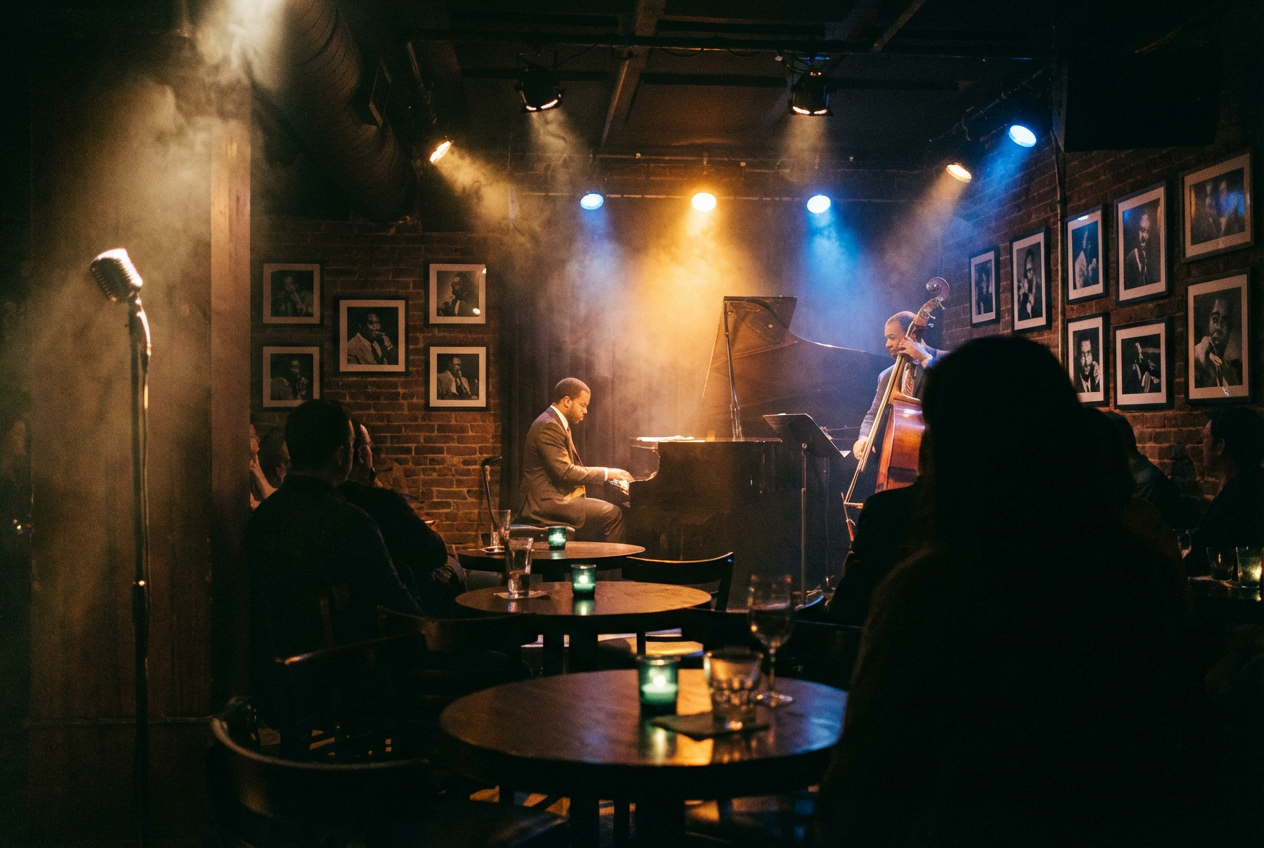
Architectural interiors — exposed brick, art deco details, intimate venues
-
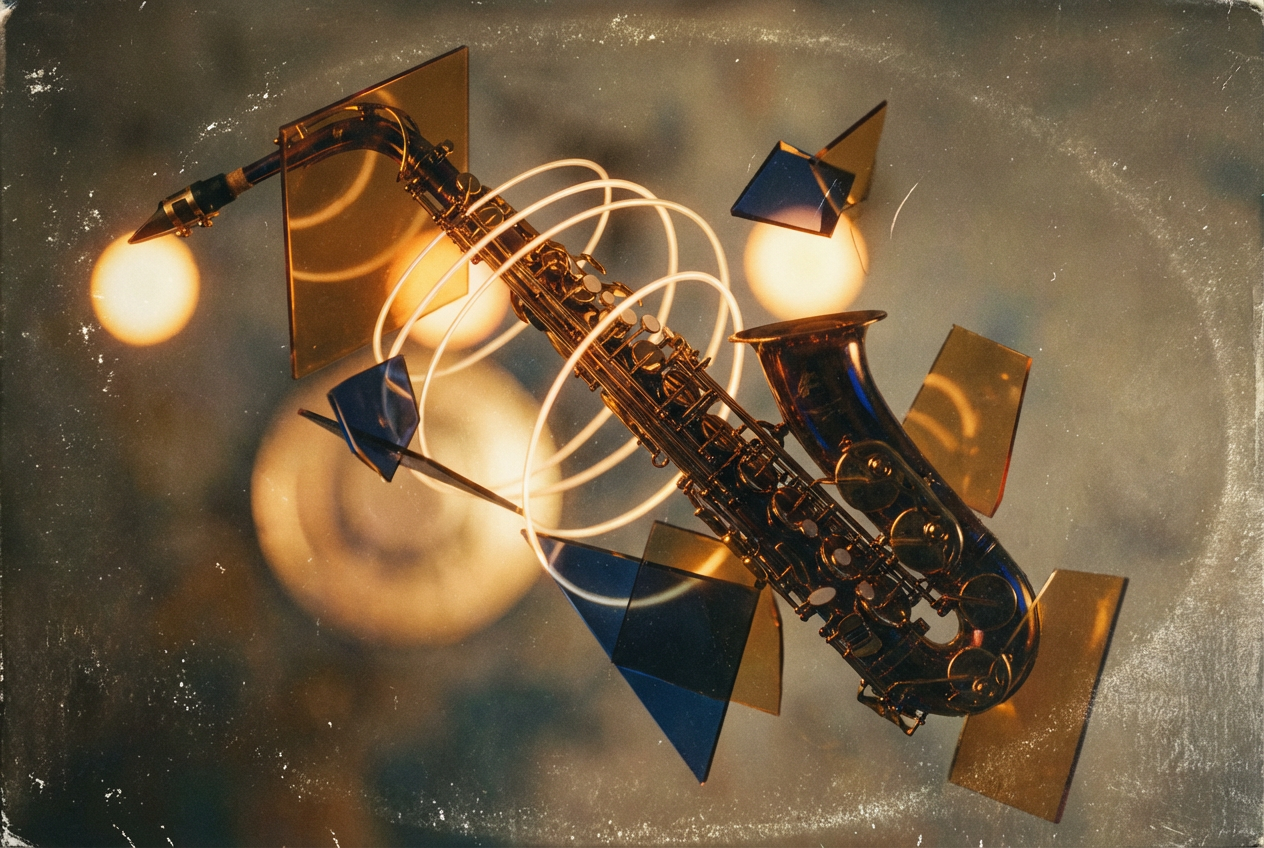
Abstract forms — shapes and patterns that respond to rhythm, the visual equivalent of improvisation
Motion and Pacing
Jazz visuals move differently from other genres. Where EDM videos pulse with rapid cuts synchronized to BPM, and hip-hop favors kinetic energy (see our AI Music Videos for Hip-Hop guide), jazz demands something more fluid:
- Slow, deliberate camera movements that mirror the swing of a rhythm section
- Longer shot durations that let a moment breathe — just like a solo
- Drift and sway rather than snap and cut
- Occasional bursts of visual intensity that mirror improvisational climaxes
Best AI Tools for Jazz Videos
In 2026, AI video creation tools are more advanced than they were in 2024 or 2025. They now offer sophisticated motion design templates, music-aware transitions, and 3D rendering capabilities that adjust according to tempo or mood. But not all tools handle jazz’s unique requirements equally well.
OneMoreShot.ai — Purpose-Built for Musicians
OneMoreShot.ai is specifically designed for musicians who need visuals that respond to the emotional arc of their music. For jazz creators, it excels because:
- Audio-reactive visual generation — The AI analyzes your jazz track’s dynamics, responding to improvisational peaks and quiet passages with matching visual intensity
- Genre-aware aesthetic intelligence — When you specify “jazz,” the system understands the difference between a smooth jazz ballad and a bebop burner, adjusting color palettes, pacing, and visual textures accordingly
- Fine-grained prompt control — Jazz requires nuance, and OneMoreShot.ai’s prompting system lets you specify everything from lighting conditions to camera angle to atmospheric elements
- Multiple output formats — Generate everything from vertical Reels to cinematic widescreen, optimized for every platform where jazz audiences live
Complementary Tools
For additional visual elements, consider these tools alongside OneMoreShot.ai:
- Runway Gen-3 — Its advanced toolset allows for high-fidelity text-to-video and image-to-video generation. Runway excels at providing users with granular control over motion and style. Useful for generating specific scene clips.
- LTX Studio — A true all-in-one AI video creation platform, especially when it comes to music videos that need story and style. Great for storyboarding longer jazz video narratives.
- Deep Dream Generator — The community has produced stunning jazz-themed AI artwork, perfect for creating still frames or album art to integrate into your video.
For a broader overview of how these tools compare across genres, check out our guide on How to Make an AI Music Video.
Step-by-Step: Creating a Jazz AI Music Video
Here’s a practical walkthrough for creating your jazz AI music video with OneMoreShot.ai.
Step 1: Define Your Visual Concept
Before you touch any tool, listen to your track with your eyes closed. Ask yourself:
- What’s the emotional arc? Does it build from intimate to expansive? Does it maintain a consistent mood?
- What era does it evoke? A straight-ahead swing tune conjures different visuals than a cosmic jazz piece.
- What’s the setting? A jazz club? A city at night? An abstract dreamscape?
- What subgenre are you in? This fundamentally shapes every visual decision.
Map your track’s structure — intro, head, solos, outro — and assign a visual mood to each section. Jazz videos benefit enormously from visual shifts that follow the musical narrative rather than maintaining a single look throughout.
Step 2: Upload Your Track
Upload your jazz track to OneMoreShot.ai. The AI will analyze the audio for:
- Tempo and rhythmic feel (swing, straight, rubato)
- Dynamic range (crucial for jazz, where quiet passages and explosive solos coexist)
- Instrumental textures and frequency content
- Emotional tone shifts throughout the piece
Step 3: Craft Your Visual Prompt
This is where jazz-specific knowledge makes all the difference. AI algorithms now detect musical cues such as drops, tempo shifts, or key changes to influence lighting and camera motion inside virtual scenes. Text to video AI software is also integrating neural art models that understand emotion-specified instructions.
Strong jazz prompts include:
- Specific atmospheric details (“warm amber spotlight cutting through blue cigarette smoke”)
- References to visual traditions (“Blue Note-style black and white photography with blue tint”)
- Emotional descriptors that match jazz vocabulary (“contemplative,” “restless,” “smoldering,” “ecstatic”)
- Camera direction language (“slow dolly toward the performer,” “intimate close-up from below”)
Avoid:
- Generic music video language (“cool visuals,” “awesome effects”)
- Over-specifying every frame — leave room for the AI to “improvise,” just like jazz itself
- Visuals that would fit any genre (generic particles, random transitions)
Step 4: Select Visual Style Parameters
Choose settings that align with your jazz subgenre:
| Parameter | Smooth Jazz | Bebop | Jazz Fusion | Neo-Jazz | Free Jazz |
|---|---|---|---|---|---|
| Color Tone | Warm golds, burgundy | Sepia, amber, B&W | Saturated neons | Duotone, high contrast | Stark B&W |
| Lighting | Soft, diffused | Hard spotlight | Mixed natural/synthetic | Dramatic, directional | Harsh, experimental |
| Motion Speed | Slow, flowing | Medium, rhythmic | Dynamic, varied | Deliberate, cinematic | Erratic, unpredictable |
| Texture | Velvet, grain-free | Film grain, vintage | Clean and textured | Matte, modern | Heavy grain, distortion |
| Atmosphere | Intimate, luxurious | Smoky, energetic | Electric, expansive | Cool, minimal | Raw, confrontational |
Step 5: Review, Refine, and Render
Watch the generated preview against your audio. Pay attention to:
- Sync points — Do visual intensity peaks align with musical climaxes?
- Emotional accuracy — Does the quiet piano intro feel different from the saxophone solo?
- Authenticity — Would a jazz fan feel at home in this visual world?
Regenerate or adjust specific sections as needed. The best jazz AI music videos often require 2-3 iterations to get the feeling right.
Prompt Examples for Jazz AI Music Videos
Here are copy-paste-ready prompts tailored to specific jazz subgenres. Use these as starting points in OneMoreShot.ai, then customize to your track.
1. Classic Jazz — The Late-Night Club
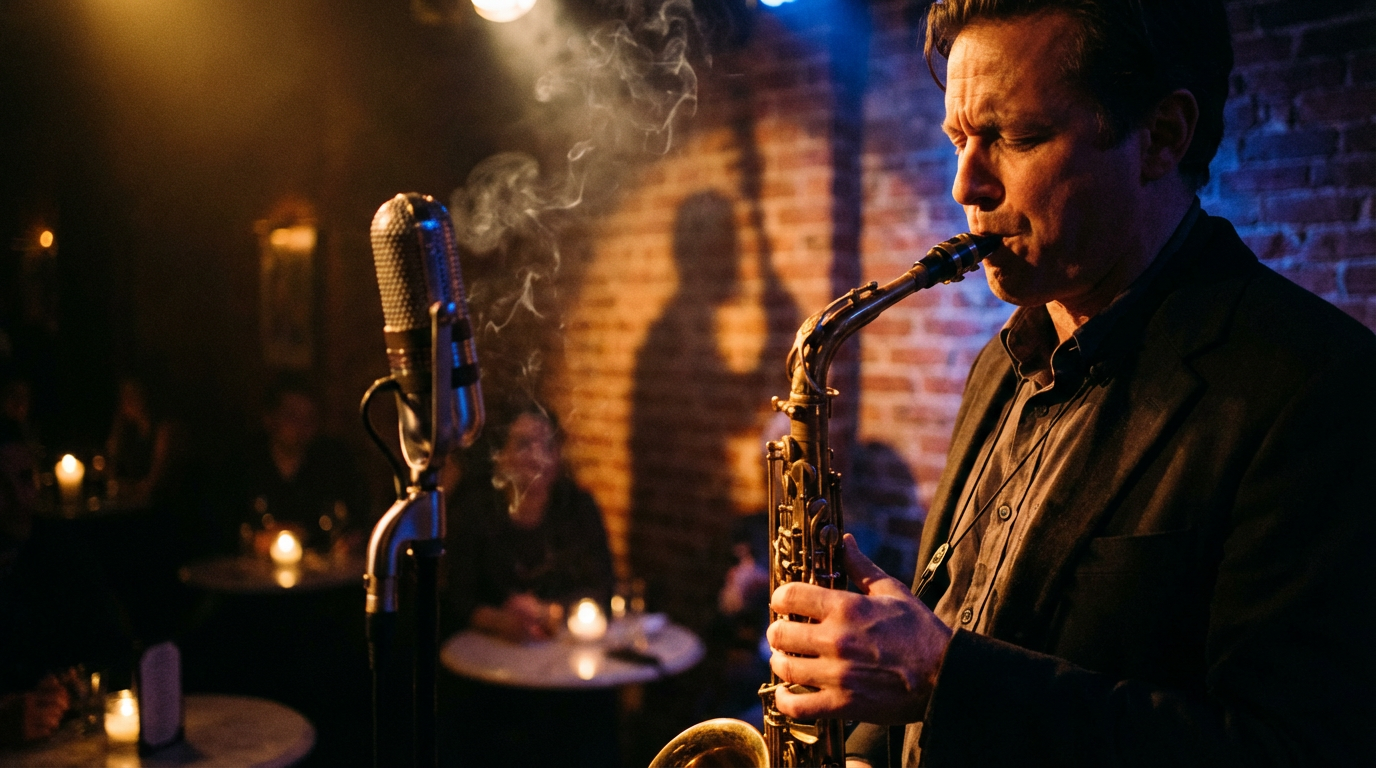
A dimly lit jazz club at midnight, warm amber spotlight on a saxophone player, cigarette smoke drifting through blue stage lights, brick walls, small round tables with candles, intimate audience in shadow, slow dolly toward the performer, vintage film grain, deep shadows and warm highlights
2. Smooth Jazz — Urban Elegance
Rainy city street at night reflecting neon signs in warm gold and soft purple, a lone figure walking past a jazz lounge window glowing with amber light, slow motion raindrops, sleek modern architecture, velvet curtains visible through glass, luxurious and contemplative mood, smooth camera drift, rich color saturation
3. Bebop — Frenetic Energy
Black and white photography with single blue tint, extreme close-up of pianist’s hands flying across keys, sweat on the brow, harsh spotlight from above, rapid cuts between instruments during solo sections, Blue Note Records aesthetic, bold sans-serif typography overlays, gritty texture, high contrast
4. Jazz Fusion — Electric Meets Acoustic
Split-screen composition: one half shows a smoky acoustic jazz trio in warm sepia tones, the other half shows abstract neon geometric patterns pulsing with the rhythm, the two worlds gradually merging as the track intensifies, electric blue and deep magenta color palette, modern and retro simultaneously
5. Neo-Jazz / Contemporary
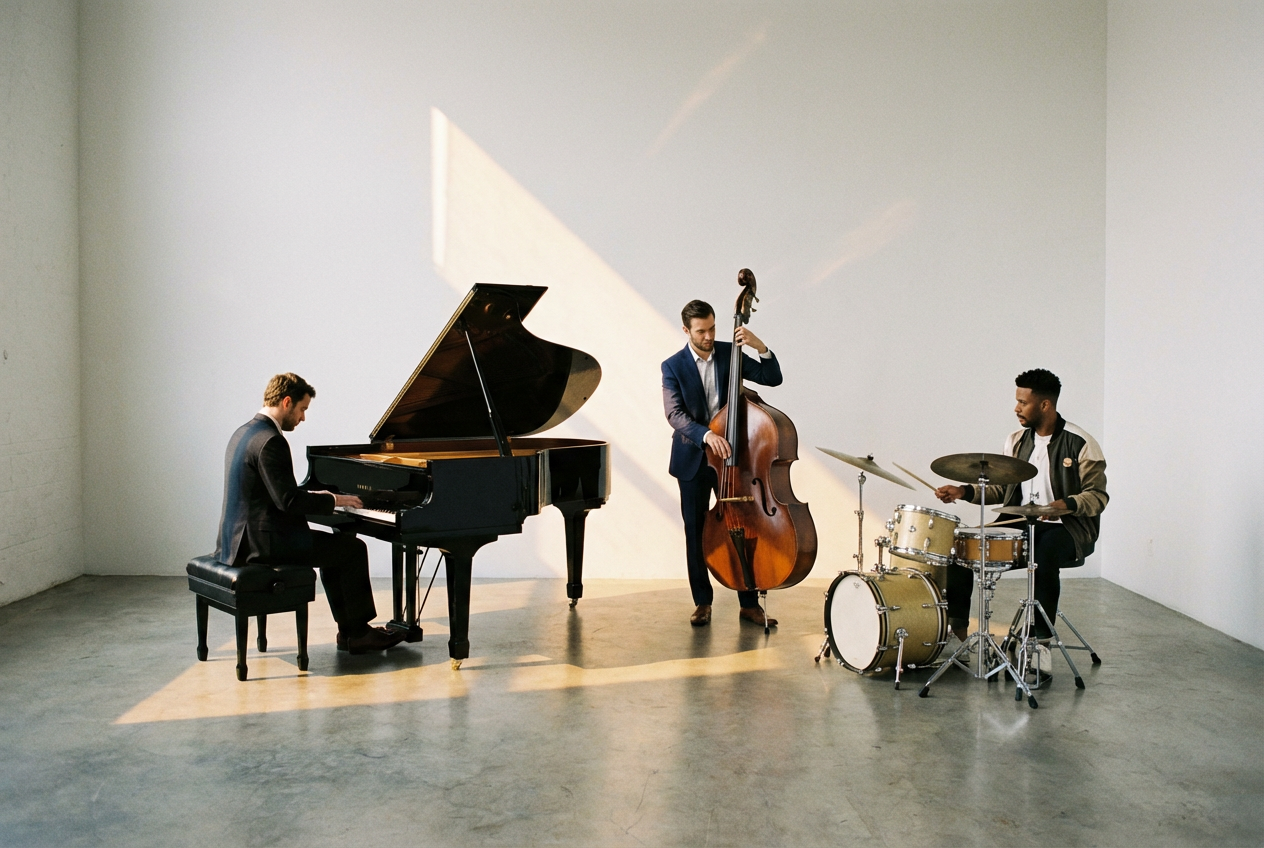
Minimalist concrete room with a single beam of dramatic directional light, modern jazz trio performing with calm intensity, camera slowly orbiting the ensemble, muted earth tones with sudden bursts of saturated color during improvisational peaks, cinematic aspect ratio, clean and architectural composition
6. Cosmic Jazz / Spiritual Jazz
Vast cosmic landscape with swirling nebulae in deep purple and gold, silhouette of a musician playing into the void, sacred geometric patterns emerging from sound waves, Sun Ra and Alice Coltrane visual references, stars pulsing with the rhythm, transcendent and expansive mood, slow zoom outward into infinity
7. Jazz Vocal — Intimate Performance
Extreme close-up of a singer’s face illuminated by a single warm spotlight against complete darkness, subtle camera sway matching the vocal phrasing, occasional wide shot revealing an empty stage with just a microphone and stand, film grain and soft focus at the edges, deeply emotional and vulnerable mood
8. Jazz-Hop / Lo-Fi Jazz Crossover
Anime-style illustration of a rainy city rooftop at night, a figure sitting by a vintage turntable spinning a vinyl record, warm light from a nearby window, jazz instruments scattered around, steam rising from a coffee cup, lo-fi aesthetic grain and muted pastel colors with warm undertones
If you enjoy the lo-fi crossover aesthetic, you’ll also love our dedicated guide to AI Music Videos for Lo-Fi.
Jazz AI Music Video Inspiration
The intersection of jazz and AI visuals is producing some remarkable work in 2026. DV Studio and filmmakers Twin came together to capture the many sounds and feelings of jazz drumming. Their collaboration, A Visual Exploration Into Jazz, featured UK jazz drummer Mackwood and explored the melodic terrains of rumbling, frenetic jazz drums by assigning shapes to different sounds. The result is something playful, lively and filled with a love for the lawlessness of jazz music.
What makes this project especially instructive for AI music video creators is its philosophy. When the animation was done by hand, it added a tactile relationship to the music — “a hair of a second out of place in one direction or another — which is very jazz-like; human, improvisational, reactive.” As motion designer Lawrie Miller noted: “When the animation becomes too rigid, the synchrony between the audio and visuals can feel forced rather than natural for the viewer.”
This insight is crucial for AI-generated jazz visuals: perfect synchronization can actually feel wrong for jazz. Allow a slight looseness, a little visual “swing,” in your AI-generated results.
On the AI art side, platforms like Deep Dream Generator host active communities of jazz visual creators. One notable prompt from the community explored “the silence between the notes in a John Coltrane solo: the rests and breaths visualized as intricate, sacred geometries that give structure to the explosive, chaotic beauty of the notes themselves.” This kind of conceptual thinking — visualizing what jazz means rather than just what it looks like — elevates AI jazz videos from decoration to art.
Meanwhile, the 2026 edition of Jazz à Vienne marked a new partnership between the festival and the Annecy International Animation Film Festival, starting a dialogue between music and image, improvisation and visual creation. This crossover between jazz and animation underscores a growing movement to reimagine jazz visually.
For curated examples of jazz AI music videos, visit our Jazz AI Music Video Examples gallery.
Tips for Authenticity: Capturing Jazz Without Clichés
Creating a jazz AI music video that resonates with actual jazz listeners — not just people who think jazz is “background dinner music” — requires attention to detail and cultural awareness.
Do: Honor the Tradition While Innovating
-
Study real jazz photography. Francis Wolff’s work for Blue Note is the gold standard. There are two camps to Wolff’s photography: energy and intimacy. His use of stark flash freezes the moment — fingers rap the piano, sweat builds, smoke from a cigarette rises.
-
Reference specific eras authentically. A 1950s bebop visual shouldn’t include modern smartphones. A 2026 neo-jazz video shouldn’t look like a period piece.
-
Let the music lead the visuals. Jazz is fundamentally about listening and responding. Your video should feel like it’s responding to the music, not the other way around.
Don’t: Fall Into These Traps
- The “smooth jazz sunset” cliché — Endless beach sunset footage with a saxophone overlay. It’s been done to death and doesn’t represent most of what jazz actually is.
- Generic “classy” imagery — Wine glasses, candlelit dinners, and fireplace montages may feel “jazzy” to non-listeners, but they flatten the genre’s wild range.
- Over-polished aesthetics — Lo-fi aesthetics, vintage film grain, and handheld cinematography are making a comeback. Many artists are opting for a DIY look that feels more personal and nostalgic. Jazz visuals benefit from imperfection and texture.
- Ignoring jazz’s diversity — Jazz isn’t just one sound or one look. Blue Note’s legendary catalog traces the entire history of the music from Hot Jazz, Boogie Woogie, and Swing, through Bebop, Hard Bop, Post Bop, Soul Jazz, Avant-Garde, and Fusion. Your visuals should reflect which corner of jazz you inhabit.
Cultural Sensitivity
Jazz is America’s most significant cultural export and is rooted in African American artistic tradition. When creating jazz AI music videos:
- Represent the genre’s cultural heritage with respect
- Avoid visual stereotypes or reductive imagery
- If your visuals include human figures, ensure they reflect the diversity of jazz’s community
- Credit and reference your inspirations honestly
Jazz — one of the most commercially underappreciated of all the musical styles — may actually thrive in the new AI ecosystem precisely because it puts authentic human performance at its center. Your visuals should amplify that humanity, not obscure it.
Distribution Strategy: Reaching Jazz Audiences
Jazz listeners consume content differently from pop or EDM fans. Here’s how to distribute your jazz AI music video for maximum impact.
YouTube — Your Primary Home
YouTube remains the most important platform for jazz video content. Jazz listeners tend to favor longer-form content, making YouTube’s format ideal. Key strategies:
- Optimize titles with specific jazz terminology — “Modal Jazz Trio | AI Visual Performance” performs better with jazz audiences than generic titles
- Create both full-length and short versions — The full video for dedicated listeners, and 60-second excerpts as YouTube Shorts for discovery
- Tag thoroughly — Include subgenre tags (smooth jazz, bebop, jazz fusion), instrument tags (saxophone, trumpet, piano), and mood tags (late night, contemplative, upbeat)
- Leverage YouTube’s Canvas-style features — Jazz listeners who discover your music through Spotify’s jazz playlists can be funneled to your visual content on YouTube
Instagram Reels and TikTok — Discovery Engines
On TikTok, the #jazzaesthetic trend has generated significant engagement, with creators producing cinematic, rhythmic visual content that blends jazz music with moody city photography and collage techniques. Strategies for short-form jazz content:
- Use visually striking moments — The saxophone solo, the drum break, the piano run — extract the most visually dynamic 15-30 seconds
- Embrace the “jazz aesthetic” trend — TikTok and Instagram users actively search for this content
- Post during evening hours — Jazz audiences tend to be evening/night listeners
Spotify Canvas
Spotify Canvas (the looping visual that plays alongside tracks) is underutilized by jazz artists. Jazz and blues still represent under 2% of streams on major platforms, though niche platforms report steady growth in dedicated fan bases. A compelling Canvas visual can help your track stand out in jazz playlists.
Platform-Specific Considerations
TIDAL works for artists in hip-hop, R&B, electronic, jazz, soul, or any genre where albums, sound quality, and dedicated fanbases are important. Jazz audiences over-index on Tidal and audiophile platforms due to their emphasis on sound quality. Bandcamp is a favorite among independent musicians for its artist-friendly model, allowing artists to sell music directly to fans, offering a much higher percentage of the revenue than traditional platforms.
For jazz specifically:
| Platform | Best For | Format | Jazz Audience Strength |
|---|---|---|---|
| YouTube | Full-length videos | 16:9 widescreen | ★★★★★ |
| Instagram Reels | Discovery, aesthetics | 9:16 vertical | ★★★☆☆ |
| TikTok | Trend-riding, discovery | 9:16 vertical | ★★★☆☆ |
| Spotify Canvas | Streaming enhancement | Square loop | ★★★★☆ |
| Tidal | Audiophile audiences | Video integration | ★★★★☆ |
| Bandcamp | Direct fan sales | Embedded video | ★★★★☆ |
| Older jazz demographics | Various | ★★★☆☆ |
For strategies that work across genres, explore our guides for other styles like AI Music Videos for R&B and AI Music Videos for EDM — cross-pollination between jazz and these genres is increasingly common, especially in the jazz-hop and jazz-electronic spaces.
Conclusion: Your Jazz Vision, Realized in Minutes
Jazz has always been about taking something beautiful and making it personal. The same approach applies to creating jazz AI music videos. The tools are ready. In 2026, the creative line between music and visuals has merged more than ever before. The rise of AI music video generators has empowered musicians, digital creators, and video producers to design immersive audio-visual experiences entirely through text input and intelligent automation.
Whether you’re a smooth jazz guitarist releasing your first single, a bebop trio documenting a live set, or a neo-jazz experimentalist pushing into new visual territory, you can now create a jazz AI music video that honors the genre’s rich visual heritage while staking out your own aesthetic territory.
The legacy of Reid Miles, Francis Wolff, and the Blue Note aesthetic doesn’t have to live only in the past. You can carry it forward — reinterpreted, reimagined, and rendered in pixels — with a tool that understands what jazz looks like as deeply as you understand what it sounds like.
Ready to create your jazz AI music video? Head to OneMoreShot.ai and turn your jazz into visuals that swing, sway, and smolder. Upload your track, craft your prompt using the examples above, and have a finished video in minutes — not months.
Your audience is listening. Now give them something to watch.