44% of Music Uploads Are Now AI Slop
The Numbers Are Staggering
Let’s not sugarcoat this: the streaming platforms are being buried alive.
Deezer announced this week that AI-generated tracks now represent 44% of all new music uploaded to its platform — nearly 75,000 AI-generated tracks per day and more than two million per month.
And it’s not just Deezer anymore. Apple Music VP Oliver Schusser confirmed in a Billboard interview that “more than a third of what we get today is actually what we would say is music that’s 100% AI.”
Read that again. Between a third and nearly half of every song uploaded to streaming platforms right now was made by a machine. Not assisted by AI. Not produced with AI tools. Entirely AI-generated, from first note to final master.
Deezer reported receiving around 60,000 AI tracks per day in January, up from 50,000 in November, 30,000 in September, and just 10,000 in January 2025. That’s a 650% spike in just over a year. And the curve isn’t flattening. It’s steepening.
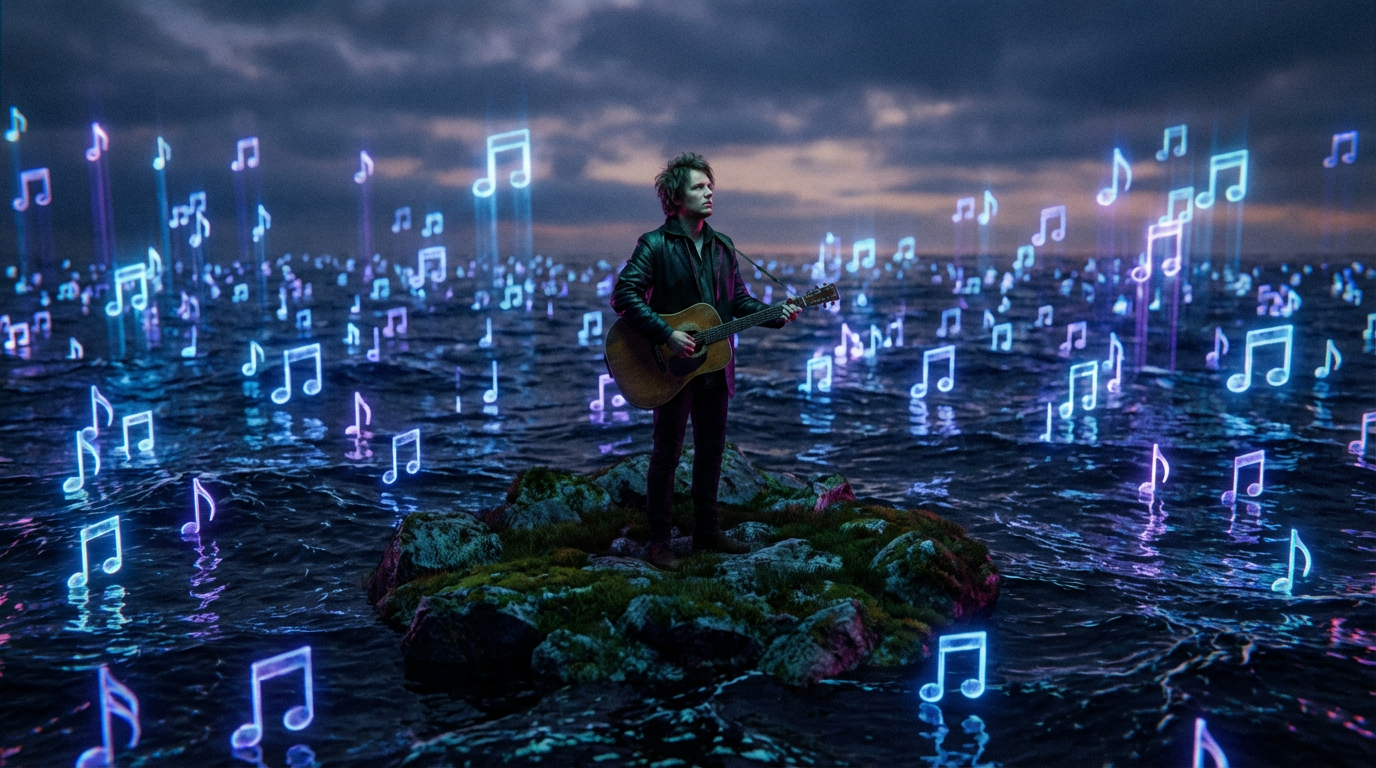
The question every musician should be asking right now isn’t “will AI affect my career?” It’s “how do I survive an ocean of infinite content where nobody can tell what’s real?”
Nobody Can Tell the Difference (and That’s the Problem)
Here’s the stat that should terrify you and empower you in equal measure: Deezer commissioned an international study that revealed 97% of people couldn’t hear the differences between AI and human-made music.
Ninety-seven percent. That means only three out of every hundred listeners can reliably identify whether a song was written in a bedroom at 2 AM or generated in 0.4 seconds by an algorithm.
But here’s the twist that makes the whole thing stranger: Deezer says consumption of AI-generated music on the platform is still very low, between 1% and 3% of the total streams, and 85% of these streams are detected as fraudulent and demonetized.
So the AI tracks flood in, but almost nobody listens to them — and most of the listening that does happen is fake, too. It’s a fraud loop: bots making music for bots to stream, extracting fractions of a penny from a royalty pool that was built for human artists.
According to a study conducted by CISAC and PMP Strategy, nearly 25% of creators’ revenues are at risk by 2028, which could amount to as much as €4 billion by that time. That’s not hypothetical anymore. That’s the current trajectory, validated by the actual upload numbers we’re seeing this week.
The Real Scam Happening Under the Surface
The story of Murphy Campbell tells you everything about where this is heading. A singer-songwriter and banjo player from North Carolina was eking out a modest living performing her original compositions online. Her fan base was steadily increasing when she noticed that songs were appearing on her Spotify page that were attributed to her, but were not hers. She hadn’t written them. She hadn’t performed them.
She eventually realized that they were AI-generated, probably created by someone who was feeding an AI with snippets of her published songs and asking it to create other songs that were similar.
This isn’t a hypothetical scenario — it’s an active scam that’s growing fast. Someone clones your style, floods your profile with AI-generated tracks, and dilutes your royalty stream. And right now, most platforms don’t have robust defenses against it.
Apple Music’s Schusser also confirmed for the first time that Apple Music has developed its own technology to detect AI-generated music when it is uploaded. But Deezer remains the only platform actually labeling AI tracks for listeners. Unlike its competitors, the company is labeling all identified AI uploads accordingly — while cracking down on the works’ rampant streaming fraud.
The Label Deals That Changed the Game (Sort Of)
While the streaming platforms scramble to build levees against the AI flood, the major labels have been cutting deals.
Warner Music Group didn’t just end its lawsuit against Suno — it teamed up with the AI-music giant. “This landmark pact with Suno is a victory for the creative community that benefits everyone,” said WMG CEO Robert Kyncl.
The terms set a precedent: all existing models were retired, Suno agreed to deprecate every model trained on unlicensed music, and new licensed models replaced them, trained on music licensed from Warner’s catalog.
But the deal isn’t all roses. Suno’s old policy stated plainly that subscribers owned the songs they generated. That language has now disappeared. The updated documentation takes a markedly different position: even when users are granted commercial use rights, they are “generally not considered the owner” of the songs.
Meanwhile, as of April 2026, two of the three major record labels are still suing the most prominent AI music generator on the market.
Universal Music, Sony Music, and Suno have reportedly encountered a hard impasse in their licensing and lawsuit-settlement discussions.
The irony is thick: the labels are simultaneously partnering with and suing the same AI companies, while the streaming platforms get flooded with content nobody asked for. It’s a mess, and independent artists are caught in the middle.
Why Visual Content Is Now Your Competitive Moat
Here’s where this gets actionable — and optimistic.
If 97% of people can’t tell AI music from human music by listening, how do you differentiate? You can’t win the audio-only game anymore, not on discovery algorithms that increasingly struggle to separate human art from machine output.
But you can win with visuals.
Think about it: the AI slop flooding Deezer and Apple Music is audio-only. It’s bare tracks uploaded in bulk by fraud farms. No music videos. No visual identity. No story. No face.
This is exactly why making AI music videos has shifted from “nice to have” to survival strategy. A compelling visual package is the single best way to signal that a human with a creative vision is behind the music. It’s your proof of artistic intent — the one thing that bot farms can’t efficiently replicate at scale (yet).
And the tools have never been better. The AI video generation landscape just had its biggest shakeup in years. OpenAI discontinued Sora on March 24, 2026, reportedly generating $2.1 million in lifetime revenue against $15 million per day in inference costs. Sora 2 had launched to Plus and Pro subscribers in January 2026, but was never able to resolve the unit economics.
But Sora’s death opened the floodgates for everything else. Alibaba revealed it created the “Happy Horse” video AI model that sent ripples across the AI industry this week, claiming ownership of a platform that topped global rankings on debut.
Happy Horse ranked first in the text-to-video track with 1389 Elo points, leaving the second-place Dreamina Seedance 2.0 by nearly 115 points.
The video generation space is moving so fast that the best model from two months ago is already obsolete. For musicians, this means professional-grade visuals are more accessible and affordable than ever.
The Indie Musician’s Survival Playbook
So what do you actually do if you’re an independent artist watching 75,000 AI tracks pour onto streaming platforms every single day?
1. Lead With Visual Identity
Audio-only releases are increasingly invisible in algorithmic feeds. Every single release needs visual content — whether that’s a full AI music video, a lyric video, or even a 15-second visual teaser for socials.
The genre doesn’t matter. Whether you’re making hip-hop, indie, country, or lo-fi, having a visual package separates you from the faceless slop machines.
2. Claim Your Visual Style
Artist identity is becoming central to AI video tools. Instead of generic outputs, creators can align visuals with their personal aesthetic — color palettes, motion styles, and visual signatures that remain consistent across releases.
This is your brand. The AI music fraudsters don’t have one. They don’t have a face, a story, or a consistent visual language. You do. Build it. Protect it.
3. Use AI to Fight AI
This isn’t about rejecting AI tools — it’s about using them strategically. Around 87% of artists are already using AI in some part of their workflow, from mastering to songwriting to promotion. The distinction isn’t “AI versus human.” It’s “mass-produced slop versus intentional creative work.”
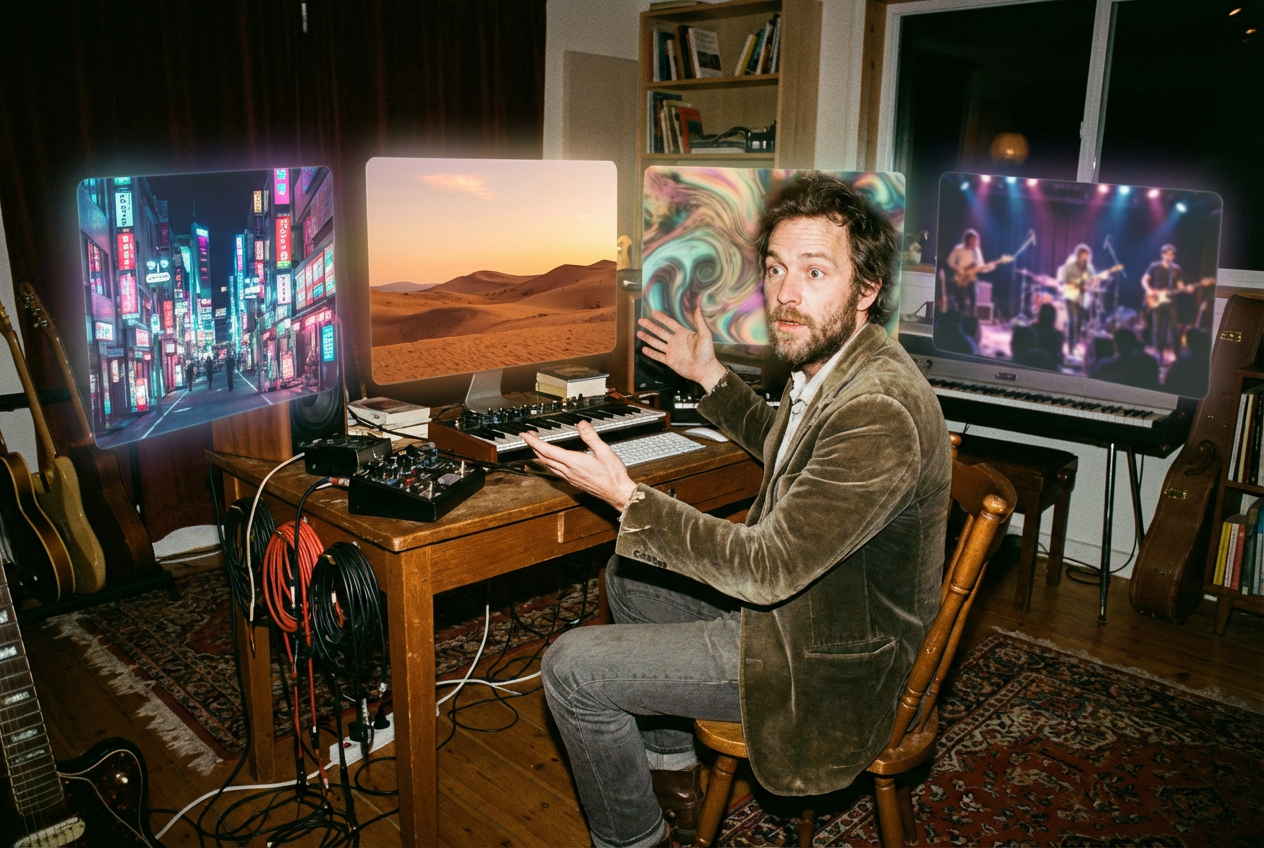
Use AI video generation to visualize your music affordably. Use it for social content. Use it to build a visual universe around your sound. AI music video tools for pop artists, EDM producers, and R&B creators have matured to the point where a bedroom artist can create visuals that would have cost thousands just two years ago.
4. Demand Transparency
A Deezer survey found that 52% of respondents said 100% AI-generated songs shouldn’t be included in charts alongside human-made songs, and 80% said 100% AI-generated music should be clearly labeled for listeners.
The audience is on your side here. They want to know what’s human-made. Support platforms that label AI content. Tag your own work as human-made. Make your creative process part of your content — show the songwriting, the recording, the mess. That’s unforgeable.
5. Build a Direct Relationship With Fans
Algorithms are increasingly unreliable for discovery when they’re drowning in AI content. Discovery is broken, listening is passive, and social context is almost non-existent. Email lists, Discord servers, direct social engagement — these are your lifelines. Don’t outsource your entire audience relationship to a platform that’s 44% machine-generated content.
What Happens Next
Apple Music’s Schusser called for the music industry to reach a consensus about “what is AI, what’s not AI,” adding that this discussion “can’t just be corporates: you need to have artists and songwriters in the room as well.”
That’s a good sign. But the consensus-building will take months or years, and the AI flood isn’t pausing for policy meetings.
As one industry analysis put it: trying to stop AI in music is like trying to stop streaming in 2008 — it’s not happening. The real question is whether the industry can price it correctly.
The platforms will eventually build better defenses. The labels will eventually settle their lawsuits. The regulatory frameworks will eventually catch up. But “eventually” doesn’t pay your rent.
What you can do right now is the same thing that has always separated artists who break through from those who don’t: tell a story that only you can tell, and tell it in a way that commands attention.
In 2026, that means combining your music with compelling visuals — and making every release feel like an event, not just another audio file in a sea of 75,000 daily uploads.
Start Building Your Visual Moat Today
The streaming platforms are being overwhelmed with AI-generated audio. Your best defense is a strong visual presence that proves there’s a real human creator behind the music. OneMoreShot.ai lets you generate professional music videos in minutes — giving you the visual identity that faceless AI slop can never replicate. Try it now, and make sure your next release doesn’t get lost in the flood.