75,000 AI Songs a Day and Sora Just Died
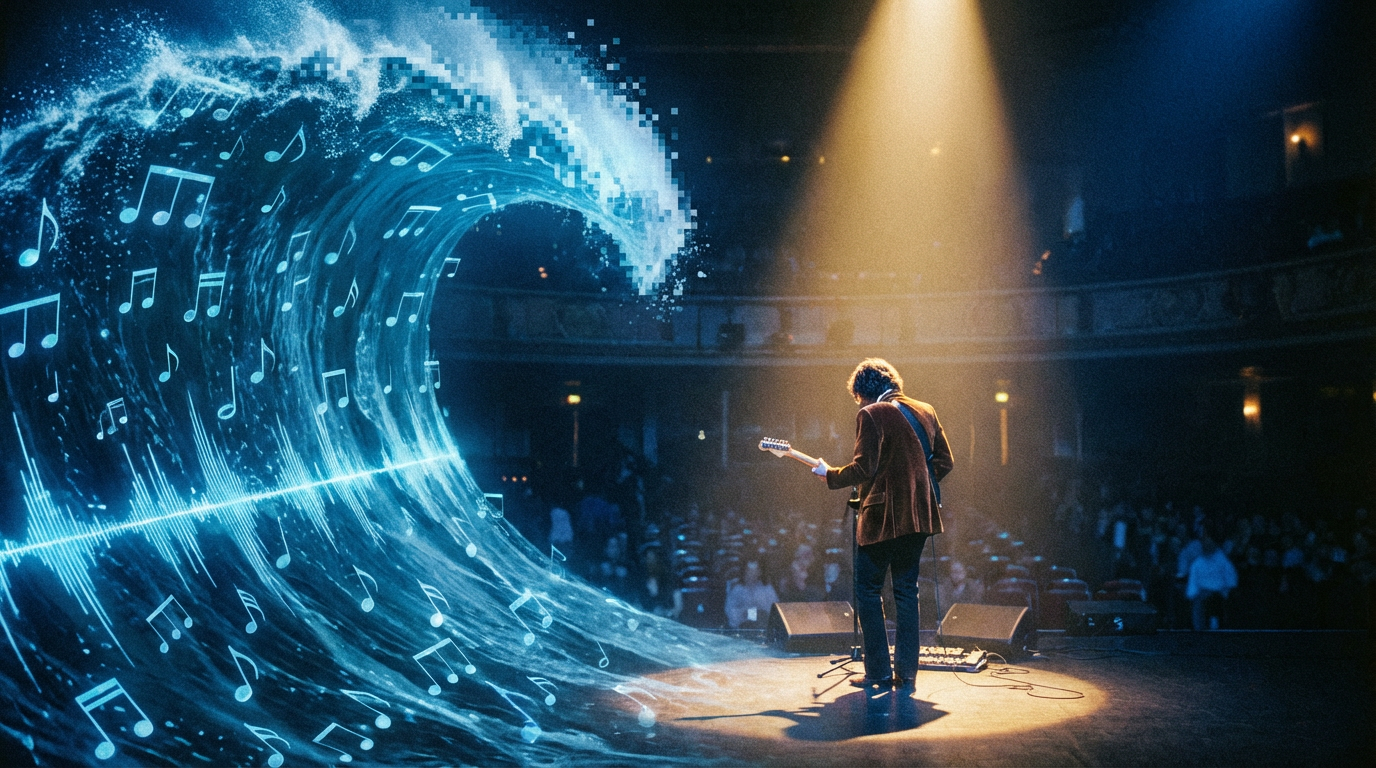
There’s a strange poetry to what’s happening in music right now. Today — literally today, April 26, 2026 — OpenAI’s Sora video generator goes dark forever. And this same week, we learned that nearly half of all new music uploaded to streaming platforms is made by robots.
If you’re a musician trying to build a career, these two facts collide in a way that changes everything about your strategy. Let’s talk about what’s actually happening, why it matters, and what smart artists are doing about it.
The Flood Is Real (and It’s Worse Than You Think)
Let’s start with the numbers, because they’re genuinely alarming.
Deezer is now receiving nearly 75,000 fully AI-generated tracks every day — accounting for more than 44% of the total daily delivery. That’s not a typo. Deezer reported receiving around 60,000 AI tracks per day in January, up from 50,000 in November, 30,000 in September, and just 10,000 in January 2025, when it first launched its AI-music detection tool. A 650% increase in just over a year.
And Deezer isn’t alone anymore. Apple Music VP Oliver Schusser confirmed on Billboard’s ‘On The Record’ podcast that “when you look at our monthly intake, more than a third of what we get today is actually what we would say is music that’s 100% AI.”
Schusser also confirmed for the first time that Apple Music has developed its own technology to detect AI-generated music when it is uploaded.
Here’s the darkest part of this story: Deezer says consumption of AI-generated music on the platform is still very low, between 1% and 3% of the total streams, and 85% of these streams are detected as fraudulent and are demonetized. In other words, almost nobody actually wants to listen to this stuff. The vast majority of it is a scam — bots streaming bot music to steal from the same royalty pool that pays real artists.
According to a study conducted by CISAC and PMP Strategy, nearly 25% of creators’ revenues are at risk by 2028, which could amount to as much as €4 billion.
This isn’t some distant threat anymore. It’s today.
Sora Is Dead. Long Live… What Exactly?
And then there’s the video side of things. The Sora web and app experiences will be discontinued on April 26, 2026. That’s today. Right now. Gone.
On March 24, 2026, OpenAI announced on X that it was discontinuing Sora in both the mobile app and the API.
The platform was reportedly generating $2.1 million in lifetime revenue against $15 million per day in inference costs. Read that again. Fifteen million dollars a day to run a product that had earned two million total. That’s not a business model — that’s a bonfire.
OpenAI is shutting down Sora primarily due to high compute costs, declining user engagement (from 1 million to under 500,000 active users), mounting copyright challenges, and a strategic decision to redirect resources toward enterprise and productivity tools ahead of a potential IPO.
The Disney deal collapsed — Disney had committed $1 billion to a partnership with Sora. According to reports, Disney found out about the shutdown less than an hour before the public announcement. The deal died with the app.
So the most hyped AI video tool of the past two years is now a cautionary tale. But here’s what’s crucial for musicians: the shutdown is not a sign that AI video is dead. It is a sign that running a consumer AI video platform at this scale is still not economically viable for a company with OpenAI’s priorities. The underlying technology, and the demand for it, is very much alive.
The Real Story: Why AI Music Videos Are Now Your Best Weapon
Here’s where these two stories crash together — and where it gets interesting for musicians.
The streaming platforms are drowning in AI-generated audio. Many musicians fear the entire industry is sliding towards the prioritization of machine-made slop, making it increasingly hard for rising or independent musicians to make a living. The discovery problem was already brutal before 75,000 fake songs started hitting servers every day.
But video? Video is where human artists still have a massive advantage — especially when they use AI as a creative tool rather than a replacement.
Think about it this way: the AI music flood is primarily audio-only. Scammers cranking out thousands of tracks on Suno aren’t also creating compelling music videos for each one. They can’t. A great music video requires artistic vision, narrative thinking, and an understanding of who you are as an artist. That’s still a profoundly human skill set.
This is exactly why AI-powered music video creation — where a real musician uses AI to bring their visual ideas to life — is the ultimate differentiator right now. You’re not competing with faceless audio slop. You’re creating visual content that tells your story, connects with fans, and gives the algorithm something it can actually work with.
If you’re new to this whole approach, our complete guide to AI music videos breaks down the entire workflow from concept to final export.
The Post-Sora Landscape for Musicians
With Sora gone, the AI video generation world has reshuffled. What briefly looked like a coherent market — platforms competing to define AI-generated video — has started to break apart. The underlying capability is being absorbed into three very different environments: social networks, creator workflows and professional production tools.
Among the players left, Grok accounts for the largest observed AI video tool traffic, according to Artificial Analysis, while Runway, Google’s Veo and Flow, and Kling all have significant minority shares. And then there’s the wildcard: HappyHorse-1.0, which appeared on the benchmarking platform Artificial Analysis around April 7, climbed to the top of blind-test rankings for both text-to-video and image-to-video generation. The developers revealed that HappyHorse was part of Alibaba’s ATH AI Innovation Unit.
For musicians, though, the question isn’t which model has the best Elo rating on a leaderboard. It’s which tool actually helps you make a music video that resonates with fans and gets your music in front of new ears. General-purpose video generators are impressive but they weren’t designed for beat-synced, narrative-driven music content.
That’s why purpose-built tools like OneMoreShot.ai exist — they’re designed specifically for the musician workflow: upload your track, define your visual style, and get a music video that actually matches the energy and structure of your song. No prompt engineering PhD required.
What Smart Artists Are Doing Right Now
Here’s the playbook that’s working for independent musicians navigating the AI slop era:
1. Lead With Visual Identity
When British singer-songwriter Benedict Cork posted a snippet of a new song on TikTok, it racked up over 100,000 plays. Days later, someone had already used AI to generate a full version and uploaded it to streaming platforms under a different name. Your audio alone is no longer enough to establish ownership of your identity.
Visual content — music videos, lyric videos, behind-the-scenes clips — creates an unbreakable connection between your face, your brand, and your music. AI scammers can clone your sound, but they can’t clone you.
Our genre-specific guides can help you nail the visual aesthetic for your style, whether you’re making hip-hop videos, indie visuals, or lo-fi content.
2. Release Videos, Not Just Singles
Every release should have a visual component. Period. In 2026, an audio-only release is like bringing a knife to a gunfight. The platforms’ algorithms favor video content. YouTube is still the world’s largest music discovery platform. And a music video gives you content for TikTok, Instagram Reels, and YouTube Shorts all at once.
The math is simple: a track with a video gets more algorithmic surface area than a track without one. And with AI music video tools, you don’t need a $10,000 production budget to make that happen.
Check out our guide on how to make an AI music video for a step-by-step breakdown of the process.
3. Use the “Human-Made” Badge as a Selling Point
Not having an AI tag on your music is becoming a “Human-Made” badge of honor. Recent surveys show nearly half of listeners actually want to filter out AI music. On Apple Music, being “AI-free” is becoming a genuine selling point for genres like folk, jazz, and indie rock.
Lean into this. Your music videos should feel personal, intentional, and distinctly you. AI is the tool that helps you execute your vision faster — but the vision has to be unmistakably human.
4. Protect Your Artist Profile
After months of artists complaining, Spotify took action by introducing a new optional feature called Artist Profile Protection, which lets artists review releases before they go live on the platform. “Music has been landing on the wrong artist pages across streaming services, and the rise of easy-to-produce AI tracks has made the problem worse,” Spotify wrote.
Turn this on immediately if you haven’t already. And remember: visual content across your profiles makes it much harder for AI impersonators to credibly mimic your presence.
The Licensing Wars Are Reshaping Everything
Meanwhile, the music industry’s legal landscape is in full tectonic shift. Udio carved out settlements and partnerships with Universal Music Group and Warner Music Group last fall, and Suno managed to settle with WMG back in November. Sony, the only major label that hasn’t settled with either, remains in litigation with both companies.
In 2026, according to the press release, Suno will make “several changes to the platform, including launching new, more advanced and licensed models.” “When the new models launch in 2026, the current models will be deprecated. Moving forward, downloading audio will require a paid account.”
And the TRAIN Act is now in front of Congress: The Recording Academy lobbied Congress for 3 AI bills in April 2026. The TRAIN Act’s subpoena power over training data is the one tech companies fear most.
What does all this mean for independent musicians? The rules of engagement are being written right now. The major labels are positioning themselves to control the AI music pipeline. The major labels are not trying to kill AI music. They are trying to own the pipes.
Independent artists who wait for the dust to settle will find that the game has been structured without them. The ones who move now — building visual brands, creating content, establishing their identity — will be the ones who thrive regardless of how the licensing battles shake out.
The Visual Advantage Is Temporary. Use It Now.
Here’s something most people aren’t talking about: the window where visual content gives musicians a decisive edge over AI slop is finite. AI video generation is improving at a terrifying pace. The generative AI in music market, valued at $642.8 million in 2024, is projected to reach $3 billion by 2030 with a CAGR of 29.5%. Similarly, the AI-generated video market is expected to grow by 35% annually, reaching $14.8 billion by 2030.
Eventually, the scammers will figure out video too. But right now — spring 2026 — there’s a gap. The audio side has been flooded. The video side hasn’t. Every music video you release right now builds a moat around your artistic identity that gets harder to breach over time.
For genre-specific inspiration, check out our template libraries for pop, R&B, rock, or country — they’ll give you a head start on nailing the visual language your audience already responds to.
The Bottom Line
The music industry is living through a strange, chaotic moment. Sora died today. Seventy-five thousand AI songs will still be uploaded to Deezer before midnight. Apple Music just admitted a third of its intake is machine-made. Deezer’s survey revealed that 97% of people couldn’t hear the differences between AI and human-made music.
But here’s the thing: listeners can’t tell by ear alone, but they absolutely can tell when an artist has a visual identity, a story, and a face behind the music. That’s the gap you exploit. That’s where you win.
Stop thinking of music videos as a luxury. They’re survival gear.
If you’re ready to start building your visual identity and creating music videos that cut through the noise, OneMoreShot.ai was built for exactly this moment. Upload your track, choose your style, and get a professional music video in minutes — not months. No crew, no budget drama, no waiting for Sora to come back from the dead (it won’t).
The flood isn’t stopping. But you don’t have to drown in it.