AI Music Is Replacing You in Every Café
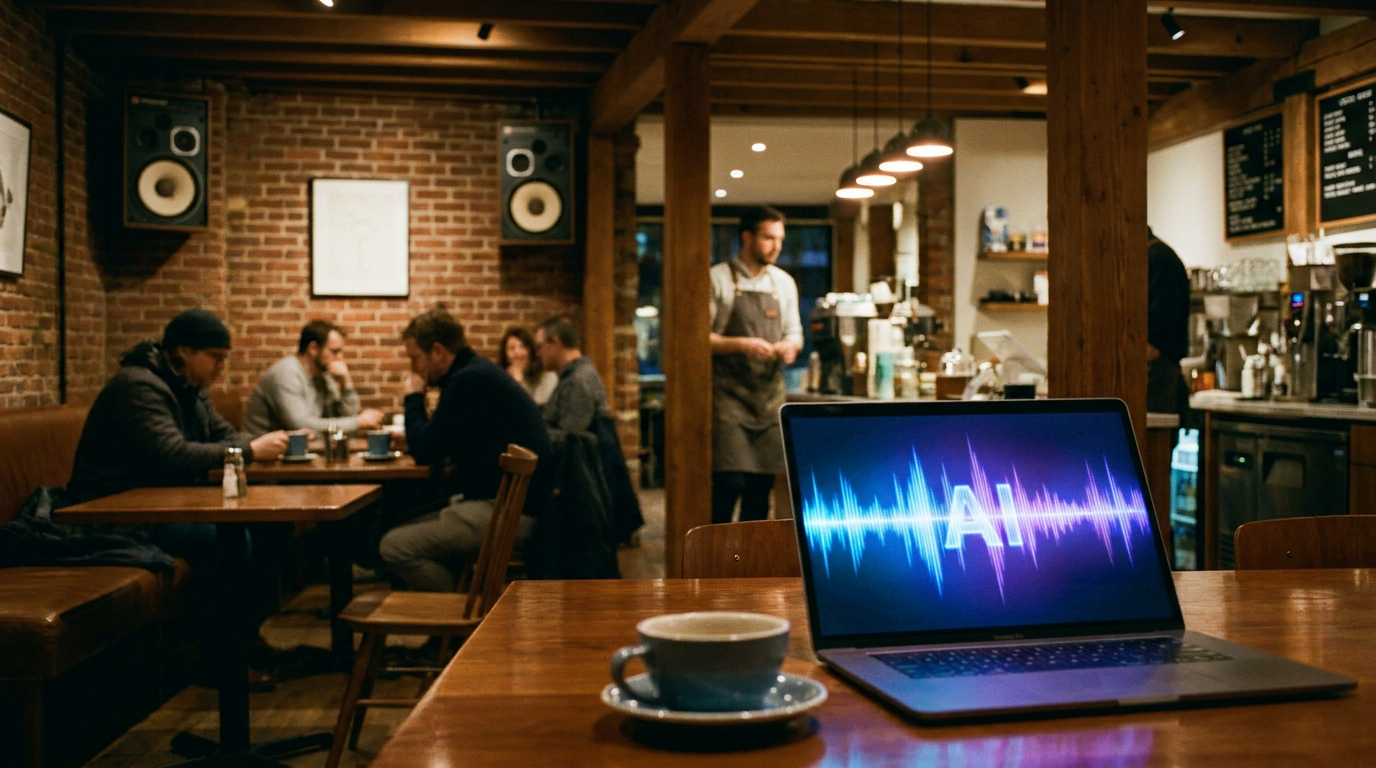
You probably didn’t notice the last time it happened. You walked into a café, ordered your flat white, and heard pleasant, vaguely jazzy music drifting from the speakers. It sounded fine. Familiar, even. But nobody wrote it. Nobody performed it. And nobody’s getting paid for it.
That’s because a growing number of cafés, bars, gyms, and retail shops are ditching licensed music entirely and switching to AI-generated playlists. And the economics behind the switch are brutal for musicians.
The $70-a-Month Problem
In New Zealand, the NZ Herald reported on August 8, 2026 that cafés are replacing licensed background music with AI-generated tracks. Under NZ copyright law, playing music in a business is considered a “public performance,” which requires a OneMusic licence. For a 50-square-metre café, that licence starts at $70 a month.
That might not sound like much. But for a café owner staring down rising costs, it adds up. One owner equated the annual cost of a music licence plus a streaming subscription to the profit on roughly 2,000 cups of coffee.
Here’s the loophole: commercial premises playing AI-generated tracks sidestep the public performance licence entirely, because no PRO-registered repertoire is being played. No registered songs means no licence needed. No licence means no royalty payments flowing back to songwriters and performers.
And these aren’t rogue operators trying to cheat the system. The pressure behind the switch is survival — hospitality liquidations in New Zealand jumped 49% in the year to March 2026. When the alternative is closing your doors, switching from Spotify to an AI background music app is the easiest cut you’ll ever make.
This Isn’t Just New Zealand
The café switch is a global phenomenon. AI-generated music is increasingly replacing licensed tracks in cafés, barber shops, and small retail spaces as businesses look to cut costs. It’s no longer limited to experimental playlists or online novelty channels — it’s becoming the default background sound in small businesses.
In the Philippines, playing licensed music comes with annual fees ranging from ₱9,000 to more than ₱20,000 under rules enforced by FILSCAP. Small businesses are doing the same math as their NZ counterparts and arriving at the same answer.
The NZ Herald puts the global AI music market at a projected $2.8 billion by 2030, and functional audio for businesses is one of its quietest, steadiest segments. Tools built specifically for this use case already exist — TuneTaxi pitched itself as background music for venues back in 2024 , and dozens more have since entered the market.
The prompt is embarrassingly simple. Type “early morning café jazz” and you get an endless, pleasant, royalty-free playlist that sounds like everything and nothing at the same time. It’s the sonic equivalent of stock photography. And it costs close to zero.

The Revenue Stream Musicians Don’t Know They’re Losing
Here’s why this matters more than you think. Performance royalties from venues are a real, meaningful income stream — especially for songwriters.
Global PROs collected over $10 billion in performance royalties in 2023. That pool includes every bar that plays your song, every gym pumping your track during spin class, every hotel lobby with your album on loop. In New Zealand alone, roughly 86% of the revenue from licensing fees collected by OneMusic is distributed to rights holders and recording artists. This year, Recorded Music NZ paid out $12.208 million after costs.
Now imagine chunks of that disappearing — not because people stopped listening to music in cafés, but because they’re listening to music that doesn’t have an author. No songwriter means no PRO registration means no royalty obligation. The music plays, the ambiance is created, and the money evaporates.
AI background music breaks venue royalties through price, and no PRO can win a price war against near-zero.
This is different from the streaming flood we’ve been tracking. When AI songs flood Spotify, they dilute the royalty pool but at least they’re on a platform with tracking. The café switch removes your music from the equation entirely. It’s not dilution — it’s displacement.
The Industry Is Drawing Lines Everywhere Else
While venues quietly adopt AI playlists, the rest of the music industry is scrambling to build walls against AI-generated content.
Beatport announced plans to ban tracks that are fully or majority AI-generated just days ago, on August 13, 2026. Tracks made with the assistance of AI will be tagged for transparency.
“Music created with AI assistance will still be accepted, provided the finished track remains majority human-made,” the platform explained. Notably, 60% of DJs surveyed said they wouldn’t play AI-generated tracks.
Beatport isn’t alone — just the day before, Spotify announced its “AI Persona” badge on artist profiles, with music from badged profiles excluded from algorithmic recommendations.
The pattern is clear: streaming platforms, download stores, and chart bodies are all implementing AI filters. But nobody is addressing the venue and background music space. It’s a regulatory blind spot, and AI is pouring through it like water through a crack.
Suno’s Licensed Model Era Makes It Worse (and Better)
Here’s the twist that makes this story even more complicated. On August 12, 2026, BMG and Suno announced a global alliance covering BMG’s recorded and music publishing repertoire — part of Suno’s upcoming launch of its first music model developed in partnership with the music industry.
After settling with Warner Music Group last November, Suno announced the BMG partnership and preemptive settlement — BMG hadn’t even sued them yet.
The deal covers both sides of BMG’s business, recorded music and publishing, and feeds into new, superior models built in partnership with the music industry.
This means Suno’s next models will be licensed. Artists who opt in will get compensated when their music trains the AI. That’s genuine progress for the copyright question. But it doesn’t solve the venue problem at all. Even a fully licensed AI model produces music that has no songwriter registration, no PRO affiliation, and no royalty obligation when played in a café.
Suno also just dropped Studio 2.0 on August 13, adding MIDI recording, a wavetable synth, and an AI chat collaborator — pushing the tool further toward a conventional digital audio workstation with AI woven into every feature. The better Suno gets at producing professional-quality background music, the more appealing it becomes for venue owners looking to cut costs.
What Musicians Should Actually Do
The instinct here is to rage against the machines. But the café owner cutting costs during a 49% liquidation spike is a business surviving, never a villain. You’re not going to guilt-trip a struggling café into paying $840 a year for something they can get for nearly free.
So what can you do?
1. Make Your Music Visible in Physical Spaces
If your song is playing in a café and nobody knows who made it, it’s just wallpaper. If your name is on a small card, a QR code, or a screen behind the bar, it’s discovery. Work directly with local venues. Offer curated playlists with your music included. Make it easy for venue owners to say yes to you rather than to an algorithm.
2. Create Visual Content That AI Background Music Can’t
AI can generate a pleasant lo-fi beat. But it can’t give a café a music video playing on a screen behind the espresso machine. This is where AI music videos become a competitive advantage beyond streaming. A visual loop tied to your actual song, your actual brand, playing on a venue’s screen — that’s something no AI playlist can replicate.
Musicians making lo-fi, jazz, and indie music — the exact genres most vulnerable to AI café replacement — should be creating visual content that makes their music worth licensing. A stunning visual loop gives a venue owner something they actually want to display.
3. Build Direct Venue Relationships
PROs need to sell venues something AI jazz can’t deliver: real artists their customers recognize, local repertoire, the sense a room is curated by a human. Artists should treat venues like the audience they are — the room playing your song is a fan relationship waiting to be owned.
Contact local cafés. Offer them a curated playlist with your tracks plus visual content for their screens. Make yourself the better option, not just the more expensive one.
4. Pair Your Music With Video for Every Platform
The café trend reinforces something we’ve been saying all year: audio alone is increasingly commoditized. The differentiator is visual identity. When you make an AI music video for your track, you’re creating something that works on YouTube, TikTok, Instagram — and yes, in venue screens. A pop music video or R&B visual running in a café is marketing, ambiance, and revenue all at once.

5. Push for Venue Music Transparency
This is the longer game. As AI labeling requirements expand — the EU AI Act’s Article 50 enforcement just started on August 2 — there’s a case to be made that venues should disclose whether they’re playing human-made or AI-generated music. Consumers increasingly care about authenticity. The same instinct that makes “farm-to-table” a selling point could make “human-curated music” one too.
The Bigger Picture
The café switch is a canary in the coal mine. Background music in commercial spaces has been a quiet, steady revenue stream for decades — one that most musicians never thought about because it just worked. PROs collected the fees, distributed the royalties, and the system hummed along.
AI didn’t break that system by being better. It broke it by being cheaper. And “cheaper” is the one argument no amount of artistry can overcome unless you change what you’re selling.
The musicians who will thrive aren’t the ones fighting to keep AI out of café speakers. They’re the ones making themselves impossible to replace — through visual content, direct relationships, and a presence that goes beyond audio.
Because here’s the thing: AI can generate endless pleasant background music. But it can’t walk into a café and shake the owner’s hand. It can’t put a face on a playlist. It can’t make a room feel like your room.
That’s still your advantage. Use it.
Ready to create visual content that makes your music impossible to ignore? OneMoreShot.ai lets you turn your tracks into stunning AI music videos in minutes — visuals that work everywhere from TikTok to the screen behind a coffee bar. Give your music a face before AI takes your place.