AI Music Labels Are Here (But Not for Videos)
Three days ago, the music industry did something it’s been threatening to do for over a year. It actually agreed on something.
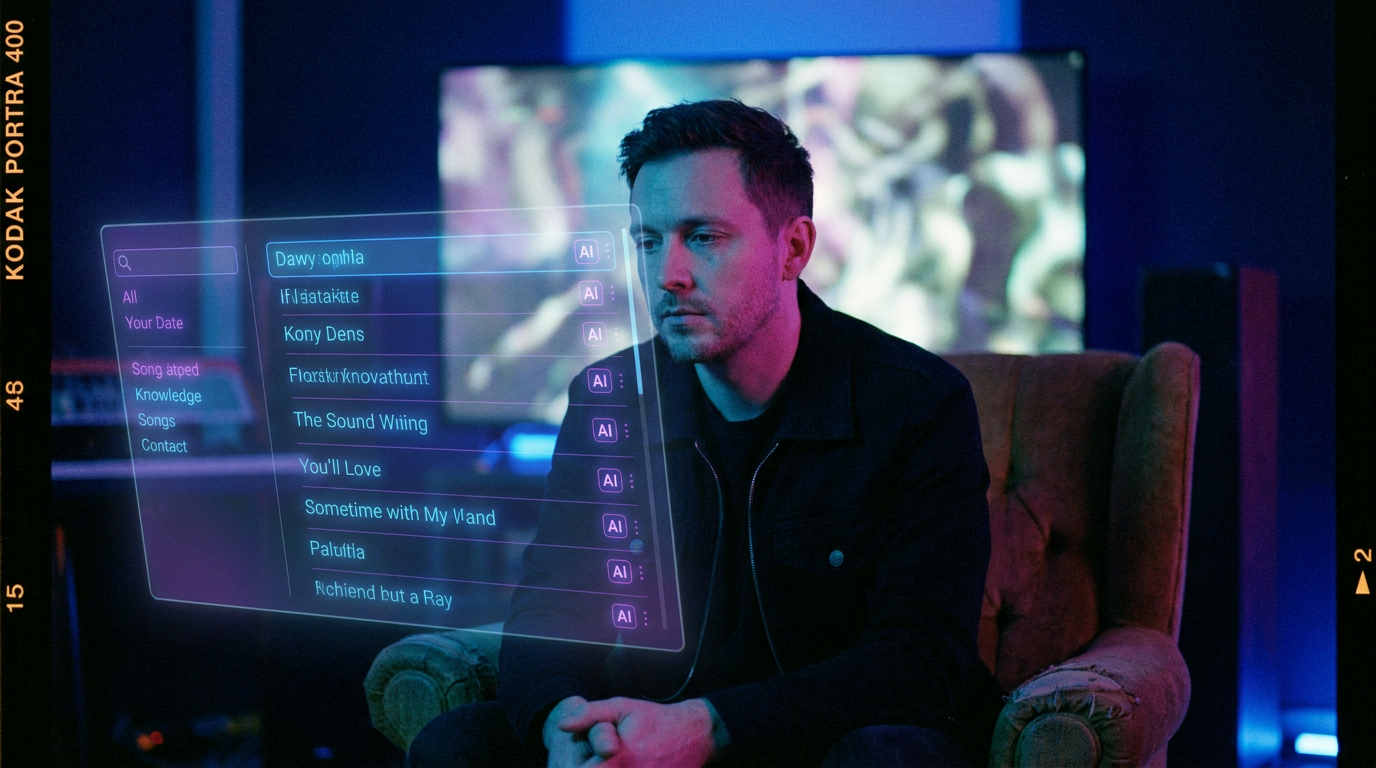
On July 10, 2026, IFPI, RIAA, A2IM, WIN, IMPALA, The Grammys, SAG-AFTRA, and the Human Artistry Campaign announced a unified approach to voluntary track labeling for generative AI in sound recordings.
The groups introduced two suggested labels, akin to labels noting a song’s explicit nature, to help indicate whether a recording has been “AI-Generated” or “AI-Assisted.”
It’s the biggest coordinated move in AI music policy since streaming platforms started individually scrambling to figure out their own approaches. And it matters enormously.
But there’s a massive gap hiding in plain sight. The RIAA and others made clear that their “system does not cover the use of generative AI in lyrics, composition, music videos or cover art at this point.”
Read that again. Music videos are not covered.
For the millions of musicians using AI to create visuals — the fastest-growing creative use of generative AI in music — the industry’s shiny new labeling system has absolutely nothing to say.
Let’s unpack why this matters, what the numbers look like, and what it means if you’re an independent musician making AI music videos right now.
The Label System, Explained
The new system is elegant in its simplicity. The RIAA-led group is putting forward two tags, drawing a line between fully AI-generated tracks and those only partly made with AI. The first, “AI-generated,” would apply to a track built entirely by AI from a text prompt, or one where a machine produced the lead vocal or the main instrumental takes. The second, “AI-assisted,” would flag a track that is mostly the work of people but leans on AI in places.
Think of it like the little “E” badge you see next to explicit tracks on Spotify. Much like the explicit label on records with inappropriate language and content, these AI tags are expected to work similarly. Simple. Recognizable. Scalable.
Grammys CEO Harvey Mason Jr. said, “This initiative ensures that creativity, authorship, and artistic intent remain at the center of every song. Giving artists the ability to tell that story strengthens trust and supports a more sustainable future for music.”
The industry needed this. Because the numbers are frankly wild.
The Flood Nobody Can Ignore
Here’s the context that forced this coalition into existence:
Deezer is now receiving almost 75,000 AI-generated tracks per day, representing roughly 44% of the daily uploads.
This amounts to more than 2 million AI-generated tracks uploaded per month.
And it’s not just Deezer. Apple Music VP Oliver Schusser explained that more than a third of tracks delivered to the service are “100% AI,” but listening remains below 0.5%.
That last stat is the one that should stick. Nearly half of everything uploaded — but almost nobody is listening. Run the arithmetic and genuine, non-fraudulent AI listening lands somewhere between 0.15% and 0.45% of all streams.
A majority (85%) of these streams are detected as fraudulent and are demonetized by Deezer. In other words, the dominant economic use of AI-generated audio tracks right now isn’t entertaining humans — it’s generating bot-driven royalty claims.
That’s the AI audio problem the industry is trying to solve with labels. And honestly? Fair enough.
Why Music Videos Got Left Out
So why did eight of the most powerful organizations in music collectively shrug at the visual side?
There are a few likely reasons:
1. The audio problem is on fire right now. When 75,000 synthetic tracks hit your platform every day and most of the listening is bots, you focus there first. Music videos aren’t flooding Spotify’s catalog the same way.
2. Music videos live on different platforms. Audio tracks go through distributors and aggregators into DSPs. Music videos primarily live on YouTube, TikTok, and Instagram — platforms that already have their own AI disclosure policies. The RIAA doesn’t control those ecosystems the same way.
3. Defining “AI-assisted” for video is even harder. There’s sure to be a bit of debate about what constitutes an AI-assisted recording. Audio will fall into this category if it “was created substantially by humans and expresses human creativity; however, generative AI was used for some expressive elements.” Now try applying that to a music video. Did the artist use an AI tool for color grading? For one transition? For the entire concept? For character animation? The spectrum is infinitely wider.
4. Nobody’s complaining about AI music videos the same way. Listeners worry about “fake” songs diluting their playlists. But visually? Audiences have been remarkably open to AI-generated imagery. The backlash against AI visuals has been concentrated in illustration and photography communities — not in music video audiences who just want something cool to watch.
This creates a fascinating asymmetry. The industry is building walls around AI audio while leaving the visual side wide open.
What This Means for Musicians Making AI Videos
If you’re an independent artist creating visuals with AI tools, the current situation is actually pretty favorable. Here’s why:
The “AI-Assisted” Label Is Your Friend
The labeling system draws a clear line. If you write your own lyrics, sing your own vocals, and play your own instruments — but use AI to generate your music video — you’re not even in the “AI-assisted” category for audio purposes. Your track is human-made. Full stop.
The video is a separate creative artifact, and right now, no industry body is demanding labels for it.
This is actually how most independent musicians are using AI in 2026. They’re writing real songs and then turning to tools like OneMoreShot.ai to create visuals they couldn’t otherwise afford. That workflow is completely untouched by the new labeling regime.
The Platforms Already Have Their Own Rules
YouTube requires disclosure when realistic AI-generated content depicts real people, places, or events. But stylized, clearly creative music video content? That’s treated as artistic expression. If you’re making an AI music video for your indie rock track with abstract visuals and stylized imagery, you’re operating well within platform guidelines.
Authenticity Lives in the Song, Not the Video
Here’s what the industry data actually shows: People care where their music comes from once you tell them. But that “caring” is overwhelmingly about the audio — the voice, the melody, the lyrics. Fans have always understood that visuals involve a production team, special effects, and technology. AI is just the latest tool in that lineage.
The entire history of music videos is a history of technology adoption. MTV-era videos used groundbreaking computer graphics. Missy Elliott’s videos pioneered digital effects. Gorillaz built their entire visual identity on animation. AI-generated visuals are a natural next step, not a betrayal.
The Bigger Picture: A Two-Speed Industry
What’s emerging is a music industry that moves at two very different speeds on AI:
Audio: Regulation mode. Labels, tags, detection tools, demonetization. TIDAL is preventing fully AI-generated music from making money on its platform. In addition, TIDAL will use automated tools to remove AI-generated music that attempts to impersonate an artist.
Traxsource introduced Human-Made and AI-Assisted music labels across its platform effective from July 1st, 2026. The walls are going up everywhere.
Video: Innovation mode. AI video generation models are getting absurdly good. The leading models output 1080p or native 4K with lip-synced dialogue, hold character identity across multiple shots, and produce 15-20 second clips in a single pass. And musicians are using them more freely than ever because there’s no regulatory overhang.
This asymmetry won’t last forever. Eventually, someone will propose labeling AI music videos too. But right now, in July 2026, we’re in a window where the smartest musicians are going all-in on AI visuals while the industry debates audio labels.
What Smart Artists Are Doing Right Now
The musicians who are winning in this environment share a few common traits:
1. Human Audio, AI Visuals
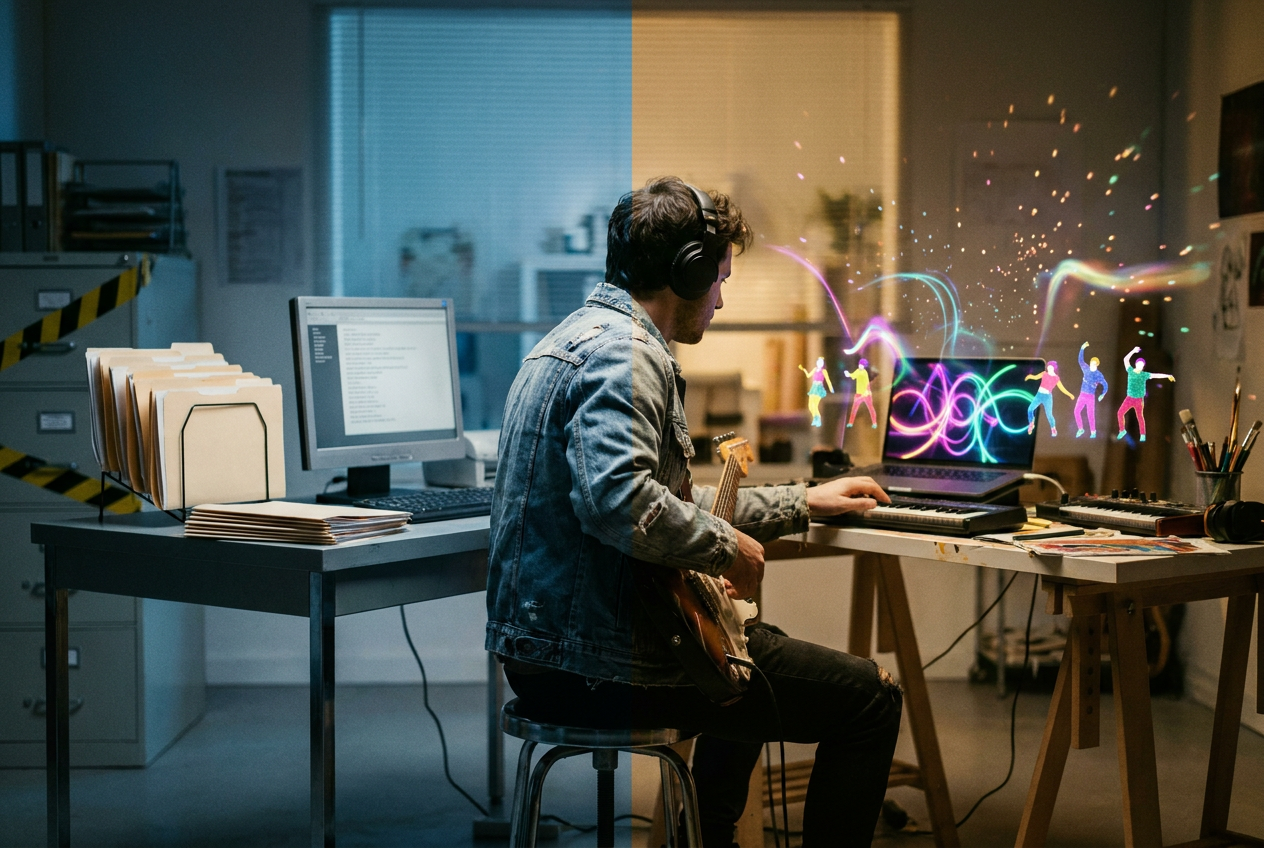
They write and perform their own music — no question about authenticity there — and then use AI to produce visuals that would otherwise cost $5,000 to $50,000. Whether it’s a hip-hop video with cinematic street scenes, an EDM video with abstract pulsing geometries, or a lo-fi video with hand-drawn aesthetic, the visual layer is where AI adds value without triggering authenticity concerns.
2. They’re Transparent Anyway
Even though nobody’s requiring it, the smartest artists are voluntarily disclosing their use of AI visuals. Not because they have to — because it builds trust. A simple “visuals created with AI” in the video description actually increases credibility because it signals honesty. When the labeling inevitably extends to video, these artists will already be ahead.
3. They’re Building a Visual Catalog
Deezer now says 44% of everything uploaded to its platform every day is AI-generated, around 75,000 tracks. The audio side is drowning in noise. But on YouTube and other video platforms, having any music video still differentiates you. Most independent artists still release tracks with nothing but a static image or lyric video. An AI-generated music video — even a simple one — immediately puts you above the median.
4. They’re Not Waiting for Permission
The AI music industry is visibly maturing: models are getting better at rewarding human input rather than replacing it, licensing is trending ethical instead of extractive, and the machinery for attribution, compensation, and provenance is getting built in real time. Nobody’s waiting for permission anymore.
The Suno Stat That Should Motivate You
Here’s a number that puts everything in perspective: Suno reported around 100 million people have used the platform, with 2 million paying subscribers and roughly $300 million in annual revenue as of early 2026.
A hundred million people have now generated audio with AI. The audio side is crowded, contested, and increasingly regulated.
But the visual side? Still wide open. The labeling coalition explicitly left it out. The platforms are welcoming it. And the tools have never been better.
If you’re a musician who writes real songs and wants to stand out in the most crowded music landscape in history, the calculus is pretty simple: your audio is your soul. Your visuals are your competitive advantage. And right now, there’s no label, no tag, and no coalition telling you how to handle the visual side.
What Comes Next
Will music video labeling come eventually? Almost certainly. The labeling is designed to evolve as technology and requirements change.
Apple’s Transparency Tags are meant to indicate if select artwork, tracks, compositions, or music videos are AI-generated. Apple is already building the infrastructure for visual labeling, even if the RIAA coalition isn’t there yet.
But “eventually” isn’t “now.” And in AI, the gap between “now” and “eventually” is where fortunes are made and careers are built.
The musicians who started making AI music videos six months ago already have a catalog of visual content that their peers are just starting to think about. The ones who start today will have the same advantage over whoever starts six months from now.
Start Building Before the Labels Arrive
The industry just told you exactly where it’s focused: audio labels, audio fraud, audio authenticity. That’s where the regulatory energy is going in 2026.
Music video? That’s where the creative energy should go.
If you’ve been thinking about creating AI visuals for your music, this is the moment. Not because you’re “getting away with something” — but because the industry has given you a clear signal that AI-assisted visual creation is not the problem they’re trying to solve.
Your song is yours. Your voice is yours. Your vision for how that song looks on screen? That’s where AI becomes your co-director, your effects studio, and your production budget — all in one.
Try OneMoreShot.ai and turn your next track into a music video before the industry catches up to the visual side. Because when they do, you’ll want to already have a catalog that proves you were here first.