D'Addario's AI Scandal Is a Warning for All
A guitar string company just became the most important case study in AI trust.
D’Addario — one of the most respected names in music gear — spent weeks denying it used AI-generated music in a product demo. Then it denied harder. Then it deleted comments. Then, on August 10, 2026, it finally admitted the truth: “We got this wrong. We’ve completed a full review and confirmed that Suno Studio was used to regenerate the original track.”
The fallout has been brutal, messy, and incredibly instructive. If you’re a musician navigating the AI landscape in 2026, the D’Addario saga isn’t just industry gossip — it’s a masterclass in how quickly trust evaporates when AI enters the picture.
The Demo That Started It All
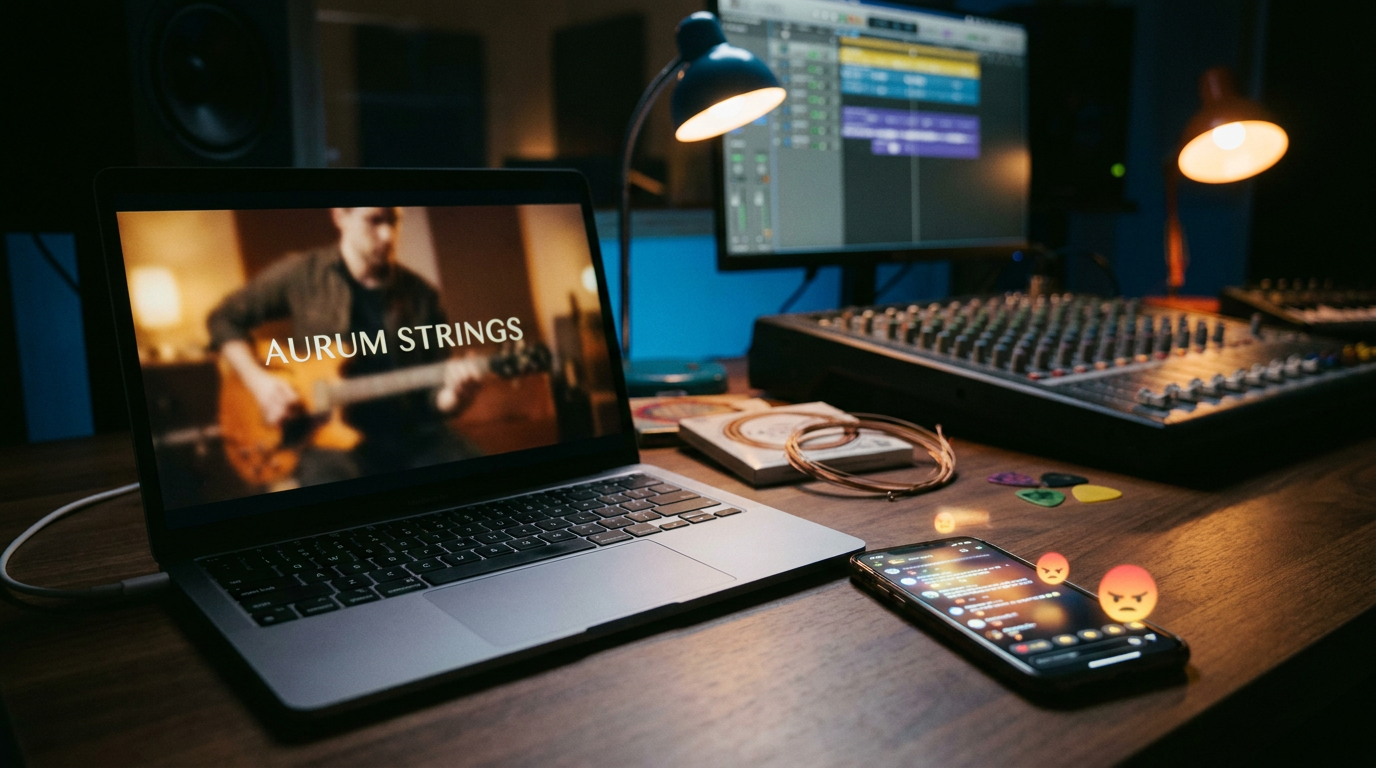
It all started when D’Addario published a promotional clip on their Instagram about their new NYXL High-Density strings. The music was questionable at best, AI-generated at worst.
The internet noticed immediately. Comments poured in like “Woah this sounds sick! What was the prompt?” and criticisms like the track sounding “like Suno trained on a 64 kb/s mp3 file.” What should have been a routine product demo became a full-blown forensic investigation conducted by the guitar community.
The controversy gathered steam when D’Addario was accused of deleting comments under the demo that alleged the use of AI. Blocking users who called it out? That’s not how you handle a community that’s already suspicious. It’s how you pour gasoline on a fire and then act surprised when the building burns down.
Deny, Deny, Deny
Here’s where the story gets truly bizarre.
D’Addario first issued a statement denying the use of AI altogether, sharing the track’s Logic DAW session, which was supplied by its creator. When glaring irregularities between the session and final track were pointed out, the firm then claimed LANDR and Logic AI mixing and mastering tools had been used without its knowledge.
So the narrative shifted from “no AI at all” to “okay, maybe some AI, but only the mixing kind.” That’s the corporate equivalent of moving the goalposts while the crowd is still sitting in the original stadium.
YouTubers Danny Sapko and KDH highlighted glaring differences between the original demo video and D’Addario’s response. In certain instances, the guitar playing didn’t match up. There were inconsistencies between lead lines and rhythm parts throughout the track. The audio between the two drifted out of sync when played side by side.
Sapko noted this was particularly damning, as music generated by AI platform Suno doesn’t stick to an exact tempo and can drift — exactly the kind of artifact listeners were hearing.
The musicians piled on. Drummer Mike Malyan (Disperse, Monuments) accused D’Addario of gaslighting, while bassist Adam Neely (Sungazer) called it “a generally pathetic attempt at saving face, and insulting to the musical community you serve.”
YouTuber Rhett Shull even got hold of the stem files and produced a video on the subject.
D’Addario artists such as Yvette Young and Mike Dawes defended the brand. The internet piled on. D’Addario started deleting comments before alleging that one of its staff members had been doxxed.
The Admission
On August 10, after weeks of escalating denials, D’Addario finally came clean.
“We got this wrong. We’ve completed a full review and confirmed that Suno Studio was used to regenerate the original track,” the statement said. “We shared inaccurate information, and we’re truly sorry. We do not support AI-generated music, and our process will reflect that going forward. We’ll require our employees and creative partners to disclose any use of generative AI, and we’ll more closely review everything we put into the world.”
D’Addario now claims it was fed false information concerning the origin of the track, and that it shared the song without any knowledge that it had been created using Suno Studio.
The company also acknowledged it “got comment moderation wrong,” stating that “honest criticism should not be erased” and committing to changing how it moderates channels.
As MusicRadar’s reporting noted, “this is a story in which no one comes out looking good — least of all Suno Studios. That this controversy exists at all speaks to the deleterious effect generative AI has in music, eroding trust in artists, in the brands who make the instruments, in everything.”
Why This Matters for Every Musician
The D’Addario story isn’t really about guitar strings. It’s about trust — the most valuable currency musicians have in 2026.
Think about it: a company that literally exists to sell products to musicians got caught using AI to replace the very thing its customers do. The irony was immediately lethal. D’Addario’s own words — “D’Addario exists to give artists the tools to shape their own sound, not to blur the line between human creativity and AI-generated content” — became deeply ironic in the context of what actually happened.
This isn’t an isolated incident. It’s a pattern. The Fender CEO backlash. Streaming platforms drowning in AI uploads. The AI trust crisis is happening at every level of the music industry simultaneously.
And it’s why platforms are moving fast to draw lines.
Spotify Just Drew a Bigger Line
Just one day after D’Addario’s admission, Spotify dropped its own bombshell. Spotify announced it would launch a new “AI Persona” badge in mid-September clearly identifying content producers that are AI-generated and not real people.
This goes beyond what Spotify has done before. Spotify defines an AI Persona as an artist whose public identity represents an AI-generated photorealistic human, including through their name, profile images, header images, album artwork, or other visual elements. One important distinction: this badge is about the artist’s public identity, not necessarily how the music was made.
The real teeth are in the algorithmic consequences. By default, Spotify won’t include AI Personas in its editorial or algorithmic recommendations, nor will it add AI Personas’ music to users’ personalized recommendations — unless they happen to follow an AI Persona.
While Spotify will allow artists to identify themselves as AI Personas, the company says it won’t rely on self-disclosure alone.
It will also review artist profiles and identify those where the artist’s name and imagery appear to represent photorealistic AI-generated identities, beginning with profiles that have met pre-defined audience thresholds.
For accounts where Spotify believes the profile probably does not belong to a real person, it will apply a “Likely AI Persona” badge. If a badge is applied in error, Spotify says the account owner will be notified and can appeal the decision.
The timing here is not a coincidence. The entire industry is converging on one message: if you’re real, prove it. If you’re AI, get labeled.
The Trust Playbook for Real Musicians
Here’s what the D’Addario debacle and Spotify’s new policies tell us about surviving as a musician in 2026:
1. Transparency Is Non-Negotiable
D’Addario’s biggest mistake wasn’t using AI. It was lying about it — repeatedly. Every denial that got debunked made the eventual admission exponentially worse. If you use AI tools in your creative process, own it upfront. Audiences can forgive a lot, but not deception.
2. Your Human Identity Is Your Moat
Spotify is literally building infrastructure to separate real artists from AI personas. The Verified by Spotify badge signals to listeners that an artist is a real human presenting themselves authentically on the platform, with hundreds of thousands of profiles already verified. If you haven’t verified your profile yet, do it today.
3. AI Is a Tool, Not a Replacement
Here’s the nuance that gets lost in every AI controversy: there’s a massive difference between using AI as a production tool and using it to replace human creativity entirely. A musician using AI video to create stunning visuals for their music is not the same as a company using Suno to fake a guitar demo.
The former enhances what you do. The latter pretends you did something you didn’t.
4. Visuals Are Your Best AI Play
While AI-generated music is getting slapped with restrictions everywhere — from Spotify badges to Deezer deletions to chart bans — AI-generated visuals remain the safest, most effective way to amplify your work. Nobody’s going to accuse you of faking your artistry because you used AI to make a music video. That’s just smart production.
Whether you’re making hip-hop visuals, indie aesthetic videos, or pop content for social media, AI video tools let you compete visually without compromising your musical authenticity.
5. The Cover-Up Is Always Worse
D’Addario denied any wrongdoing despite scrutiny from the online guitar community, and comments mentioning AI were being deleted from the original post. This is the Streisand Effect on steroids. Every deleted comment created ten new critics. Every denial generated another forensic YouTube video.
If you’re caught, own it immediately. The internet will find out anyway. In 2026, AI detection tools, community sleuths, and platform-level scanning make cover-ups almost impossible.
What This Means Going Forward
The D’Addario scandal marks a turning point. It’s the moment the music industry’s AI trust crisis stopped being abstract and became visceral. A company that musicians trusted — that endorsed musicians, that made the strings they played — got caught faking the very thing those strings are supposed to enable.
Meanwhile, Spotify’s AI Persona badge system is just the latest in a rapidly expanding infrastructure of AI transparency. Deezer claimed to be the first music streamer to transparently tag AI music, revealing 75,000 AI songs uploaded per day in April, and this number increased to nearly 90,000 per day by June.
Bandcamp has banned music “generated wholly or in substantial part by AI,” TIDAL has blocked royalties for AI-generated tracks, Apple Music launched a tagging system, and Qobuz announced its own AI detection tool.
The walls are closing in on AI deception in music. But the doors are wide open for musicians who use AI honestly — especially for visuals.
The Bottom Line
D’Addario’s AI scandal is the kind of story that reshapes an industry’s relationship with trust. It proves three things:
- Audiences can tell. The guitar community spotted AI artifacts in a polished demo video within hours.
- Cover-ups fail. Three rounds of denials followed by an admission is the worst possible playbook.
- Human creativity is the product. When a string company uses AI to demo strings, it undermines the entire reason the product exists.
For musicians, the lesson is clear: be real about your music, be strategic about your visuals, and never underestimate how fast the internet will catch you if you fake it.
Your music is yours. Your voice is yours. Your creative process — however messy, imperfect, and human — is what makes people care. Use AI where it amplifies that humanity (like creating music videos that bring your songs to life), not where it replaces it.
Ready to create AI-powered visuals for your real, human-made music? OneMoreShot.ai lets you generate stunning music videos in minutes — no Suno required, no controversy included.