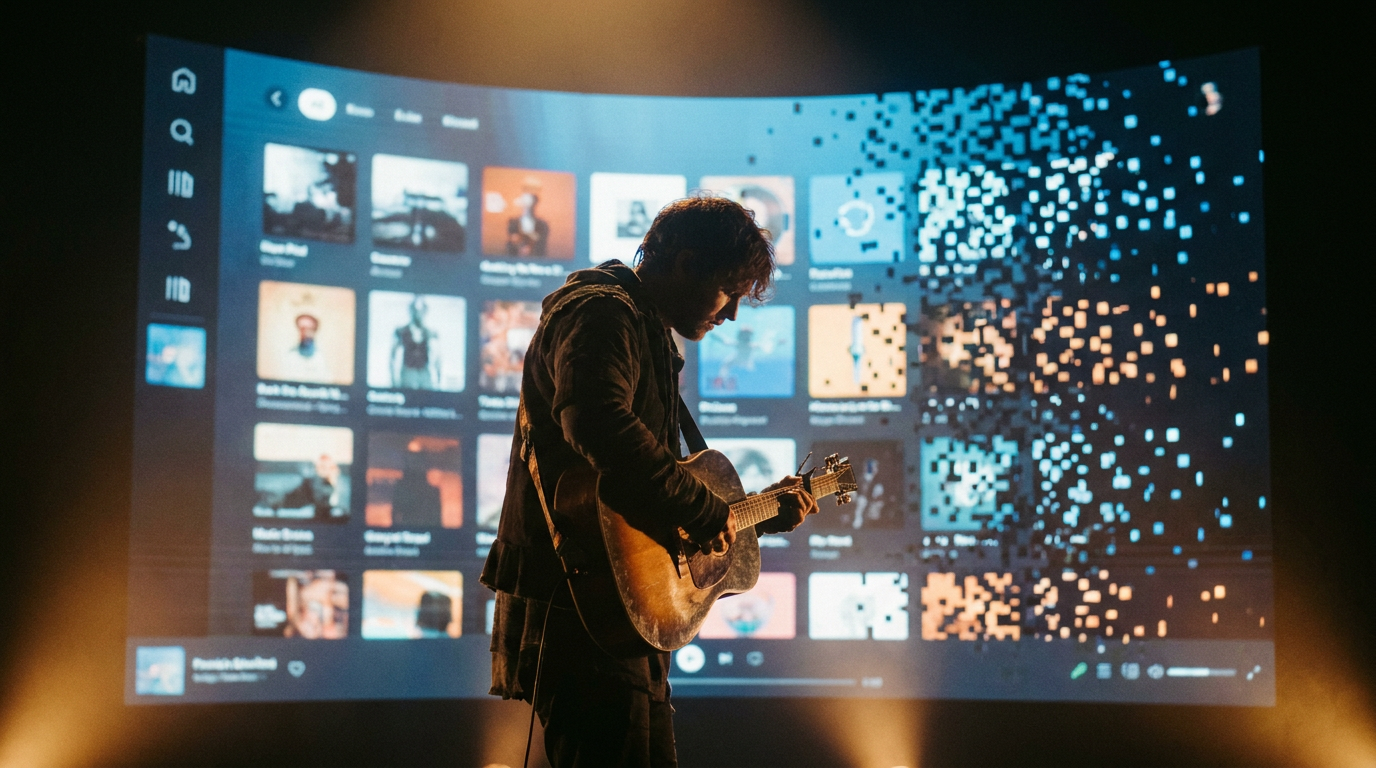
Deezer Is Now Deleting AI Music
Ninety thousand AI-generated tracks per day. Over 50% of all new uploads. And now, for the first time, a major streaming platform is pressing delete.
On July 21, Deezer announced that AI-generated music has officially crossed the 50% threshold on its platform — meaning machines are now uploading more new music every day than humans. And instead of just tagging or demonetizing this flood, Deezer is now vowing to remove any AI track that it suspects has been used in streaming fraud scams as well as AI tracks that haven’t been streamed for six months or more.
This isn’t a policy tweak. This is the beginning of a platform-wide purge. And every musician making music in 2026 needs to understand what comes next.
The Numbers Are Staggering
Let’s trace how fast this happened. The daily count climbed from 10,000 AI tracks in January 2025 to 20,000 by April, 30,000 in September, 50,000 in November, 60,000 in January 2026, 75,000 this past April, and nearly 90,000 today.
That’s a ninefold increase in sixteen months. Deezer notes that if this is the case for their platform, it’s likely also the kind of volume being seen by its bigger rivals including Spotify and Apple Music.
And here’s the kicker that should worry anyone in the music industry: when 9,000 participants across eight countries were asked to listen to three tracks and determine whether or not they were fully AI-generated, 97% of the respondents failed.
Read that again. Ninety-seven percent of people cannot tell the difference.
More than half — 52% — felt uncomfortable with not being able to tell the difference between AI and human-made music. And yet the flood keeps accelerating.
From Detection to Deletion
What makes this week’s announcement different from everything before is the escalation. Deezer has been the industry’s canary in the coal mine for AI music, and their response has evolved through four distinct phases:
Phase 1 — Detection (January 2025): Deezer’s proprietary, patent-pending AI detection tool has been in place since January 2025, enabling the company to track and exclude AI-generated music from algorithmic and editorial recommendations.
Phase 2 — Tagging (June 2025): Deezer became the first (and so far only) music streaming platform to explicitly tag AI-generated music.
Phase 3 — Demonetization: Previously, the service reported that up to 85% of the streams on fully AI tracks were fraudulent, and when streaming manipulation of any kind was found, Deezer would exclude the streams from royalty payments.
Phase 4 — Deletion (July 2026): Moving forward, Deezer will systematically take down AI-tracks used for streaming fraud, and those that haven’t been streamed for at least 6 months.
See the trajectory? Each step gets more aggressive. And Deezer isn’t just policing its own platform anymore — since January 2026, Deezer has made its AI detection technology commercially available to any organization in the music ecosystem, including other streaming platforms, rights organizations, and distributors.
They’re handing the weapon to everyone.
Why 97% Should Terrify and Liberate You
Here’s where things get philosophically interesting. People can’t tell, but they still say they don’t want it.
That’s the paradox at the center of the AI music debate in 2026. The same Ipsos blind test that found 97% couldn’t distinguish AI from human also found that 80% want fully AI-generated tracks clearly labeled , and Luminate’s data shows 44% are less interested in AI-generated music versus 24% more interested, with discomfort rising quarter over quarter.
Translation: listeners can’t detect AI music with their ears, but they reject it with their values. The quality gap has closed. The trust gap hasn’t.
This is actually good news for real musicians — if you know how to play it right.
The Visual Authenticity Edge
When every ear-based test fails to distinguish human from AI, the proof of humanness shifts to something else: visuals. The story behind the music. The face on camera. The performance. The creative intent made visible.
This is exactly why AI music videos have become the most important release asset in 2026. Not because they’re AI-generated (though many are assisted by AI), but because they provide the visual proof of creative intent that an audio file alone never can.
Think about it: a raw .mp3 uploaded to a distributor looks identical whether a human songwriter spent six months writing it or a bot spit it out in twelve seconds. But a music video — with consistent characters, intentional storytelling, and visual choices that match the mood — communicates something an algorithm can’t fake: direction.
The value is in the human direction behind the work. A trusted creator can explain why the song exists, who it is for, what inspired the lyrics, how the first draft changed, what parts were rejected, what edits were made, what tools were used, and how the final release supports a larger creative goal.
Whether you’re making hip-hop, pop, or indie music, a visual presence is now the fastest way to signal “a human made this — on purpose.”
What Deezer’s Deletion Policy Means for Your Strategy
Let’s get practical. Here’s what changes right now:
1. The Six-Month Clock Is Real
If you release a track on Deezer and it doesn’t get streamed for six months, and it gets flagged as AI-generated, it’s eligible for deletion. This matters even if your music is 100% human-made — because Deezer’s detection isn’t perfect, and false positives exist.
Your defense? Engagement. Streams. And above all, content that drives people to your music. A music video on YouTube that links to your Deezer page is now a survival mechanism, not a nice-to-have.
2. Other Platforms Will Follow
The rapid rise of AI-generated music has forced streaming services to decide how much of it they want on their platforms. There is no single consensus yet, but some take strict steps, like Bandcamp banning such tracks or Tidal cutting off monetization.
Deezer is the first to go from demonetization to deletion. But if you’ve been watching the industry this year, the pattern is clear: what Deezer does today, Spotify considers tomorrow. Every platform is building its own AI fence. The question is just how high.
3. Visual Content Is Your Proof of Life
In a world where you no longer need a band, a studio, or even much musical knowledge — with an AI app like Suno, a prompt, and a few clicks, you can produce tracks that are good enough to pass as human work — the differentiator isn’t the audio anymore. It’s everything around the audio.
Music videos. Live performance clips. Behind-the-scenes content. Lyric videos with intentional visual design. These are the artifacts that say “a creator exists here.”
The Paradox of AI-Assisted Visuals
Here’s the twist that confuses people: you can use AI to create the very visuals that prove your music is human-directed.
That’s not a contradiction. It’s the entire point.
When you use an AI music video generator to bring your song to life, you’re making hundreds of creative decisions: the mood, the color palette, the narrative, the characters, the pacing, the genre-specific aesthetics. Whether you’re going for the neon-drenched visuals of EDM or the raw authenticity of country storytelling, those choices are yours. The AI is the brush. You’re the painter.
The 90,000 daily AI tracks flooding Deezer have no such creative direction. They’re prompt-and-forget uploads designed to game streaming royalties. Up to 85% of the streams on fully AI tracks were fraudulent. These aren’t artists using AI as a creative tool. They’re bots using AI as a slot machine.
The distinction matters — and visuals make that distinction undeniable.
What Smart Musicians Are Doing Right Now
The artists who will thrive in the post-purge streaming landscape are the ones building visual ecosystems around their music today. Here’s the playbook:
Release a music video with every single. Not next month. Not when you have budget. Now. Making an AI music video takes minutes, not weeks. Do it before your track gets buried under 90,000 daily uploads.
Create genre-specific visual identities. Whether you’re in R&B, rock, or lo-fi, consistent visual branding across your releases creates a recognizable identity that no algorithm will mistake for bot content.
Use video to drive streaming engagement. A YouTube music video linking to your streaming profiles creates the engagement signal that keeps your track alive on platforms that are increasingly willing to delete what doesn’t get played.
Document your process. If you are using AI tools, start building a proof-of-process folder for every serious release. This does not need to be complicated. It needs to be consistent. The goal is to be able to show how the song moved from idea to final release.
The Bigger Picture
Deezer’s July 21, 2026, announcement that uploads of AI-generated tracks have, for the first time, exceeded half of all daily new music deliveries isn’t just a statistics milestone. It’s a turning point in how platforms relate to the music on them.
For the first time, a major streaming service is admitting that the volume is unmanageable and starting to delete content at scale. Deezer will systematically take down AI-tracks used for streaming fraud, and those that haven’t been streamed for at least 6 months.
The era of uploading anything and hoping the algorithm catches it is ending. The era of proving your music deserves to exist is beginning.
That proof doesn’t come from the audio file. It comes from everything around it — the visual content, the creative story, the human fingerprint that no detection algorithm can question.
Make Your Music Visible
The streaming platforms are drawing lines. Deezer is deleting. TIDAL has cut monetization. Bandcamp has banned AI music entirely. The walls are going up, and the musicians who survive will be the ones who can show their work.
A music video is the fastest, most compelling way to do that. It transforms an anonymous track into a visual experience with a creator behind it. It drives the engagement that keeps your music alive on platforms increasingly willing to purge what doesn’t perform.
OneMoreShot.ai lets you turn any song into a stunning music video in minutes — no budget, no crew, no editing skills required. Upload your track, shape your vision, and give your music the visual proof of life that 2026 demands.
Because in a world where 90,000 AI tracks hit streaming every day, being heard isn’t enough anymore. You need to be seen.