
Google Flow Music Wants to Be Your Only AI Tool
Google didn’t just update Flow Music last week. It tried to make every other AI tool on your desktop irrelevant.
Between July 24 and July 29, Google shipped two massive updates back-to-back. First, Flow Music Spaces got AI-powered song editing, stem splitting, image generation, lyrics, and video creation — all inside the same workspace. Then, four days later, Google rolled out Lyria 3.5 to users of Google Flow Music , upgrading the engine that powers everything underneath.
The message isn’t subtle. Google wants Flow Music to be the only creative platform musicians need.
And for independent artists trying to build a visual presence around their music? This changes the math on literally everything.
What Google Actually Shipped
Let’s break this down, because the scope of what dropped in seven days is kind of staggering.
The Spaces Update (July 24)
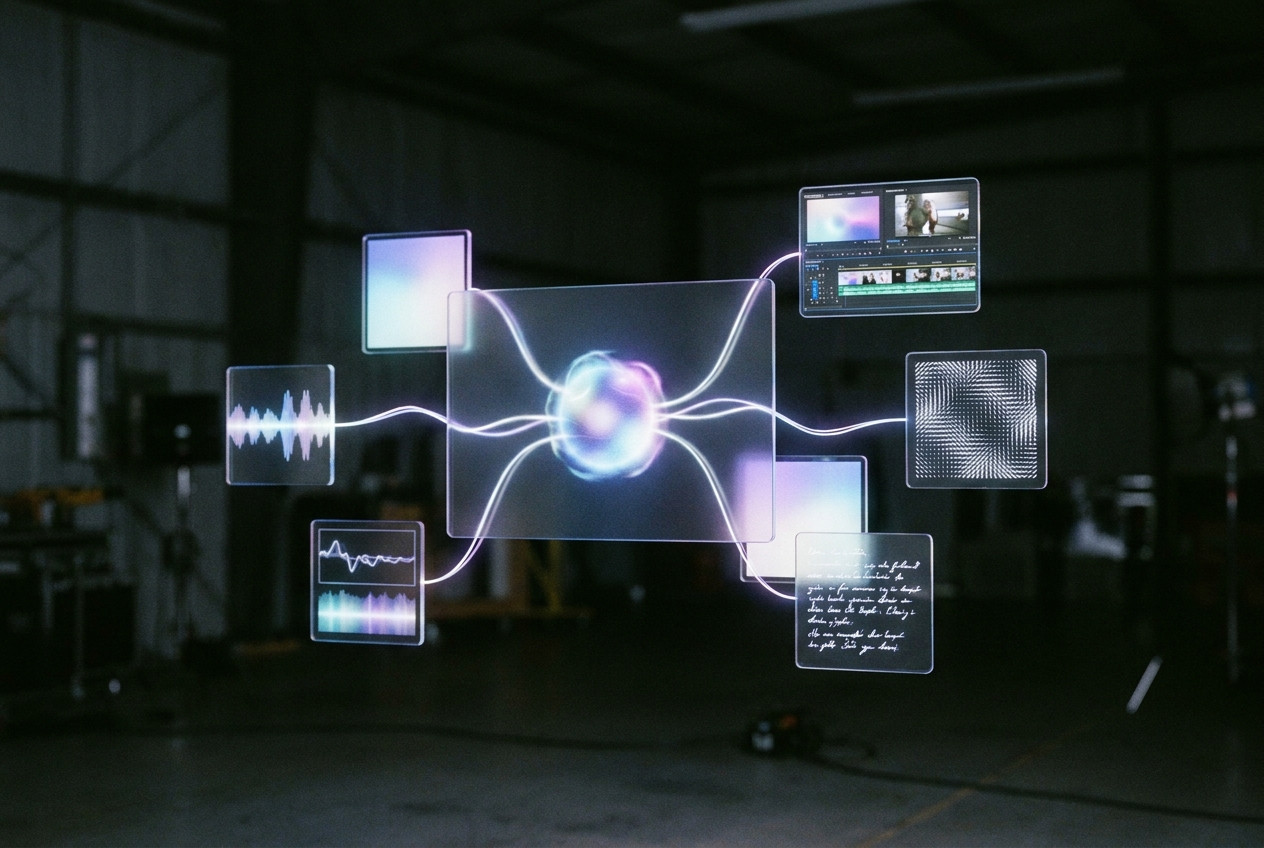
The biggest advantage is that creators no longer need to jump between multiple AI tools or start a new session every time they want to tweak a project. A musician can generate a song, replace a verse, extend the track, separate vocals from instrumentals, create album artwork, write matching lyrics, and even produce a promotional video from the same workspace.
That’s the whole stack. Song. Stems. Art. Lyrics. Video. One tab.
Flow Music Spaces is progressively becoming a comprehensive creative production platform where music, visuals, and videos converge within a unified workflow. Previously, Google’s Spaces feature was mainly a collaboration tool — a place to build custom instruments and share them with other users. Now it’s swallowed entire product categories.
You might remember Riffusion back in 2022, an open-source project that went viral before officially launching as ProducerAI last year. Google scooped it up in February and quickly rebranded it to align with its Flow suite of AI video and image tools. Flow Music utilizes Lyria 3 Pro, Google DeepMind’s music-generation model. It also draws on Google’s Gemini chat model, as well as Veo and Nano Banana for video and images.
That combination is what makes this different from Suno or Udio bolting on a new feature. Google isn’t building one model. It’s wiring together an ecosystem of models — each best-in-class at its specific job — under one roof.
Lyria 3.5 (July 29)
According to Google, Lyria 3.5 builds on those foundations by delivering richer, more complex melodic structures, higher-quality lyric writing, and vocal performances that sound noticeably more human. The new model offers tighter control over tempo and track duration, allowing users to shape a song’s architecture with greater precision.
The update is live now for all Google Flow Music users at no additional cost. It is the third significant Lyria milestone since February, a pace that signals Google is treating AI music not as a research experiment but as a priority product line.
Three major model updates in five months. That’s not a side project. That’s a product Google is clearly betting on.
The Pricing Makes This Interesting
Here’s where it gets real for independent musicians watching their budgets.
Flow Music’s core tier is free with a standard Google account — no credit card required. The AI Pro plan, which unlocks 1,000 credits per month, is priced at $19.99 per month for general users, but college students can access it free for one year through Google’s education program.
The dedicated Flow Music plans break down further. The Starter plan is $6/month, Plus is $18/month, and Member is $48/month , with increasing credit allotments and features.
Compare that to the competition. Both Suno and Udio charge $10 per month for their core paid plans. On paper, Google undercuts both at the entry level — and gives you video generation, image creation, and lyrics that neither competitor bundles into their base offering.
But — and this is a big but — Flow Music’s video generation eats credits fast. A 60-second short film requires roughly 8 to 12 individual 8-second clips. At Veo 3.1 Quality (100 credits each), that is 800 to 1,200 credits for one complete short film — nearly a full Pro monthly allowance on video alone. For social media clips and short-form content, the math is more manageable: a 15-second social clip requires 2 Quality generations (200 credits).
So you can make a video inside Flow Music. But if you’re serious about AI music videos — making them consistently, at quality, for every release — you’ll burn through credits before the chorus hits.
This is exactly where dedicated AI music video tools still win. They’re built for musicians who need video as a core output, not as one feature among dozens. More on this in a minute.
How Flow Music Compares to Suno and Udio
The competitive dynamics are fascinating here, and they go beyond features.
Both competitors carry legal baggage. Suno settled with Warner Music in November 2025, and active litigation from Sony Music and Universal Music Group was still ongoing as of July 2026.
Google’s pitch leans hard into the “clean” narrative. Lyria is trained on licensed music — data that YouTube and Google are contractually authorized to use under partner agreements and terms of service. Every output gets watermarked with SynthID, Google’s invisible audio watermark. This means platforms can detect AI-generated music, but listeners cannot hear the watermark.
Suno currently leads the consumer AI music market by a wide margin — roughly 2 million paid subscribers and $300 million in annual recurring revenue as of mid-2026. That’s a massive head start. But Google has distribution advantages that no startup can match: integration with YouTube, Search, Gemini, and the entire Google Cloud ecosystem.
The direction of travel is building Flow Music into a fully-featured AI-music studio, built around Google’s Lyria 3 model. Flow Music could be viewed solely through a ‘Suno rival’ lens, but the Believe deal suggests that there is more afoot here: a suite of AI tools that Google wants to integrate directly into distributor and label workflows.
In May, Believe partnered with Google to offer Flow Music to artists across the distributor and its self-release arm, TuneCore. Google and Believe described the tool as a “creative collaborator,” with a group of artists set to meet weekly with Google’s product team to shape its development.
That’s the play. Google isn’t just competing for hobbyists making beats in their bedroom. It’s embedding Flow Music into the infrastructure that real artists already use to distribute their work.
What This Means for Musicians Making Videos
Here’s where I want to get practical, because this matters directly for anyone using AI to create music videos.
Google Flow Music now lets you generate video inside the same workspace where you made the song. That’s genuinely cool. Once the track is perfected, you can use the video model to direct an AI music video. Google Flow Music is a conversational platform that lets users generate songs, music videos and custom instruments.
But “can generate video” and “is built for music video creation” are very different things.
Flow Music’s video capabilities run on Veo, Google’s general-purpose video model. It’s powerful. It’s also designed for everything from product demos to social clips to film prototyping. It doesn’t know what a verse looks like. It doesn’t understand that the visual energy should spike when the drop hits. It doesn’t natively sync to your song’s BPM, mood shifts, or lyrical themes.
This is the gap that music-first AI video tools fill. If you’re making a quick 15-second clip for Instagram Reels? Flow Music can probably handle it. If you’re making a full AI music video for hip-hop or building out visual content across EDM, pop, or indie releases? You want a tool that speaks music natively.
Think of it this way: Google Docs can technically do page layout. But you wouldn’t design a magazine in it. Same principle.
The All-In-One Trap
There’s a broader lesson here that goes beyond Google.
Every major AI platform is racing to become the everything tool. Suno added a DAW. Udio added Sessions. Google just added… everything at once. The pitch is always the same: stay here, do it all here, never leave.
And for exploration? For getting started? For that first creative spark? All-in-one tools are genuinely great. A musician who has never made a video before can now go from song idea to visual content inside a single Google tab. That’s democratization in its purest form.
But there’s a trap hiding in the convenience.
When every tool does everything, none of them do any one thing exceptionally well. The stem splitting is good enough. The lyrics are good enough. The video is good enough. And “good enough” works right up until it doesn’t — until you need a music video that actually cuts through the noise, that syncs to your track like it was scored to it, that captures the visual identity of your project.
That’s when you need a tool that was built for one thing and does it brilliantly.

The Smart Stack for 2026
The smartest musicians I see aren’t choosing between all-in-one and specialized tools. They’re layering them.
Here’s what a practical 2026 workflow looks like:
For song creation and editing: Google Flow Music (free tier for experimentation, paid for serious work), Suno v5.5 for vocal-heavy tracks, or Udio for production control.
For music videos: A dedicated music-video platform like OneMoreShot.ai that understands your track, syncs to it, and gives you visual templates built for your genre — whether that’s R&B, rock, country, or K-pop.
For distribution: Your existing distributor (DistroKid, TuneCore, CD Baby) — though watch the Google-Believe integration closely, because that pipeline is getting shorter.
For promotion: The video content you create becomes your promotional engine. Every single needs a visual. Every visual needs to feel intentional, not like an afterthought auto-generated from a general-purpose model.
What Happens Next
Google is moving fast. This is the third significant Lyria milestone since February , and they’re clearly not slowing down. Flow Music will keep getting better. The video generation will improve. The integration between music, visuals, and distribution will get tighter.
But here’s what I’d watch:
The training data question. Google claims Lyria is trained on licensed music, but that claim traces back to YouTube’s terms of service — the same terms that artists are actively challenging in court. If the legal landscape shifts (and after the GEMA ruling against Suno, it’s shifting fast), Google’s “clean” positioning gets a lot more complicated.
The credit economy. Right now, video eats credits like they’re going out of style. If Google makes video generation cheaper inside Flow Music, that changes the competitive landscape overnight.
The ecosystem lock-in. The more you build inside Flow Music — your songs, your stems, your art, your videos — the harder it becomes to leave. Google knows this. Every platform knows this. The question is whether the convenience justifies the dependency.
The Bottom Line
Google Flow Music is the most ambitious AI music platform launch of 2026. Full stop. The combination of song generation, editing, stem splitting, image creation, lyrics, and video in one workspace — powered by Lyria 3.5 and backed by Google’s infrastructure — is genuinely impressive.
But for musicians who are serious about their visual presence, the video component is a starting point, not a destination. Flow Music gives you video generation. What it doesn’t give you is a music video tool — something that thinks in beats, feels in moods, and knows that a lo-fi track needs different visuals than a metal anthem.
That’s where purpose-built tools still matter. And honestly? The best results come from using both: Google’s all-in-one studio for the creative spark, and a dedicated platform for the visual execution.
Ready to make your music visual? OneMoreShot.ai turns your tracks into stunning AI music videos in minutes — built from the ground up for musicians who need their visuals to hit as hard as their sound.