Half of All New Music Is AI. Nobody's Listening.
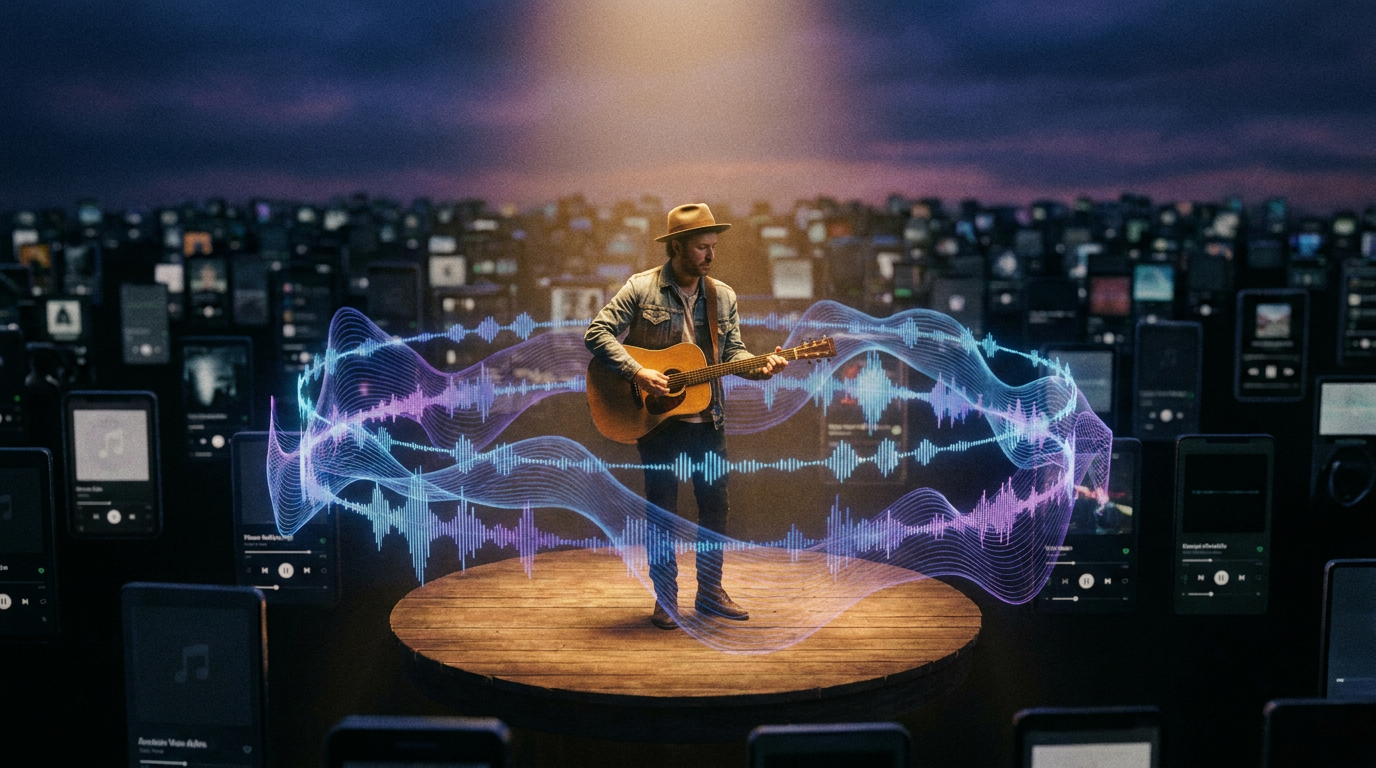
Here’s a number that should stop every musician mid-scroll: 44% of all new music uploaded to streaming platforms is now fully AI-generated.
That’s not a projection. That’s not some breathless VC prediction. Deezer announced in April 2026 that AI-generated tracks now represent 44% of all new music uploaded to its platform.
The company said it’s receiving almost 75,000 AI-generated tracks per day and more than two million per month.
And here’s the twist that changes everything: the consumption of AI-generated music on the platform is still very low, at 1-3% of total streams, and 85% of these streams are detected as fraudulent and demonetized by the company.
Read that again. Nearly half of all new uploads. Less than 3% of streams. Most of those are bots talking to bots. The AI music flood is enormous — and almost entirely hollow.
So what does this mean for you, the actual musician trying to build a career in 2026? More than you might think.
The Flood Nobody Asked For
The growth curve is staggering. Deezer reported receiving around 60,000 AI tracks per day in January, up from 50,000 in November, 30,000 in September, and just 10,000 in January 2025, when it first launched its AI-music detection tool. In barely 16 months, the daily volume of synthetic music has grown by 650%.
Since January 2025, when Deezer launched its patent-pending AI-music detection tool, the company has driven the conversation around AI-generated music, by regularly revealing updated facts and figures — a number which has increased from 10,000 to 75,000 in little over a year.
And Deezer is the only major platform actually counting. Other major streaming services are pursuing AI transparency via supply-chain self-disclosure rather than platform-level detection. Apple Music launched its Transparency Tags system in March, placing the onus on labels and distributors to declare AI-generated content at the point of delivery.
Which means the real number — across Spotify, Apple Music, YouTube Music, Amazon, and everything else — is probably far higher than anyone’s willing to admit.

The Listeners Have Spoken (They Said “No Thanks”)
Here’s where it gets interesting for real musicians. The flood isn’t working. People aren’t buying what the bots are selling.
Across three studies, Jana Friedrichsen, Julia Schwarz, and Michel Clement explored how generative AI will change the music industry. They found that while consumers enjoy and even prefer AI-generated music, preferences shift upon learning that the song was AI-generated.
A Luminate study backs this up with hard data. The study compared attitudes towards AI use in music creation from May to November of 2025. It found that overall interest dropped from -13% to -20% during that time period. The trend is clear: the more people learn about AI music, the less they want it.
Deezer also commissioned a unique international study on attitudes towards AI-music, which revealed that 97% of people couldn’t hear the differences between AI and human made music, and that 80% of people agree that 100% AI-generated music should be clearly labeled to listeners.
Let that paradox sink in. People can’t tell the difference — but they overwhelmingly want to know, and when they find out, they like it less. This isn’t a quality problem. It’s a trust problem. And trust is something no algorithm can manufacture.
The Artists Fighting Back
The pushback isn’t just from data scientists. It’s coming from the artists themselves.
SZA has said that she feels like she’s “at war” because of the rise in AI in music. In an interview with i-D Magazine, she said “I feel like I’m at war because of AI” and added “It’s happening disproportionately with Black music.”
Her point about AI-generated covers stealing streams from emerging artists is devastating. She notes that the technology is producing unauthorized covers of emerging artists, which often generate streams that the original creators cannot claim.
And the platforms are starting to draw lines. On January 13, 2026, Bandcamp announced it will no longer allow music “generated wholly or in substantial part by AI,” positioning itself as the first major music platform to issue a full ban on AI-generated audio.
In September 2025, Spotify removed 75 million AI-generated “spam” tracks in a fraud crackdown.
The message is becoming unmistakable: platforms are tired of being flooded with synthetic slop, and listeners are voting with their play buttons.
The Paradox: AI Tools Are Getting Better Than Ever
Here’s the weird thing. While the audio flood is drowning in its own irrelevance, the AI tools for real musicians are genuinely improving.
Believe is partnering with Google to offer the tech giant’s AI music creation platform, Google Flow Music, to artists across Believe and TuneCore. Under the deal, Believe will offer Flow Music — the Google Labs-housed AI music tool formerly known as ProducerAI — to its artists, producers and songwriters as what the companies describe as a “creative collaborator.”
The platform is powered by Lyria 3 Pro, Google’s music generation model designed to understand musical composition including intros, verses, choruses and bridges. The model supports diverse musical styles from amapiano to dream pop and can generate complex rhythms and test vocals in different languages.
And just yesterday at Google I/O 2026, the Flow ecosystem got a massive upgrade. Google announced major updates for its Flow family of AI creative tools, bringing Gemini Omni-powered video generation, AI creative agents, bespoke workflow creation tools, advanced music editing features, and dedicated mobile apps.
Google is also integrating its new Gemini Omni Flash model into Flow Music for AI-generated music videos. Through conversational prompts, users can guide scene direction, pacing, visual style and subjects to match a track’s narrative.
Believe’s CEO captured the nuance perfectly: the company is automatically blocking the distribution of AI-generated tracks produced on unlicensed “pirate studios” — while simultaneously investing in what it calls “value-creative AI” tools designed to enhance artist creativity.
This is the split. AI as a replacement for musicians? Failing. AI as a tool for musicians? Thriving.
Why Music Videos Are Your Secret Weapon
So you’re a real musician in a sea of 75,000 daily AI uploads. How do you stand out?
You can’t out-produce the bots — they’ll always generate more tracks faster. But you can out-story them. You can build a visual identity that no prompt-to-song generator could dream of.
This is where AI music videos become not just nice-to-have, but essential survival gear. The irony is beautiful: you use AI as a creative tool to differentiate yourself from the AI-generated flood.
Think about what separates an artist from a track. It’s narrative. It’s visual identity. It’s the ability to make someone see your music, not just hear it. A 30-second AI-generated beat on a streaming playlist competes with two million other AI tracks uploaded that month. But a musician with a compelling music video — even one made with AI assistance — has a face, a story, a reason to care.
The data supports this. The generative AI in music market, valued at $642.8 million in 2024, is projected to reach $3 billion by 2030 with a CAGR of 29.5%. Similarly, the AI-generated video market is expected to grow by 35% annually, reaching $14.8 billion by 2030, with 54% of major artists already using AI visuals.
More than half of major artists are already using AI-powered visuals. They know something the prompt-to-playlist crowd doesn’t: in a world where anyone can make a track, the visual layer is what builds the brand.
The Genre Advantage
The flood affects every genre differently. If you’re making hip-hop, the visual storytelling component has always been inseparable from the music. Same for K-pop, where production values define the genre. Even traditionally less visual-forward genres like lo-fi and jazz are finding that atmospheric visuals create listener loyalty in ways that audio alone can’t.
The lesson is straightforward: the AI flood makes audio-only distribution a race to the bottom. But musicians who pair their tracks with visual content — whether it’s R&B aesthetics, indie dreamscapes, or EDM visuals — are playing a different game entirely.
What Smart Musicians Are Doing Right Now
If the data tells us anything, it’s this: 2026 is the year of separation. The AI-generated audio flood will continue to grow. Platforms will continue to struggle with it. And real musicians who adapt will have an unprecedented opportunity to stand out.
Here’s the playbook:
1. Embrace AI tools, reject AI replacement. Use AI to enhance your workflow — whether that’s brainstorming melodies, generating visual content, or experimenting with production styles. Don’t let it replace the thing that makes you, you.
2. Invest in visual identity. Every track you release should have a visual component. It doesn’t need a six-figure budget. AI-powered music video tools have made stunning visuals accessible to everyone. What matters is that you have something that tells your story beyond the waveform.
3. Build trust through transparency. Transparency may spare artists while giving consumers what they want. If you’re a human making music, say so. Loudly. That declaration is worth more in 2026 than any production trick.
4. Focus on platforms that reward authenticity. Whether it’s YouTube (where videos drive discovery), TikTok (where personality wins), or even Bandcamp (where human creativity is literally policy), go where being real is an advantage.
The Bottom Line
Nearly half of all new music being uploaded to streaming platforms is AI-generated noise. The listeners don’t want it. The platforms are fighting it. The artists are furious about it. And yet the volume keeps growing.
For real musicians, this isn’t a crisis — it’s a signal. The bar for standing out with audio alone has never been lower (because the competition is mostly synthetic garbage) and never been higher (because the sheer volume is suffocating). The artists who will thrive are the ones who give fans a reason to care beyond the sound.
That means visuals. That means story. That means building something a prompt can’t generate.
Ready to stand out from the flood? OneMoreShot.ai lets you create stunning AI music videos in minutes — turning your real music into visual content that no bot army can replicate. Because in a world where half the music is fake, the artists who show their face win.