Music-First AI Video Tools Are Winning in 2026
There’s a quiet war happening inside the AI video market, and most musicians are picking the wrong side.
Here’s what happened: by mid-2026, the AI video generation space ballooned to over 258 tracked tools — 169 tagged for image generation, 114 for video, and 25 that do both. The market is enormous, fragmented, and growing fast. According to Statista, the global AI video generation market has grown 340% since 2025, reaching $8.7 billion in projected revenue for 2026.
But here’s the twist nobody saw coming. The most significant 2026 trend is the rise of music video generators, with five dedicated platforms entering the market, catering to artists and labels needing rhythm-synced visuals. Not just general-purpose video tools bolting on a “music mode.” Full-blown, music-first platforms that understand song structure the way a drummer understands a kick pattern.
And if you’re still trying to make music videos with Runway or Pika alone, you might be playing the wrong game entirely.
The Category That Didn’t Exist Two Years Ago
Rewind to 2024. If you wanted an AI music video, you had two options: use a general AI video generator and manually stitch clips together, or fire up an audio visualizer and hope the waveform looked cool enough for Spotify Canvas.
AI music video creation has evolved rapidly over the past few years. What started as simple visualizers has become a category of tools capable of generating full music videos, lyric videos, animated performances, and cinematic visual stories from a single track.
According to CNET’s April 2026 analysis, the AI video sector now splits into four main segments: enterprise video tools, creative editing suites, free consumer platforms, and specialized music video generators. That last segment? It barely existed 18 months ago. Now it’s the fastest-growing corner of the market.
Musicians and artists have emerged as the fastest-growing segment, with five dedicated platforms now catering specifically to music video creation as noted by New Wave Magazine. These specialized tools analyze song BPM, lyrics, and mood to generate perfectly timed visual narratives. Independent artists can produce MTV-quality videos for under $50 — a game-changer for the 83% of musicians who previously couldn’t afford professional video production.
Think about that number. Eighty-three percent of musicians couldn’t afford a proper video. Now the entire economics of visual music content has been rewritten.
Why General Tools Fall Short for Musicians
Here’s the fundamental problem. General AI video generators — your Runways, your Pikas, your Klings — produce absolutely gorgeous footage. Runway Gen-4 sets the current benchmark for cinematic AI video quality. The motion is physically coherent, the lighting is convincing, and the visual polish surpasses most alternatives on the market.
But there’s a catch. For music video creation, its lack of any audio integration is a fundamental constraint.
Runway and Kling produce the most cinematically impressive footage, but neither tool touches your audio. Kaiber and Neural Frames respond to music, but stop short of a complete video: no character system, no lip sync, no lyric video, no song-section structure.
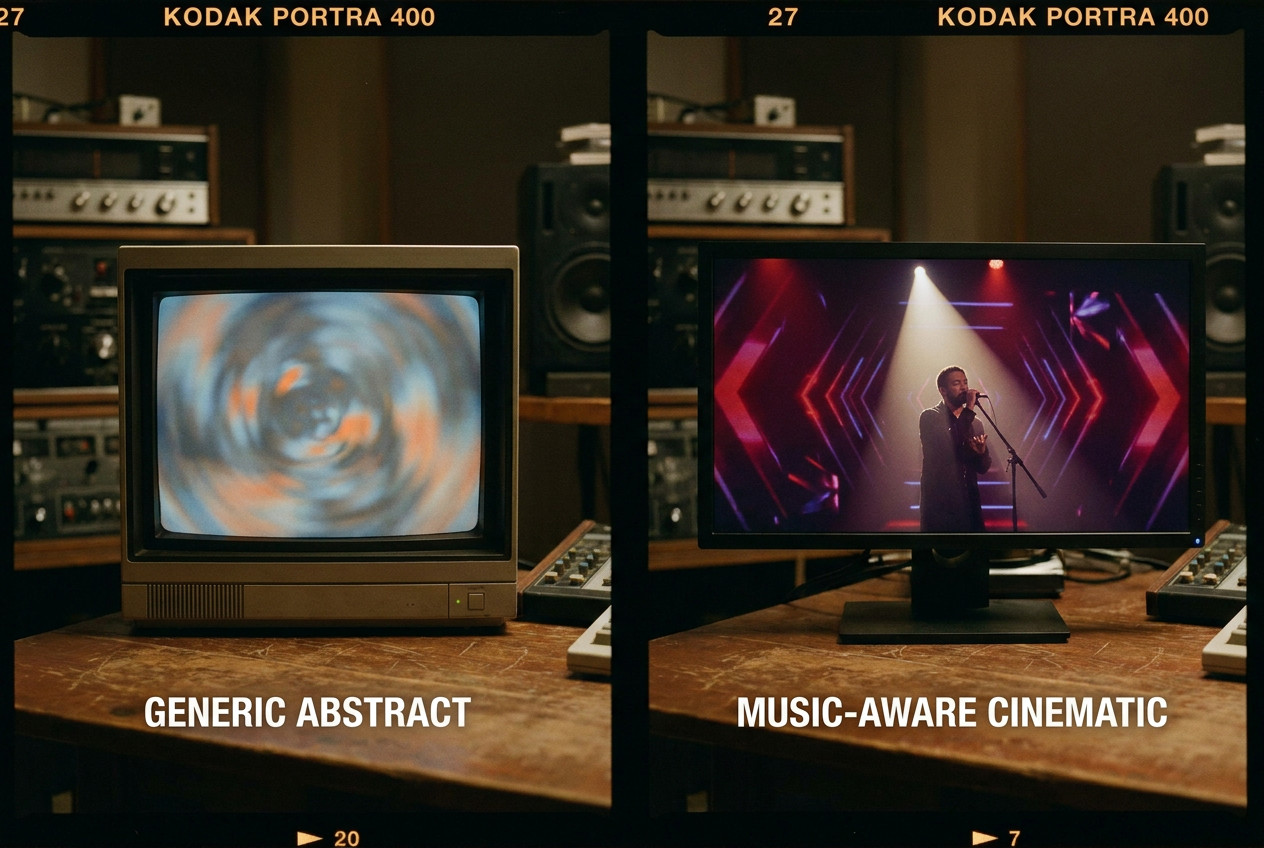
This is the gap that music-first platforms are racing to fill. The question isn’t “can AI generate pretty video?” anymore — it absolutely can. The question is whether the AI actually understands what music is doing.
And that distinction matters more than you think. If you’re making a hip-hop track where the beat drops at 1:32, you don’t want your visuals doing a gentle fade. You want them to hit. If your chorus rises, the energy should visually escalate. If there’s a bridge where everything strips back to just vocals, the visual world needs to breathe too.
General tools don’t know any of this. They’re blind to your song’s architecture.
What Makes a Music-First Platform Different
The key differentiator isn’t visual quality — it’s music intelligence.
These generators analyze BPM, lyrics, and song structure to create rhythm-synced visuals automatically. The top options combine stem separation with visual generation, allowing different instruments to trigger corresponding visual elements.
Leading platforms offer genre-specific templates that understand musical conventions — for example, automatically generating faster cuts for EDM versus smooth transitions for ballads. According to industry tests, these tools reduce music video production time from weeks to hours while maintaining artistic control through detailed beat mapping interfaces.
Let’s break down what “music intelligence” actually means in practice:
Song Structure Analysis
The best music-first tools don’t just detect BPM. They map your entire song: intro, verse, chorus, bridge, outro. The differences matter: some analyze full song structure and sync visuals to individual beats, while others generate isolated clips that must be manually assembled.
Beat-Sync Precision
We’re talking frame-level accuracy. Key advancements include automatic beat-synced transitions accurate to within 2ms and lyric-aware visual metaphors. Two milliseconds. That’s tighter than most human editors could achieve.
Contextual Understanding
Here’s where it gets wild. One test generated a hip-hop video where the AI correctly interpreted “diamond in the rough” as alternating between jewelry close-ups and urban development footage. Such contextual understanding was impossible in 2025 systems.
Character Consistency
For any narrative or performance-based music video, you need your characters to look the same from the first verse to the final chorus. Character consistency has become the “holy grail” for artist branding , and music-first platforms are investing heavily here — maintaining face, skin tone, hair, and clothing across 80+ shots.
This is the stack that separates a music video generator from a video generator that happens to have music playing over it.
The New Landscape: Who’s Building What
The market has segmented quickly. Here’s how the landscape breaks down:
Music-First Platforms
These are tools built from the ground up for musicians. They accept your track as the primary input and build everything around it. Think of them as your AI music video director — they “hear” the song before generating a single frame.
In 2026, AI music video generators are no longer experimental tools — they have become essential resources for independent musicians, marketing teams, and digital creators seeking faster and more scalable visual production. Platforms in this category include OneMoreShot, Freebeat, Kaiber, and Sondo AI, which recently announced creators worldwide have generated more than 15 million music videos on the platform over the past year.
General Video Generators with Music Capabilities
Tools like Veo 3.1, Runway, and Kling produce cinema-quality clips but require external editing to assemble into full music videos. Veo 3.1 still looks like the safest overall pick. It combines strong realism, good motion, and native audio in a way that makes it feel more complete than most of the field.
Google’s move to make every personal Google account get 10 Veo 3.1 video generations per month, no credit card required is a massive play. But for musicians, those 10 clips per month are individual shots — you still need to assemble them into a coherent video yourself.
Audio-Reactive Visualizers
Neural Frames and similar tools sit in a unique niche. Neural Frames takes a model-agnostic approach, aggregating multiple generation engines under one interface with audio reactivity layered on top. The platform’s energy-curve analysis is more nuanced than basic beat detection. These are great for electronic producers and ambient artists, but they don’t produce narrative music videos.
The Workflow-First Platforms
Newer entrants like Sondo AI are evolving beyond generation into full production workflows. Instead of relying only on a ‘generate-and-finish’ model, creators can refine pacing, adjust narrative flow, improve emotional expression, and align visuals more precisely with musical rhythm and lyrical content. This reflects a broader industry shift: AI music video creation is becoming more workflow-based. As creators seek faster production methods and more adaptable tools, the core value of an AI video platform is moving beyond generation speed alone.
The Economics Are Insane
Let’s talk numbers, because this is where the story gets genuinely transformative.
Cost structures have flipped entirely. Where a basic 3-minute music video previously required $15,000-$50,000 budgets, AI tools now deliver comparable quality for $300-$1,200.
Most AI music video platforms now operate through subscription models, typically ranging between $5 and $30 monthly depending on video duration, rendering quality, and customization features.
For an indie artist, this changes everything. You’re not choosing between one expensive music video and no music video. You’re choosing between making visuals for every track or leaving money on the table. As we’ve written about in our complete guide to AI music videos, the math now favors maximum visual output.
In 2026, a song without a compelling visual component is effectively invisible on social algorithms. Yet, indie artists and producers often face a significant “quality gap” — lacking the five-figure budgets required for professional videography while needing constant, high-quality content for platforms like TikTok, YouTube, and Spotify.
According to recent streaming data, tracks with dynamic visuals see a 40% higher retention rate than static audio uploads. That’s not a nice-to-have. That’s a 40% competitive disadvantage if you’re releasing audio-only.
The One-Song, Five-Video Strategy
The smartest musicians in 2026 aren’t making one music video per song. They’re making five. And music-first platforms make this practical because they understand multi-format output natively.
Here’s the playbook the top indie artists are running, and you can learn more about it in our guide on how to make an AI music video:
- Full 16:9 music video for YouTube — your anchor piece
- 9:16 vertical cut for Instagram Reels and TikTok
- 15-second hook clip optimized for TikTok discovery
- Spotify Canvas loop — a 3-8 second looping vertical clip
- Behind-the-scenes teaser showing the AI creation process
One song. Five visual outputs. Each one optimized for the platform where it lives. This isn’t overkill — it’s the new baseline.
The genre-specific approach matters too. If you’re working in EDM, your visuals need aggressive beat-matched cuts and high-energy effects. If you’re in lo-fi, you want something dreamy and atmospheric. Music-first tools increasingly offer genre profiles that pre-configure visual pacing and style — EDM gets rapid transitions, jazz gets smooth, contemplative camera work, hip-hop gets cinematic street-level energy.
What To Look For When Choosing a Tool
After digging through dozens of tests, reviews, and benchmarks from 2026, here’s what actually separates the contenders from the pretenders:
Does it accept your track as the primary input? If the tool starts with a text prompt and treats audio as optional, it’s a video generator, not a music video generator. You want your song to be the starting point.
Does it analyze song structure, not just BPM? Beat detection is table stakes. You need intro/verse/chorus/bridge mapping. The biggest difference is whether a platform understands music itself or simply generates video.
Can it maintain character consistency across the full song? A three-minute video with character drift is unwatchable. Look for “character seed” locking or avatar systems.
Does it export for multiple platforms? You need 16:9, 9:16, and 1:1 outputs without re-generating from scratch. Some platforms handle this natively.
What’s the actual cost per finished video? Not the cost per clip — the cost per complete, platform-ready music video. This number varies wildly between platforms.
Where This Is Heading
The most advanced 2026 music video generators incorporate AI vocal analysis to match visuals with emotional tone. That means the AI isn’t just following the beat — it’s reading the mood of the vocal performance itself.
We’re also seeing the early stages of real-time AI music video generation. Looking toward the end of 2026 and into 2027, we expect to see even deeper integration between live performance and real-time AI generation. Imagine a virtual concert where the visual environment reacts dynamically to your improvisation. It’s coming faster than anyone expected.
Cybernews’ June 2026 analysis found that 89% of viewers couldn’t distinguish AI-generated brand videos from human-produced equivalents in blind tests. The quality gap is essentially closed for most practical purposes.
The legal landscape is also crystallizing. June 2026’s legal developments establish that AI video outputs qualify for copyright protection when significantly modified by humans, though training data ownership remains contentious. For musicians using AI tools to generate videos for their own original music, this is overwhelmingly good news.
The Bottom Line
The emergence of dedicated AI music video platforms isn’t a niche trend — it’s a structural shift in how music gets visualized. In 2024 and 2025, many tools impressed people for ten seconds and disappointed them for ten projects. In 2026, the strongest products are fixing practical founder problems such as keeping the same character across scenes, generating synchronized audio, adapting one asset into many formats, and cutting editing time after generation.
For indie artists, this means the tools have finally caught up to the ambition. You don’t need to be a video editor. You don’t need a $20,000 budget. You don’t need to understand After Effects keyframes. You need a finished track and a platform that understands music.
The question for musicians in 2026 isn’t whether to make AI music videos. It’s whether to use a tool that was actually built for you.
Ready to see what a music-first AI video platform actually feels like? OneMoreShot.ai was built specifically for musicians — upload your track, define your visual direction, and generate a complete music video in minutes. No editing skills required. No five-figure budget. Just your music and your vision. Try it free today.