Musicians Are Picking Sides on AI Right Now
The AI music debate just stopped being theoretical. This week, it got personal.
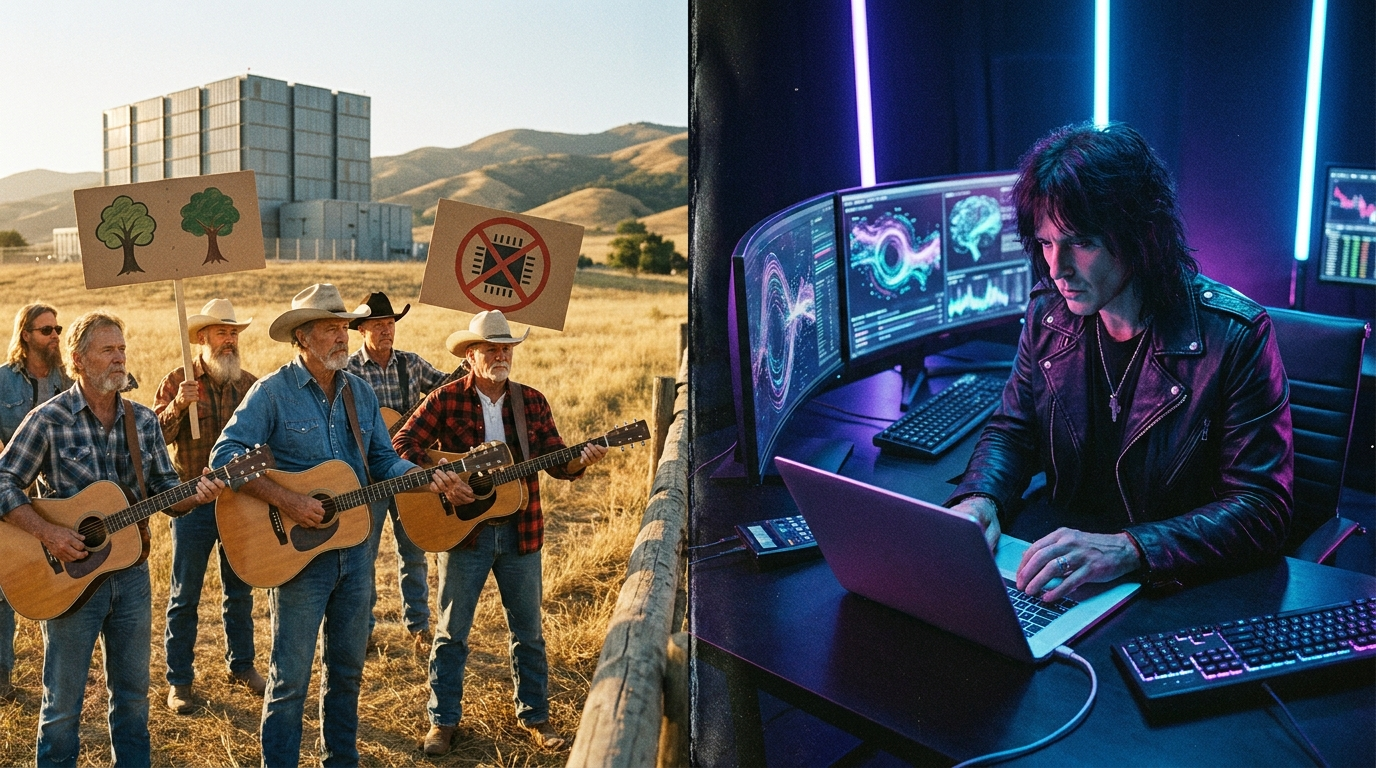
On one side: Willie Nelson, Brad Paisley, and Tanya Tucker are leading a revolt against AI data centers near their communities. On the other: Rudy Sarzo — the man who played bass for Quiet Riot, Ozzy Osbourne, and Whitesnake — is openly using Suno as a “studio band” for his new songs. And right in the middle, the CEO of the world’s biggest guitar brand has drawn the ire of musicians after comparing cover bands to chatbots.
All of this happened in the last ten days. Musicians aren’t quietly thinking about AI anymore. They’re drawing lines, going on record, and getting loud about it. If you make music in 2026, you can’t sit this out.
Here’s what’s actually going on — and what it means for your creative strategy.
Fender’s CEO Just Compared Your Cover Band to ChatGPT
Let’s start with the firestorm. During an interview with T3 published earlier this year, Fender CEO Bud Cole compared tribute bands to artificial intelligence, dubbing cover music as “a sort of analog AI.” The comments resurfaced in early August and the guitar community lost it.
Key figures such as Rhett Shull, Josh Scott, and Samuraiguitarist were among those to take issue with Cole’s stance. The Needle Drop called it “disheartening” when the head of one of the world’s most iconic guitar companies praises AI. On musician forums and social media, players pointed out the key difference: a human learning a cover song engages in a limited, interpretive act that rarely threatens the original artist’s livelihood.
The backlash got hot enough that Cole addressed the controversy in a statement issued to Fast Company.
His response: “My intent was to talk about how technology can help artists and players learn and grow, but I realize I didn’t fully convey that perspective.” He added the one line that actually mattered: “Music starts and ends with people. It always will.”
Here’s the thing — Cole wasn’t entirely wrong in spirit. He was just spectacularly bad at articulating it. Cole’s broader point was that AI could help guitar players “connect with other musicians, to be more productive” and cross “the chasm into becoming a student of songwriting to a master of songwriting.” That’s not a crazy position. The problem is that equating the sweat-drenched, deeply human act of learning someone else’s song to a statistical pattern-matching algorithm isn’t just clumsy — it’s insulting.
But if Fender’s CEO getting dragged is one side of the coin, the other side is far more interesting.
Rock Legends Are Using AI — And Saying So Out Loud
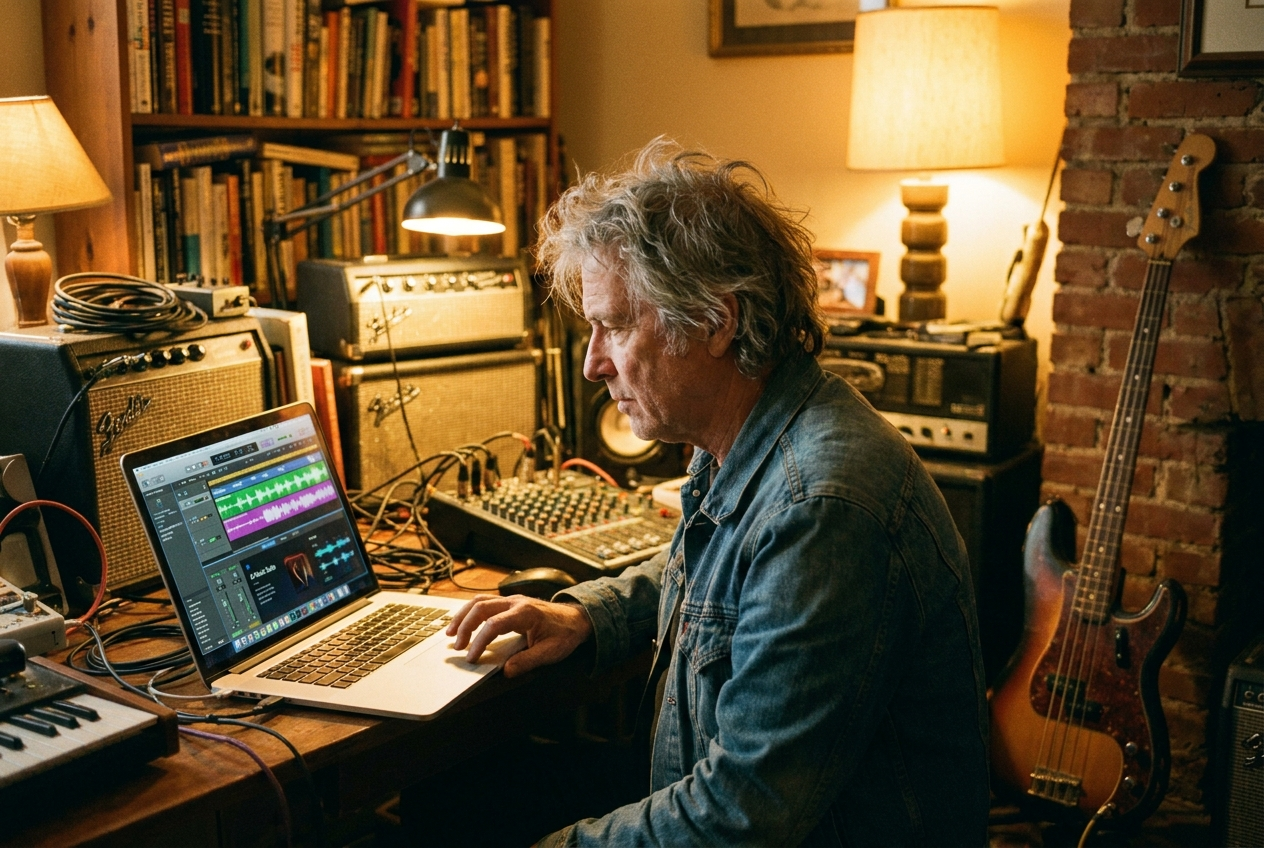
Episode 682 of The Music Biz Weekly Podcast features an in-depth conversation with bassist Rudy Sarzo about his use of AI in music creation. And Sarzo didn’t tiptoe around it.
Sarzo named Suno as one of the platforms he uses, describing it as a “studio band” that plays his song ideas back to him. He treats the output as a working arrangement rather than a finished release. His reasoning is brutally pragmatic: “I don’t have a budget. Who has a budget? I don’t have a budget to go home, spend 10 grand and dump it in the studio just for songs.”
This is a man who recorded Metal Health — the first heavy metal debut to hit #1 on Billboard — and toured the world with Ozzy. And he’s using Suno because he can’t afford studio time. Let that sink in for a moment.
His argument is about access rather than quality. Sarzo says AI tools let a musician realize a full arrangement without a record deal, a session budget, or booked studio time, which removes the gatekeeping that used to sit between an idea and a finished recording.
Meanwhile, Empire Of The Sun’s Luke Steele admitted he uses AI to create music during an interview with iHeartRadio Canada at Osheaga festival in Montreal. When asked, his answer was instant: “Of course.” He called AI “just another tool” for musicians, adding: “It’s like a really smart guitar pedal.”
Steele went further than Sarzo. His message to artists resisting AI? Be careful. He said AI will “empower artists that know how to use it, and they’re going to become unstoppable” and that artists against it “have got to be careful, because it’s going to come and swallow you like a boogie monster at night.”
That’s two established artists, two different genres, both saying the same thing: AI is a tool, not a threat, and pretending it doesn’t exist won’t save you.
Country Music Is Fighting a Different AI Battle Entirely
While Sarzo and Steele embrace the software, country music’s biggest names are fighting the hardware.
Willie Nelson leads the backlash against 56 planned data centers threatening Abbott, Texas farmland. Brad Paisley’s Nashville Zoo opposition sparked 560,000+ petition signatures against a proposed facility.
Paisley didn’t mince words. “AI is already taking our intellectual property without asking,” he wrote. “You feel the effect on Music Row. And it’s not pleasant.” He drew a direct line between AI scraping musicians’ work and data centers being built without community consent.
In the past few weeks, artists including Brad Paisley, Tanya Tucker, Gavin Adcock, and Willie Nelson have all spoken out against new projects. While their politics vary, their concerns overlap. That’s the most surprising part — this fight has united artists from across the political spectrum.
$64 billion in U.S. data center projects now face delays as 142 groups organize across 24 states. This isn’t a symbolic protest. It’s having a material impact on infrastructure development.
And there’s an uncomfortable irony here. The very data centers country artists are protesting power the AI models that other musicians are using to make their records. Sarzo’s Suno generations and Steele’s AI-assisted productions run on the same kind of GPU-packed facilities that Nelson wants nowhere near his farm in Abbott, Texas.
The Real Split Isn’t Pro vs. Anti AI
Look past the headlines and a more nuanced picture emerges. The musicians fighting data centers aren’t necessarily opposed to AI as a creative tool. They’re opposed to the way AI infrastructure is being built — without consent, without transparency, and at the expense of the communities it displaces.
And the musicians using AI tools aren’t saying human artistry doesn’t matter. Sarzo still writes his own songs. Steele still performs live with Empire of the Sun’s trademark elaborate staging. They’re using AI to fill gaps that used to require five-figure budgets or label backing.
The real split is between musicians who have the resources to ignore AI and those who don’t.
If you’re signed to a major label, you’ve got a budget for studio musicians, producers, engineers, and video shoots. You can afford to say AI is unnecessary. If you’re independent — like most musicians reading this — you’re working with whatever tools can stretch a $500 marketing budget into something that looks like $5,000.
This is exactly why the visual side of AI has become so important. While the debate about AI-generated music rages on (and the legal battles continue to play out), AI-generated visuals are a different story entirely. No one’s getting sued for using AI to make a music video. No streaming platform is flagging AI-generated visuals. No chart is banning songs because the video used generative AI.
If you’re still building your visual strategy, our complete guide to AI music videos breaks down everything you need to know. And if you want to see what’s possible in your specific genre, check out our guides for hip-hop, rock, country, and pop.
Meanwhile, Spotify Is Quietly Building the Middle Ground
While artists argue about whether AI belongs in music, Spotify and Merlin announced a new licensing agreement for Spotify’s upcoming fan-made covers and remixing tool, which will give listeners a new way to engage with music from participating artists and songwriters.
The deal brings more than 30,000 labels from Merlin’s network to the product, which will allow fan-made covers and remixes by artists who agree to participate. This comes on top of Universal Music Group being unveiled as the launch partner back in May.
Spotify’s co-CEO framed it with a very deliberate positioning: the company’s AI music product will be about “real artists, not fake artists.” That’s a shot directly at Suno and Udio.
The tool will launch as a paid add-on, which will create an additional revenue stream for participating artists. Charlie Hellman, SVP and Global Head of Music at Spotify, said the agreement “ensures participating artists are credited and compensated, and that every creation drives listeners back to the original work.”
The key detail: participation is optional. Eligible rights holders can decide whether to make their music available through the tool. Consent built in from day one.
This is the model that could actually work. Not AI replacing artists, but AI creating new engagement between fans and the artists they already love — with the artists getting paid.

What Smart Musicians Are Actually Doing
Forget the takes. Forget the drama. Here’s what’s working right now for musicians who want to use AI without getting caught in the crossfire:
1. Use AI for Visuals First, Music Second
The legal and reputational risks of AI-generated music are real and unresolved. AI-generated visuals? Completely different landscape. Every major music video uploaded to YouTube, TikTok, and Instagram is judged on the content, not the production method. Learn how to make an AI music video and you’ll unlock a content engine that works across every platform.
2. Be Transparent About Your Process
Sarzo has the right idea here. He doesn’t hide his AI use — he talks about it openly. “I come clean. But I come clean. I say, ‘Yeah, I use artificial intelligence.’ I don’t have a budget.” In 2026, transparency is your armor. Audiences respect honesty far more than they respect perfection.
3. Keep Your Voice Human
Empire of the Sun is a good example. Steele uses AI as a production tool, but the performances, the voice, the staging — that’s all human. AI gives you leverage. It doesn’t replace the thing that makes you you.
4. Build a Visual Content Engine
The artists winning right now aren’t just releasing music — they’re releasing visual experiences. Whether it’s a full music video, a lyric visualizer for Instagram, or a 15-second teaser for TikTok, visual content is what moves the needle on discoverability. Check out genre-specific strategies for EDM, indie, or R&B to find approaches that fit your sound.
5. Don’t Wait for the Industry to Decide
The major labels, streaming platforms, and regulators will spend years working out the rules for AI-generated music. You don’t have years. You have right now. While the industry argues about chart eligibility and training data, you can be building an audience with consistent, high-quality visual content.
The Bottom Line
2026’s AI debate isn’t about whether the technology is good or bad. It’s about power — who gets to use it, who profits from it, and who gets steamrolled by it.
Willie Nelson doesn’t want a data center next to his farm. Rudy Sarzo doesn’t want to spend $10,000 on studio time for a single he’s releasing independently. Luke Steele thinks artists who ignore AI will get “swallowed.” And the CEO of the world’s biggest guitar company can’t even make an analogy without starting a war.
They’re all responding to the same disruption. They just have wildly different relationships to it.
For independent musicians, the play is clear: own your creative output, use AI as a tool (not a crutch), be honest about it, and invest heavily in the one area where AI is all upside and zero controversy — visuals.
The musicians who build a strong visual identity now will be the ones who survive the shakeout. That’s not opinion. That’s math.
Ready to build your visual strategy? OneMoreShot.ai lets you create stunning AI music videos in minutes — no budget, no crew, no drama. Just your music, your vision, and a finished video your fans will actually watch.