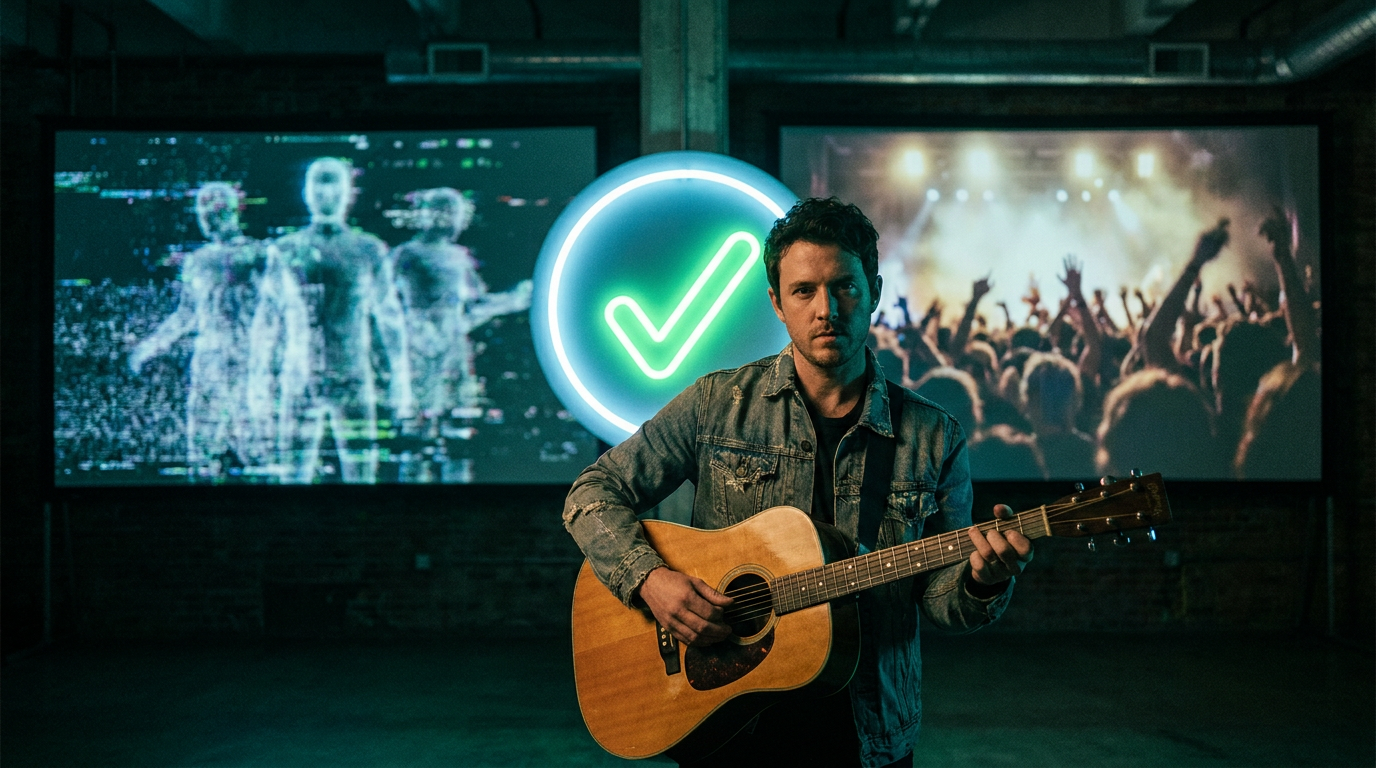
Proving You're Real Is Music's New Game
Here’s a sentence that would have been absurd three years ago: in 2026, the hardest part of being a musician isn’t making music. It’s proving you’re a human who made it.
We’ve spent months covering the flood — 75,000 AI tracks uploaded daily to Deezer, phantom artists topping iTunes, entire catalogs conjured overnight by people who’ve never touched an instrument. But something shifted this spring. The platforms stopped just talking about the problem and started building walls.
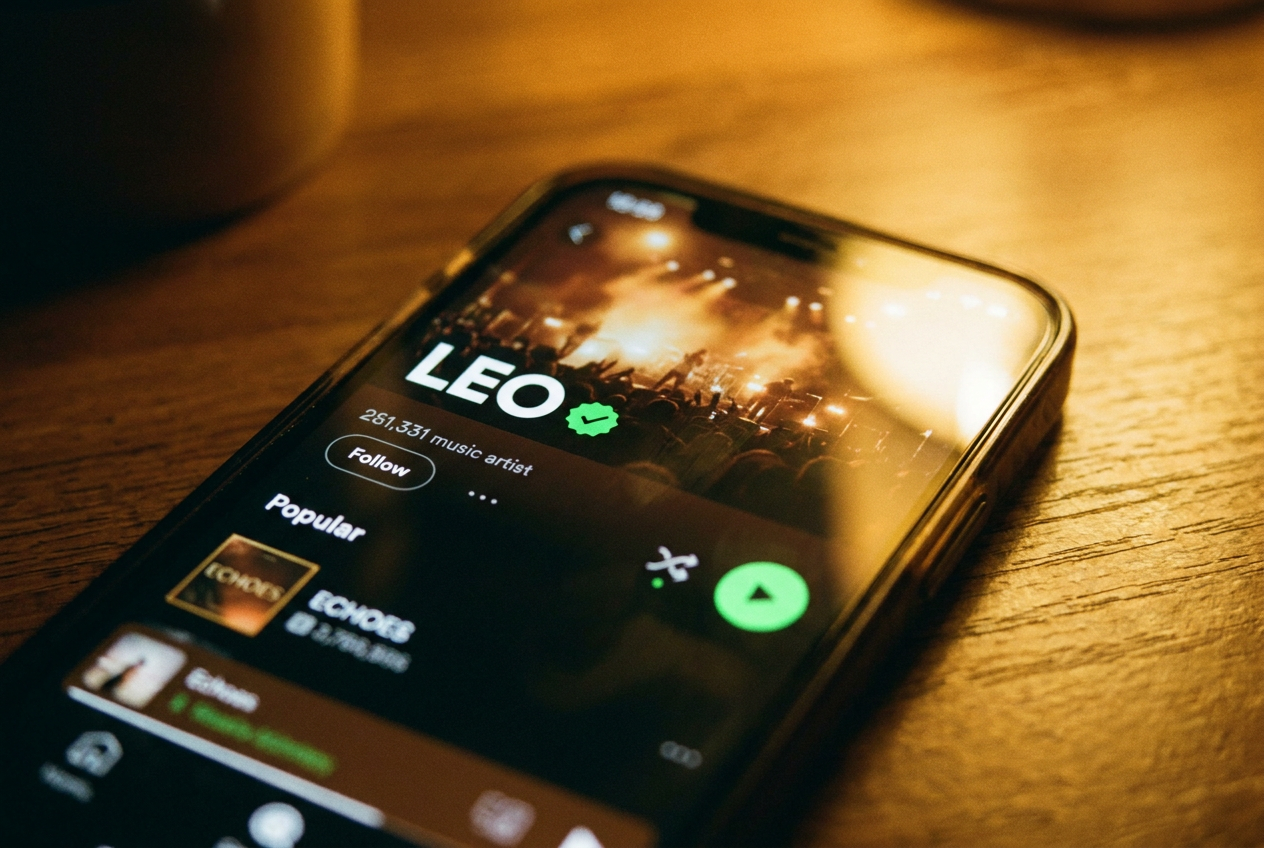
Spotify’s “Verified by Spotify” badge, which launched on April 30, is the most visible brick in that wall. And it has massive implications for every independent musician trying to cut through the noise right now.
The Green Checkmark That Changes Everything
As AI-generated artists and tracks flood music streaming platforms, Spotify is rolling out a new “Verified by Spotify” badge to help listeners more easily identify authentic human artists.
This isn’t a rebrand of their old blue checkmark. Over time, the term “verified” came to suggest more than the checkmark was designed to represent, so Spotify transitioned the current “Verified Artist” blue checkmark to a more accurate label: Registered Artist. The new green badge is something else entirely — a signal of authenticity specifically designed for the AI era.
The new Verified by Spotify badge shows an artist profile has been reviewed and meets Spotify’s criteria for authenticity and trust.
So what does it actually take to get verified? Three things:
-
Proof of a real artist behind the profile. Spotify looks for an identifiable artist presence both on and off-platform, such as concert dates, merch, and linked social accounts on their artist profile.
-
Consistent listener activity. Artists must have consistent listener activity and engagement over time. Spotify is focusing on artist profiles that people are actively seeking out over a sustained period of time, rather than those that are experiencing one-time spikes in engagement.
-
No AI personas. Profiles that primarily represent AI-generated music or AI-persona artists are not eligible for verification.
That third point is the bombshell. It’s the first time the world’s biggest streaming platform has drawn a hard line between human artists and AI personas at the profile level. At launch, more than 99% of artists that listeners actively search for will be verified.
Why This Matters More Than You Think
Let’s connect some dots.
The Eddie Dalton situation earlier this year was a wake-up call. Dallas Little, a content creator from Greenville, South Carolina, unleashed Eddie Dalton — another AI creation that held ELEVEN spots on the iTunes top 100 simultaneously, plus the number three album on iTunes. Then IngaRose — a Suno-generated persona — hit #1 on iTunes in five countries. According to Luminate, Eddie’s digital dominance comes from just 6,900 actual track sales, which reveals something crucial about how easily iTunes charts can be gamed.
These weren’t edge cases. They were proof that the system was broken.
Now layer on the fact that with the release of Suno v5.5 in March 2026, the platform now has a built-in voice cloning feature called Voices — and yes, it actually works.
Upload 15 seconds to 4 minutes of audio and Suno builds a reusable “vocal persona” that becomes the lead singer on any track you generate. It collapses the distance between “AI instrumental” and “AI song that sounds like a real artist.”
The technology to create convincing fake artists has never been more accessible. Which means the infrastructure to prove you’re real has never been more valuable.
The Proof-of-Humanity Playbook for Musicians
Here’s the uncomfortable truth that Spotify’s verification criteria reveals: in 2026, being a real musician isn’t enough. You need to be provably real.
Look at what Spotify’s badge actually rewards:
- Concert dates — you play live shows
- Merchandise — you sell physical goods
- Linked social accounts — you exist as a person across platforms
- Sustained engagement — your fans seek you out intentionally, not through algorithmic spikes
Notice what’s conspicuously absent from this list? The music itself. Spotify isn’t analyzing your audio to determine if you’re human. They’re analyzing your behavior — your digital footprint as a working artist.
This creates a fascinating strategic framework. The question isn’t just “how do I make great music?” It’s “how do I build an artist presence that’s obviously, undeniably human?”
And this is where the conversation gets really interesting for musicians using AI as a creative tool — because there’s a massive difference between being an AI artist and using AI tools.
The “AI-Assisted Human” Sweet Spot
In today’s music landscape, the concept of artist authenticity is complex and quickly evolving. Spotify isn’t saying you can’t use AI tools. They’re saying your profile can’t primarily represent an AI persona.
This distinction matters enormously. A human songwriter who uses Suno to prototype melodies, then records vocals in their bedroom and produces the final track? That’s a human artist using AI tools. An IngaRose-style persona where the “artist” doesn’t exist and the entire catalog is machine-generated? That’s an AI persona.
The green checkmark goes to the first one. Not the second.
How AI Video Actually Helps You Prove You’re Real
Here’s the twist nobody’s talking about: AI-generated music videos might be the best way to strengthen your position as a verified, authentic artist.
Think about it. Spotify’s criteria include linked social accounts, concert dates, and merch. But YouTube is the world’s second-largest search engine and the biggest music discovery platform on Earth. A consistent visual presence on YouTube — music videos, lyric videos, behind-the-scenes content — is one of the strongest signals that a real artist is behind a profile.
And here’s the paradox: AI phantom artists almost never invest in video. They don’t need to. Their entire playbook is volume — upload dozens of tracks, game the algorithm, extract streams. Creating music videos takes intentionality, creative direction, and a cohesive visual identity. That’s exactly the kind of “proof of work” that separates human artists from the slop flood.
If you’re an independent musician, building a visual catalog is one of the smartest moves you can make right now. Not because the algorithm demands it (though it does), but because it demonstrates the kind of sustained creative investment that platforms are specifically rewarding.
Whether you’re making hip-hop, indie, R&B, or country, having a visual identity that extends across your releases tells platforms and fans alike: there’s a real person here, making intentional creative decisions.
Our complete guide to AI music videos breaks down the full process — but the key insight is this: using AI tools to create videos for human-made music is the opposite of being an AI artist. It’s using technology to amplify an authentic creative vision.
What Every Platform Is Really Asking For
Spotify isn’t alone in this shift. Rolling out in beta, Spotify announced Artist Profile Protection, a new opt-in system that puts artists in direct control over what new music appears under their name and profile.
Spotify stated: “That’s not the experience we want artists to have on Spotify, and that’s why we’ve made protecting artist identity a top priority for 2026.”
Meanwhile, Apple Music asked labels to add AI transparency tags in March 2026. Deezer is actively deleting AI music. TIDAL banned AI monetization. Bandcamp prohibits AI-generated uploads entirely. And as of today — August 2, 2026 — the EU AI Act’s Article 50 enforcement begins, requiring AI-generated content to be labeled across Europe.
Every platform, every regulator, every institution is converging on the same question: are you real?
The musicians who build robust, multi-platform artist presences — with video content, social engagement, live shows, and consistent creative output — will thrive in this environment. The ones who try to hide behind anonymous profiles and AI-generated personas will find every door closing.
The Practical Verification Checklist
If you’re an independent musician reading this and wondering “am I going to get verified?”, here’s what to do right now:
1. Lock Down Your Social Presence
Link every social account to your Spotify for Artists profile. Instagram, TikTok, YouTube, your website. Concert dates, merch sales, linked social accounts, and other proof of an active career are exactly what Spotify is looking for.
2. Build a Video Catalog
Every release should have a visual component. At minimum: a full music video for YouTube, vertical clips for TikTok and Reels, and a Spotify Canvas. Learning how to make an AI music video takes less time than you think, and the ROI in terms of platform signals is enormous.
3. Play Live (or Document That You Exist)
Even small shows count. House concerts, open mics, livestreams — anything that creates a paper trail proving you’re a flesh-and-blood human who performs music. Concert listings show up in Spotify’s verification review.
4. Sell Something Physical
Merch doesn’t have to mean a full print run of t-shirts. Stickers, signed prints, limited vinyl — anything that connects your digital presence to a physical product signals authenticity.
5. Be Consistent, Not Viral
Spotify is prioritizing artists with active fan interest and notable contributions to music culture, rather than so-called “functional music” creators — think algorithm-optimized background or focus playlists — whose content is designed for passive or background listening. Steady engagement over time beats a one-hit viral spike.
The Bigger Picture: Verification as Competitive Advantage
Here’s what most musicians aren’t seeing yet: in a world where anyone can generate professional-sounding music in seconds, the verified human artist becomes a premium brand.
Think about it the way food works. When every grocery shelf was flooded with processed food, the “organic” label became a competitive advantage. When fast fashion dominated, “handmade” became a selling point. The same thing is happening in music right now.
In the AI era, it’s more important than ever to be able to trust the authenticity of the music you listen to. At Spotify, the focus is providing you with more context about artists and their music, so you can build more meaningful connections with them.
That green checkmark isn’t just a badge. It’s a trust signal that will increasingly drive discovery, playlist placement, and fan loyalty. As AI detection tools improve and platforms get better at filtering synthetic content, the artists who invested early in proving their authenticity will have a structural advantage.
And the irony? AI tools — the very technology that created the trust crisis — can be your best ally in building that authentic presence. Using AI to generate music video templates for your releases, creating genre-specific visuals for your catalog, automating the visual side of your release strategy — all of it frees up time and money to invest in the things that actually prove you’re real: live shows, fan relationships, and creative risks.
The Artists Who Win This Era
The musicians who thrive in 2026 and beyond will be the ones who understand a fundamental shift: making music is table stakes. Building a verifiable, multi-dimensional artist identity is the game.
That means:
- Your music is human-created (even if AI-assisted in production)
- Your visual presence is consistent and intentional
- Your digital footprint proves a real person behind the art
- Your fan relationships are genuine and sustained
The platforms are building the infrastructure to reward exactly this kind of artist. The question is whether you’re building the presence to qualify.
The proof-of-humanity era isn’t a threat to real musicians. It’s the biggest opportunity independent artists have had in years — because for the first time, the platforms are actively working to separate signal from noise. If you’re the signal, this is your moment.
Ready to build the visual presence that proves you’re real? OneMoreShot.ai lets you create stunning AI music videos in minutes — giving you the visual catalog, the YouTube presence, and the release strategy that platforms like Spotify are specifically designed to reward. Your music is human. Your videos should match.