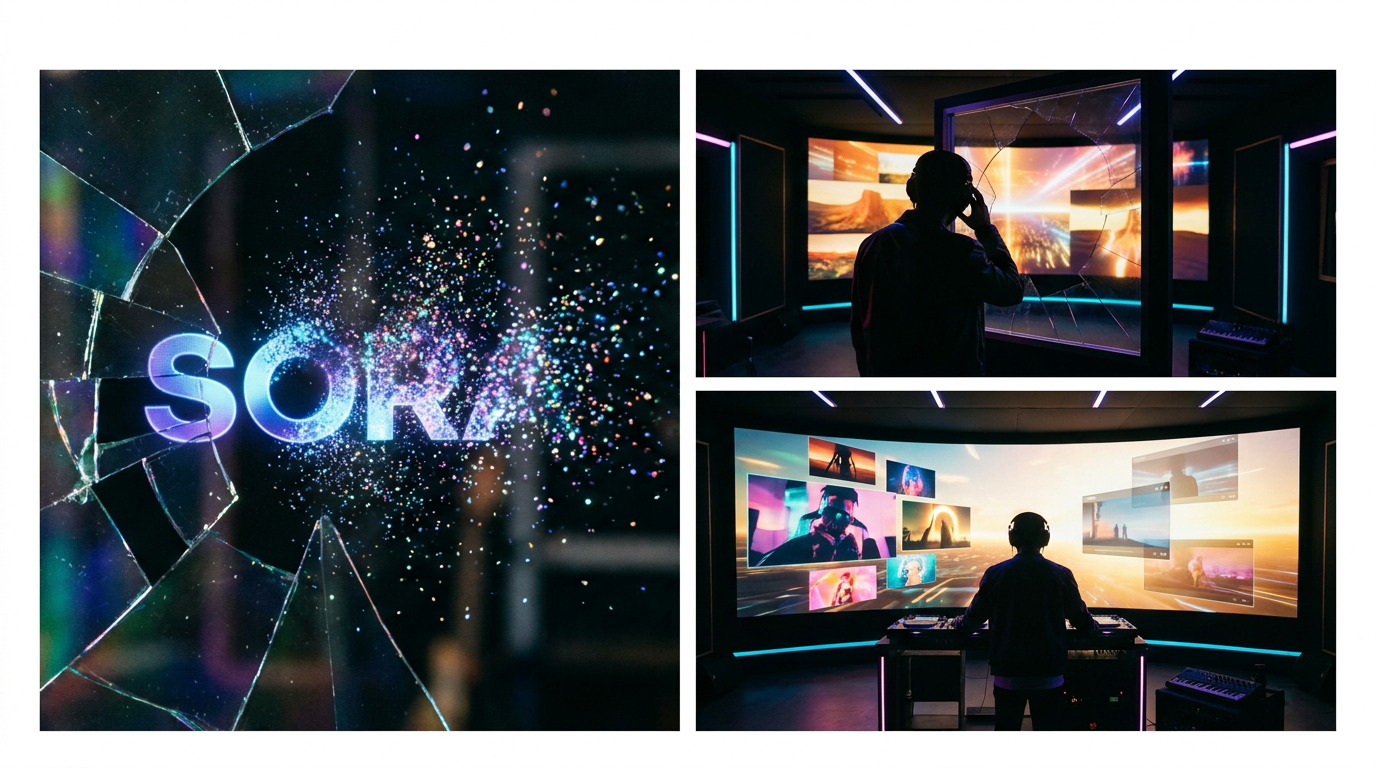
Sora Is Dead and AI Video Just Got Better
Three months ago, OpenAI killed the most hyped AI video tool on the planet. And somehow, musicians are better off for it.
If you’ve been sleeping on the AI video landscape since early 2026, wake up. The ground has shifted dramatically. Sora — once the flashiest name in text-to-video generation — is gone. Meanwhile, ByteDance just launched Seedance 2.5 with 30-second native video generation, Google’s Veo 3.1 leads on cinematic quality with integrated audio, and the entire AI music video pipeline has matured faster than anyone predicted.
For musicians, this isn’t just tech news. It’s a practical rewrite of how you make, afford, and release music videos.
The Rise and Spectacular Crash of Sora
Let’s rewind. OpenAI CEO Sam Altman announced the Sora app in 2025, teasing a new reality where unreal videos become the centerpiece of our social feeds. The hype was intoxicating. Sora, OpenAI’s first standalone app after ChatGPT, rose to the top of the iPhone’s App Store soon after its September launch.
Then it all unraveled with breathtaking speed.
Sora’s user base peaked at around one million and then collapsed to fewer than 500,000 while burning through roughly $1 million per day in compute costs — and that’s not a typo. The product was losing approximately $15 million per day in compute costs while generating only $2.1 million in total in-app purchases. Read that again: total. Not per month. The entire lifetime of the app.
The Sora web and app experiences were discontinued on April 26, 2026. The Sora API will be discontinued on September 24, 2026.
The casualties weren’t just OpenAI’s balance sheet. Disney had announced a $1 billion investment and a three-year character licensing deal with OpenAI in December 2025. No money had actually changed hands yet. Disney teams were in a joint working session with OpenAI on Monday evening and learned of the shutdown within 30 minutes. A source described it to Reuters as “a big rug-pull.”
The lesson here isn’t just about vendor risk (though it absolutely is). It’s that the AI video market has evolved past the “one big name” era. If your organization’s AI strategy is essentially “we will use whatever OpenAI, Google, or Microsoft offers,” you have no strategy — you have a dependency.
For musicians who were eyeing Sora for music videos? You dodged a bullet. The app had zero music-specific features anyway. No beat synchronization, no audio-reactive visuals, no understanding of song structure. It was a general-purpose clip generator that happened to make pretty footage — right up until it didn’t exist anymore.
What Replaced Sora (And Why It’s Better)
Here’s where things get genuinely exciting. While Sora was burning cash and generating deepfakes of Sam Altman in a slaughterhouse (yes, really), the rest of the AI video market was quietly building something better.
Seedance 2.5: The 30-Second Revolution
ByteDance’s Seedance 2.5 is entering its public launch window today, July 3, 2026. The model claims a technical milestone that no competing AI video tool has hit: generating a continuous, unbroken 30-second video clip in a single pass, with no segment stitching, no scene-cut splicing, and no visible seams.
Why does this matter for music videos? Because the biggest pain point in AI video has always been stitching. You generate a 10-second clip, then another, then another, and they never quite match — different lighting, drifting faces, inconsistent style. Previous-generation models top out around 15–20 seconds and expect you to generate several short clips and edit them together. Every stitch is a risk: a slightly different face, a lighting jump, a hand that changes shape between cuts.
A 30-second native clip changes the math entirely. That’s an entire verse. An entire chorus. A complete visual thought that holds together.
Seedance 2.5 can generate 30-second native videos with 50 multimodal references as input. Major features also include local editing — instead of regenerating an entire 30-second clip if one detail is incorrect, users can now modify specific areas within the scene to fix it. This prevents the loss of preferred acting performances, facial expressions, or lighting established in the original take.
And here’s the real kicker for musicians: Seedance 2.5 also includes a beta long-video mode extending clips to 3 minutes. Three minutes. That’s an entire music video’s worth of footage.
The Seedance 2.5 API launches July 16, 2026 , with CapCut integration expected mid-July 2026 , putting this model in front of hundreds of millions of video editors almost immediately.
Google Veo 3.1: The Audio-Native King
While Seedance makes headlines, Google has been quietly winning the quality race. Veo 3.1 offers the best overall mix of realism, motion quality, prompt following, and native audio support. That last part — native audio — is crucial for music video creators.
Seedance 2.0, Veo 3.1, and Kling 3.0 all now produce video with synchronized audio in a single pass. Veo is the only one reliably generating 48kHz dialogue, per Google’s documentation. The others handle SFX, ambient, and rough lip-sync.
The Rest of the New Landscape
Runway Gen-4.5 remains the most obvious pro workflow choice when control matters more than leaderboard screenshots. Camera moves, structured prompting, and downstream editing fit real creative teams better than one-shot consumer tools.
Sora now belongs in the legacy and migration conversation rather than the default shortlist. OpenAI closed the Sora app on April 26, 2026, and the API sunsets on September 24, 2026.
Why Musicians Should Care More Than Anyone
Here’s the thing most AI video coverage misses: musicians aren’t like other creators. A filmmaker starts with a storyboard. A marketer starts with a brief. A musician starts with a finished song and needs visuals that serve the music.
That distinction is everything, and it’s why the general-purpose AI video tools — even the fancy new ones — often miss the mark for music video creation.
Creating visuals for your music used to mean hiring a director, renting a studio, and blowing through your entire advance. AI music video generators promise to change that, but most of them are general-purpose video tools with no understanding of song structure, beat timing, or what makes a music video feel like a music video.
The tools that actually work for musicians need audio synchronization, beat detection, character consistency across a three-to-four minute video, and an understanding that a chorus should feel different than a verse. If you’re exploring this space for the first time, our Complete Guide to AI Music Videos in 2026 breaks down the full workflow.
The Supply Flood Makes Visuals Non-Negotiable
Here’s the uncomfortable context making music videos more important than ever: Deezer is now receiving almost 75,000 AI-generated tracks per day, representing roughly 44% of the daily uploads. This amounts to more than 2 million AI-generated tracks uploaded per month. Thanks to Deezer’s measures, consumption of AI-generated music on the platform is still very low, between 1-3% of total streams. A majority (85%) of these streams are detected as fraudulent and demonetized.
Deezer now says 44% of everything uploaded to its platform every day is AI-generated, around 75,000 tracks. And yet AI music accounts for only 1 to 3% of actual streams, with about 85% of those streams flagged as fraudulent and demonetized. Nearly half the supply. Almost none of the demand.
When the streaming platforms are drowning in 75,000 new tracks a day — most of them synthetic junk — a compelling music video isn’t just nice to have. It’s how you prove you’re real. It’s how you tell a story that makes someone press play on your Spotify page instead of the ten thousand other songs uploaded today.
If you’re making hip-hop, a video with consistent character performance and lip-sync turns a SoundCloud link into a visual statement. If you’re in EDM, beat-reactive visuals transform a track into a shareable experience. If you’re making indie music, a moody, artistic video can be the difference between 200 streams and 20,000.
The Smart Musician’s Playbook for July 2026
So Sora’s dead, Seedance 2.5 is launching, Veo 3.1 is leading on quality, and the streaming platforms are being flooded with AI music. What do you actually do?
1. Stop Waiting for the “Perfect” Tool
If Sora taught us anything, it’s that the biggest-name tool can vanish overnight. Diversifying your content creation tools is the same principle as diversifying your revenue: single dependencies are vulnerabilities.
Don’t bet your entire visual strategy on one platform. Learn two or three tools. Have a backup. Export your assets.
2. Use Music-First Tools, Not General-Purpose Generators
Runway Gen-4.5 makes gorgeous footage. Seedance 2.5 will likely produce stunning 30-second clips. But neither was built from the ground up for musicians. For a filmmaker who happens to be making a music video, Runway is a legitimate option. For a musician who wants to generate a music video from a finished track, it’s the wrong tool — not because it lacks quality, but because it lacks the workflow.
Platforms like OneMoreShot.ai are built for the specific problem musicians have: start with a song, end with a music video. No manual stitching. No timeline editing. No praying that your character’s face stays consistent across 47 generated clips.
Our guide on how to make an AI music video walks through the full process from track upload to final export.
3. Invest in Visual Identity Now
With the top AI video creators now utilizing “Identity Locking” technology that allows a musician to create a digital avatar that remains identical across an entire five-minute music video, maintaining the same clothing, facial structure, and even “vibe,” this is crucial for building a recognizable brand in a crowded digital marketplace where visual identity is as important as the sound itself.
Whether you use AI or not, establish your visual language now. Color palettes, recurring visual motifs, character design, aesthetic mood — these are the building blocks that make AI video tools actually useful instead of randomly pretty.
4. Think in Formats, Not Just Videos
A single AI music video session should give you more than one deliverable. Think about it:
- A full-length music video for YouTube
- 15-second clips for Instagram Reels and TikTok
- A lyric video for Spotify Canvas
- Thumbnail stills for social posts
- Behind-the-scenes-style content showing your creative process
Whether you’re making pop, R&B, or rock, the same visual assets can serve multiple platforms.
5. Embrace the “Proof of Process”
When anyone can generate a track, the value is no longer in the act of generation alone. The value is in the human direction behind the work.
This applies to visuals too. Document your creative process. Save your prompts. Screenshot your iterations. Show fans the evolution from concept to final video. In a world where AI can generate both the music and the video, your creative intent — the why behind the what — is your most valuable asset.

What Comes Next
The AI video market in July 2026 is not a stable thing. It’s a controlled explosion. Models are leapfrogging each other every few weeks. Pricing is shifting. The pattern across this round of pricing moves: per-second cost is dropping at the budget tier. What cost hundreds of dollars a year ago now costs tens.
EU AI Act Article 50 enforcement begins August 2, 2026. It requires machine-readable marking on all AI-generated video distributed to EU audiences. Penalties up to €15M or 3% of worldwide annual turnover. This will affect every musician releasing AI-assisted videos to European fans — stay compliant or stay off European platforms.
The Sora shutdown isn’t a cautionary tale about AI video failing. Sora’s shutdown is not a failure of the technology — text-to-video generation works. It’s a failure of the business model at current compute costs and quality thresholds. The technology is better than it’s ever been. It’s just that OpenAI picked the wrong business model, the wrong product direction, and burned a billion dollars learning that “TikTok but AI” wasn’t it.
For musicians, the real story is this: the tools available to you in July 2026 are dramatically better than what existed six months ago. Thirty-second native clips. Four-K resolution. Audio-synchronized generation. Character consistency that actually holds. And prices that keep dropping.
The best time to start making AI music videos was last year. The second-best time is right now.
Ready to turn your next track into a music video without burning your entire budget? Try OneMoreShot.ai — upload your song, and get a complete, beat-synced music video in minutes. No film crew. No stitching clips. No hoping your favorite tool survives until September.