Spotify's AI Labels Are Here. Now What?
Here’s a number that should rattle every musician: 44% of all new music uploaded to Deezer every single day is now fully AI-generated. That’s 75,000 synthetic tracks hitting one platform daily. Two million per month. And nobody’s listening.
Meanwhile, Spotify just quietly launched a system to label which songs used AI. Listeners say they want transparency. Researchers say that same transparency tanks how people feel about the music. And artists are caught in the middle of a paradox nobody designed.
Welcome to the AI labeling era. Let’s break down what’s actually happening, what the data says, and — most importantly — how smart musicians can navigate it.
The Deezer Bombshell: 44% AI and Rising
Let’s start with the numbers, because the numbers are wild.
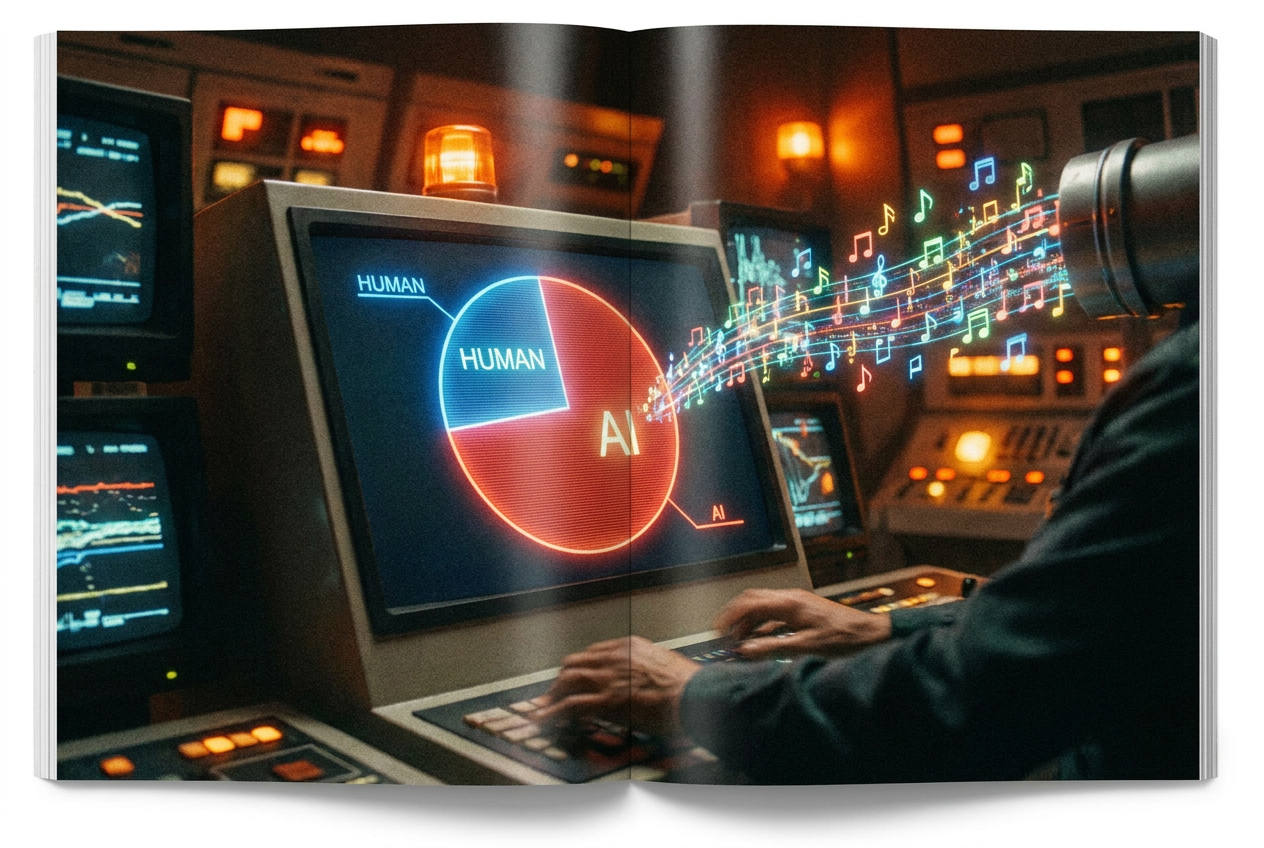
Deezer announced that AI-generated tracks now represent 44% of all new music uploaded to its platform — the company said it’s receiving almost 75,000 AI-generated tracks per day and more than two million per month.
To put the growth rate in perspective: Deezer reported receiving around 60,000 AI tracks per day in January, up from 50,000 in November, 30,000 in September, and just 10,000 in January 2025, when it first launched its AI-music detection tool. That’s a 650% increase in about 15 months.
But here’s the twist that makes this story interesting instead of terrifying: the consumption of AI-generated music on the platform is still very low, at 1-3% of total streams, and 85% of these streams are detected as fraudulent and demonetized by the company.
Read that again. Nearly half the uploads. Almost none of the listens. And most of the streams that do happen are bots.
Deezer CEO Alexis Lanternier put it plainly: “AI-generated music is now far from a marginal phenomenon and as daily deliveries keep increasing, we hope the whole music ecosystem will join us in taking action to help safeguard artist’s rights and promote transparency for fans.”
Deezer has responded with action, not just words. Songs tagged as AI-generated on Deezer are automatically removed from algorithmic recommendations and not included in editorial playlists. The company also announced that it will no longer store hi-res versions of AI tracks.
They’ve even started licensing their detection technology to others. French collecting society Sacem was its first partner. The message is clear: Deezer wants to be the industry’s AI cop. But what about the bigger players?
Spotify’s AI Credits: Transparency or Trap?
In April, Spotify entered the chat — carefully.
“Starting today, we’re launching a beta feature that allows artists to share how they’ve used AI in their music,” the company announced.
“Where artists have chosen to disclose through their label or distributor, you’ll see credits for specific contributions like vocals, lyrics, or production in Song Credits on mobile.”
The feature is called AI Credits, and it’s more nuanced than a simple “this is AI” stamp. Instead of slapping a generic “AI-generated” label on the entire track, the system lets you specify exactly which parts involved AI. You can disclose AI-generated vocals, AI-assisted lyrics, AI-produced instrumentals, or AI involvement in post-production.
That granularity matters. Most AI music is not 100% synthetic. A producer might write original lyrics but use Suno for the instrumental. A vocalist might record their own voice but use AI for mastering.
The old binary of “human or AI” never reflected how people actually make music in 2026. Spotify’s system acknowledges that.
But there’s a massive catch: the whole thing is voluntary.
The system relies entirely on voluntary disclosures from creators and rights holders. Cornell psychologist Gordon Pennycook flagged the obvious problem: “It is possible for voluntary disclosures to backfire if people who are being honest (by disclosing AI use) are punished for it, while people who are dishonest (by not disclosing AI use) avoid punishment.”
The feature launched April 16 with DistroKid as the first distribution partner. Spotify has confirmed additional distributors are being onboarded, but DistroKid is currently the only path to getting AI Credits displayed on your tracks.
For indie musicians, the practical question right now is simple: should you opt in? The risk question for indies is whether the tag affects editorial pitching or algorithmic placement. So far Spotify has not published any policy linking disclosure to playlist eligibility, and editors confirm the tag is informational, not gating.
In other words: disclosing AI use doesn’t currently hurt your chances. But “currently” is doing a lot of heavy lifting in that sentence.
The Label Bias Problem: Science Says It’s Real
Here’s where things get psychologically messy.
Across three studies, researchers Jana Friedrichsen, Julia Schwarz, and Michel Clement found that while consumers enjoy and even prefer AI-generated music, preferences shift upon learning that the song was AI-generated.
Let that sink in. People like AI music. They just don’t like knowing it’s AI music.
Deezer’s own research backs this up with an even more dramatic finding: while 97% of tested listeners couldn’t tell the difference between AI songs and human-made music, 80% agreed that AI songs should be clearly labeled on streaming platforms.
So the audience can’t identify it but wants it flagged. That’s not a quality problem. That’s a perception problem.
A separate academic study found something even more striking: participants heard six human-composed pieces — including works by Beethoven, Mozart, Debussy and Ravel — without being told who composed them. The more strongly listeners believed a given piece was computer-generated, the less likely they were to imagine a story — and the less engaging the stories they did imagine were.
The mere suspicion of AI reduces how deeply people connect with music. Not because the music is worse, but because the story around it changes.
Luminate’s 2026 report confirms the trend at scale: the study compared attitudes towards AI use in music creation from May to November of 2025, finding that overall interest dropped from -13% to -20% during that time period. The public is becoming more skeptical, not less.
Every Platform Has Chosen a Side
The streaming world has fractured into three distinct camps:
The Detectors (Deezer)
Deezer claims its detection tool can identify 100% AI-generated music from leading generative models including Suno and Udio, with the capability to add detection for other tools. Deezer has also said it has made progress in creating a system with increased generalizability, capable of flagging AI-generated content without a specific dataset to train on.
The Disclosers (Spotify, Apple Music)
Spotify introduced an “AI Credits” beta feature built around the DDEX metadata standard, enabling creators to specify where AI tools were used during the creative process.
Apple Music entered the conversation in March 2026 with the launch of its AI Transparency Tags — a metadata framework designed to identify AI involvement in music creation. Labels and distributors can already begin applying the tags voluntarily, although Apple plans to make the disclosures mandatory for future releases.
The Banners (Bandcamp, Qobuz)
Bandcamp (“Keeping Bandcamp Human”) and Qobuz have banned all fully AI-generated content to prioritize artist-to-fan connection.
For musicians using AI tools as part of their creative process — whether that’s AI-assisted production, Suno-generated demos, or AI music videos — understanding which camp each platform falls into isn’t optional anymore. It’s survival knowledge.
What This Means for AI Music Videos
Now, here’s where this gets relevant for anyone creating visuals with AI.
The labeling conversation has been entirely focused on audio. Nobody is tagging AI music videos yet. But the trajectory is obvious, and musicians who are already creating AI music videos for their releases should be paying attention.
Consider the emerging DDEX standard. Because DDEX is an industry-wide framework, the AI disclosure metadata being submitted now could surface on Apple Music, Amazon Music, and YouTube Music in the future. YouTube already requires creators to label AI-generated content. How long until the video disclosure layer connects to the audio disclosure layer?
The smart play right now is to think of AI as a tool in your creative stack, not a replacement for your creative identity. That means:
AI-assisted music videos are in a different category than AI-generated music. When you upload your original track and use AI to create visuals that match your artistic vision, you’re still the author. The AI is your cinematographer, not your band. This is the same distinction that Spotify’s granular credit system is trying to make — and it’s a distinction that protects you.
If you’re making hip-hop visuals or indie aesthetic videos with AI, the music itself is still yours. The visuals are a creative expression of your direction. That’s fundamentally different from generating a track on Suno and uploading it to Spotify with bot streams.
This distinction is exactly what music industry leaders have been pushing for — an approach that focuses more on AI as a collaborative tool instead of something to generate fully automated songs.
The Producer Survey Tells the Bigger Story
A recent Sonarworks survey of over 1,100 working music producers reveals where the professional community actually stands.
Producers make a clear distinction between tools that assist with labor-intensive technical tasks and those that attempt to automate creative decision-making. Audio cleanup, noise reduction, stem separation, and session organization were commonly cited as areas where AI feels useful and non-threatening. Here, AI saves time, reduces friction, and frees attention for higher-level decisions.
By contrast, tools designed to generate lyrics, compose songs, or make aesthetic choices attracted significantly more skepticism. Producers generally express hesitance to delegate authorship or creative direction to apps, even when the results were technically impressive. The line between assistance and authorship matters deeply.
This tracks with how the best musicians are approaching AI video creation too. The EDM community has embraced AI visuals because EDM has always been about synthetic, futuristic aesthetics — AI fits the genre’s DNA. Lo-fi creators use AI to generate dreamy, atmospheric loops that feel authentically lo-fi. The AI is serving the artist’s vision, not replacing it.
When the survey asked producers to identify their biggest concerns about AI in music, one theme emerged consistently: originality. Respondents widely highlight concerns that AI could accelerate musical sameness — flooding the market with palatable but generic-sounding content.
The antidote to sameness? A strong visual identity. When your track lives inside a music video that reflects your specific creative world, it becomes instantly more distinctive. That’s why AI music videos aren’t just marketing — they’re a creative moat.
The €4 Billion Warning
The financial stakes aren’t abstract. According to a study conducted by CISAC and PMP Strategy, nearly 25% of creators’ revenues are at risk by 2028, which could amount to as much as €4 billion by that time.
Sony Music Entertainment revealed at the launch of the IFPI’s Global Music Report 2026 in March that it had asked streaming platforms to take down more than 135,000 songs created by fraudsters using generative AI to impersonate its artists.
The labeling systems aren’t just about transparency — they’re about money. Every fake AI track that games the system dilutes the royalty pool that real musicians depend on. Streaming platforms and distributors have been active in pushing for transparency that will protect human creators and prevent royalty dilution. Distributors like DistroKid have started requiring creators to disclose if their tracks are AI-assisted and categorize the level of AI generation.
For legitimate musicians who happen to use AI in their workflow, the path forward is clear: be transparent, be human-first, and make the AI serve your creativity — not the other way around.
How to Navigate the Labeling Era
Here’s the practical playbook for musicians in 2026:
1. Disclose Proactively
Don’t wait to be caught. If you used AI in your production pipeline, say so through Spotify’s AI Credits system. According to campaign data from 2,400+ campaigns, AI-disclosed and non-disclosed tracks perform within the same variance band on stream-per-dollar metrics. There’s no current penalty for honesty.
2. Keep Your Music Human-Led
Use AI for stems, mastering, ideation — the grunt work. Keep the creative decisions yours. The strongest legal position is a track where AI provided the foundation but human creativity and post-processing shaped the final product.
3. Build a Visual Identity
In a world flooded with AI-generated audio slop, a compelling music video does more than promote your track — it proves there’s a human creative vision behind it. Whether you’re crafting R&B mood pieces or Latin-flavored visuals, the video itself becomes evidence of artistic intent.
4. Document Your Process
Keep logs of your creative decisions. Screenshot your prompts. Save your iterations. In a world where provenance matters, a documented creative process is your best defense.
5. Don’t Fear the Label
The research shows that context matters. When listeners know an artist intentionally chose to use AI as a tool — rather than having AI replace the artist entirely — the perception shifts. Own your process. Tell the story.
The Bottom Line
We’re living through a sorting event. The streaming platforms are building walls between “AI-generated content” and “human-made music that uses AI tools.” Those are fundamentally different things, and the industry is finally starting to understand that.
For musicians, the message is simple: don’t hide from AI. Use it. But use it as a creative amplifier, not a creative replacement. Make music that only you could make, then use AI to give it visuals that only you would imagine.
The artists who thrive in the labeling era won’t be the ones who avoided AI. They’ll be the ones who used it so intentionally that the label became a badge of innovation, not a scarlet letter.
Ready to create a music video that showcases your creative vision — powered by AI but driven by you? Try OneMoreShot.ai and build something that makes the algorithm irrelevant.