
Suno's Big Week Just Reshaped AI Music
Last week, Suno did something it’s never done before: it tried to grow up in public.
In the span of five days — from August 10 to August 14 — Suno announced download caps, signed a global licensing deal with BMG, launched Studio 2.0 with full MIDI support and AI-generated plugins, and watched Beatport ban fully AI-generated music from its platform. Oh, and it all landed one week after a German court ruled Suno violated copyright law.
Read those headlines individually and they’re interesting. Read them together and they tell a different story: the most controversial company in AI music is trying to become the most legitimate one, and the entire industry is rearranging itself around the outcome.
Here’s what it all means — and what musicians should actually do about it.
The BMG Deal: Suno’s Second Big License
On August 12, BMG and Suno announced a global alliance covering BMG’s recorded and music publishing repertoire, as part of Suno’s upcoming launch of its first music model developed in partnership with the music industry.
This is significant for two reasons. First, after settling with Warner Music Group last November, Suno announced a partnership and preemptive settlement with the fourth-largest music company, BMG, which had yet to launch a lawsuit against it. So this wasn’t damage control from a lawsuit — it was a proactive move.
Second, the deal covers Suno’s use of BMG songs to train its past models and data, and states artists and songwriters must opt in to having their music used for AI inputs and outputs. That opt-in language matters. It’s a direct response to the criticism that AI music companies train on everything and ask permission from nobody.
BMG Rights Management represents more than 3 million songs and publishing rights for songwriters and musicians including Rolling Stones members Mick Jagger and Keith Richards, Bruno Mars, and John Legend. That’s not a niche catalog. That’s music history.
But here’s the catch musicians should watch: as with Suno’s Warner Music Group deal, the agreement isn’t the whole story. The next challenge is to persuade the artists and songwriters signed to BMG to agree to be part of it. A licensing deal between two companies means nothing until the actual creators opt in. And given the level of distrust between musicians and AI platforms right now, that opt-in rate is the real metric to follow.
Universal settled with Suno rival Udio last October, but is plunging ahead with the Suno case, expanding the lawsuit and fighting to uncover the terms of Suno’s Warner deal. Sony is even further from settling. So Suno’s licensing mosaic is far from complete — two of the three majors are still pointing loaded lawsuits directly at it.
Studio 2.0: Suno Wants to Be Your DAW
The day after the BMG announcement, Suno dropped Studio 2.0 — and this is where things get genuinely interesting for musicians.
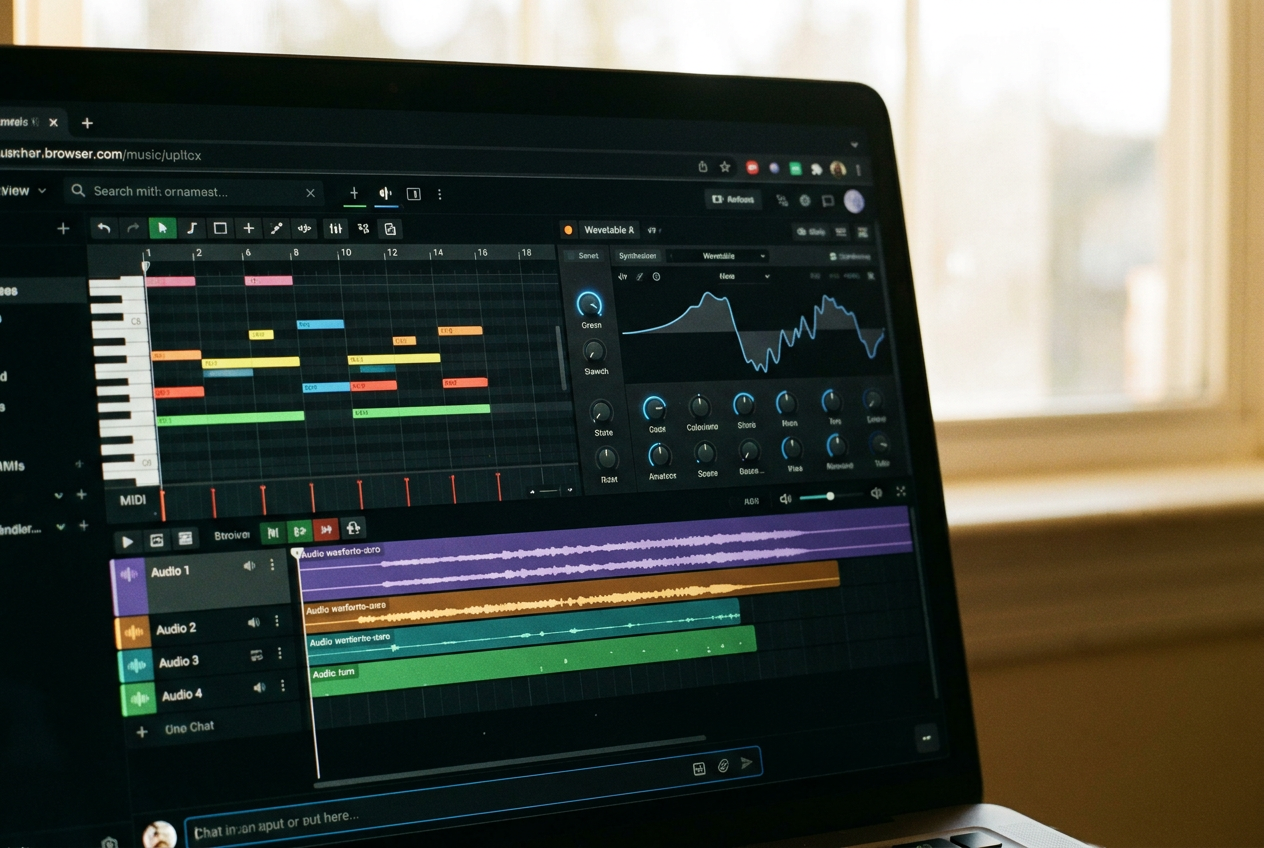
Suno released Studio 2.0 on August 13, 2026, a major upgrade to its browser-based generative audio workstation that adds MIDI recording and editing, a wavetable synth, a session-aware chat collaborator, custom user-built effects plugins, track automation, and higher-fidelity stem separation.
Let’s unpack that, because this isn’t a minor feature bump. MIDI support is the centerpiece. Phipps called it the most-requested addition to Studio since the workstation launched in September 2025. Users can now import, record, and edit MIDI directly on the timeline, play notes with a typing keyboard if they do not own a controller, and design sounds with a new built-in wavetable synth.
But the wildest feature? Perhaps the most unique aspect of Studio Chat is its ability to build customized audio effects. AI-powered vibe coding tools that turn prompts into plugins are nothing new, but this is the first time we’ve seen this kind of capability baked directly into a DAW. You type what you want — “build me a rotary cabinet tremolo effect” — and the AI generates a custom plugin inside your session. That’s not assisted music production. That’s AI writing the tools you use to produce music.
Suno Studio 2.0 is a browser-based DAW update that adds MIDI recording and editing, a built-in wavetable synth, a beta chat assistant that can build its own plugins, updated stem separation, automation curves, and unlimited 32-bit/48kHz multitrack export for Premier subscribers.
Here’s the strategic read: Suno’s near-term roadmap is now visible on two tracks: the opt-in, industry-developed music model promised under the BMG partnership, and the continued conversion of Studio from a generator with editing bolted on into the production environment those licensed models would run inside.
Suno isn’t just building a song generator anymore. It’s building the entire production environment.
The Download Cap Contradiction
Now here’s where it gets messy. On September 3, 2026, Suno starts capping downloads across the rest of the platform at 7 lifetime on Free, 20 a month on Pro, and 60 a month on Premier.
But Studio 2.0 Premier subscribers? “For Premier subscribers who use Suno Studio, our professional production suite for generating and manipulating stems and samples, there are no download limits,” Suno assures. Beyond that, Suno clarified that users can “download and export with no limits.”
Suno shipped Studio 2.0 one day after it announced a global licensing alliance with BMG and three days after it quietly capped how many songs free and casual users can download starting September 3. Read those three announcements together and Suno Studio 2.0 stops looking like a feature drop. It looks like a fence going up, with paying producers on one side and everyone else on the other.
This is classic platform economics. The free tier becomes a funnel. The slop faucet gets tightened. And the real product — the DAW, the licensed models, the unlimited exports — lives behind a $24/month paywall.
For musicians who’ve been worried about the flood of AI-generated tracks hitting streaming platforms, the download caps are genuinely good news. For musicians evaluating whether to use Suno as a creative tool, Studio 2.0 is the most serious version of the product that’s ever existed.
Beatport’s Line in the Sand
While Suno was courting the industry, Beatport was building a wall against the output.
Beatport has announced plans to ban tracks that are fully or majority AI-generated.
Tracks made with the assistance of AI will also be tagged as such in order to improve transparency. The move follows an expanded partnership with fraud detection specialist Beatdapp.
The nuance here matters: “Music created with AI assistance will still be accepted, provided the finished track remains majority human-made.” So Beatport isn’t banning AI tools. It’s banning AI replacement. If you use AI for mixing, mastering, stem separation, or sound design — you’re fine. If AI wrote the whole track — you’re out.
60% of DJs surveyed said they wouldn’t play AI-generated tracks. That’s a number that should matter to every electronic music producer thinking about how AI fits into their workflow.
Beatport is not the only digital service provider to take a stand against AI-generated music recordings this week. Just yesterday, August 11, streaming giant Spotify announced that it will start displaying an “AI Persona” badge on artist profiles that it deems suspect, and their music will not be served to listeners by its algorithm.
The pattern is now undeniable: Spotify badges, Deezer deletions, Beatport bans, Bandcamp’s blanket prohibition. Every major platform is drawing a line — and every line says the same thing: AI-generated music is welcome as a tool, but not as a substitute for human artists.

What This Means for Musicians Making Music Videos
Here’s where this connects to your creative workflow — and why this week matters even if you never plan to use Suno.
The AI music landscape is splitting into two clear lanes:
Lane 1: AI-generated music is getting increasingly regulated, capped, watermarked, and flagged. Platforms are building detection systems. Download limits are tightening. Charts are banning AI tracks. The Wild West era of AI music generation is ending.
Lane 2: AI-assisted creation tools — including AI video — are getting more accepted, more sophisticated, and more integrated into professional workflows. Nobody is banning AI-assisted mixing. Nobody is flagging AI music videos. Nobody is deleting your track because you used AI to generate visuals for it.
This is the split that matters. If you’re a musician, using AI to generate your music puts you on the wrong side of every trend this week revealed. But using AI to create visuals, music videos, promotional content, and visual storytelling for your human-made music? That puts you squarely in the sweet spot — leveraging the technology that’s accelerating while avoiding the technology that’s getting walled off.
Think about it. Suno itself is pivoting from “generate a song from a text prompt” toward “here’s a professional DAW with AI features built in.” The direction of travel is clear: AI as assistant, not AI as author.
The Licensed Model Question
The biggest unanswered question from this week: what will Suno’s licensed model actually sound like?
Suno has still not announced an exact release date or officially named its next model. What has become much clearer is the direction: Suno is preparing a new generation of licensed, music-industry-partnered models, and its new BMG alliance adds another major rights-holder to that transition.
According to Warner Music CEO Robert Kyncl, who’s at the helm of the lone major label to license and settle with Suno to date, said model remains on track to launch later in 2026.
Older models are being phased out. When the next licensed models ship later in 2026, the current pre-deal models are scheduled for deprecation. If you have legacy projects depending on a specific model version, archive your stems now.
This is the part musicians should be watching closely. A model trained on licensed BMG and Warner catalog could produce output that sounds meaningfully different from the current Suno — possibly better in some ways (trained on world-class recordings), possibly more constrained in others (limited to opted-in catalogs). And when the old models get deprecated, the Suno you know today effectively ceases to exist.
For musicians who’ve been using Suno as part of their creative workflow, the practical advice is: finish and export anything you want to keep on the current models before the licensed versions roll out.
What Musicians Should Do Right Now
This was the most consequential week in AI music since the original Suno and Udio lawsuits. Here’s what you should actually do about it:
1. Stop Worrying About AI Music, Start Using AI Video
Every platform action this week targeted AI-generated music. Not one targeted AI-generated video. The regulatory and platform energy is entirely focused on audio. AI music videos remain the single most powerful, least controversial way to use AI in your music career. Whether you’re making visuals for hip-hop, EDM, pop, or indie, the path is clear: human music, AI visuals.
2. Archive Your Suno Projects
If you’ve been using Suno’s current models in your workflow — for demos, sound design, beat sketches, or anything else — download and archive everything before the licensed models replace them. The transition timeline isn’t confirmed, but “later in 2026” is getting very close.
3. Watch the Opt-In Rates
The BMG deal is only as meaningful as the number of artists who agree to participate. If major songwriters refuse to opt in, the licensed models will be trained on a thin catalog and the output quality could suffer. Follow this story.
4. Understand the New Rules
Beatport’s policy is the clearest articulation of where the industry is heading: AI tools are fine, AI replacement isn’t. If you’re using AI in your production chain — for anything from mastering to stem separation to creating music videos — make sure your finished work is majority human-made, and be transparent about where AI enters the process.
5. Use AI Where It’s Winning
The technology that’s accelerating without backlash is AI video generation for music. While AI music gets watermarked, capped, and banned, AI music videos are becoming the standard visual strategy for independent artists across every genre — from country to K-pop to metal.
The Bigger Picture
Suno’s August blitz tells us something important about where AI music is heading. The scrappy, move-fast-and-break-things era is giving way to something more structured: licensed training data, professional tools, download limits, industry partnerships.
That’s not necessarily bad for musicians. A Suno that pays for its training data, watermarks its output, and limits mass downloads is a Suno that creates far fewer problems for real artists. The slop flood gets slower. The provenance chain gets clearer. The platforms can tell the difference between human and AI output.
But it also means the window for casual, frictionless AI music generation is closing. What Suno is building now is a professional tool — with professional pricing, professional partnerships, and professional expectations.
For independent musicians, the play hasn’t changed: make your music with human hands, and use AI to amplify everything around it. The music is yours. The visuals, the marketing, the content — that’s where AI earns its keep.
Ready to put your human-made music in front of AI-powered visuals? Try OneMoreShot.ai and create your first music video in minutes. No studio, no film crew, no compromise on your music — just your track, brought to life visually.